


Missouri voters will be deciding four statewide ballot measures on Aug. 4, 2026.
Three measures were referred to the ballot by the state legislature, while one was automatically referred to the ballot. All four measures are constitutional amendments. Later this year, Missouri voters will decide three constitutional amendments on Nov. 3, 2026.
Here are the measures voters will be deciding on Aug. 4:
Amendment 1
Amendment 1, which was automatically referred to the ballot, would renew the existing sales and use tax of 0.1% for 10 years. The revenue from the tax goes toward state parks and soil and water conservation efforts.
According to the Missouri Department of Natural Resources, approximately half of the revenue generated from the tax is allocated to conserving soil and water resources within the state, and that the tax has generated over $772 million in revenue.
The measure originated with a 1984 constitutional amendment. Due to the wording of this original amendment and subsequent iterations, the measure needs to be renewed by voters. It is automatically referred to the ballot every 10 years. Previous versions of this amendment were approved in 1988, 1996, 2006, and 2016.
The campaign supporting the amendment, Citizens for State Parks and Water, raised $212,877.82 in contributions and reported $145,552.32 in expenditures.
Amendment 2
Amendment 2 would delete language from the Missouri Constitution that exempts charter counties with populations between 600,001 and 699,999 from having an elected assessor. In Missouri, the county assessor is responsible for classifying property and determining the value of real and tangible personal property for tax purposes.
As of 2025, there is one charter county within this population range — Jackson County. Therefore, Amendment 2 would require the Jackson County Assessor to be an elected position. All other Missouri counties are already required to elect their assessors.
Amendment 2 was referred to the ballot by the Missouri State Legislature, and passed unanimously in both chambers.
Amendment 4
Amendment 4, if approved, would require voter approval of future citizen-initiated constitutional amendments in each congressional district, rather than statewide. The amendment would also prohibit foreign nationals and foreign adversaries from spending to support or oppose ballot measures, with penalties for violations, and add language regarding penalties for ballot initiative signature petition fraud.
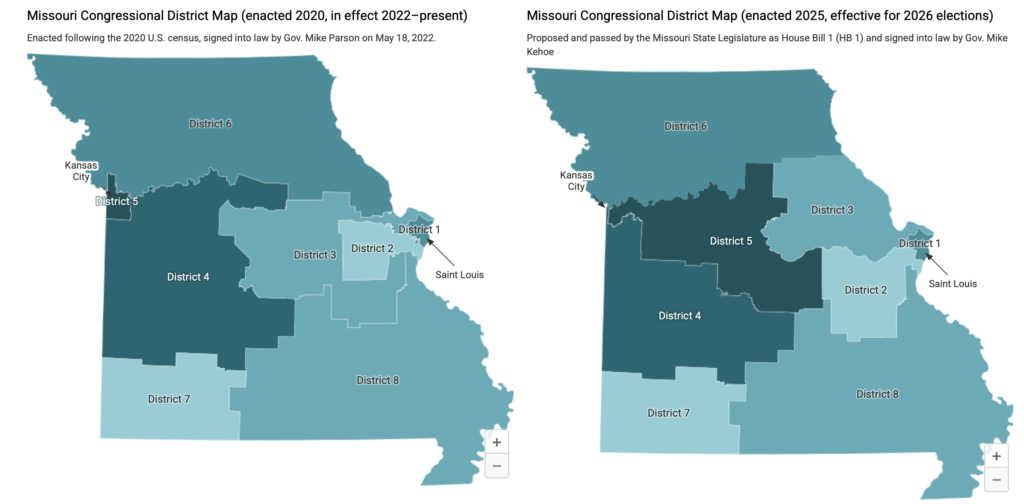
In Missouri, as well as 17 other states, citizens have the power to initiate constitutional amendments. Currently, in Missouri, a simple majority is required to pass citizen-initiated constitutional amendments in the state. Under Amendment 4, a simple majority requirement would be needed in each of the state's congressional districts to approve citizen-initiated constitutional amendments. This would not apply to constitutional amendments referred to the ballot by the state legislature. No state currently has a voter approval requirement in each congressional district.
Missouri currently has eight congressional districts. Two districts — Missouri's 1st and Missouri's 5th — have a Democratic congressional representative, while six districts — Missouri's 2nd, 3rd, 4th, 6th, 7th, and 8th — have a Republican congressional representative. In 2025, Gov. Mike Kehoe (R) signed new congressional district boundaries into law. According to the secretary of state, the new congressional map will be enforced for the 2026 elections.
The Missouri Republican Party supports the amendment, while the Missouri Democratic Party opposes it. It was referred to the ballot by the Missouri State Legislature, with support from 94% of Republicans in the legislature, and no support from Democratic lawmakers.
Gov. Mike Kehoe (R), who spoke in support of the amendment, said, “If there’s a process to change the constitution, the bar should just be a little bit higher than it is right now, and that’s what Amendment 4 does.”
Kay Park, the director of the League of Women Voters of Missouri, spoke out against the amendment, saying, “Requiring a majority in all eight districts will be virtually impossible to pass the initiative petition and would effectively silence the voice of the people.”
Three campaigns — Protect MO Voters, Missouri Right to Life PAC, and Protect Election Integrity — are registered to support the amendment, and have reported $848,674.49 in contributions. Three other campaigns — Missourians for Fair Governance, Protect Majority Rule Missouri, and Protect Freedom and Democracy — are registered to oppose the amendment, and reported $10.6 million in contributions.
Top donors supporting Amendment 4 include Trails West, Inc ($100,000), MCR PAC ($87,500), and Missouri Chamber Advantage ($15,000). Top donors opposing the amendment include the Missouri Association of REALTORS ($5.1 million), The Fairness Project ($1.37 million), and the ACLU ($500,000).
Amendment 5
Amendment 5 would require the legislature to reduce the state individual income tax based on revenue growth until the tax is eliminated, and would prohibit future state income taxes once it is eliminated. Federal income taxes and Missouri's corporate income tax would not be eliminated.
The amendment would also authorize the legislature to extend state and local sales and use taxes to transactions involving any goods and services. If lawmakers expand the sales-tax base or increase the state sales-tax rate, the legislation would have to reduce individual income-tax revenue by an amount estimated to be at least substantially equal to the additional sales-tax revenue.
Currently, Missouri has a graduated income tax with rates ranging from 2% to 4.7%, with a top rate beginning at $9,191 in taxable income. The state sales tax is 4.225%. The state constitution currently prohibits extending sales and use taxes to services and transactions that were not taxed on January 1, 2015. Amendment 5 would create an exception to that restriction for legislation intended to reduce the individual income tax and local tax rates.
Amendment 5 was referred to the ballot by the state legislature. It had support from 90% of Republicans in the legislature, and no support from Democrats.
Rep. Bishop Davidson (R-130), who sponsored the amendment in the legislature, said, “[The income tax] has killed the source of wealth for Missouri’s middle class. It has made the American Dream an American memory and even that is fading out of view. It has decayed our economy, stagnated our wages, chased young people out of the state and left our seniors without their families.”
Claire Cook-Callen, the executive director of Progress Missouri, spoke out against the amendment, saying, “Missourians expect strong public schools, reliable roads and bridges, and fully-funded, accessible services — and for everyone to pay their fair share. Instead, this plan gives a tax break to the state’s eight billionaires and sticks each working family with a bill of about $500 more each year.”
One campaign, Missouri Promise, is registered to support the amendment, and reported $15.5 million in contributions. Four campaigns — Missourians for Fair Taxation, No Everything Tax, Protect Freedom and Democracy, and Parents for Missouri Public Schools — are registered to oppose the amendment, and collectively reported $5 million in contributions.
Top donors supporting Amendment 5 include Missouri Action ($6.5 million), Secure Missouri ($2.9 million), and American Policy Coalition ($2 million). Top donors opposing the amendment include Missouri Association of REALTORS ($1.9 million), the National Education Association ($1.25 million), and the Missouri National Education Association ($250,000).