


Welcome to Ballot Bulletin: Ballotpedia's Weekly Election Policy Digest. Every Tuesday, we deliver the latest updates on election policy around the country, including nationwide trends and recent legislative activity.
In this week’s edition, we cover seven bills state legislatures acted on last week and look at Kansas’ three-day grace period for mail ballots ahead of the August 4 primary election.
The state of election legislation in the U.S.
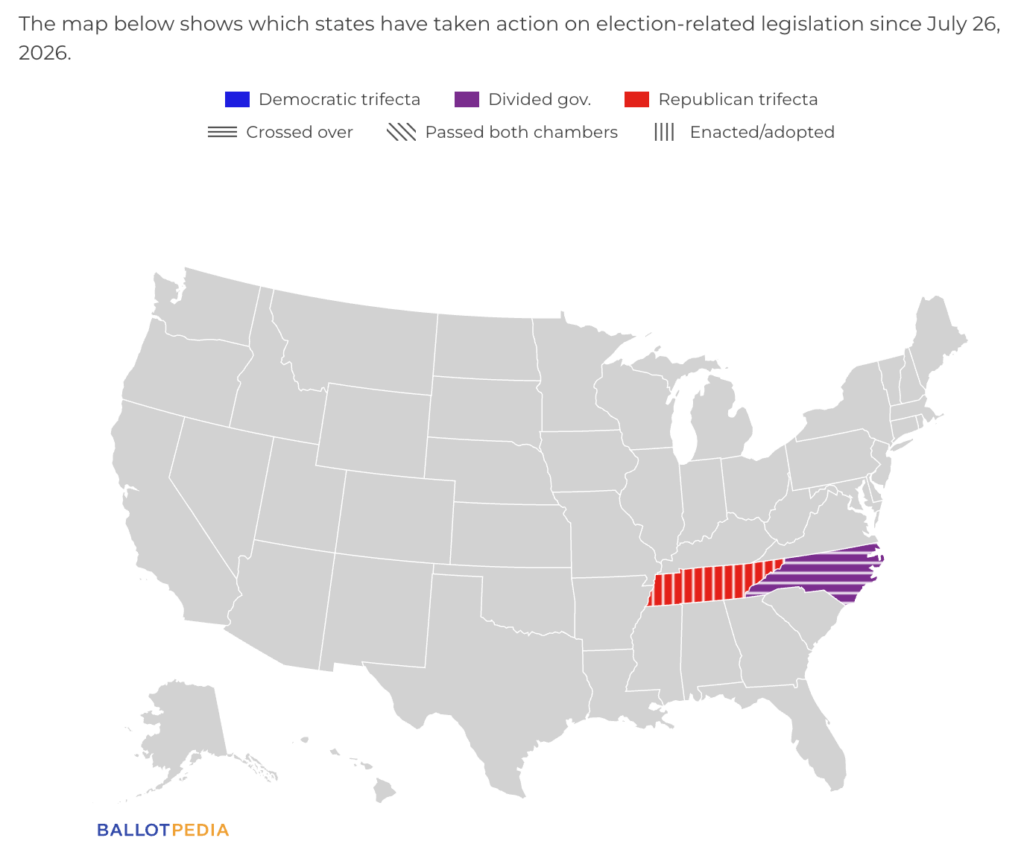
Lawmakers in two states acted on seven election-related bills last week. Nine state legislatures are in regular or special sessions. Last week, no bills were enacted, no bills passed both chambers of a state legislature, and no bills were vetoed.
Of the bills acted on last week, none are in states with Democratic trifectas, four (57.1%) are in states with Republican trifectas, and three (42.9%) are in states with divided government. The most active bill categories last week were election dates and deadlines (5), ballot access (5), campaign finance (3), and audits and oversight (3).
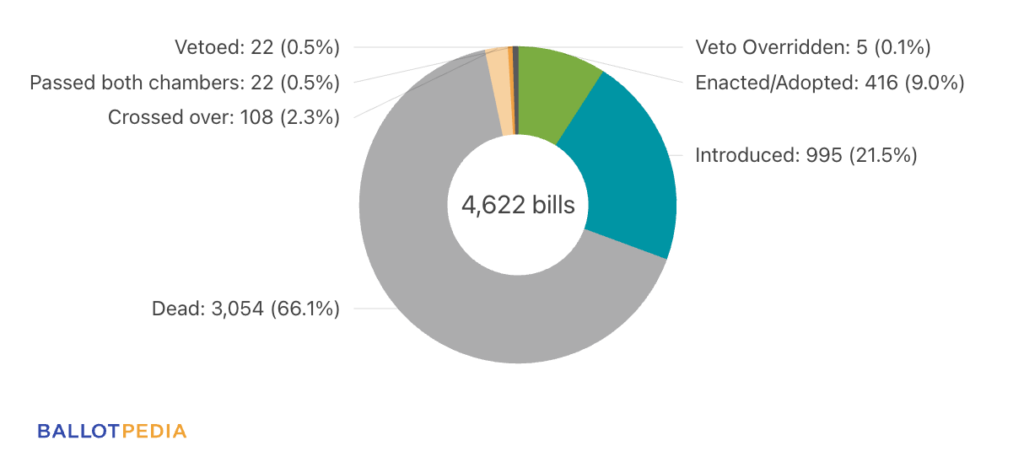
We are currently tracking 4,622 election-related bills across the country. The chart below breaks down the status of those bills based on where they stand in the legislative process:
Enacted bills
No bills were enacted or adopted last week.
To see a full list of enacted/adopted bills, click here.
Bills passing both chambers
No bills passed both chambers of a state legislature last week.
To see a full list of bills awaiting gubernatorial action, click here.
Vetoed bills
No bills were vetoed this week.
To see a list of all bills vetoed this session, click here.
All bills
The chart below shows all bills Ballotpedia is currently tracking, broken down by partisan sponsor.
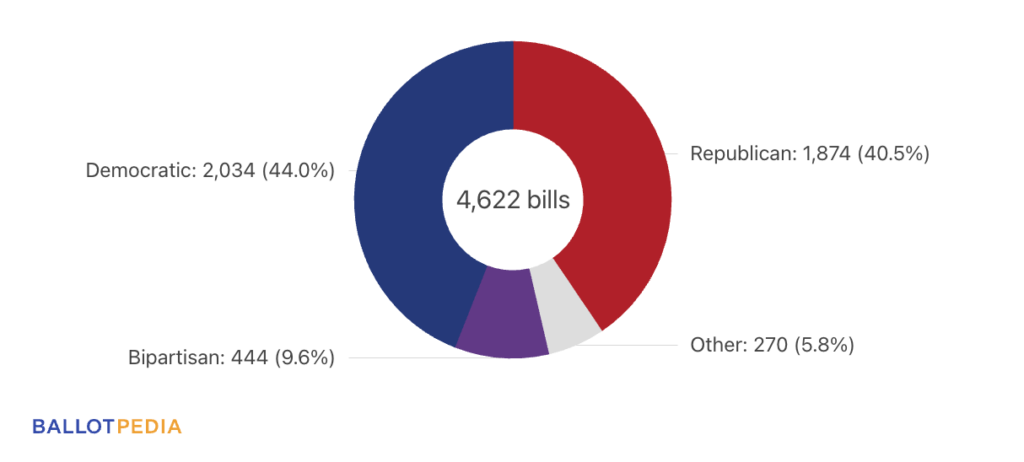
We are currently following 4,622 election-related bills, including bills carried over from the previous year.
- Trifecta status
- Democratic: 1,983 (42.9%)
- Republican: 1,648 (35.7%)
- Divided: 991 (21.4%)
- Partisan sponsorship
- Democratic: 2,034 (44%)
- Republican: 1,874 (40.5%)
- Bipartisan: 444 (9.6%)
- Other: 270 (5.8%)
In the news
On Aug. 3, the Maryland General Assembly convened for a special session on redistricting. On July 17, Gov. Wes Moore (D) issued an executive order calling the special session in response to what he called “coordinated efforts to weaken voting rights, dilute Black representation, and bend the rules of democracy for partisan gain, through the dismantling of the Voting Rights Act.” Lawmakers are considering HB 2100, a bill regarding the applicability of a provision in the state constitution requiring compact legislative districts to congressional maps.
The bill, introduced by Senate President Bill Ferguson (D) and House Speaker Joseline Peña-Melnyk (D), is a legislatively-referred constitutional amendment that would specify that the constitutional compactness requirements do not apply to congressional districts and would give the Maryland’s Supreme Court original jurisdiction over congressional districting. On August 3, the bill passed the Maryland House 96-38 and now heads to the Senate for consideration.
Maryland joins Louisiana, Tennessee, Alabama, and South Carolina in calling special sessions to address mid-decade redistricting following the U.S. Supreme Court’s decision in Louisiana v. Callais.
Here are other news stories from across the country:
- On July 28, the U.S. Court of Appeals for the District of Columbia Circuit declined to block the U.S. Postal Service from implementing President Donald Trump’s (R) executive order on mail-in ballots. The court ruled that the case was not ripe for review because plaintiffs only identified concerns about the legality of potential government actions, since the executive order is not self-executing. The Postal Service proposed a rule to implement the executive order on June 2. A similar case before the U.S. Court of Appeals for the First Circuit and subsequent appeal by U.S. Solicitor General John Sauer was covered in the July 28 edition of Ballot Bulletin.
- On July 27, Californians for Voter ID and Yes on 39, along with a voter from Orange County, filed a lawsuit in Sacramento County Superior Court regarding the ballot language for Proposition 39. The plaintiffs allege that the new ballot measure title and summary provided by Attorney General Rob Bonta’s (D) office “is not a true and impartial statement of the measure’s purpose.” The original description, “Establishes additional voter identification and citizenship verification requirements,” was changed to read: “Prohibits citizens from voting unless they present government-issued identification.” The proposition will appear on the Nov. 3 ballot.
- On July 31, America First Legal filed a lawsuit against Arizona Secretary of State Adrian Fontes (D) in the Maricopa County Superior Court. The plaintiffs allege that Fontes’ ballot summary of Arizona Proposition 144, which would prohibit noncitizens from registering to vote or voting and require voter ID, among other measures, was inaccurate. Previously, Judge Adele Ponce of the Maricopa County Superior Court rejected a legal challenge to Proposition 144 on the basis of the Arizona Constitution’s requirement for ballot measures to have a single subject.
Policy spotlight: Kansas Supreme Court allows three-day grace period for mail ballots to be temporarily reinstated ahead of primary
The story below is adapted from a recent Ballotpedia News story by Stefan Martinez-Ruiz.
On July 30, the Kansas Supreme Court left in place a lower court’s temporary reinstatement of a previous three-day grace period for returning advance mail ballots, meaning that voters who return their Aug. 4 primary ballots by mail will have their votes counted if the ballots are postmarked by Aug. 4 and received by Aug. 7.
On July 16, a Kansas district judge ordered the temporary reinstatement of a policy allowing advance mail ballots to be accepted if the ballots are postmarked by election day and are received within three days of the election. The court’s decision blocked a 2025 law that changed the deadline for ballots to be received to 7:00 p.m. on election day while litigation continues.
Following the decision, Kansas Secretary of State Scott Schwab (R) filed an appeal with the Kansas Court of Appeals on July 16. On July 20, Schwab asked the court to keep the 2025 law in place in the meantime. On July 27, the court of appeals denied Schwab's request to reinstate the election day deadline ahead of the state's Aug. 4 primary. And on July 30, the Kansas Supreme Court denied Schwab’s request to lift the district court’s injunction blocking implementation of the law.
Kansas Attorney General Kris Kobach (R) and Schwab's attorneys appealed that decision to the Kansas Supreme Court on July 28. Kobach previously filed an emergency motion to transfer the case to the supreme court on July 20.
Absent further court rulings, the three-day grace period will remain in place for the Aug. 4 primary election. County election officials have asked voters to mail back their advance ballots early enough to ensure they arrive by the close of polls on election day.
In March 2025, Kansas' Republican-controlled Legislature overrode Gov. Laura Kelly's (D) veto of Senate Bill 4. SB 4 eliminated the state's previous three-day grace period for ballots postmarked by election day and required all advance ballots to arrive by 7:00 p.m. on election day in order to be counted.
Kansas Appleseed, Loud Light, and the Disability Rights Center of Kansas filed a lawsuit in May 2025 challenging SB 4. The groups alleged that the deadline change would harm their "rights to equal protection, due process, and suffrage under the Kansas Constitution."
In his July 16 ruling, Douglas County District Court Judge Carl Folsom III agreed to temporarily block SB 4, writing that there was a "substantial likelihood that SB 4 will result in arbitrary treatment of voters because ballots will be rejected due to postal delays outside the voters’ control." Folsom also cited a recent U.S. Supreme Court decision upholding Mississippi's post-election grace period in responding to an argument that federal law requires ballots to be received by election day.
Following Folsom's ruling, Kobach said that "over 44,000 Kansas voters have received or are about to receive, probably in today’s mail, their advance ballot. ... And it’s accompanied by a note saying 'You have to get this in by Election Day.' ... We would like the higher courts to intervene as soon as possible and give clarity and presumably restore Kansas law."
In denying the state's request to block Folsom's ruling, Court of Appeals Chief Judge Sarah Warner wrote, "This court finds that the potential for irreparable harm of voter confusion weighs against the requested stay. ... This very real and irreparable harm—that the votes of well-meaning Kansans, acting in good faith based on a judicial decision, would not be counted—outweighs the administrative burden of counting the mail-in ballots received within three days after Election Day."
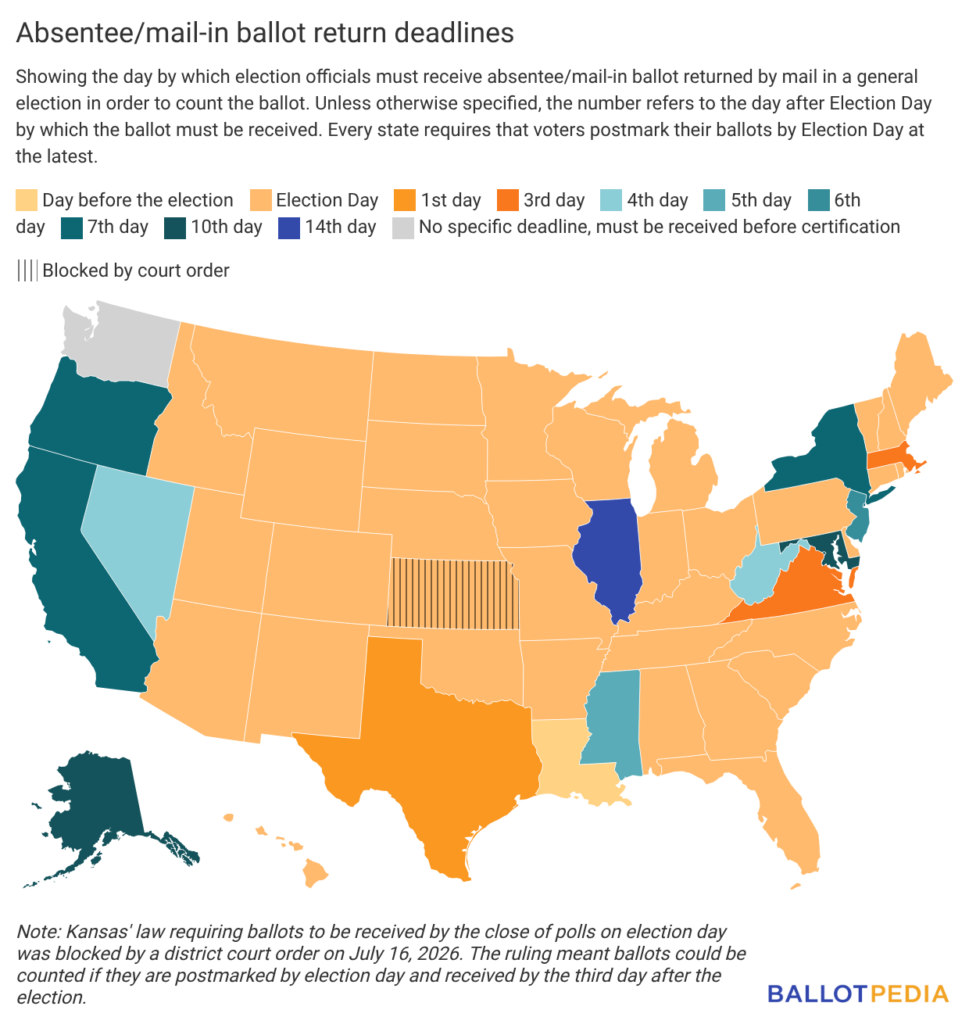
Nationally, 14 states allow all valid absentee/mail-in ballots postmarked by election day to be counted if they arrive within a set period of time after the election. Thirty-six states require ballots to arrive on or before election day in order to be counted.