


Welcome to the Wednesday, Aug. 5, 2026, Brew.
By: Briana Ryan
Here’s what’s in store for you as you start your day:
- Spanberger restores voting rights to thousands of individuals with felony convictions in return to previous governors' processes
- Initiative 308 would be the 43rd revenue-related measure since 1992 requiring voter approval under the Colorado Taxpayers' Bill of Rights
- What the Democratic candidates in the Aug. 11 Minneapolis-area U.S. House primary have said on immigration
Spanberger restores voting rights to thousands of individuals with felony convictions in return to previous governors' processes
On July 31, Virginia Gov. Abigail Spanberger (D) announced that since taking office on Jan. 17, she has restored the voting rights of 66,085 Virginia residents with felony convictions.
Virginia is one of three states, along with Iowa and Kentucky, where individuals convicted of any felony never regain the right to vote without some form of state action to restore their rights, under state law. However, executive orders in Iowa and Kentucky, and a court ruling in Virginia, have changed the states’ policies.
Since 2018, 13 states, not including Virginia, have expanded voting rights for individuals with felony convictions.
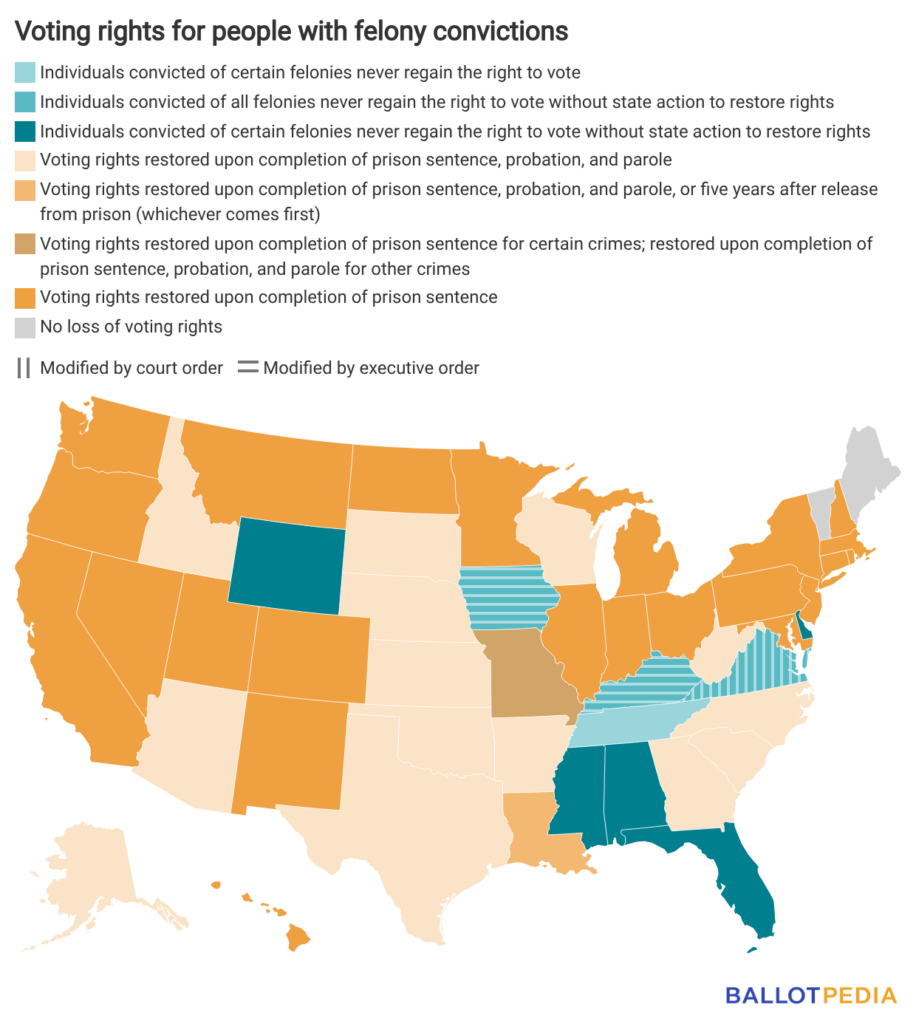
In Virginia, the state constitution states that individuals convicted of a felony lose their right to vote unless their “civil rights have been restored by the Governor or other appropriate authority.” Individuals with felony convictions must apply to the governor's office for restoration of their rights. People convicted of certain felonies may also petition the courts for restoration of their civil rights if they completed their prison sentence, probation, and parole more than five years ago.
Spanberger resumed the practice of restoring voting rights to individuals with felony convictions who had completed their prison sentence without requiring them to apply. In a statement, Spanberger’s office said the “Secretary of the Commonwealth’s Office is working to proactively identify Virginians who lost their right to vote, confirm that these Virginians are eligible, and restore their rights.” Virginia residents can also apply to have their rights restored.
Starting in 2010, Gov. Bob McDonnell (R) began automatically restoring voting rights to individuals convicted of nonviolent offenses who had completed their prison sentences, probation, and parole. Gov. Terry McAuliffe (D) used a similar review system for individuals convicted of all felonies, and Gov. Ralph Northam (D) expanded the system by removing a requirement that individuals complete parole before being eligible for restoration.
In 2023, Gov. Glenn Youngkin (R) announced that individuals seeking to have their rights restored must apply and have their applications considered on a case-by-case basis.
Opponents of Virginia's current policy have challenged in court the requirement that individuals with felony convictions petition the governor or a court to have their rights restored.
On Jan. 22, 2026, U.S. District Court Judge John Gibney ruled that Virginia's law violated a federal law governing the commonwealth's readmission to the U.S. following the Civil War.
Gibney granted an injunction preventing Virginia from disenfranchising individuals convicted of felonies created after the passage of the Virginia Readmission Act of 1870. Individuals convicted of some crimes, such as arson, burglary, manslaughter, murder, and rape, would still need to petition the governor to have their voting rights restored.
On Nov. 3, Virginia voters will decide on a constitutional amendment that would automatically restore voting rights for people with felony convictions after they complete their prison sentence. If voters approve the amendment, Virginia would become the second state in 2026 to change its policies on restoring voting rights to people with felony convictions.
On July 13, Missouri Gov. Mike Kehoe (R) signed HB 1871, which restored voting rights to people convicted of certain felonies upon completion of their prison sentences. Previously, an individual had to complete their prison sentence and any parole or probation before being able to register to vote. For 11 crimes, voting rights are still restored to people upon completion of prison time, parole, and probation.
Legislators in Delaware also passed HB 180, a constitutional amendment that would automatically restore voting rights to individuals with felony convictions upon their release from prison. The amendment must be passed again in the next legislative session before it takes effect, but it would not need voter approval.
Here’s how current laws compare across the U.S.:
- In two states and Washington, D.C., people with felony convictions never lose the right to vote.
- In 23 states, voting rights are restored upon completion of the prison sentence.
- In Missouri, voting rights are restored for individuals convicted of 11 crimes upon completion of the prison sentence, parole, and probation, and for those convicted of all other crimes, voting rights are restored upon completion of the prison sentence.
- In Louisiana, voting rights are restored upon completion of the prison sentence, parole, and probation, or five years after release from prison (whichever comes first).
- In 14 states, voting rights are restored upon completion of the prison sentence, probation, and parole.
- In five states, voting rights are never restored for individuals convicted of certain felonies, unless the state acts to restore the person’s rights.
- In three states — including Virginia — voting rights are never restored for individuals convicted of any felony without the state acting to restore the person’s rights, under state law.
- In Tennessee, voting rights are never restored for individuals convicted of certain felonies.
Click here for more information about voting rights for people with felony convictions.
Initiative 308 would be the 43rd revenue-related measure since 1992 requiring voter approval under the Colorado Taxpayers' Bill of Rights
If it qualifies for the Nov. 3 ballot, Initiative 308 in Colorado would be the 43rd measure in state history regarding revenue that required voter approval under the Colorado Constitution's Taxpayer's Bill of Rights (TABOR). Voters have approved 16 of these measures and defeated 26.
Supporters submitted signatures for Initiative 308 to the Colorado Secretary of State's office on July 27. The measure would exempt sales tax revenue generated from the sale of sporting goods and equipment from the TABOR provision.
Instead, the initiative would allocate that revenue to a newly created fund for environmental protection and wildfire prevention, called the Conserve and Protect Colorado's Water, Land, and Forests Fund.
The TABOR provision, Article X, Section 20(7)(d) of the Colorado Constitution, requires non-exempt revenue that exceeds the limits of TABOR to be refunded to voters in the following fiscal year, unless they approve a ballot measure exempting such funds.
Colorado voters created TABOR in 1992 when they approved Amendment 1, 53.7% to 46.3%.
The last time Colorado voters decided on such a measure was in 2025, when they approved Proposition LL. It allows the state to keep $12.4 million in excess revenue and interest that would have been refunded under TABOR, along with future revenue from reduced income tax deductions, to fund the Healthy School Meals for All Program. Colorado voters approved it 66.2% to 33.8%.
The last time Colorado voters decided on a statewide ballot measure related to wildlife preservation was in 2024, when voters defeated Proposition 127. The measure would have defined and prohibited trophy hunting as "intentionally killing, wounding, pursuing, or entrapping a mountain lion, bobcat, or lynx; or discharging or releasing any deadly weapon at a mountain lion, bobcat, or lynx." Colorado voters defeated it 54.7% to 45.3%.
The Colorado Secretary of State's office has until Sept. 2 to review the signatures submitted for Initiative 308 to determine whether the petition contains at least 124,238 valid signatures — the minimum number of valid signatures required to put the initiative on the Nov. 3 ballot.
Click here for more information about the Colorado Sporting Goods Sales Tax for Environmental Funding Initiative, and here to check out all the measures Colorado voters will decide on this year.
What the Democratic candidates in the Aug. 11 Minneapolis-area U.S. House primary have said on immigration
Five candidates are running in the Democratic primary for Minnesota's 5th Congressional District on Aug. 11, which includes Minneapolis and its surrounding areas. This primary will be the first since Operation Metro Surge, the federal immigration enforcement effort in Minnesota between December 2025 and February 2026.
Three of those candidates lead in media attention: incumbent Rep. Ilhan Omar (D), Julie Le (D), and Latonya Reeves (D). All three have also completed Ballotpedia's Candidate Connection survey.
While the candidates wrote about multiple topics, the starkest difference in their responses was on immigration between Omar and Le. Omar, who is the Deputy Chair of the Congressional Progressive Caucus, supported abolishing Immigration and Customs Enforcement (ICE). Le, an attorney and former federal prosecutor who was an Assistant Chief Counsel at Homeland Security and a Special Assistant U.S. Attorney during Operation Metro Surge, wrote that she supports reforming the immigration system.
Omar wrote: “We must abolish ICE. Minnesotans saw firsthand what a tyrant in the White House can do with an unaccountable paramilitary force. Masked agents roamed our streets, kidnapped our neighbors, and killed American citizens who were exercising their constitutional rights. …There is no reforming an agency that will ignore the Constitution and kill Americans and prevent any meaningful investigation into their deaths.”
Le wrote, "I've seen the shortcomings of our immigration system from the inside. I've stood in courtrooms and navigated the bureaucratic red tape that hinders dedicated officers and leaves families in uncertainty. ... We need a leader who not only understands the law but knows how to reform it so it works for everyone."
Reeves, a probation officer, union president, and Democratic National Committee member, did not directly mention immigration in her survey, but does on her campaign website. On ICE, Reeves' campaign website says, "We must work to hold federal agents accountable, and trim their budget back to previous levels."
Abena McKenzie (D) and Nate Schluter (D) are also running. McKenzie also completed our Candidate Connection Survey.
Click here to read all candidates' responses and to see our full coverage of the Democratic primary in Minnesota’s 5th Congressional District.