


Welcome to the Thursday, Aug. 6, 2026, Brew.
By: Lara Bonatesta
Here’s what’s in store for you as you start your day:
- Voters defeated three measures that Republican Legislatures put on the ballot in Missouri and Kansas
- Florida's GOP gubernatorial primary candidates are split on data centers
- On The Ballot examines how novels have helped define many different nations and peoples — and why the U.S. is the exception
Voters defeated three measures that Republican Legislatures put on the ballot in Missouri and Kansas
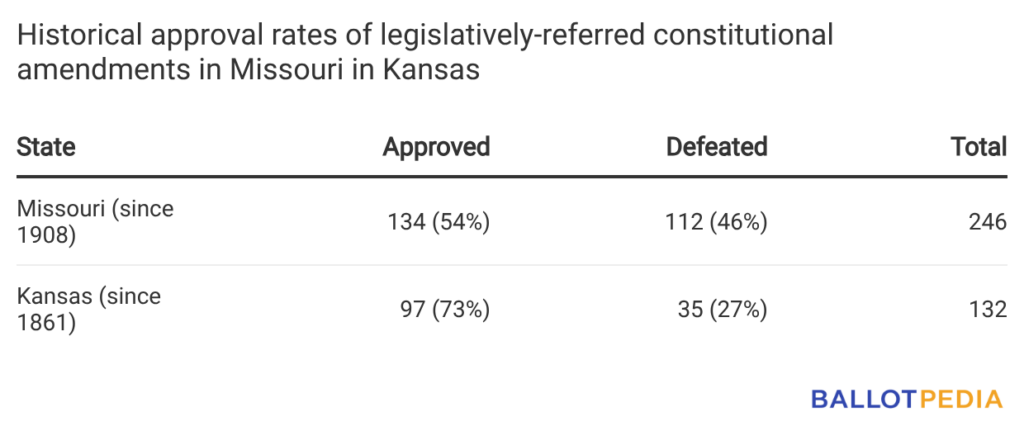
On Aug. 4, voters in Missouri and Kansas defeated three constitutional amendments that their Republican-controlled legislatures put on the ballot. Based on the vote totals as of 2 p.m. on Aug. 5, voters defeated Missouri’s Amendment 5 and Amendment 4 by the third and eighth-largest margins in state history.
Here's a summary of these ballot measure results and other notable takeaways from the Aug. 4 elections.
Missouri Amendment 4, which voters defeated 80.3 to 19.7%, would have required voter approval of citizen-initiated constitutional amendments in each congressional district, rather than statewide. Missouri Amendment 5, which voters defeated 83.3% to 16.7%, would have required the Legislature to reduce the state individual income tax based on revenue growth until the tax was eliminated, among other tax changes.
Kansas voters rejected an amendment that would have abolished the existing state Supreme Court nominating commission and made it one of 22 states to elect state Supreme Court Justices. As a result, Kansas remains one of 21 states that use assisted appointment — when the governor selects justices from a list provided by a nominating commission. Kansas is the only state in the country where the state bar association appoints the majority of nominating commission members.
Seven DSA-backed candidates win federal and state primaries
In other elections, candidates endorsed by the Democratic Socialists of America (DSA) or its local chapters won two of seven U.S. House races they ran in, and six of eight state legislative races so far.
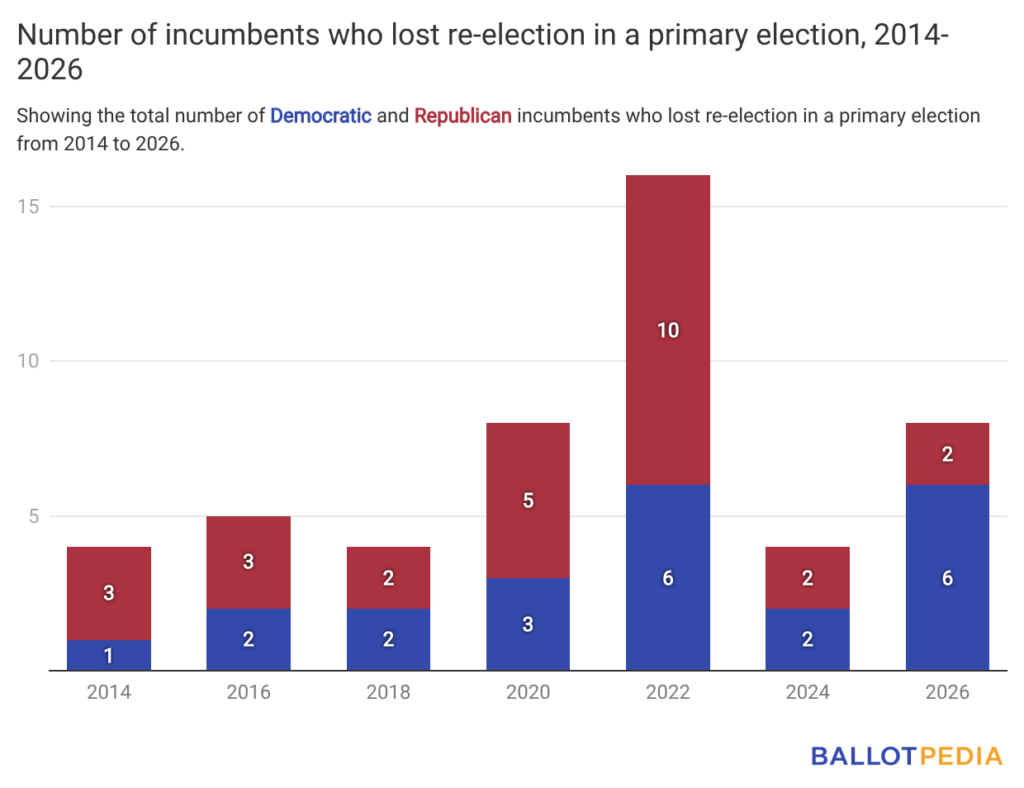
The DSA-backed winners in U.S. House primaries are incumbent Rashida Tlaib (D) in Michigan’s 12th District and Donavan McKinney (D) in Michigan’s 13th District. McKinney defeated incumbent Shri Thanedar (D), who became the eighth U.S. House incumbent to lose a bid for re-election this year. Thanedar’s loss means 2026 ties with 2020 for the second-most U.S. House members to lose in primary elections. Among the five DSA-endorsed candidates who lost was former U.S. Rep. Cori Bush (D) (see below for more details on that race).
The DSA-backed winners in state legislative primaries are Jimmy Lappe (D) in Missouri House District 81, Isaiah Harris (D) in Kansas House District 3, Shaun Scott (D) in Washington House District 43-Position 2, Jaelynn Scott (D) in Washington House District 37-Position 2, Dylan Wegela (D) in Michigan House District 26, and Chris Gilmer-Hill (D) in Michigan House, District 8. Two other DSA-endorsed candidates lost their primaries.
First Trump-endorsed U.S. House candidate loses primary
Thomas Smith, who withdrew from the Republican primary in Michigan's 8th Congressional District in July but still appeared on the ballot, defeated Amir Hassan and Al Lemmo. President Donald Trump (R) endorsed Hassan, and Smith endorsed Lemmo when he withdrew from the race. Hassan was the first Trump-backed candidate to lose a primary this year. Trump has endorsed 240 U.S. House candidates this year. So far, 193 won, one lost, and elections have not taken place for 33 of them (13 candidates did not appear on the ballot).
Two of three former U.S. House members win Congressional primaries
Three former Democratic U.S. House members ran in primaries for non-consecutive terms. Elaine Luria (D) in Virginia's 2nd Congressional District and Tom Perriello (D) in Virginia’s 5th Congressional District won their primaries. Cori Bush (D) in Missouri’s 1st Congressional District lost her primary to incumbent Wesley Bell.
Luria, who was first elected in Virginia’s 2nd Congressional District in 2018, will now face incumbent Jennifer Kiggans (R) in a rematch of the 2022 general election. Luria was one of three candidates running in Aug. 4 primaries that the Democratic Congressional Campaign Committee (DCCC) backed as part of its Red-to-Blue program, along with Shannon Taylor (D-Va.) and Sean McCann (D-Mich.), who both won primaries. All three of these races were part of a debate over whether the DCCC should be involved in Democratic primaries. To see our previous Daily Brew coverage on this, click here.
Augusta Township, Michigan, voters repeal proposed data center rezoning
Voters in Augusta Township, Michigan, voted to repeal an ordinance that rezoned 522 acres of land to allow for a proposed data center owned by Augusta Development Corp. Voters backed 'Repeal' 89.6% to 10.4%.
This is the third local ballot measure related to data centers that voters have decided this year, and all three outcomes limited or restricted data center development. Voters approved restrictions in Monterey Park, California, and Port Washington, Wisconsin, while voters in Augusta Township rejected the development ordinance through a veto referendum, as sought by the group that collected signatures.
Those three measures are among eight local ballot measures related to data centers voters will decide in six states this year. Five of these measures would prohibit data center development, overturn a related law, or create additional steps, such as voter approval, before certain data center projects can be developed. Three ballot measures would allow or advise support of data center development.
Other notable results
- In Michigan’s Democratic U.S. Senate primary, Abdul El-Sayed (D) defeated Haley Stevens (D). El-Sayed will face Republican Mike Rogers in the general election, which major race forecasters have rated Toss-up or Lean Democratic. U.S. Sen. Bernie Sanders (I-Vt.) endorsed El-Sayed and U.S. Sen. Chuck Schumer (D-N.Y.) endorsed Stevens.
- U.S. Rep. John James (R-Mich.) won the Republican primary for governor of Michigan. Ten U.S. House members — all Republicans — retired to run for governor this year. So far, two candidates won their primaries, and five lost.
- In Michigan’s 7th Congressional District, William Lawrence (D), who received endorsements from several lawmakers and groups who describe themselves as progressive, defeated two other candidates. Lawrence will face incumbent Tom Barrett (R) in November in a general election that major race forecasters have rated as Lean Democratic or Tossup.
- In the Republican primary in Missouri's 6th Congressional District, Chris Stigall (R) defeated four other candidates in the primary to succeed incumbent Rep. Sam Graves (R). Graves, who endorsed Stigall, was one of 23 retiring U.S. House members who endorsed a candidate to succeed them. So far, sixteen of those candidates have won their respective primaries, and four lost.
- In Kansas, incumbent Roger Marshall (R) and Adam Hamilton (D) advanced from their respective primaries. Following Hamilton’s win, The Cook Political Report announced that it was changing its rating in the general election from Solid Republican to Likely Republican. The last time Kansas elected a Democrat to the U.S. Senate was 1932.
- In the primaries to succeed term-limited Kansas Gov. Laura Kelly (D), Democrat Cindy Holscher and Republican Ty Masterson won, respectively. Masterson, who is Kansas’ Senate President, won his primary on the same night voters defeated the amendment he supported to change how the state’s Supreme Court justices were selected. Major race forecasters have rated the open Kansas governor's race as Lean Republican or Toss-up.
- In Washington’s 3rd Congressional District, incumbent Marie Gluesenkamp Perez (D) and John Braun (R) advanced from the top-two primary. The American Israel Public Affairs Committee (AIPAC) endorsed Gluesenkamp Perez and Trump endorsed Braun.
Kansas, Missouri, Michigan, and Washington held state legislative elections on Aug. 4. As of 2 p.m. E.T. on Aug. 5:
- Three incumbents had lost their bids for re-election in Kansas: Kenneth Collins (R), Henry Helgerson (D), Ford Carr (D). Three races featuring incumbents were still uncalled.
- Four incumbents – all Republicans – were defeated in Missouri: Tony Harbison, Michael Davis, David Casteel, and Curtis Trent.
- No incumbents lost a bid for re-election in Michigan. One race featuring an incumbent – Helena Scott (D) – was still uncallled.
- In Washington, which uses all-mail voting, 19 races featuring incumbents were still uncalled.
Click here to learn more about the election we covered on Aug. 4.
Florida's GOP gubernatorial primary candidates are split on data centers
Early voting in Florida’s statewide primary is already underway in some parts of the state, and on Aug. 8, it must officially begin everywhere, lasting through Aug. 15.
Twelve candidates are running in the Republican primary for governor of Florida on Aug. 18. Jay Collins (R), Byron Donalds (R), James Fishback (R), and Paul Renner (R) lead in local media attention. Incumbent Ron DeSantis (R) is term-limited.
One issue that the candidates differ on is whether data centers should be built in Florida. As we mentioned in the story above, data centers are a growing political issue nationwide, with voters in six states deciding local ballot measures on them this year. Additionally, through the first half of the year, Ballotpedia identified 33 recall efforts targeting 58 officials over data center projects across seven states. To learn more about those, check out our Mid-Year Recall report.
Donalds, who media outlets have reported has received campaign contributions from various pro-AI PACS and donors, has spoken both in support of data center development and in support of increasing protections for Floridians from data centers. In March, Donalds said Florida should be a leader in AI and data center development saying, “we can not put our heads in the ground with the next wave of innovation.” On Aug. 3, he said, “I know firsthand that if you don’t have fresh water, you have nothing. So, we are going to protect the water resources of the people of Florida. Secondarily, we are not going to let your electric bill go up because of a data center.”
Fishback and Renner have said they want to stop or slow the expansion of data centers. Fishback said he would "ban them in all 67 counties by preventing county commissions from approving them in the first place" to "protect Florida’s land, water, and electric bills from an industry that takes everything and gives nothing back." In an interview with WFLA, Renner said he supports a temporary pause on data centers: "I’ve called for a statewide moratorium. A full halt, like other counties have done. We are going to do a 12 month or 24 month, to ask questions first."
Collins has said data centers cannot legally be banned and said that: "What we're doing is the only plan out there that actually focuses on what we should be talking about: governance, protecting our people, building an economy. If you heard me, I acknowledge data centers aren't new. The hyperscale issue is a bigger discussion."
Below is a background on each candidate. To read more about how Ballotpedia defines noteworthy candidates, click here.
- Collins is the Lieutenant Governor. DeSantis appointed him to replace Lt. Gov. Jeanette Nunez (R) in 2025. Collins served in the Florida Senate from 2022 to 2025. Collins' other experience includes serving in the U.S. Army Special Forces and working at the nonprofit Operation BBQ Relief. Collins is running on his military service and relationship with DeSantis.
- Donalds represents Florida's 19th Congressional District. He was first elected in 2020. He served in the Florida House from 2016 to 2020. His career experience includes working in finance, banking, and insurance. Donalds' campaign has highlighted his endorsement from President Donald Trump (R).
- Fishback founded the investment firm Azoria and the nonprofit Incubate Debate. He was a consultant for the Department of Government Efficiency (DOGE) during the second Trump administration. Fishback’s campaign website says he wants to eliminate property taxes and ban data centers.
- Renner was a member of the Florida House from 2015 to 2024. From 2022 to 2024, he was speaker of the House. His other experience includes serving in the Navy and working as a prosecutor and business attorney. Renner is running on his record in the Legislature.
Jim Holcomb, Arthur McCaffrey, Daniel Nokovich, William Reicherter, Rachel Rodriguez, James Shaw, Caneste Succe, and Bobby Williams Jr. are also running.
Major race forecasters have rated the general election Solid/Safe or Likely Republican. Republicans have held the governor's office since 1999.
Click here to see our full coverage of Florida’s Republican gubernatorial primary.
On The Ballot examines how novels have helped define many different nations and peoples — and why the U.S. is the exception
In our new episode of On The Ballot, Ballotpedia founder and CEO Leslie Graves joins host Norm Leahy to discuss the books that have defined nations and cultures and why the U.S. has no national novel.
National novels – such as Don Quixote of Spain and The Seven Brothers of Finland – are books that literary critics consider fundamental to a nation’s character and culture. Leslie and Norm discuss the way these books have shaped how people in some countries think and perceive the world around them.
Interestingly, the U.S. has no such national novel. Leslie and Norm discuss what this might say about Americans, how we view ourselves, and our culture. Leslie and Norm also discuss what we do have – the Declaration of Independence – how it is different from the national novels of other countries, and how the document has defined what it means to be American.
Click here to watch the recording of the episode on YouTube and make sure to subscribe to On The Ballot wherever you get your podcasts.