


Welcome to the Monday, Aug. 10, 2026, Brew.
By: Lara Bonatesta
Here’s what’s in store for you as you start your day:
- Maryland Democrats put measure on 2026 ballot, making it the fourth state to take action towards redistricting ahead of 2028
- House Ethics Committee investigation of the incumbent is an issue in Florida’s 7th Congressional District GOP primary
- Democratic governors have now appointed six of seven justices on the Kansas Supreme Court
Maryland Democrats put measure on 2026 ballot, making it the fourth state to take action towards redistricting ahead of 2028
On Aug. 4, the Democratic-controlled Maryland General Assembly voted to put a measure on the 2026 ballot that makes Maryland the fourth state to take steps towards redistricting ahead of the 2028 elections.
The measure would provide that the state constitution's requirements around contiguity, compactness, substantially equal population, and consideration of natural and political subdivision boundaries apply only to state legislative districts, not congressional ones. It would also state that, “Nothing … in this constitution … provides applicable criteria for the boundaries of a congressional districting plan.”
In March 2022, when the state was adopting maps after the 2020 census, Circuit Court Judge Lynne Battaglia threw out a proposed map that would have favored Democrats in all eight of the state's congressional districts, saying it violated these requirements. According to Maryland Matters, before 2022, the requirements had “historically been interpreted to apply to legislative districts,” rather than congressional districts. Following Battaglia’s ruling, Maryland adopted a new map in April 2022, and voters ultimately elected seven Democratic representatives and one Republican representative, as they have in each election cycle since 2012. State Sen. Clarence Lam (D) said the amendment is “putting the Battaglia decision before the voters and letting them decide whether that interpretation was wrong or not.”
The proposed amendment would not affect the 2026 elections, but would allow the General Assembly to implement a new map in 2027. Democratic lawmakers have called the measure the first step to allowing the General Assembly to pass new maps in the future and said that concerns over redistricting will grow leading up to 2028.
Article III, Section 4 of the Maryland Constitution says, “Each legislative district shall consist of adjoining territory, be compact in form, and of substantially equal population. Due regard shall be given to natural boundaries and the boundaries of political subdivisions.” The proposed measure in Maryland would also allow the General Assembly to grant the state supreme court original jurisdiction over challenges to congressional redistricting plans.
The state House passed the amendment 96-38. The state Senate passed it 32-13. The votes took place on Aug. 4 and were largely along party lines. Governor Wes Moore (D) signed it on Aug. 5. Maryland has a Democratic trifecta, with Democrats holding a 102-39 supermajority in the state House and a 34-13 supermajority in the state Senate.
Democrats who support the amendment have said that the provisions in Article III never applied to congressional districts and instead say that the U.S. Constitution and federal laws apply to congressional maps. Republicans who oppose the amendment have said it would lead to a map that disenfranchises and discriminates against Republican voters.
In Maryland, the governor submits a state legislative redistricting proposal (an advisory commission that the governor appoints assists in drafting this proposal). The General Assembly may pass its own plan by joint resolution, which is not subject to gubernatorial veto. Maryland is one of 33 states in which the legislature plays the dominant role in congressional redistricting. Of those, it is one of 31 in which the lines that the General Assembly draws are subject to a gubernatorial veto.
As of Aug. 7, Maryland and New York have taken official action toward passing a new congressional map for the 2028 elections. Georgia and Wisconsin have congressional maps that are subject to change due to ongoing litigation. The Colorado Supreme Court struck down a proposed congressional redistricting ballot measure on June 29, and Georgia lawmakers passed on redrawing the congressional map in a June special session.
Alabama, California, Florida, Louisiana, Missouri, North Carolina, Ohio, Tennessee, Texas, and Utah have adopted new congressional maps ahead of the 2026 elections. Six of those states implemented new maps voluntarily. Ohio was required to implement new maps by law, and litigation led to new maps in Alabama, Louisiana, and Utah. Before 2025, only two states had voluntarily conducted mid-decade redistricting since 1970.
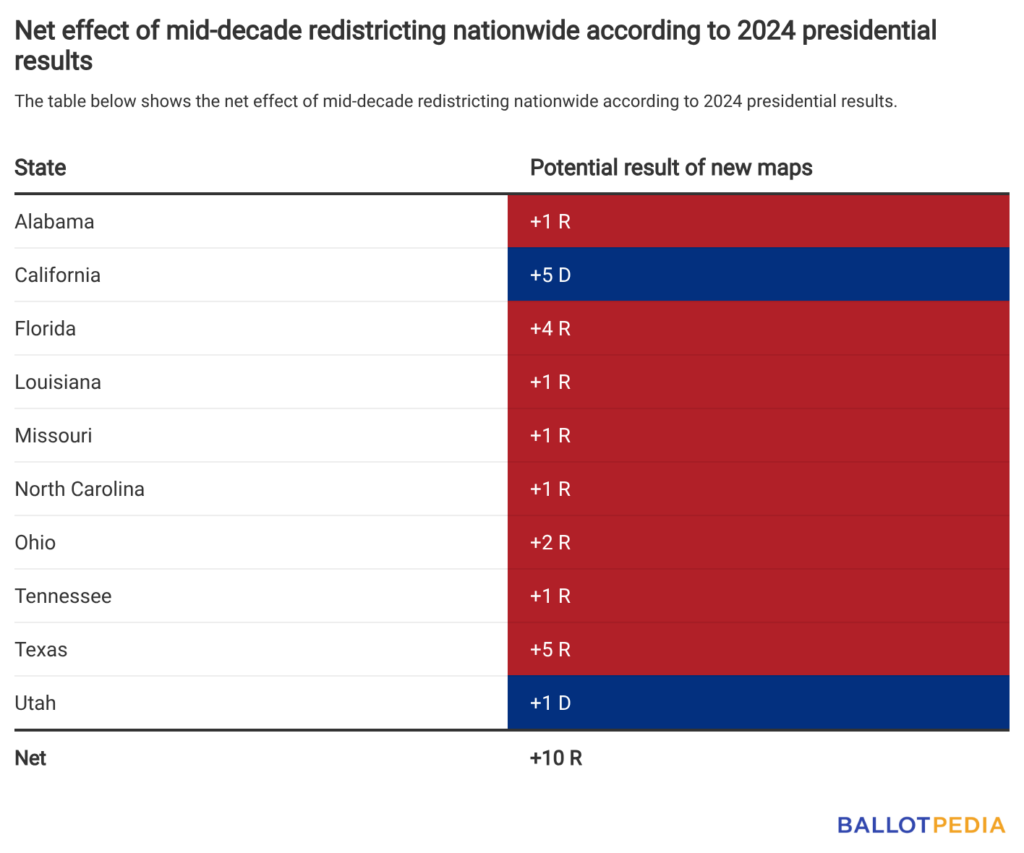
Maryland voters have decided on at least two veto referendums on congressional maps, one in 2012 and the other 1962. The 2012 measure was approved 65% to 35%, upholding the districts the General Assembly passed. The 1962 measure was defeated 65% to 35%, repealing the districts the 1961 General Assembly passed.
Click here to learn more about the Maryland redistricting amendment and here to learn more about Maryland’s 2026 ballot measures.
House Ethics Committee investigation of the incumbent is an issue in Florida’s 7th Congressional District GOP primary
Four candidates are running in the Republican primary for Florida's 7th Congressional District on Aug. 18. Incumbent Cory Mills (R) and Ryan Elijah (R) lead in media attention and campaign fundraising.
The House Ethics Committee has been investigating allegations of misconduct against Mills since 2025. According to Politico's Andrew Atterbury, “Mills was accused by a former girlfriend of threatening to circulate sexually explicit videos of her. ” Mills is also facing allegations of violations of campaign finance law and of holding weapons contracts with the federal government during his time in Congress. Mills has faced calls to resign over the investigation and withdraw his re-election bid, but he has denied any wrongdoing, saying, "Anything [the committee] asked of us, we’ve complied. Why not let the investigating body and the Ethics Committee to be able to do their jobs? ... We’re very happy to see what the outcome is."
Elijah said the Committee’s investigation of Mills could make him vulnerable in the general election. Mills, who President Donald Trump (R) endorsed, said the president’s support is evidence that he is still favored. In 2024, Trump won the district 55% to 43%.
Mills was first elected in 2022. He is campaigning on his record and said he supports reducing the size of the federal government. Trump, U.S. Sen. Ted Cruz (R-Texas), and various members of the U.S. House have endorsed Mills.
Elijah is a former newscaster for WOFL-TV in Orlando. Elijah completed Ballotpedia's Candidate Connection survey. Click here to read his responses. U.S. Reps. Anna Paulina Luna (R-Fla.) and Mike Haridopolos (R-Fla.), and gubernatorial candidate Paul Renner endorsed Elijah
According to reports filed with the FEC, as of June 30, Mills had raised $864,851 and spent $824,661, and Elijah had raised $301,662 and spent $33,791.
Michael Johnson (R) and Sarah Ulrich (R) are also running.
This district was not affected when Florida redrew its maps prior to the election. To read more on which districts were redrawn, click here.
Click here to read more about the Republican primary in Florida’s 7th Congressional District.
Democratic governors have now appointed six of seven justices on the Kansas Supreme Court
On Aug. 3, K. Christopher Jayaram was sworn into the Kansas Supreme Court, becoming the sixth Democratic gubernatorial appointee on the court.
On Aug. 4, Kansas voters defeated a constitutional amendment 61% to 39% that the Republican-controlled Legislature put on the ballot. It would have made Kansas one of 22 states to elect state supreme court justices and would have abolished the state supreme court nominating commission. As a result, Kansas remains one of 21 states that use assisted appointment — when a nominating commission provides the governor with a list from which to select a justice. Kansas is the only state in the country where the state bar association appoints the majority of nominating commission members.
Governor Laura Kelly (D) appointed Jayaram on July 13. He joins three other justices that Kelly appointed, two that former Gov. Kathleen Sebelius (D) appointed, and one that former Gov. Sam Brownback (R) appointed. Jayaram had previously served as a district court judge in Johnson County since 2021.
Jayaram replaced Justice Marla Luckert, who retired on March 28. Luckert announced her retirement in a letter on March 2. Governor Bill Graves (R) appointed Luckert to the court in November 2002, and voters retained her in 2004, 2010, 2016, and 2022.
Here’s a look at other recent state supreme court news.
One justice retired and another was sworn in to replace her
On July 29, Delaware Court of Chancery Vice Chancellor Morgan Zurn was sworn into the Delaware Supreme Court. Governor Matt Meyer (D) nominated Zurn on June 5, and the Delaware Senate confirmed her on June 30. Zurn replaces Justice Karen L. Valihura, who retired at the end of her term on July 25. Zurn will serve on the state supreme court until 2038, when she will be eligible for reappointment.
One other justice was appointed
In Mississippi, Gov. Tate Reeves (R) appointed Celeste Wilson to the state's supreme court. Wilson has served as a circuit court judge in DeSoto County since 2017. Wilson replaces Robert Chamberlin, who was appointed to the U.S. District Court for the Northern District of Mississippi in December 2025. Wilson was sworn in on Aug. 4.
Click here to see our full coverage of state supreme court vacancies in 2026.