



Voters in four states will decide six statewide ballot measures related to housing policy on Nov. 3 — the most in a single election year between 2006 and 2026.
Three of the measures are on the ballot in California, while Hawaii, Massachusetts, and Rhode Island each have one. Three were referred to the ballot by state legislatures, and three are citizen initiatives.
The six measures fall into three policy areas — zoning and permitting, housing assistance programs, and housing development funding.
Land use, zoning, and permitting
Land use, zoning, and permitting ballot measures address housing development regulations.
- California Proposition 45, Changes to Environmental Review Process for Certain Projects Initiative: The citizen-initiated statute would change the California Environmental Quality Act (CEQA) and Permit Streamlining Act for essential projects, defined to include housing, water, renewable energy, medical facilities, public safety infrastructure, broadband, education, and transportation. The initiative would establish deadlines for agencies to review applications and make permitting decisions, shorten or limit parts of the environmental review process, expedite court challenges, and restrict the circumstances in which courts could delay or overturn project approvals.
- The Committee to Build an Affordable California is leading the campaign in support of Proposition 45. Through June 30, supporters reported $25.4 million. The largest donors to the campaign include the California Building Industry Association Issues Committee, Edison International & Affiliated Entities, and the CA Business PAC. Sergey Brin's Building a Better California PAC also supports the initiative.
- People Over Polluters is leading the campaign in opposition to Proposition 45. Through June 30, opponents reported $4.1 million. The largest donors were Clean and Healthy California, the Members' Voice of the State Building and Construction Trades Council of California, and the State Building and Construction Trades Council of California Independent Expenditure PAC.
- Massachusetts Question 7, Limit on Required Lot Size for Single-Family Homes Initiative: The citizen-initiated statute would limit how much land cities and towns could require for a single-family home in areas already zoned for residential use. If a lot has at least 5,000 square feet of area, at least 50 feet of frontage on a street or public way, and access to public sewer and water service, the municipality would have to allow a single-family home on the lot. In practice, the measure would override local zoning rules that require larger minimum lot sizes in those areas. According to Massachusetts' 2025-2029 Comprehensive Housing Plan, many zoning districts in the state currently require between one-half acre and two acres for a single-family home; 5,000 square feet is about 0.12 acres.
- The Legalize Starter Homes PAC is leading the campaign in support of Question 7, with support from Abundant Housing Massachusetts, League of Women Voters of Massachusetts, and Massachusetts Association of Realtors. The New York Times Editorial Board also endorsed the measure.
- As of Aug. 11, there is no organized campaign opposing Question 7. The Massachusetts Municipal Association opposes the ballot initiative.
Housing assistance programs
Housing assistance program ballot measures provide public funding and support for housing aid, including mortgage assistance, subsidies, and related programs.
- California Proposition 1, Veteran and Housing Assistance Programs Bond Measure: The ballot measure would authorize the state to issue $11.25 billion in bonds to fund income-qualified housing programs, such as the Multifamily Housing Program, the CalHome Program, and the Joe Serna, Jr. Farmworker Housing Grant Program, and the veteran home loan program. The state's veteran program offers loans to veterans through the issuance of bonds, and the bonds are repaid as veterans repay the loans. In the Legislature, the proposal received support from Democrats and 25% of Republicans.
- California Proposition 37, Second Mortgage Homebuyer Program and Revenue Bond Initiative: The citizen-initiated statute would authorize the California Housing Finance Agency (CalHFA) to issue up to $25 billion in revenue bonds to fund a new down-payment assistance program. The program would provide qualifying buyers with a second mortgage covering up to 17% of the purchase price of an eligible home, while buyers would be required to contribute a down payment of at least 3%. Borrowers would make monthly payments on the second mortgage, with interest rates and repayment terms set to repay the bonds and cover administrative costs. CalHFA would be required to keep borrowers' interest costs as low as possible.
- California Coalition for Homeownership is leading the campaign in support of the initiative, with support from gubernatorial candidate Xavier Becerra (D), State Controller Malia Cohen (D), State Treasurer Fiona Ma (D), the California Democratic Party, and the California Association of Realtors. Through June 30, the campaign reported $16.2 million in contributions.
- As of Aug. 11, there is no organized campaign opposing Proposition 37. Reform California opposes the ballot initiative.
Housing development funding
Housing development funding ballot measures provide public funding or incentives for housing development.
- Hawaii Authorize Resilient Infrastructure for Shelter and Equity (RISE) Bonds Amendment: The constitutional amendment would authorize local governments to issue bonds for infrastructure and public improvements that support housing development, such as water, sewer, drainage, and roads. The Legislature also passed companion legislation, contingent on voter approval of the ballot measure, that would establish a tax increment financing (TIF) program allowing counties to create districts where bonds could be used to finance public improvements supporting housing development and increases in property tax revenue could be used to fund projects and repay the bonds. The constitutional amendment received bipartisan and unanimous support from legislators.
- Rhode Island Housing Development Bond Measure: The ballot measure would authorize the state to issue up to $120 million in bonds for projects to "increase and preserve the availability of affordable and accessible housing." At least $25 million would need to be allocated to increasing the production of housing intended for homeownership, and up to $10 million would need to be allocated for a public housing development program. The ballot measure was included in the state's fiscal year 2027 appropriations bill, which was supported by legislative Democrats and opposed by legislative Republicans.
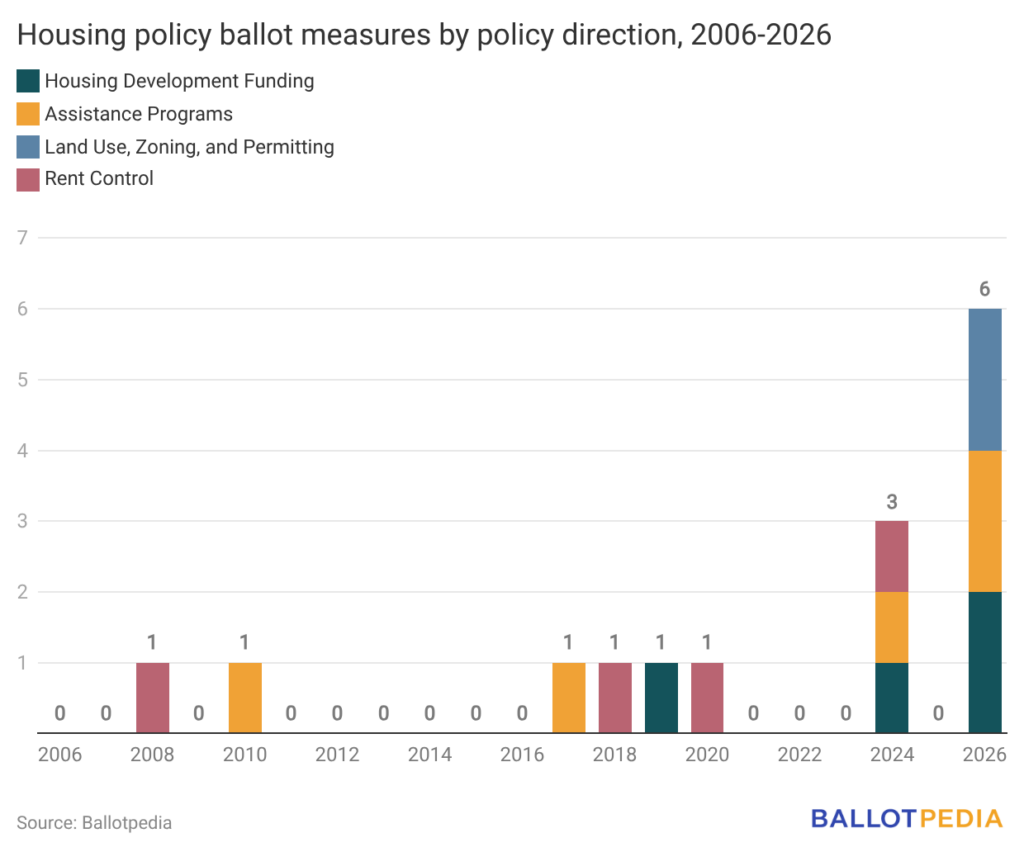
State ballot measures addressing housing were uncommon before 2024
Between 2006 and 2025, voters decided nine statewide housing policy measures. Three were approved, and six were defeated. No more than one such measure appeared on the ballot in any year from 2006 through 2023. The number increased to three in 2024 and six in 2026.
Those nine earlier measures addressed housing development funding, housing assistance, and rent control. Voters approved all three housing assistance measures and defeated all four rent control measures and both housing development funding measures.
The 2026 measures are also the first during this period to address statewide housing policy related specifically to land use, zoning, and permitting.
Two measures missed the ballot
Two state ballot initiatives for which signatures were submitted did not make the ballot in 2026: one in California and one in Massachusetts.
In California, signatures were submitted after the recommended deadline for the State University Staff First-Time Homebuyer Down Payment Loan Program Initiative. The proposal could still appear on the ballot in 2028. It would create a first-time homebuyer down payment loan program for qualifying staff members of state universities.
In Massachusetts, signatures were submitted for the Rent Control Initiative, which would have established rent control statewide, limiting annual rent increases for residential units to the CPI or 5%, whichever is lower. The ballot initiative was disqualified after the Supreme Judicial Court ruled that the proposal's exemption for religious facilities violated the state constitution’s ban on initiatives addressing religion.