


Welcome to Hall Pass, a newsletter written to keep you plugged into the conversations driving school board governance, the politics surrounding it, and education policy.
In today’s edition, you’ll find:
- On the issues: The debate over regulating homeschooling
- School board filing deadlines, election results, and recall certifications
- U.S. Senate committee advances federal science of reading bill
- Extracurricular: education news from around the web
- Candidate Connection survey
On the issues: The debate over regulating homeschooling
In this section, we curate reporting, analysis, and commentary on the issues school board members deliberate when they set out to offer the best education possible in their district. Missed an issue? Click here to see the previous education debates we’ve covered.
Homeschooling refers to a form of K-12 education in which parents teach their children instead of enrolling them in a public or private school. In some cases, homeschooling families may join together in what is known as a homeschooling co-op, where one or more parents teach a group of children.
Interest in homeschooling began to grow in the 1970s and 1980s. In many states, families who wanted to homeschool had to contend with truancy laws that required children to be enrolled in school, prompting a series of legal battles. According to the Coalition for Responsible Homeschooling, an advocacy group that supports homeschooling, homeschooling became legal in all 50 states by the 1990s.
Data on homeschooling is patchy, because not all states collect information on homeschoolers. Researchers estimate that homeschooling increased from roughly 2% of all K-12 students in the 1990s (between 700,000 and 1.15 million), to 3% in 2019 (or roughly 1.5 million). Following the pandemic, the number of homeschooled students grew at a faster rate than before, with an estimated 6% of students taught at home during the 2023-24 school year. In comparison, roughly 85% of students attended public schools and 10% attended private schools that year.
Today, we’re looking at two contrasting perspectives on whether to increase oversight of homeschooling families.
Jo Anderson, a student at Vanderbilt University who was homeschooled, writes that although she had a positive homeschooling experience, lax or nonexistent regulation in many states means that too many in that community suffer physical abuse and academic neglect. Anderson says inconsistent state requirements result in students falling through the cracks, though it’s unclear how many. She says that in public schools, staff are trained on how to identify and report abuse. Anderson writes that families choosing to homeschool should be required to undergo home inspections and adhere to the same academic and safety requirements as any other schools.
Angela Dills, a Western Carolina University economics professor, says it’s not clear from the data that homeschoolers are less safe than those in public schools — and Dills says it’s not obvious putting more regulations on homeschooling families would reduce abuse and neglect. Dills says safety is one of the reasons families choose to keep their children out of public schools, where bullying, fights, school shootings, and sexual crimes occur, and that making it harder to homeschool risks leaving kids in unsafe schools. Dills says public school employees don’t report many cases of suspected abuse, especially when their colleagues are involved. She says laws designed to provide greater oversight of homeschooling would likely be enforced more harshly against minority families.
The homeschooled kids are not alright | Jo Anderson, The Tennessean
“Change doesn’t happen in a day, but we seem to be turning a corner in some states. Recent abuse cases in Connecticut have prompted lawmakers to pass legislation, now headed to the governor to sign, that would require homeschool parents to provide proof of ‘equivalent instruction’ every year. Lawmakers believe this will deter abusive parents from using homeschooling as a guise to remove children from society.
“Homeschool environments should be subject to the same education and safety standards as public schools, with yearly standardized tests and regular home inspections as the minimum.
“Pennsylvania is an excellent example of standards that should be adopted nationwide. In addition to requiring parents to submit education objectives and immunization records, maintain a portfolio of student work, and sign an affidavit, the state also requires a licensed psychologist or experienced teacher to review that portfolio annually and a certification that supervisory adults and others in the home ‘have not been convicted of certain criminal offenses within the past five years.’ These requirements aim to ensure a high level of education for homeschooled children and their safety.”
Are Students Safer in Government-Run Schools? | Angela Dills, The Daily Economy
“Whether additional regulation of homeschooling is likely to improve child safety is also unclear. Child maltreatment is illegal in all states. Educational neglect is illegal in 24 states. We have existing laws on the books to remove children from unsafe households. And for some children, making it harder for their families to homeschool would mean staying in unsafe schools.”
“Should government have access to our children to ‘check’ for abuse? There’s little evidence that these checks are likely to be effective. Evidence on home visits for infants, for example, show mixed effects on child abuse and neglect. Public schools are part of government and the similarity of child maltreatment rates between schooled and homeschooled children suggest that this oversight does not significantly deter maltreatment. Further, school employees fail to report large fractions of suspected abuse, particular at the hands of their colleagues. And we have every reason to expect that any rule is likely to be enforced in disparate ways against families of color or non-mainstream religious groups.”
School board update: filing deadlines, election results, and recall certifications
In 2026, Ballotpedia will cover elections for more than 30,000 school board seats. We’re expanding our coverage each year with our eye on covering the country’s more than 80,000 school board seats.
Election results from the past week
Aug. 11
The Minneapolis Public Schools, in Minnesota, held a primary for two at-large seats on the board. Five of the nine seats on the school board are up for election this year, but primaries for three seats were canceled because only two candidates filed to run for each.
Upcoming school board elections
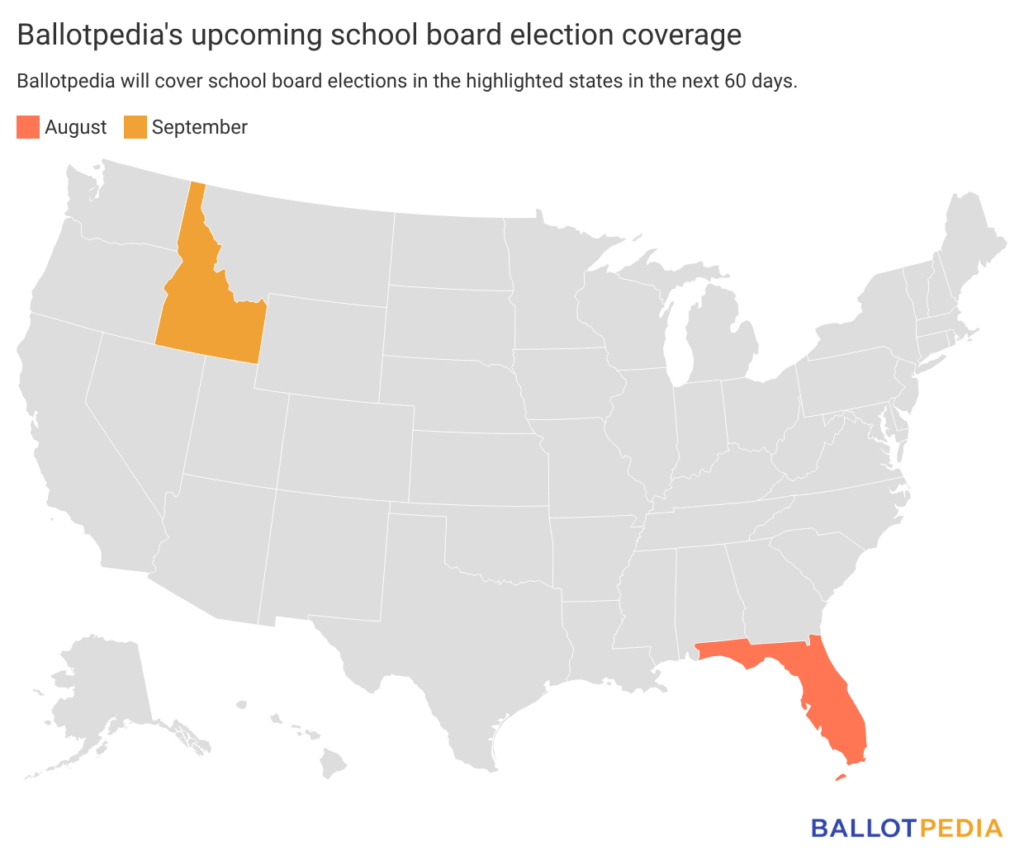
- Florida will hold primaries on Aug. 18.
- The Boise School District, in Idaho, will hold a special general election for an at-large seat on the Board of Trustees on Sept. 1.
U.S. Senate committee advances federal science of reading bill
On July 30, the U.S. Senate Committee on Health, Education, Labor, and Pensions voted 20-2 to send the Reading Excellence and Achievement for Development (READ) Act to the full Senate for consideration.
The READ Act would establish the science of reading — a set of instructional practices and research rooted in phonics and vocabulary development that advocates say reflects how the brain learns to read — in federal law for the first time.
Here’s what to know.
What the bill would do: The READ Act would amend the Comprehensive Literacy State Development (CLSD) grant program to require that states receiving funds align their literacy instruction with the science of reading. The CLSD is one of the largest federal K-12 literacy grant programs, providing $194 million to 22 states and D.C. for comprehensive literacy instruction in 2024.
The bill defines the science of reading as a body of research that “demonstrates the explicit, systematic use of the essential components of phonemic awareness, phonic decoding, fluency, language structure, oral language, vocabulary, background knowledge, and literacy knowledge, which together lead to strong comprehension.”
- The bill would prohibit states receiving CLSD grants from using an approach to reading instruction known as the three-cueing system, which encourages young readers to use meaning, sentence structure, and visual letter cues to identify unfamiliar words.
- The bill also includes provisions requiring states to screen students for reading difficulties and dyslexia, align teacher preparation and licensure with the science of reading, and develop or support instructional material grounded in the science of reading.
Why it matters: The READ Act advanced from the Committee on Health, Education, Labor, and Pensions on a bipartisan basis — a reflection of a growing consensus around the science of reading among lawmakers. U.S. Sen. Bill Cassidy (R-La.) proposed the bill, while U.S. Sens. Maggie Hassan (D-N.H.), Jim Banks (R-Ind.), John Hickenlooper (D-Colo.), Tim Scott (R-S.C.), and Mark Kelly (D-Ariz.) signed on as cosponsors.
- Cassidy said, “Capable students are dropping out of high school simply because they were never taught how to read. Children with dyslexia are extremely bright, but without early testing and proper resources, they are being left behind. Let’s learn from states like Louisiana and implement proven reforms so every child has the power to read and reach their full potential.”
- Kelly said, “I am the product of a good public education, and every kid deserves that. If we want our kids to get ahead, we need to invest in the teachers, parents, and schools helping them get there. This bill is a step towards every kid having an opportunity to succeed, whether they want to join the military, go into public service, or just build a good life.”
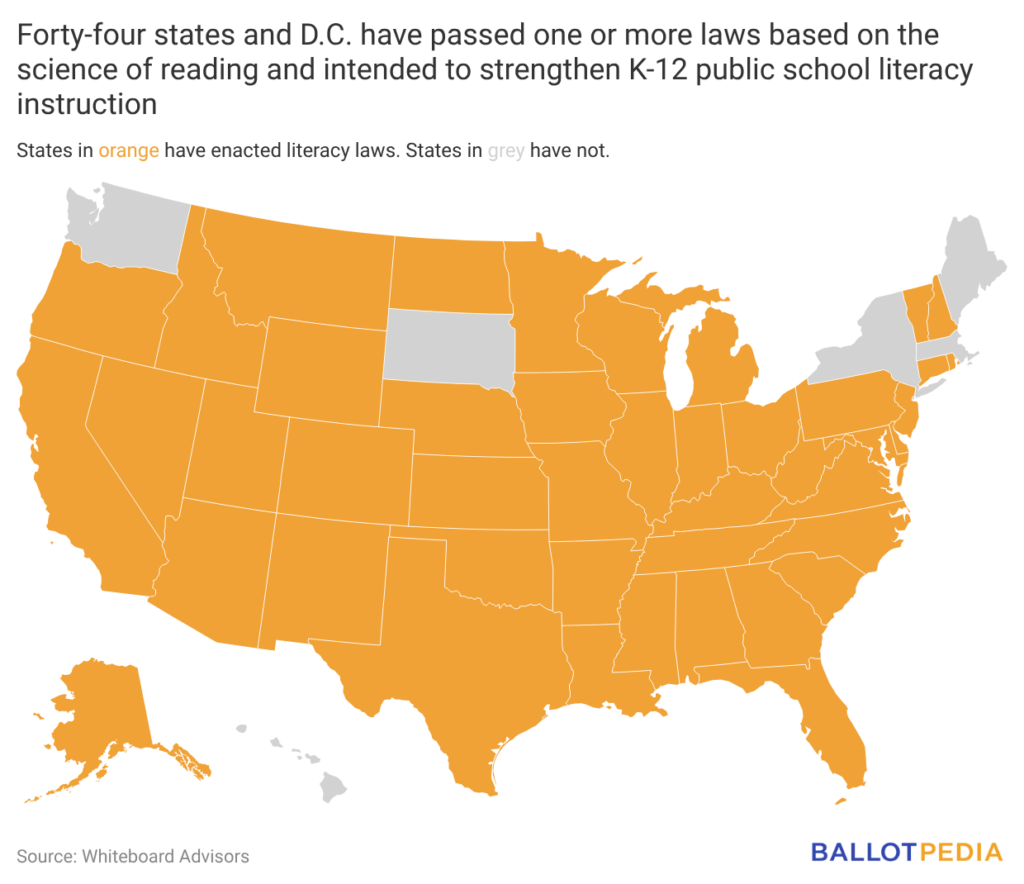
The big picture: According to Whiteboard Advisors, an education research and consulting firm, 44 states and D.C. have passed one or more laws based on the science of reading intended to improve K-12 literacy instruction since 2010, when Arizona enacted its Move on When Reading law designed to support struggling K-3 readers.
The debate: The dominant approach to literacy instruction in public schools has fluctuated throughout the 20th century and into the 21st in what some have styled “the reading wars.” The phonics-based, science of reading approach to literacy instruction contrasts with whole language, which emphasizes the context in which readers encounter words. The whole language approach is closely associated with the three-cueing system.
- Proponents of the science of reading say that it has been shown to improve students’ reading scores, and point to states like Mississippi and Louisiana as evidence. Mississippi and Louisiana reformed their literacy programs over the last decade and a half and have since seen their reading scores increase on the National Assessment of Educational Progress (NAEP), a federal standardized test known as the Nation’s Report Card.
- Critics of the science of reading movement say it offers a silver bullet approach to literacy instruction. Furman University education professor Paul Thomas, for example, says “[T]he current science of reading reform movement has not served reading policy decisions well because advocates and commercial vendors often exaggerate and oversimplify both the problems and solutions around reading achievement and instruction.”
- In 2023, Hall Pass ran a four-part deep dive into the debate around the science of reading. Click to read parts one, two, three, and four.
What’s next:
The READ Act was placed on the U.S. Senate’s Calendar of Business on Aug. 6, where the full chamber can now vote on it.
- Earlier this year, a bill similar to the READ Act, titled the Science of Reading Act of 2026, was introduced in the U.S. House. The U.S. House Committee on Education and Workforce voted 33-0 on March 17 to send the bill to the full House for consideration. As of this writing, the U.S. House had not acted on it. Click here to read Hall Pass coverage of this bill.
Extracurricular: education news from around the web
This section contains links to recent education-related articles from around the internet.
- As Enrollment Falls, Texas School Districts Are Competing for Students | Governing
- Only 1% of Teachers: Why Education Is a Hostile Space for Black Men | Emerald Pages
- States’ special education complaints are up by almost 50%, survey says | EdSource
- NYC expands Mamdani-backed program for students in homeless shelters to more schools | Daily News
- A Bad Jobs Report for Public Education | The 74
- The “ADHD Epidemic” Is Just an Overdiagnosis Epidemic | Human Progress
- Bureaucratic Hurdles Shouldn't Prevent Giving Students More Public School Choice | RealClearEducation
- Freedom Foundation Ramps Up Its Campaign to Crush Public Sector Unions | Exposed by CMD
Take our Candidate Connection survey to reach voters in your district
Today, we’re looking at survey responses from the three candidates running in the Aug. 18 Republican primary for Wyoming Superintendent of Public Instruction. The general election is Nov. 3. Wyoming is one of seven states holding elections for state superintendent.
The Superintendent of Public Instruction runs the Wyoming Department of Education. The current superintendent, Megan Degenfelder, is running for governor. According to WyoFile, “Degenfelder’s seat opens as lawsuits, policies, funding decisions and technological innovation pose major changes to Wyoming’s educational landscape. The Legislature just passed a recalibration bill that represents a new funding model for school districts; Wyoming’s universal school choice program is tied up in court and the state just overhauled literacy standards and instruction.”
At the time of this writing, neither of the candidates running in the Democratic primary, Ana Cordova and Sergio Maldonado, had completed the survey.
Chad Auer’s career experience includes working as the Wyoming Department of Education chief of staff between 2022 and 2023, as well as working as a high school teacher, attorney, and senior policy advisor to Gov. Mark Gordon (R). Here’s how Auer answered the question, “What are the main points you want voters to remember about your goals for your time in office?”
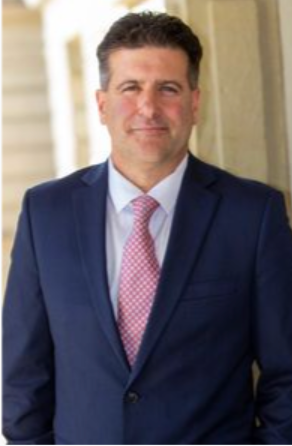
- “I will cultivate innovation, work collaboratively with local educators, parents and school boards. I will lead the Wyoming Department of Education with integrity and optimism.
- I will advocate for investing as many resources in education as we can afford. I will respect parents, teachers and local control.
- I will be a trusted thought partner and an advocate for strong public schools. I will work with the legislature as they consider critical education policies. I will keep the best interests of all students at the top of my priority list.”
Click here to read the rest of Auer’s responses.
Steve Harshman represents District 37 in the Wyoming House of Representatives. He was elected in 2002. Before getting into politics, he taught high school and coached football. Here’s how Harshman answered the question, “What areas of public policy are you personally passionate about?”

“Wyoming's future depends on every child succeeding, whether they attend public, private, or homeschool programs. We must support the educators and staff who make learning possible while focusing on strong literacy, career readiness, and workforce opportunities. By preparing students for college, careers, military service, and meaningful lives in Wyoming, we strengthen our schools, our communities, and our state's future while respecting parental choice and investing in what matters most: our children.”
Click here to read the rest of Harshman’s responses.
Thomas Kelly represents District 30 in the Wyoming House of Representatives. Kelly was elected in 2024. His career experience includes working as a high school teacher and, later, as an associate professor and university department chair. Here’s how Kelly answered the question, “What are the main points you want voters to remember about your goals for your time in office?”

- “Stagnating proficiency in literacy and math is a challenge that requires input from our thousands of educational professionals to address, not more top-down mandates from Cheyenne. However, the primary issue is complacency over the status quo believing that Wyoming doesn’t need to do better for our kids simply because we perform better than most other states. The state needs to take a step back with mandated standards and requirements, allow educators to help identify the core priority standards, and then trust our educators to develop and deliver curriculum appropriate and tailored to their local communities.
- I’ve been a vocal advocate for significantly increased compensation for those in the trenches with our kids because teaching is challenging enough without having to work a second job. However, I recall public school teaching, while always a challenge, to be fun. Fewer requirements from the state and less pressure for kids to perform on WYTOPP could allow educators more freedom to exercise their talents. Academic freedom allows teachers to innovate, to enjoy their work more, and that ultimately translates into more student success when a teacher is motivated rather than burnt out or demoralized.
- Wyoming law requires that the SBLC and SLIB maximize revenues from state lands to fund education. The sale of state lands is exploitation of our resources for a quick buck, not optimizing our resources for the best returns. Wyoming should sell no state lands. If the federal government sells lands, Wyoming should have the first chance to purchase those properties to add to our assets rather than have them go to private ownership.”
Click here to read the rest of Kelly’s responses.
As a reminder, if you're a school board candidate or incumbent planning to run this year, click here to take the survey. If you complete the survey, your answers will appear in your Ballotpedia profile. Your responses will also appear in our sample ballot. If there is an election in your community, share the link with your candidates and urge them to take the survey!