In this week’s edition of Economy and Society:
- States enact 14 ESG-related bills in 2026
- Five states enact proxy advisor disclosure laws
- State ESG legislation largely follows party lines since 2020
This week, we're pausing our regular coverage to take a look at the ESG legislation enacted during the 2026 state legislative sessions. For a closer look at the legislation, including how enacted legislation differs by partisan control of state government, click here.
States enact 14 ESG-related bills in 2026
What’s the story?
State legislatures enacted 14 ESG-related bills during the 2026 legislative sessions, including two that became law after lawmakers overrode gubernatorial vetoes. This was the fewest ESG bills enacted in a single year since 2021. Legislators introduced 174 ESG-related bills this year. Fourteen became law, one was vetoed, eight advanced to a second chamber, 72 are pending, and 79 failed.
State ESG legislation addresses how governments, investors, financial institutions, and corporations consider environmental, social, and corporate governance (ESG) factors. Ballotpedia tracks approaches including public investment and fiduciary standards, restrictions for financial institutions, consumer and investor protections, and corporate disclosure requirements.
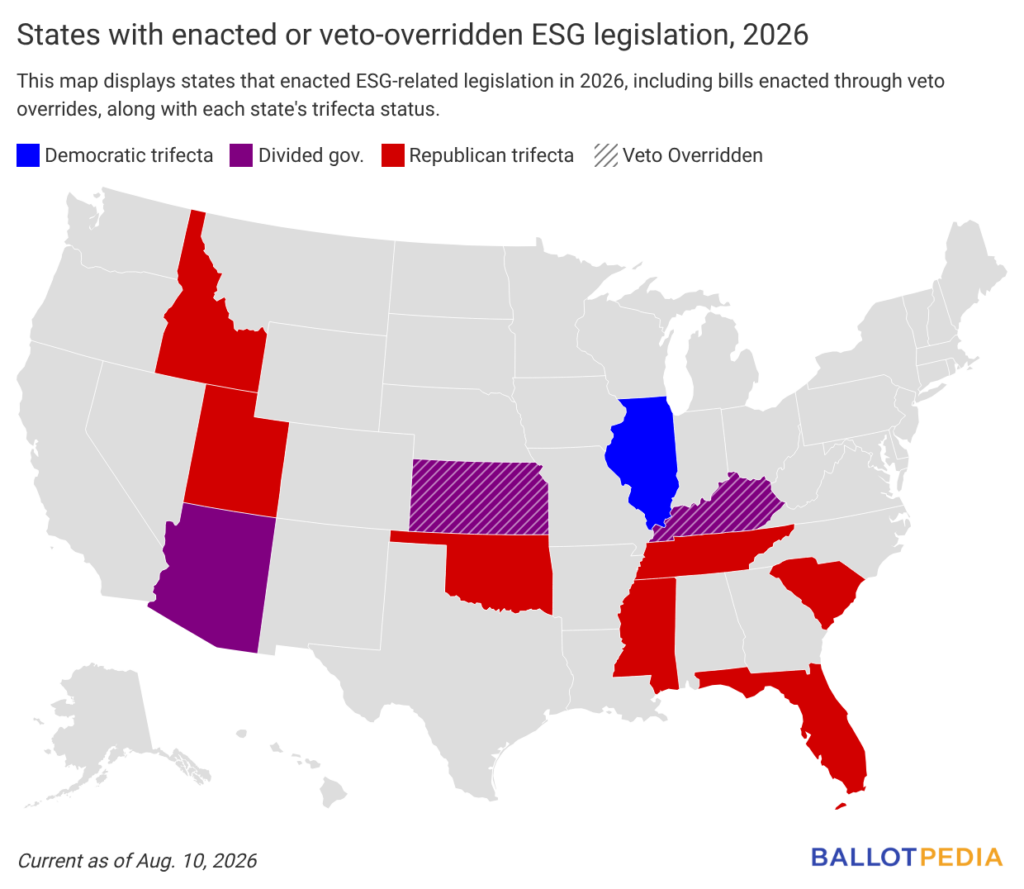
States with Republican trifectas enacted 10 of the 14 laws, while states with Democratic trifectas enacted one and states with divided governments enacted three. The enacted legislation addressed several policy areas:
- Tennessee, Oklahoma, Indiana, Kentucky, and Kansas enacted proxy advisor disclosure laws requiring certain disclosures when voting recommendations rely on nonfinancial factors rather than financial analysis. We take a closer look at those laws in the story below.
- Oklahoma, Mississippi, and Tennessee enacted or expanded sole fiduciary standards requiring public pension fiduciaries to base investment and proxy voting decisions only on financial factors.
- Florida and Idaho enacted restrictions on diversity, equity, and inclusion (DEI) programs, while Arizona referred a related constitutional amendment to voters for the 2026 election.
- South Carolina and Utah enacted laws prohibiting certain financial services providers or payment systems from restricting services based on ESG-related criteria.
- Illinois was the only Democratic-trifecta state to enact an ESG-related law, requiring certain insurers to participate in the National Association of Insurance Commissioners' Climate Risk Disclosure Survey.
Why does it matter?
The 2026 legislative sessions continued the partisan divide that has characterized state ESG policymaking. Republican-controlled state governments enacted most new laws and generally focused on limiting the use of ESG considerations in public investments, financial services, and corporate governance. Democratic-controlled state governments enacted no legislation supporting ESG policies this year.
The results also highlight the role of partisan control in state policymaking. With governorships and legislative majorities on the ballot this year, changes in trifecta status could alter the direction of ESG legislation in many states beginning with the 2027 legislative sessions.
Five states enact proxy advisor disclosure laws
What’s the story?
Five states — Tennessee, Oklahoma, Indiana, Kentucky, and Kansas — enacted proxy advisor disclosure laws during the 2026 legislative sessions, making proxy advisor regulation the most common ESG-related policy approach enacted this year. Kentucky and Kansas enacted their laws after Republican-controlled legislatures overrode vetoes from Democratic governors.
Proxy advisory firms, including Institutional Shareholder Services (ISS) and Glass Lewis, analyze shareholder proposals and provide voting recommendations to institutional investors, such as pension funds and asset managers. Several Republican-led state governments adopted new disclosure requirements intended to inform investors when recommendations rely on ESG or other nonfinancial considerations rather than financial analysis.
Tennessee's HB 2476 requires a proxy advisory firm providing advice to public pension plans to "provide a financial analysis supporting every recommendation that the proxy advisory firm makes to the pension plan on a shareholder proposal that differs from the company management's recommendation."
Kansas' SB 375 requires disclosures when a proxy advisor recommends a vote against company management. The law defines a written financial analysis as one that "analyzes the expected short-term and long-term financial benefits and costs to the company" and "concludes what vote or course of action is most likely to positively affect shareholder value."
The laws have also prompted federal court challenges in Kansas, Indiana, and Kentucky.
Why does it matter?
The 2026 proxy advisor laws represent a more specific approach to proxy voting than much of the ESG legislation enacted in earlier years. Previous laws often addressed proxy voting through broader sole fiduciary requirements governing public funds. This year's laws directly regulate proxy advisory firms and the recommendations they provide to investors.
Supporters of the laws argue the disclosure requirements improve transparency because they inform investors when voting recommendations rely on nonfinancial considerations rather than financial analysis. ISS and Glass Lewis say the laws violate the First Amendment because they impose disclosure requirements based on the viewpoint expressed in their recommendations.
The legal challenges these laws are facing will determine how far states can regulate proxy advisors and how states pursue similar legislation in future sessions.
What’s the background?
The recent lawsuits build on a broader legal challenge to state regulation of proxy advisors.
In July 2025, ISS and Glass Lewis sued Texas over SB 833, which imposed disclosure requirements when proxy voting recommendations relied on certain nonfinancial considerations, including ESG and diversity, equity, and inclusion (DEI) factors. U.S. District Court for the Western District of Texas later issued a preliminary injunction blocking enforcement of the law against the firms while the litigation continues.
The federal government also increased its scrutiny of proxy advisors later that year. In December 2025, President Donald Trump (R) issued an executive order directing the Securities and Exchange Commission (SEC) to review rules governing proxy advisors, including their considerations of ESG and DEI factors.
On June 24, 2026, U.S. District Judge Holly L. Teeter of the U.S. District Court for the District of Kansas — a Donald Trump (R) appointee — issued preliminary injunctions preventing Kansas from enforcing the Proxy Advisory Transparency Act (SB 375) against ISS and Glass Lewis while the litigation proceeds. Judge Teeter concluded the firms were likely to succeed on their claims that the law regulates speech based on viewpoint and therefore likely violates the First Amendment.
On June 26, U.S. District Judge Matthew Brookman of the U.S. District Court for the Southern District of Indiana — a Joe Biden (D) appointee — granted preliminary injunctions preventing Indiana from enforcing HB 1273 against ISS and Glass Lewis pending a final decision. Judge Brookman likewise concluded the firms were likely to succeed on their First Amendment claims.
ISS and Glass Lewis have also challenged Kentucky's law in the U.S. District Court for the Eastern District of Kentucky, where the litigation remains pending. The firms continue to litigate a similar challenge to Texas' 2025 proxy advisor law.
The Kansas and Indiana rulings are the second and third preliminary federal court injunctions against state proxy advisor disclosure laws. Together, the cases have become an early test of how far states may regulate proxy advisors' recommendations under the First Amendment while broader debates over ESG investing continue.
State ESG legislation largely follows party lines since 2020
What’s the story?
State legislatures enacted 155 ESG-related bills across 40 states between 2020 and 2026. States with Republican trifectas enacted 94 of those laws, or 61% of all enacted ESG legislation.
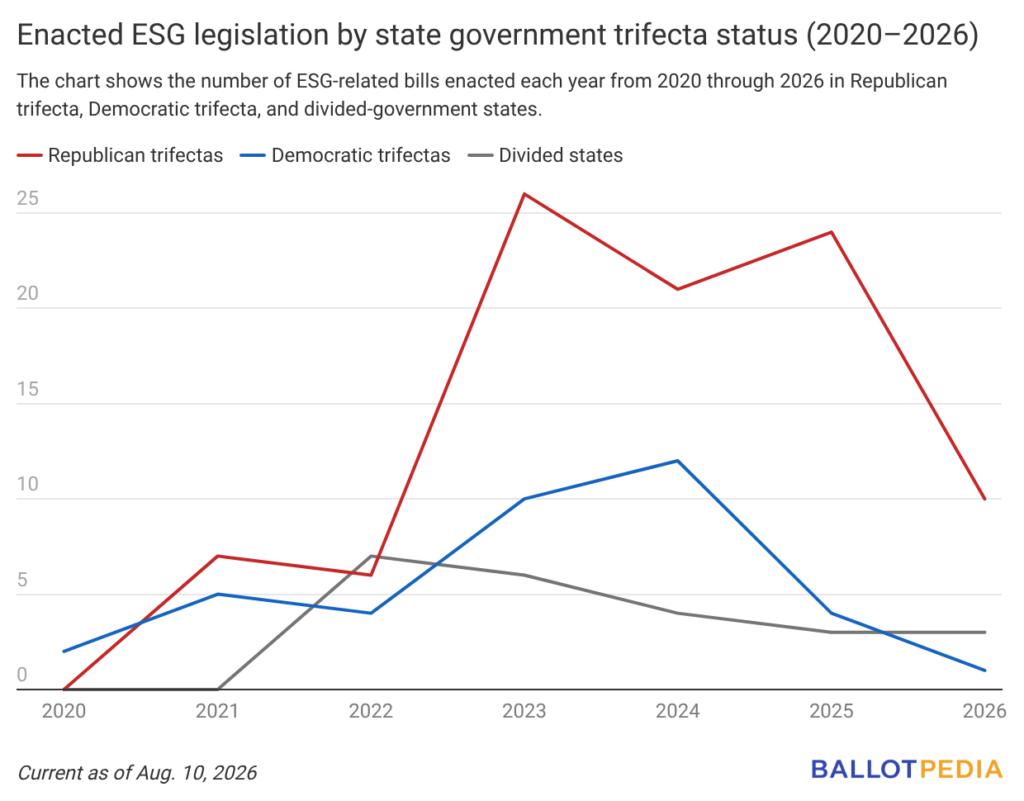
Of the 155 enacted bills, 118 (76%) opposed the use of ESG-related practices, while 37 (24%) supported ESG policies. The types of enacted legislation differed largely along party lines.
Every ESG-related law enacted by states with Republican trifectas opposed ESG practices. The most common policy approaches were:
- Anti-discrimination and anti-ESG-scoring approaches (37 bills): Restricted ESG-based discrimination and the use of social credit scoring by banks and financial institutions.
- Sole fiduciary standards (31 bills): Required public investment decisions to focus only on financial factors.
- Anti-boycott approaches (23 bills): Prohibited certain state investments in or contracts with companies that boycott specified industries.
South Dakota was the only Republican trifecta state that did not enact an ESG law during that period.
Democratic trifecta states enacted 38 ESG-related laws. Thirty-three supported ESG policies, while five opposed them. The most common policy approaches were:
- ESG state contract and licensing requirements (12 bills): Required ESG-related criteria in certain state contracts or licensing decisions.
- Nonfinancial criteria consideration (8 bills): Allowed public fund managers to consider ESG data and other nonfinancial factors in investment decisions.
- Corporate disclosure requirements (6 bills): Required companies to disclose certain ESG-related information, such as emissions or climate-related risks.
States with divided governments enacted 23 ESG laws. Nineteen opposed ESG practices, while four supported them. Sole fiduciary standards were the most common approach, followed by public disclosure requirements and restrictions on ESG-based discrimination.
Why does it matter?
The data since 2020 show a strong relationship between partisan control of state government and the types of ESG policies states enacted.
Because the parties have pursued different approaches, changes in trifecta control can affect the direction of a state's ESG policy, including whether lawmakers seek to restrict or expand ESG practices.
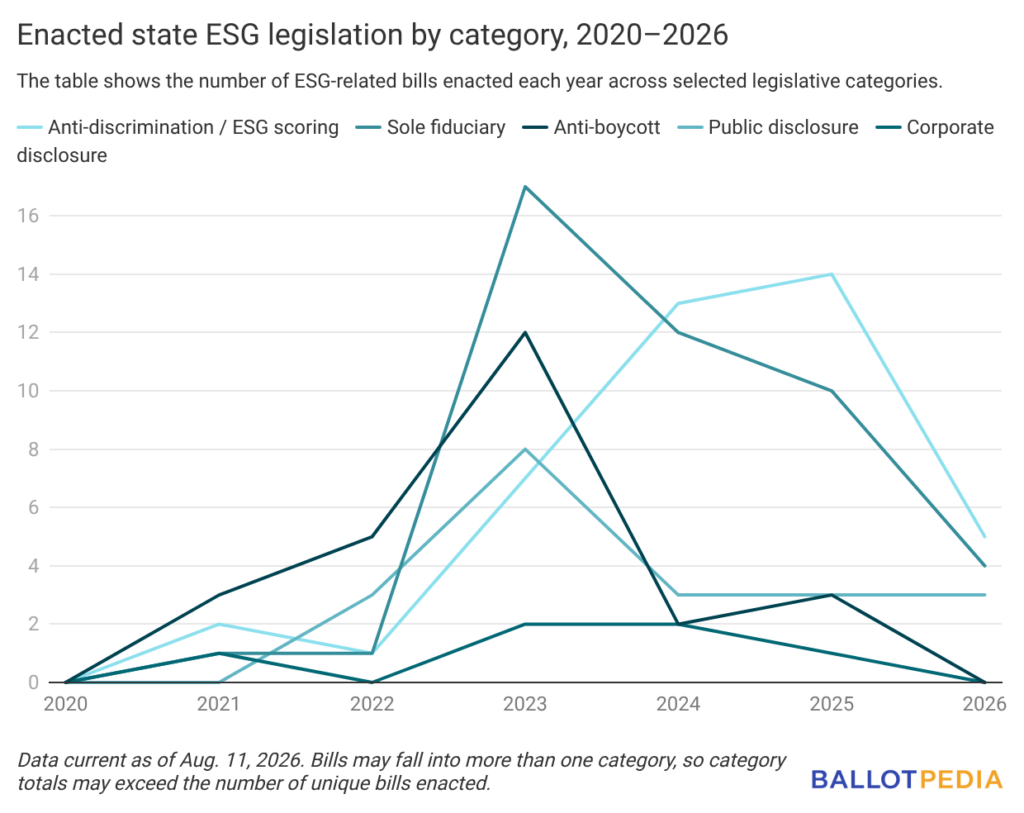
The data also show how the focus of state ESG legislation has changed over time. Anti-boycott and sole fiduciary legislation peaked in 2023, with 12 and 17 enacted bills, respectively. Anti-discrimination and ESG-scoring legislation increased in the following years, from seven enacted bills in 2023 to 13 in 2024 and 14 in 2025, before falling to five in 2026.