


Welcome to the Wednesday, Aug. 12, 2026, Brew.
By: Lara Bonatesta
Here’s what’s in store for you as you start your day:
- Voters in Washington, D.C., and Denver, Colorado, will decide on foie gras ban ballot initiatives in November
- Recognized Endorsement Contributors-endorsed candidates won 88% of primary races across five states in Aug. 4 elections
- Federal judicial vacancies are at the lowest since 2011
Voters in Washington, D.C., and Denver, Colorado, will decide on foie gras ban ballot initiatives in November
On Nov. 3, voters in Washington, D.C., and Denver, Colorado, will decide on ballot initiatives on the force-feeding of birds and the sale of foie gras.
Foie gras means “fatty liver” in French. The USDA defines goose- and duck-liver foie gras as liver “obtained exclusively from specially fed and fattened geese and ducks.”
Pro-Animal D.C. and Pro-Animal Colorado, the campaigns supporting the two initiatives, are regional chapters of the same national organization, Pro-Animal Future.
Currently, California is the only state that bans force-feeding birds and selling products resulting from force-feeding. Cities with foie gras bans include New York City, Pittsburgh, Brookline, Massachusetts, and Portland, Oregon. None of these prohibitions came through ballot measures.
On Aug. 5, the D.C. Board of Elections verified signatures for Initiative 86, which would prohibit the force-feeding of birds to enlarge their livers and ban the commercial sale, distribution, and importation of foie gras and other fattened bird liver products in Washington, D.C.
On Dec. 23, 2025, the Denver Elections Division determined a similar initiative had enough valid signatures to appear on the ballot. It would prohibit the force-feeding of birds to enlarge their livers and ban the commercial sale, distribution, importation, transportation, and receipt of products derived from force-fed birds, including foie gras, in Denver.
Between 2016 and 2024, D.C. voters decided on a total of five local ballot measures. Voters approved all five. In that same period, Denver County voters decided on 82 measures. Voters approved 69, and defeated 13.
Pro-Animal Colorado sponsored two ballot initiatives in 2024, both of which were defeated. Denver Initiated Ordinance 308, which would have prohibited the sale of certain animal fur products, was defeated 57.6% to 42.4%. Denver Initiated Ordinance 309, which would have prohibited the construction, maintenance, or use of slaughterhouses within Denver, was defeated 63.75% to 36.75%.
Voters in Colorado will also decide on a statewide ballot measure related to animals this year. That measure would make the 25th state with a state constitutional right to hunt and fish. Between 1996 and 2025, 25 measures on the right to hunt and fish appeared on the ballot in 24 states. Of those, only one was defeated. In 2010, Arizona voters rejected Proposition 109 56.5% to 43.5%.
Sponsors of an initiative to ban hunting and fishing in Oregon did not submit enough valid signatures to qualify for the November ballot. While previous animal treatment measures have addressed certain hunting methods, wildlife trafficking, farm animal confinement, animal fighting, animal racing, and animal experimentation, none have sought to criminalize all hunting, fishing, slaughtering animals for food, and livestock husbandry.
Click here and here to learn more about the initiatives in D.C. and Denver. Plus, click here to see our full coverage of local animal treatment ballot measures dating back to 2016.
Recognized Endorsement Contributors-endorsed candidates won 88% of primary races across five states in Aug. 4 elections
Endorsements are one of the ways voters learn who candidates are and what they stand for. They can be particularly useful for voters in two types of elections: in partisan primaries, when voters may find it difficult to discern differences between candidates with the same party affiliation, and in nonpartisan local elections, when party labels don't appear on the ballot and little other information is available about each candidate. A number of both types of elections took place on Aug. 4.
Ballotpedia gathers endorsements from organizations we call Recognized Endorsement Contributors (RECs): groups including from political action committees, local associations, unions, media editorial boards, and more that publicly support candidates and communicate those choices to voters. In the Aug. 4 statewide elections, we tracked 2,842 endorsements from 566 RECs across five states: Kansas, Michigan, Missouri, Virginia, and Washington. These included 917 endorsements of candidates in local races.
Partisan primaries
In partisan primaries, endorsements can help voters discern meaningful differences between candidates who otherwise share the same party affiliation: differences in policies, approaches to electability, commitment to principles, and more.
One such example from Aug. 4 was the Democratic primary for District 8 in the Michigan House of Representatives. Different RECs supported the two candidates who received the most votes in this primary:
- Chris Gilmer-Hill, who won the primary with 48.8% of the vote, was endorsed by Metro Detroit chapter of the Democratic Socialists of America and Run For Something.
- State Rep. Helena Scott, who finished second with 43.0% of the vote, was endorsed by the Michigan AFL-CIO, United Auto Workers, and the Detroit Free Press Editorial Board.
We identified 10 RECs that issued more than 50 endorsements each in these primary elections. The table below displays the organizations and their endorsee success rates. Candidates that these organizations endorsed won 85% of their races, lost 11%, and the remaining races were uncalled.
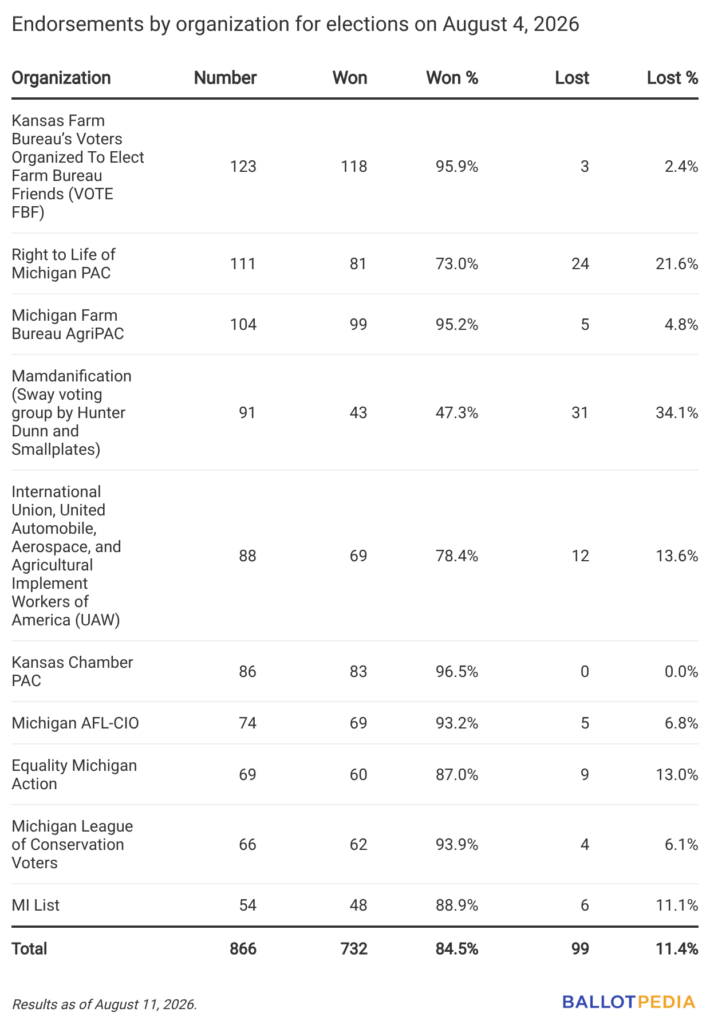
Among these organizations, three endorsed candidates from multiple political parties in these partisan primaries:
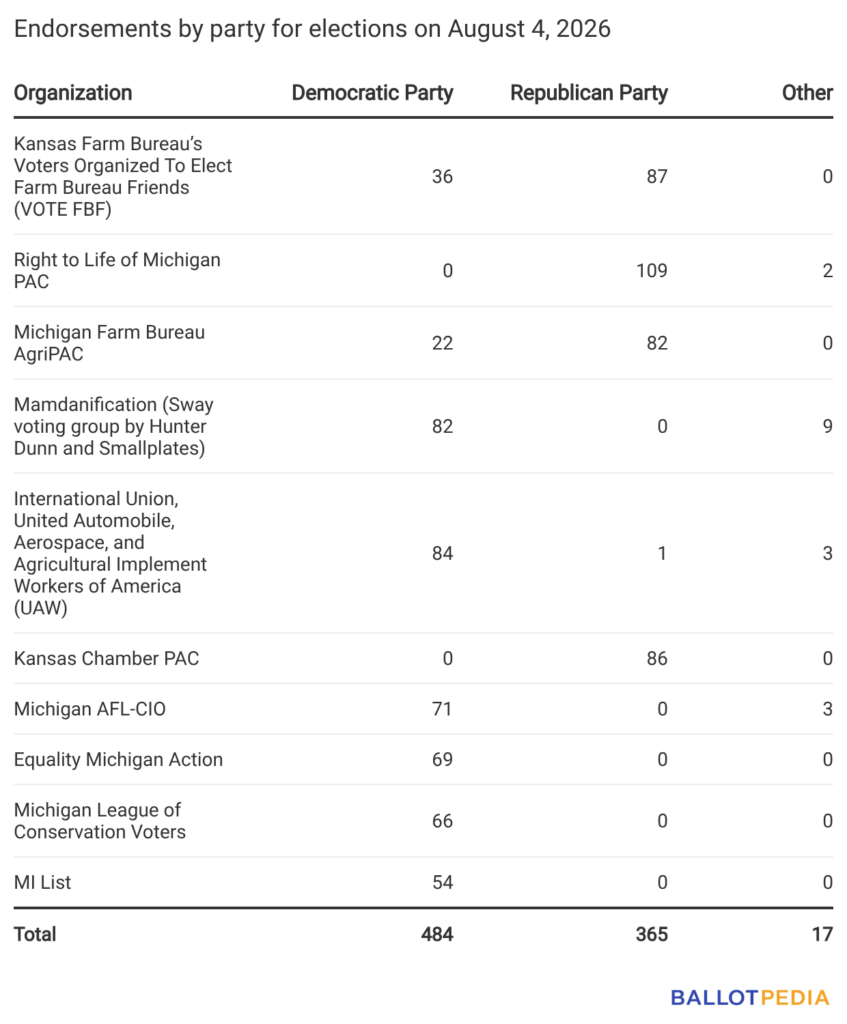
Kansas Farm Bureau’s Voters Organized To Elect Farm Bureau Friends (VOTE FBF): Endorsed 36 Democratic candidates and 87 Republican candidates.
Michigan Farm Bureau AgriPAC: Endorsed 22 Democratic candidates and 82 Republican candidates.
United Auto Workers: Endorsed 84 Democratic candidates and one Republican candidate.
The remaining organizations endorsed candidates from one major political party in these partisan primaries. The table below displays the candidate affiliations of all 10 RECs endorsees.
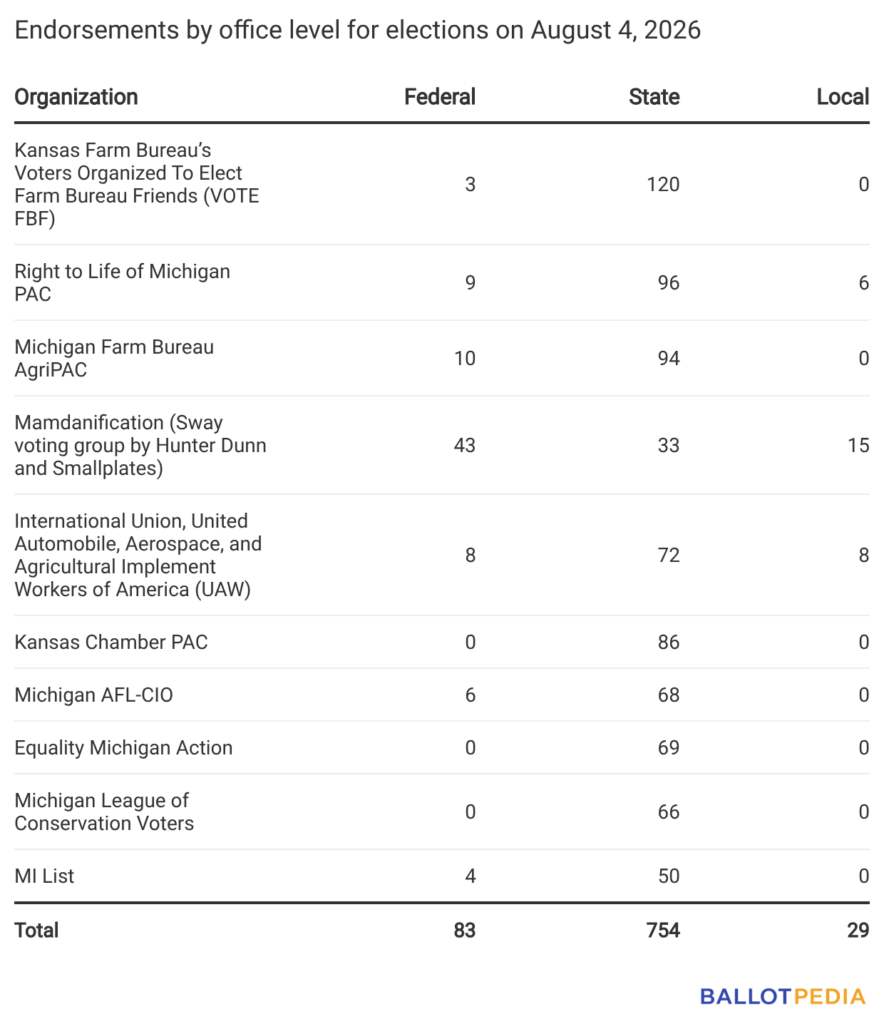
Endorsements by these 10 RECs were mostly in state primaries (754), followed by federal primaries (83). Three of the 10 RECs — the United Auto Workers, Right to Life of Michigan PAC, and the Mamdanification Sway voting group — issued endorsements in local-level races. The table below displays the endorsements the RECs issued by level of government.
Local primaries
Endorsements can also be particularly helpful in local primaries, which are often officially nonpartisan. In these instances, endorsements can help voters understand where a candidate may fall along more traditional party lines.
A helpful case study from the Aug. 4 primaries was in Jackson, Michigan, a town of about 31,000 people as of the 2020 census. Although the race was officially nonpartisan, two candidates received endorsements from people and groups who typically align with one of the major political parties:
- Derek Dobies, who finished first and advanced from the primary, received endorsements from a pair of sitting Democratic state representatives and the local AFL-CIO.
- Christy Davis, who finished fourth in the primary, received an endorsement from Right to Life of Michigan, a group that most commonly endorses Republican-aligned candidates.
Similarly, two of the four candidates in the top-two primary for Clark County Council District 1 in Washington received competing endorsements. Clark County is Washington’s southernmost county and was its fifth-most populous (about 503,000 people) as of the 2020 census:
- Bryan Shull, who finished second and advanced from the primary, received an endorsement from the Clark County Republican Party.
- Dusti Arab, who finished third in the primary, received endorsements from the Alliance for Gun Responsibility Victory Fund and Washington Conservation Action, which most commonly endorse Democratic-aligned candidates.
Endorsements also played a role in nonpartisan judicial primaries on Aug. 4. Two candidates received endorsements in the Oakland County Probate Court primary in Michigan. Oakland County contains the northern Detroit suburbs and had a population of 1.3 million as of the 2020 census:
- Elisabeth Dery, who won the primary, received endorsements from a pair of sitting Democratic legislators and the Unity Fund Detroit Tri-County LGBTQ+ PAC.
- Jessica Ann Hallmark, who finished second in the primary, received endorsements from a local Bricklayers & Allied Craftworkers union.
Endorsements are statements or actions that an individual or group provides in support of a candidate, but they are also much more than that. Endorsements reveal alliances, ideological leanings, and potential policy priorities in ways that campaign platforms and quotes from a candidate sometimes can’t. Endorsements also play a practical role in campaigns. Many endorsers — especially for statewide and national candidates — can provide candidates with volunteer support, access to possible campaign donors, and give candidates a degree of credibility and notoriety.
Ballotpedia is tracking endorsements made by organizations in races at all levels of government, with a particular focus on groups that endorse candidates at the local level. Endorsements are one component of Ballotpedia's goal to provide robust information — data that helps voters understand who a candidate is and what their political philosophy is — for every office on the ballot. Click here to learn more about Recognized Endorsement Contributors.
Federal judicial vacancies are at the lowest since 2011
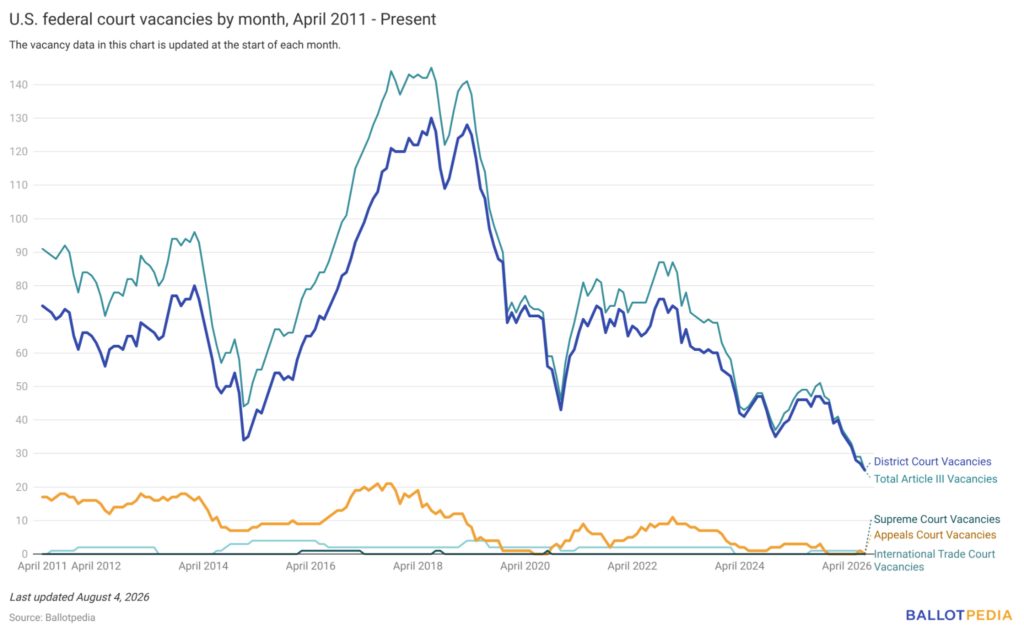
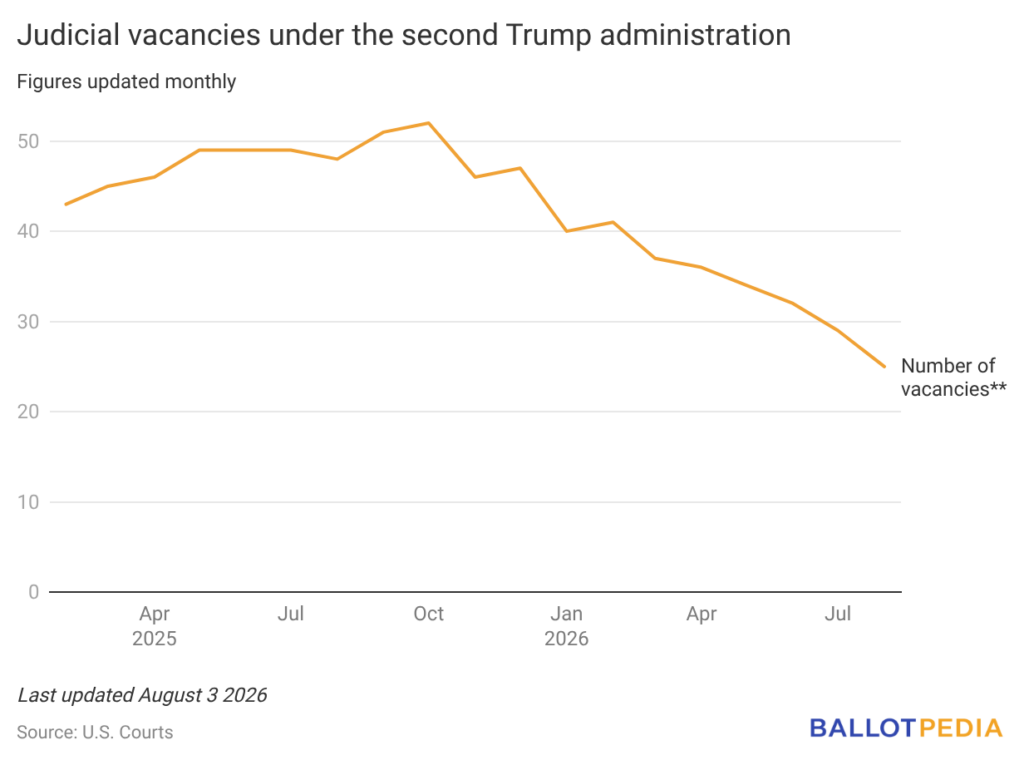
The number of federal judicial vacancies fell to 25 as of Aug. 1 — the fewest among the 870 Article III judgeships in the country since 2011 — after the U.S. Senate confirmed eight judges in July.
Two of the federal judges confirmed in July were the first to receive supportive blue slips from Democratic senators during President Donald Trump's (R) first term. A blue slip is a piece of paper that a home state senator returns to the chair of the Senate Judiciary Committee to show their approval of a federal judicial nominee. The U.S. Constitution does not mandate the use of blue slips, they are considered a senatorial courtesy. Depending on the Senate Judiciary Committee chair’s policy, withholding a blue slip may prevent a nominee from receiving a hearing.
U.S. Sen. John Fetterman (D-Pa.) was the first Democratic senator to return a blue slip supporting one of Trump’s nominees – Antonio Pozos, to the U.S. District Court for the Eastern District of Pennsylvania. U.S. Sens. Elissa Slotkin (D-Mich.) and Gary Peters (D-Mich.) returned supporting blue slips on June 8 for Michael Martin’s nomination to the U.S. District Court for the Eastern District of Michigan. The Senate confirmed Martin and Pozos on July 22 and July 23, respectively.
The other six judges confirmed between July 2 and Aug. 1 were:
- Daniel Traynor, to the U.S. Court of Appeals for the Eighth Circuit
- Benjamin Flowers, to the U.S. Court of Appeals for the Sixth Circuit
- Kara Westercamp, to the U.S. Court of International Trade
- Jeffrey T. Kuntz, to the U.S. District Court for the Southern District of Florida
- Matthew Schwartz, to the U.S. Court of Appeals for the Second Circuit
- Rob Jones, to the U.S. District Court for the Southern District of Texas
As of Aug. 1, the Senate has confirmed 53 of Trump's judicial nominees — 42 district court judges, 10 appeals court judges, and one Court of International Trade judge — since January 2025.
There have been two new judicial vacancies since July 2
Two judges left active status between July 2 and Aug. 1:
- Judge Daniel Traynor, who was a judge for the U.S. District Court for the District of North Dakota, and became a member of the U.S. Court of Appeals for the Eighth Circuit.
- Judge Gregory F. Van Tatenhove, who retired from the U.S. District Court for the Eastern District of Kentucky.
All 25 of the current vacancies are for U.S. District Court positions. This is the fewest vacancies among Article III judicial positions since 2011.
Article III judges are appointed for life terms. As Article III judicial positions, these vacancies must be filled through presidential nomination. Nominations are subject to Senate confirmation.
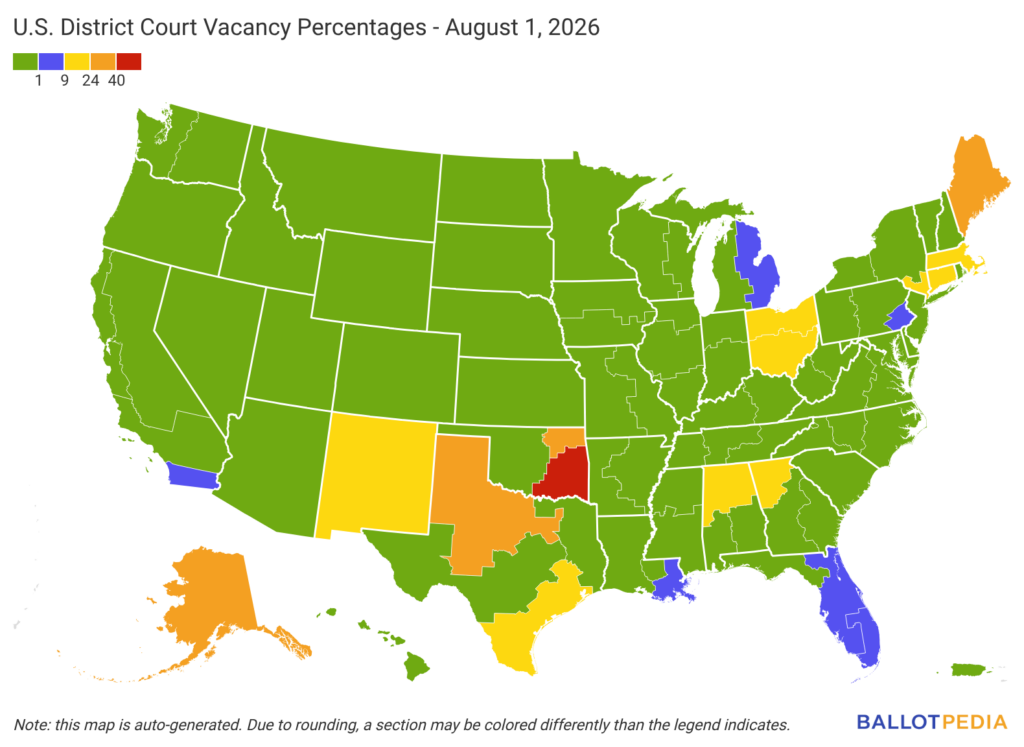
The following map shows the number of vacancies in the U.S. District Courts as of Aug. 1.
The following chart shows the number of federal judicial vacancies each month during the Trump administration from Jan. 21, 2025 to Aug. 1, 2026.
Trump did not nominate anyone to Article III judicial positions between July 2 and Aug. 1. Since taking office in January 2025, Trump has nominated 60 individuals to Article III positions.
Click here to read more about federal judicial vacancies.
Editor’s note: This article was updated to correct the description of endorsements received by Jessica Ann Hallmark. The Women Lawyers Association of Michigan did not endorse Hallmark.