


Welcome to the Friday, Aug. 14, 2026, Brew.
By: Lara Bonatesta
Here’s what’s in store for you as you start your day:
- Proposed initiative in Massachusetts second in the country that would prohibit or limit data center development
- Miami voters to decide election timing, Marine Stadium ballot measures on Aug. 18
- Nine statewide candidate filing deadlines are in the next two weeks
Proposed Massachusetts initiative would be the nation’s second statewide ballot measure on data center policy
A recent Massachusetts ballot initiative filing for the November 2028 ballot would make the state the second, after Ohio, where voters could decide on data center policy. Voters have decided on four local data center measures this year. In all four, they sided with greater restrictions on data center development.
The Massachusetts initiative, which will now be reviewed by the Massachusetts Attorney General's office, would prohibit local permitting agencies from issuing a data center permit until certain conditions are met and two-thirds of the local electorate approve the data center. The conditions include:
- establishing a utility cost-shielding contract with its electric company
- acquiring a water-supply certification that guarantees the data center's water demand fits within existing system capacity
- developing a drought contingency plan
In Massachusetts, initiated state statutes are only put on the ballot in even years. The Massachusetts Attorney General’s office will next review the initiative to determine if it meets the state’s constitutional and procedural requirements by Sept. 2. If approved, sponsors would then need to collect 74,574 valid signatures to put the initiative on the ballot.
In 2024, the Massachusetts General Court created a sales and use tax exemption for qualifying data centers. The exemption applies to the purchase of equipment used to construct, furnish (including with computer equipment and software), and maintain the data center. To qualify for the exemption, a data center must cost at least $50 million to construct or refurbish, maintain at least 100 Massachusetts jobs, and cover at least 100,000 square feet of space over one or more buildings.
On June 25, 2026, Gov. Maura Healey (D) announced a pause on data center sales tax exemption applications. She said, "I am halting any tax incentives for data centers until we have strong protections in place for our residents and communities against higher gas and electric bills."
The Massachusetts initiative is the second statewide initiative to address data centers. In March, Conserve Ohio filed an initiative that would prohibit the construction of data centers used for digital data processing with an aggregate power demand exceeding 25 megawatts. On June 17, Conserve Ohio announced it would aim to put the measure on the ballot in 2027 instead of 2026.
Voters have already decided four local data center ballot measures this year, voting in favor of greater restrictions on data centers in all four cases. Four more measures remain to be decided. These measures would either (1) allow data center development or advise government officials to support their development, or (2) limit or prohibit data center development or add requirements before certain projects can move forward.
Not including the eight local measures mentioned above, Ballotpedia is following 17 proposed local measures concerning data centers in 10 states. The state with the most proposed measures is Ohio, with seven.
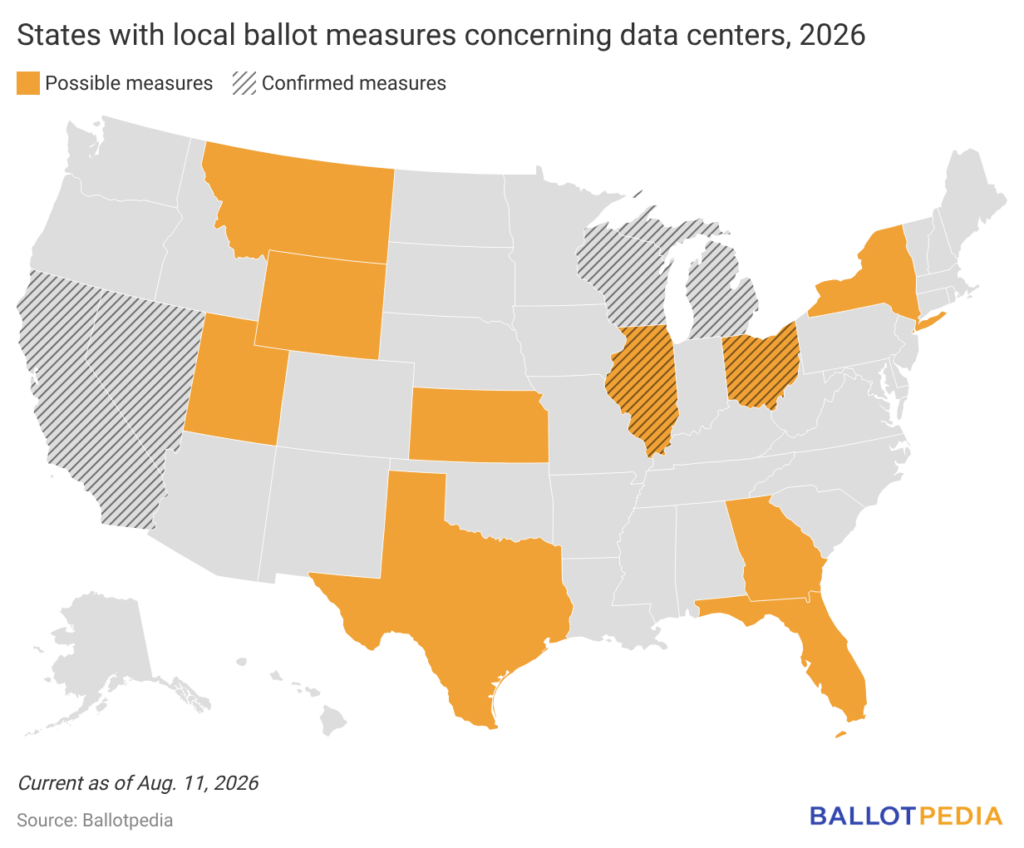
Data centers are a growing political issue nationwide. In addition to the ballot measures we mentioned above, through the first half of the year, Ballotpedia identified 33 recall efforts targeting 58 officials over data center projects across seven states. To learn more about those, check out our Mid-Year Recall report.
Click here to learn more about the proposed initiative in Massachusetts and here to learn more about data center-related ballot measures in 2026.
Miami voters to decide election timing, Marine Stadium ballot measures on Aug. 18
Miami voters will decide two local ballot measures on Aug. 18. Referendum 1 would move city elections from odd-numbered years to even-numbered years. Referendum 2 would authorize the city to enter an agreement with Global Spectrum to renovate and manage the Miami Marine Stadium.
Referendum 1
Referendum 1 would change general and runoff elections from odd-numbered years to even-numbered years starting in 2034 and 2036.
In 2025, the Miami City Commission passed an ordinance to move city elections from odd years to even years, which would have postponed the November 2025 election until November 2026.
A trial court ruled that the ordinance was unconstitutional, saying the city cannot change municipal elections or terms of office without voter approval. Florida’s Third District Court of Appeal upheld that decision, allowing the November 2025 election to proceed as scheduled. After the City Commission was unable to place a proposed election-year change on the November 2025 ballot, the measure was placed on the August 2026 ballot.
Odd-year elections are also known as off-cycle elections, while on-cycle elections are held at the same time as federal elections in November in even years. Generally, voter turnout is higher for on-cycle elections than off-cycle elections. Registered voter turnout in Miami’s 2025 November mayoral election was 21.68%. In the 2024 general election, Miami-Dade County reported a voter turnout of 72.41% (in the 133 precincts with Miami referendum questions on the ballot, turnout was 69.11%).
According to the Miami Herald, the majority of Miami-Dade cities hold elections in even years.
Referendum 1 would also reduce the terms of office for those elected in 2031 and 2033 to three years. The elections for mayor and city commissioner would be held as scheduled in 2027 for Districts 1, 2, and 4 and in 2029 for mayor and Districts 3 and 5. The winners of those elections will serve four-year terms. In 2031, the elections for Districts 1, 2, and 4 would occur and in 2033, the elections for mayor and Districts 3 and 5. The winners of those races would serve three-year terms. The switch to even-year elections would occur in 2034 for Districts 1, 2, and 4 and 2036 for mayor and Districts 3 and 5.
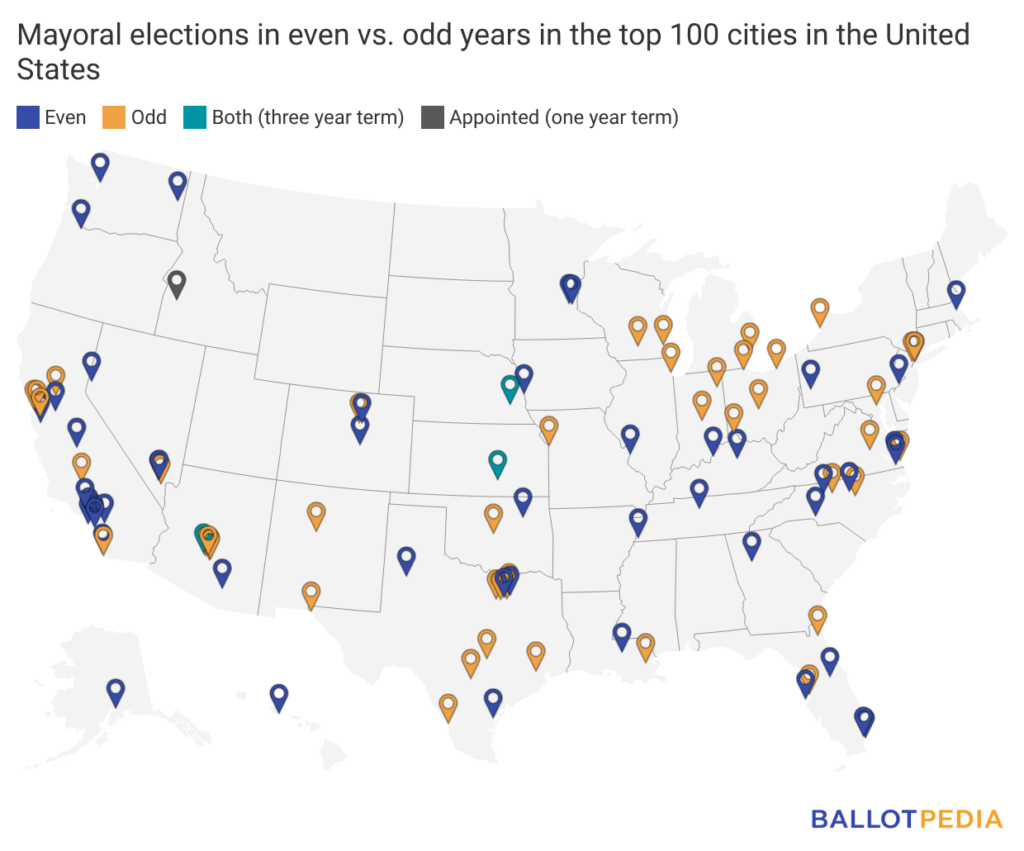
The election date change would make Miami the 44th of the 100 most populous U.S. cities to hold even-year elections. Miami is currently one of 36 of the 100 largest cities that hold odd-year elections. Twenty-one cities hold elections in both even and odd years. For example, Indianapolis, Indiana, holds general elections for mayor and city council in odd years, but holds elections for coroner, surveyor, treasurer, and superior court judges in even years.
The change would make Miami the 50th of the top 100 cities to hold mayoral elections in even years. Miami is currently one of 47 top 100 cities that hold odd-year mayoral elections. Three cities among the 100 most populous have three-year mayoral terms. In those cities, mayoral elections alternate between even and odd years. In one city – Santa Clarita, California – members of the city council appoint the mayor, who serves a one-year term.
Referendum 2
Referendum 2 would authorize the city to enter a 40-year agreement with Global Spectrum to renovate and manage events at the Miami Marine Stadium.
The Miami Marine Stadium, an outdoor music and event venue sitting on Biscayne Bay, was built in 1963. It closed in 1992 after it was damaged during Hurricane Andrew and declared unsafe.
According to the proposal, the city would receive 93% of gross event sales, after deducting a $33,333 monthly management fee, and 85% of sponsorship revenue over the 40-year term. Global Spectrum — part of Oak View Group, a venue management company — would also contribute up to $10 million toward restoring the stadium.
Because the Marine Stadium is a city-owned waterfront property, the charter requires voter approval for leases and private management contracts lasting more than five years.
Click here to learn more about this year’s local ballot measures in Florida.
Nine statewide candidate filing deadlines are in the next two weeks
Nine states have statewide candidate filing deadlines in the next two weeks. The map and bulleted list below show which states have candidate filing deadlines scheduled between Aug. 15 and Aug. 28.
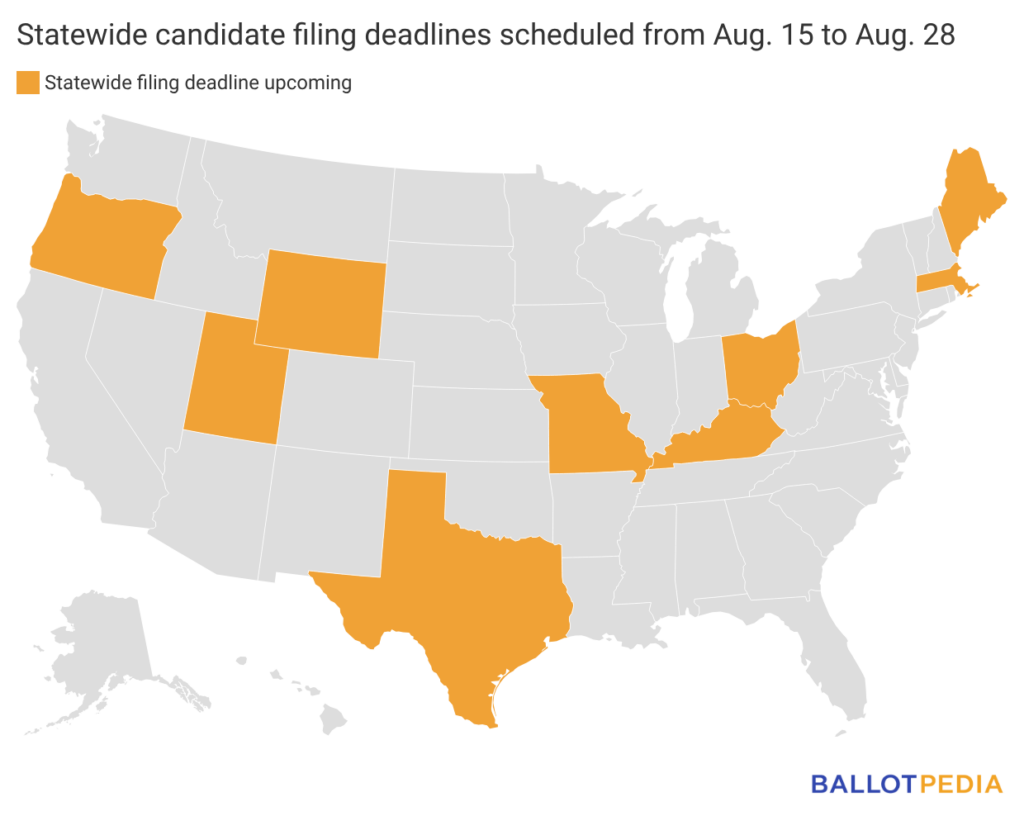
- Kentucky: Aug. 24 (statewide general write-in candidate filing deadline)
- Maine: Aug. 25 (statewide general write-in candidate filing deadline)
- Massachusetts: Aug. 25 (statewide unaffiliated candidate filing deadline for U.S. Senate, U.S. House, governor, lieutenant governor, attorney general, secretary of state, treasurer, and auditor)
- Missouri: Aug. 25 (statewide judicial retention candidate filing deadline)
- Ohio: Aug. 24 (statewide general write-in candidate filing deadline)
- Oregon: Aug. 18 (statewide unaffiliated and minor party incumbent candidate filing deadline) and Aug. 25 (statewide unaffiliated and minor party new candidate filing deadline)
- Texas: Aug. 17 (statewide write-in candidate filing deadline)
- Utah: Aug. 28 (statewide write-in candidate filing deadline)
- Wyoming: Aug. 24 (statewide unaffiliated candidate filing deadline)
Eighteen states, the District of Columbia, Guam, and the Northern Mariana Islands had candidate filing deadlines in the past two weeks.
Voting dates and deadlines in the next two weeks
There are four statewide elections:
- Alaska: Aug. 18 statewide primary election
- Florida: Aug. 18 statewide primary election
- Oklahoma: Aug. 25 statewide primary runoff election
- Wyoming: Aug. 18 statewide primary election
Early voting periods will start in three states:
- Massachusetts: Early voting begins Aug. 22 for the Sept. 1 primary.
- Oklahoma: Early voting begins Aug. 20 for the Aug. 25 primary runoff.
- Rhode Island: Early voting begins Aug. 20 for the Sept. 9 primary.
Three states have voter registration deadlines:
- Delaware: Aug. 22 is the last day to register to vote in the Sept. 15 primary.
- Massachusetts: Aug. 22 is the last day to register to vote in the Sept. 1 primary.
- Wyoming: Aug. 18 is the last day to register to vote in person in the Aug. 18 primary.
Three states have absentee/mail-in ballot request deadlines:
- Massachusetts: Aug. 25 is the last day to request an absentee/mail-in ballot for the Sept. 1 primary.
- Rhode Island: Aug. 19 is the last day to request an absentee/mail-in ballot for the Sept. 9 primary.
- Wyoming: Aug. 17 is the last day to request an absentee/mail-in ballot in person or online for the Aug. 18 primary.
Click here to see our list of upcoming election dates and filing deadlines.