


Welcome to the Monday, Aug. 17, 2026, Brew.
By: Briana Ryan
Here’s what’s in store for you as you start your day:
- Republican and Democratic trifectas both enacted more bills increasing agency power than decreasing it in 2026
- Two Democratic primaries for the Massachusetts Senate feature incumbents running against challengers endorsed by Boston Mayor Michelle Wu
- Voters to decide elections in five states on Aug. 18
Republican and Democratic trifectas both enacted more bills increasing agency power than decreasing it in 2026
States passed more bills in 2026 that increase agency power than decrease it, making this the first year since Ballotpedia began tracking legislation related to the administrative state in 2024 where that’s the case. Both Republican and Democratic trifecta states enacted more bills that increase administrative agency power than decrease it. A total of 38 states passed laws across a range of administrative topics such as agency structure, permitting processes, sunrise and sunset reviews, judicial deference, and more, according to Ballotpedia's Administrative State 2026 Legislation Report.
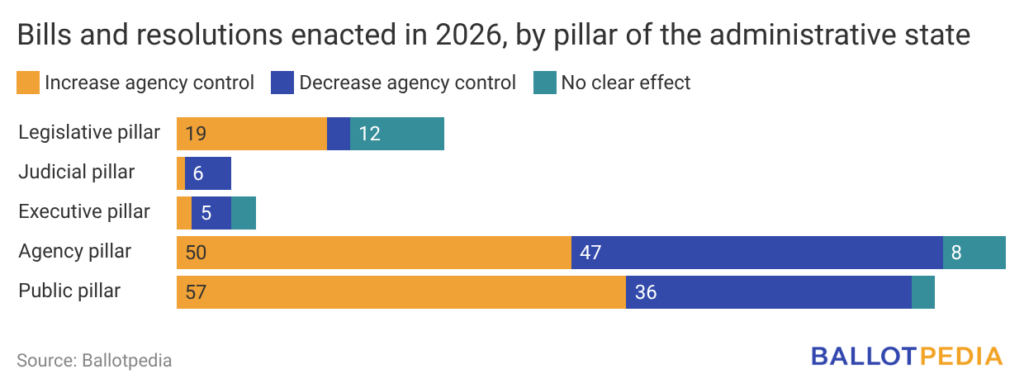
The report contains an analysis of administrative state-related legislation and draws on findings from Ballotpedia's Administrative State Legislation Tracker. It categorizes administrative state legislation into five categories and classifies them by whether they increase, decrease, or have no clear net effect on agency power. The pillars are:
- Legislative – the interplay between agencies and lawmakers and the related reform proposals and legal doctrines
- Judicial – the interplay between agencies and the courts, including the level of judicial deference given to agency rules
- Executive – the interplay between agencies and the executive branch
- The public – how agencies relate to the people and organizations subject to their rules, including procedural rights, enforcement, and adjudication
- Agencies – the dynamics among agencies and sub-agencies.
The report identifies trends and takeaways on legislation introduced across the five categories and covers U.S. administrative state-related activity from this year. Let's take a look at some highlights from the report.
Lawmakers in 45 states considered 1,722 bills and resolutions that would decrease or increase agency authority and influence or otherwise affect the administrative state. Thirty-eight states enacted 225 of those bills or resolutions, or 13% of proposed bills. The total number of new administrative state laws is less than in 2025, but more than 2024.
- Thirty-two states enacted 94 laws that decrease agency control.
- Twenty-nine states enacted 101 laws that increased agency control.
- Twenty-six bills and resolutions did not clearly increase or decrease agency control.
- Four bills and resolutions increased agency control in some ways and decreased it in others.
Many bills that increase or decrease agency power do so for a specific topic, agency, industry, or program. Others — such as those addressing REINS, judicial deference, rulemaking processes, and oversight — apply to all or most agencies in the state.
Partisan breakdown of new laws increasing and decreasing agency power
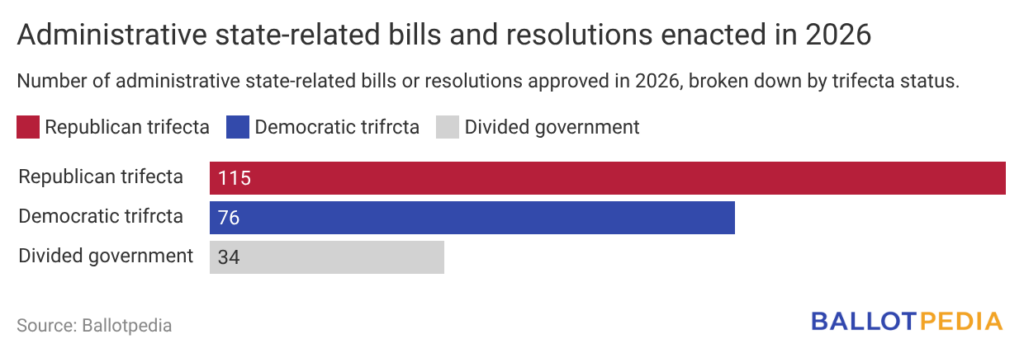
- States with Republican trifectas enacted 48 bills (in 13 states) that increase agency power, and 46 bills (17 states) that decrease agency power.
- States with Democratic trifectas enacted 39 bills (nine states) that increase, and 31 (nine states) that decrease agency power.
- Divided governments adopted 14 bills (seven states) that increase, and 17 bills (six states) that decrease agency power.
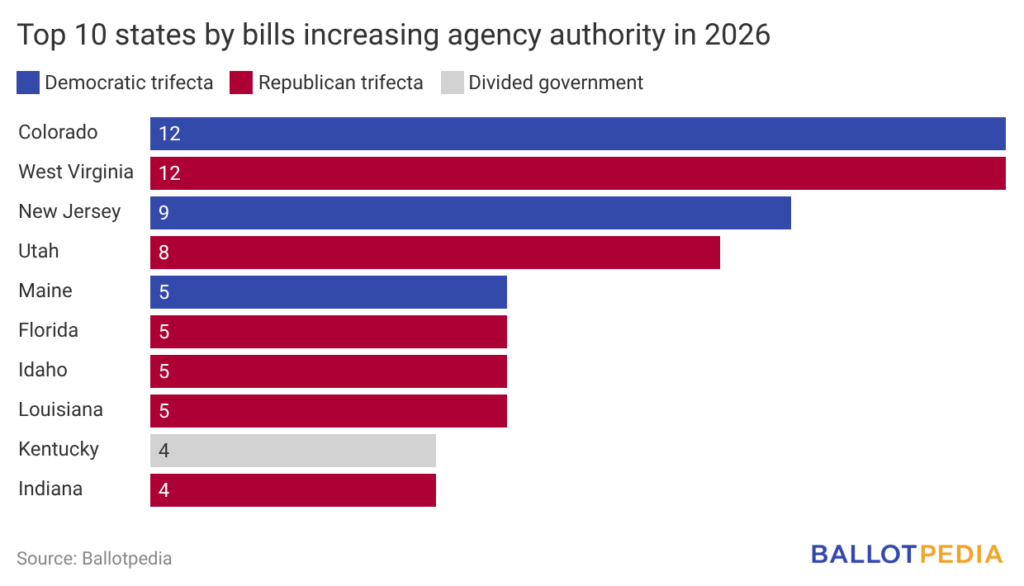
The 10 states that enacted the most bills increasing agency power are shown on the chart below, shaded by their trifecta status.
The chart below shows how many of the bills and resolutions approved in each of the five pillars increased agency power, decreased agency power, or had no clear net effect one way or the other.
Vetoes
Governors vetoed 13 bills that the state legislature did not override. Most of these (7) came from states with divided governments. Four were in states with Democratic trifectas, and two from a Republican trifecta. Nine of the vetoed bills would have decreased agency control, three would have increased it, and one would have decreased it in some ways and increased it in others.
Click here to read our full report.
Two Democratic primaries for the Massachusetts Senate feature incumbents running against challengers endorsed by Boston Mayor Michelle Wu
On Sept. 1, there will be six Democratic primaries for the Massachusetts Senate. Two of those primaries are for open seats, and four include incumbents facing challengers.
Since 2010, 34 incumbent members of the state Senate — 32 Democrats and two Republicans — have faced primary challengers. During that period, only one incumbent — a Democrat in 2020 — has lost in a primary.
Two of those four incumbents — Nick Collins (D) and William Brownsberger (D) — are facing challengers that Boston Mayor Michelle Wu (D) endorsed.
According to the Boston Globe’s Niki Griswold, “Both Collins and Brownsberger have publicly clashed with Wu over her push to temporarily shift more of the city’s property tax burden onto commercial real estate in order to soften a spike in homeowners’ property tax bills.”
Collins, Latoya Gayle (D), and Juwan Skeens (D) are running in the primary for the 1st Suffolk District. Collins has served in the chamber since 2018. Gayle is a senior director at the nonprofit Neighborhood Villages. Skeens is the founder and executive director of the nonprofit By Believe Inspire Repeat Tree House.
Several current and former state legislators and municipal officeholders endorsed Collins. Meanwhile, Wu endorsed Gayle.
Brownsberger, who has served in the chamber since 2012, and Daniel Lander (D), who chairs the Ward 21 Democratic Committee, are running in the primary for the Suffolk and Middlesex District.
Governor Maura Healey (D), Lt. Gov. Kim Driscoll (D), and Attorney General Andrea Joy Campbell (D) endorsed Brownsberger. Meanwhile, Wu and U.S. Sen. Elizabeth Warren (D) endorsed Lander.
MassLive's John L. Micek wrote, "Whether Bay State voters choose insurgent candidates or stick with well-known name brands reflects a broader tension within the Democratic Party, where loyalists are wrestling with similar questions about generational change."
There are 40 seats up for election in the state Senate this year. Currently, Democrats have a 35-5 majority in the chamber.
Click here to read more about the Democratic primaries for the chamber.
Voters to decide elections in five states on Aug. 18
Voters in Alaska, California, Florida, Pennsylvania, and Wyoming are headed to the polls tomorrow, Aug. 18. Here's a look at the four battleground primaries that we're watching closely.
Alaska
Seventeen candidates — 12 Republicans, two Democrats, and three independents — are running in the open top-four primary for governor. Under Alaska's primary system, all candidates for a given office run in a single primary election. The top four vote-getters, regardless of partisan affiliation, then advance to a ranked-choice voting (RCV) general election.
According to the Anchorage Daily News, this primary system leads to an environment in which the candidates "are competing not just against candidates from their own party, but against the entire field. That creates unusual incentives: Candidates have reason to distinguish themselves, but also to avoid alienating voters who might otherwise support them as a second choice in November."
Tom Begich (D), Click Bishop (R), David Bronson (R), Jonathan Kreiss-Tomkins (D), Bill Walker (Nonpartisan), and Bernadette Wilson (R) lead in polling and media attention.
Florida
Twelve candidates are running in the open Republican primary for governor. Jay Collins, Byron Donalds, James Fishback, and Paul Renner lead in media attention. Ahead of the primary, the Florida Republican Party announced it would not hold a debate, saying Donalds was the only candidate to meet its polling and fundraising qualifications. In response, the other candidates and Incumbent Gov. Ron DeSantis (R) criticized the state party and Donalds.
In the Republican primary for the 7th Congressional District, a U.S. House Ethics Committee investigation into the incumbent has become an issue in the election. Rep. Cory Mills and Ryan Elijah lead in media attention. The Committee has been investigating allegations of misconduct against Mills since 2025. Mills has denied any wrongdoing and said he complied with the investigation. Elijah said the investigation could make Mills vulnerable in the general election, while Mills has pointed to President Donald Trump's (R) endorsement as evidence that he was still favored.
Ten candidates are running in the open Republican primary for the 19th Congressional District — the most of any primary for the U.S. House of Representatives in Florida this year. Madison Cawthorn, Chris Collins, Ola Hawatmeh, Catalina Lauf, Jim Oberweis, Jim Schwartzel, and John Strand lead in fundraising, endorsements, and local media attention. Most of these leading candidates are no strangers to congressional races. Cawthorn and Collins previously represented districts in other states. Hawatmeh, Lauf, and Oberweis have all run unsuccessfully for districts in other states. Schwartzel and Strand have not run for the U.S. House before.
Incumbent Rep. Debbie Wasserman Schultz, Luther Campbell, Sheila Cherfilus-McCormick, Dale Holness, and Elijah Manley are running in the Democratic primary for the 20th Congressional District, which is taking place following redistricting. Wasserman Schultz is running for re-election there after redistricting shifted the district she currently represents — the 25th Congressional District — towards Republicans. Cherfilus-McCormick formerly represented the 20th Congressional District from 2023 until she resigned in April 2026 after the U.S. House Ethics Committee determined she had violated the chamber's campaign finance rules. She has denied the allegations.
Click here to check out more about the elections we're following tomorrow, Aug. 18. And, if you're heading to the polls, make sure to check out our Sample Ballot Lookup Tool to see what's on your ballot