


Welcome to the Wednesday, Aug. 19, 2026, Brew.
By: Briana Ryan
Here’s what’s in store for you as you start your day:
- 25 states have an August deadline for removing a candidate's name from the ballot
- Recognized Endorsement Contributors-endorsed candidates won 94% of Aug. 11 elections across five states
- Candidates running in the Sept. 1 Democratic primary for Massachusetts' 6th Congressional District use their resumes to appeal to voters
25 states have an August deadline for removing a candidate's name from the ballot
2026 tied a 108-year record for the number of major or minor party U.S. Senate nominees withdrawing from an election and having their name removed from the ballot. Most states' deadlines to withdraw and have a candidate's name removed from the ballot are in August or September.
Twenty-five states have candidate withdrawal deadlines for this year's general election in August, and seven states have deadlines in September.
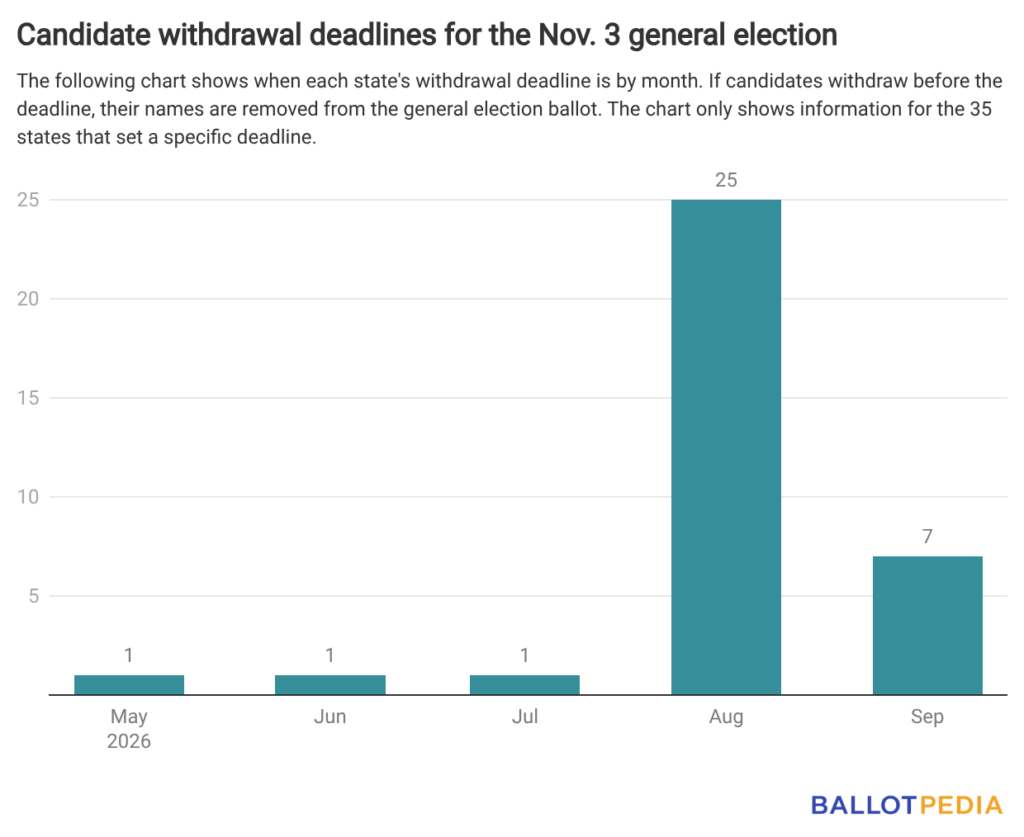
Whether candidates can withdraw from a general election and have their name removed from the ballot varies by state.
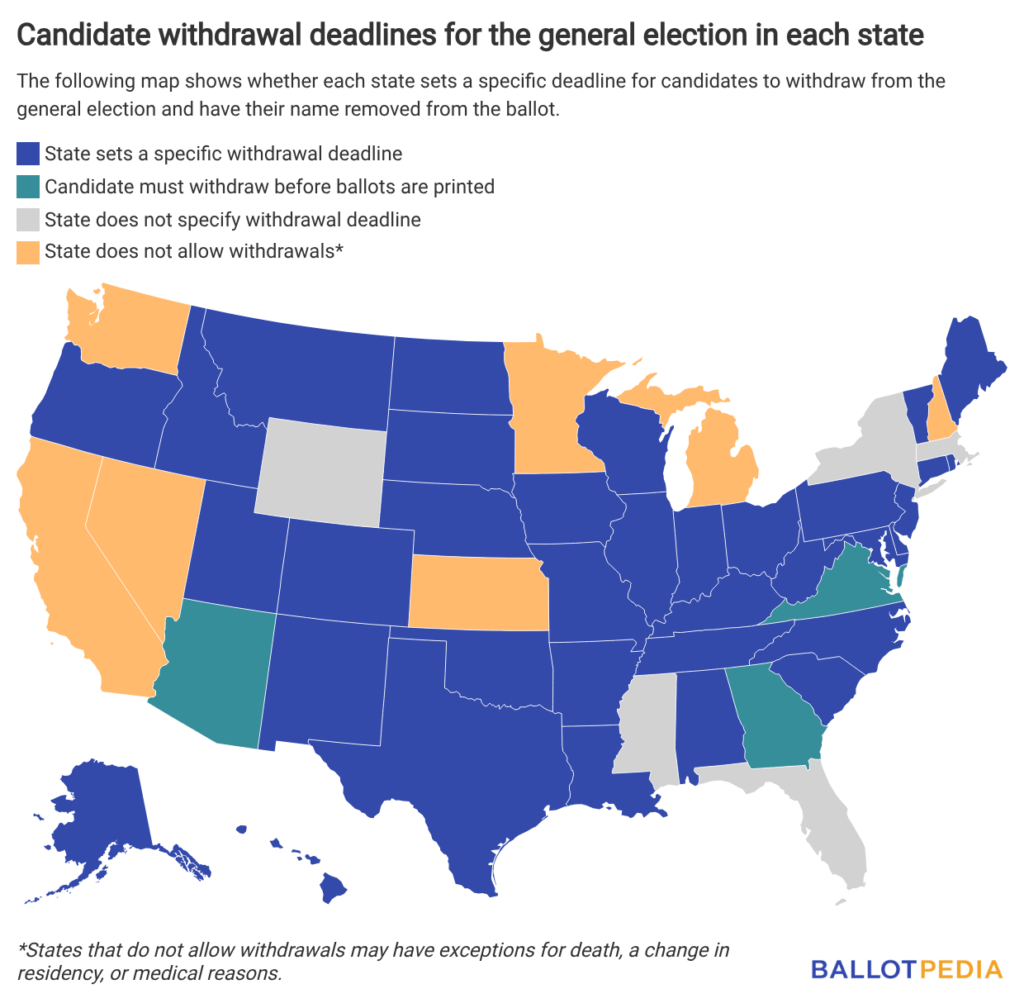
Thirty-five states have a specific deadline by which a candidate can withdraw and have their name removed from the ballot.
Three states — Arizona, Georgia, and Virginia — allow candidates to request removal from the ballot until ballots are printed.
Five states — Florida, Massachusetts, Mississippi, New York, and Wyoming — do not set specific withdrawal deadlines.
Seven states — California, Kansas, Michigan, Minnesota, Nevada, New Hampshire, and Washington — do not remove candidates from the general election ballot. However, exceptions such as death, a change in residency, or medical reasons may apply, depending on the state.
Five major or minor party nominees have withdrawn from U.S. Senate general elections this year — tying with 2014 for the most since 1918. Here’s a look at the nominees who withdrew:
- In South Dakota, Julian Beaudion (D) withdrew from the U.S. Senate general election on Aug. 4, the same day as the state's withdrawal deadline.
- In Idaho, David Roth (D) withdrew from the U.S. Senate general election on July 28, ahead of the state's Sept. 4 withdrawal deadline.
- In Nebraska, Cindy Burbank (D) withdrew from the U.S. Senate general election on July 17, ahead of that state's Aug. 3 withdrawal deadline.
- In South Carolina, then-incumbent Sen. Lindsey Graham (R), who was the Republican nominee for this year’s U.S. Senate general election, died on July 11, ahead of the state’s Sept. 4 withdrawal deadline.
- In Maine, Graham Platner (D) withdrew from the U.S. Senate general election on July 10, ahead of the state's Aug. 25 withdrawal deadline.
Additionally, Rep. Chuck Edwards (R-N.C.) withdrew from the general election for North Carolina's 11th Congressional District on Aug. 5, ahead of the state's Sept. 4 withdrawal deadline.
Click here to check out all the general election candidate withdrawal deadlines.
Recognized Endorsement Contributors-endorsed candidates won 94% of Aug. 11 elections across five states
Last week in the Daily Brew, we looked at how candidates endorsed by Recognized Endorsement Contributors (RECs) — the political action committees (PACs), local associations, unions, editorial boards, and other groups whose endorsements Ballotpedia tracks — fared in the Aug. 4 primaries. Today we’re looking at REC-endorsed candidates in the Aug. 11 primaries. We identified 1,924 endorsements from 276 RECs across Alabama, Connecticut, Vermont, and Wisconsin, including 158 endorsements of local candidates.
Endorsements can be most helpful to voters in two kinds of races: partisan primaries, where every candidate shares the same party label, and nonpartisan local elections, where no party label appears at all. Both were on the ballot on Aug. 11.
Local primaries
Endorsements can be particularly helpful in local primaries, which are often officially nonpartisan. In these instances, endorsements can help voters understand where a candidate may fall along more traditional party lines.
A helpful case study from the Aug. 11 primaries was in Rochester, Minnesota, a city of 121,000 people as of the 2020 census. Three RECs endorsed competing candidates in that primary:
- Jess Garcia, who finished second and advanced from the primary, received an endorsement from the Minnesota Association of Professional Employees.
- Benjamin Zastrow, who finished fourth in the primary, received an endorsement from Forward Independence, the state affiliate of the Forward Party.
- Axe Abdimajid Ahmed, who finished sixth in the primary, received an endorsement from Mamdanification, a Sway voting group.
Partisan primaries
In partisan primaries, endorsements can help voters discern meaningful differences between candidates who otherwise share the same party affiliation: differences in policies, approaches to electability, commitment to principles, and more.
One such example from Aug. 11 was the Republican primary for Wisconsin's 7th Congressional District. Different RECs supported two of the three candidates who received the most votes in this primary:
- Michael Alfonso, who won the primary, received endorsements from Turning Point Action, President Donald Trump (R), and Dick Uihlein.
- Jessi Ebben, who finished third in the primary, received endorsements from the Club for Growth and Liz Uihlein.
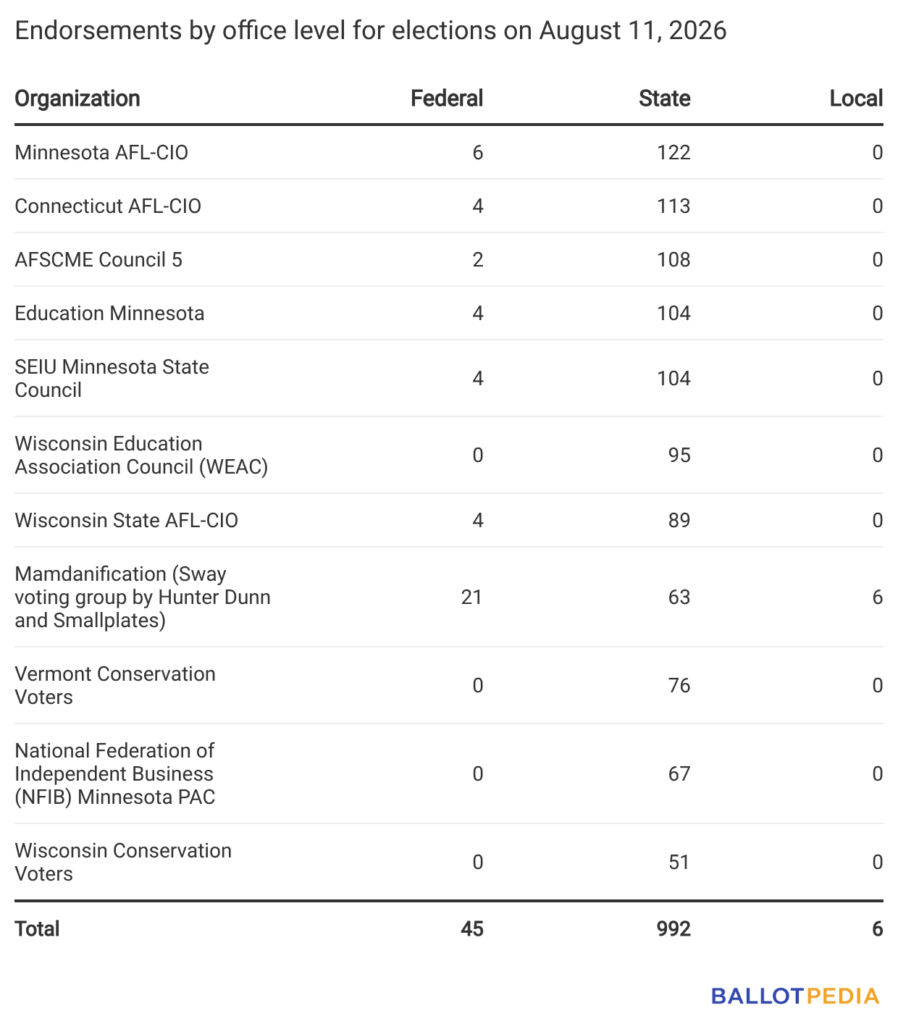
We identified 11 RECs that issued more than 50 endorsements each in these primary elections. The table below displays the organizations and their endorsee success rates. Candidates that these organizations endorsed won 94% of their races, lost 2%, and the remaining races were uncalled.
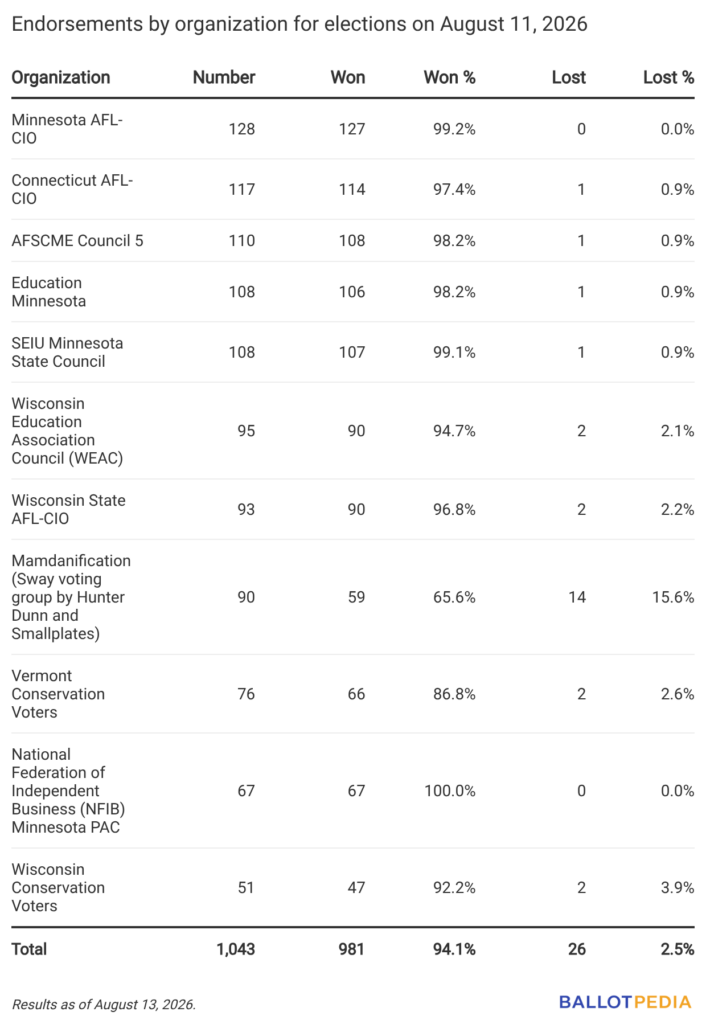
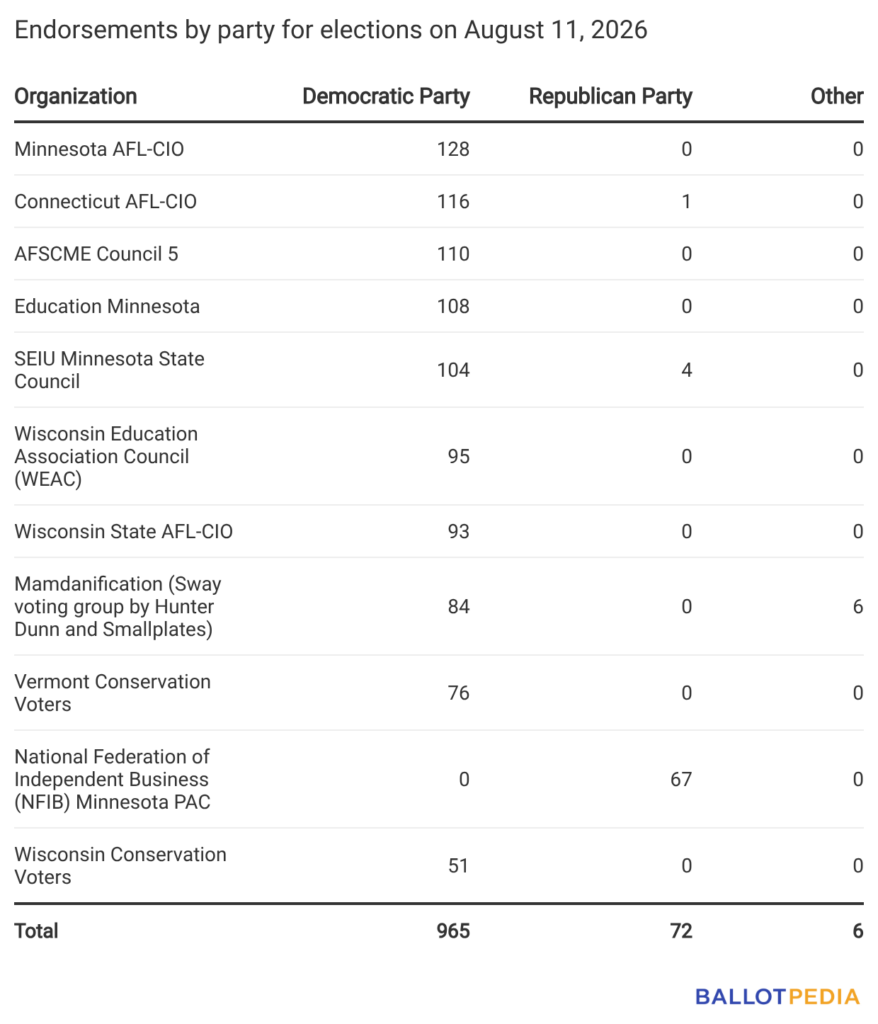
Among these organizations, two endorsed candidates from multiple political parties in these partisan primaries. The Connecticut AFL-CIO endorsed 116 Democratic candidates and one Republican candidate. The SEIU Minnesota State Council endorsed 104 Democratic candidates and four Republican candidates.
The remaining organizations endorsed candidates from one major political party in these partisan primaries. The table below displays the partisan affiliation of all RECs' endorsees.
Endorsements by these 11 RECs were mostly in state primaries (992), followed by federal primaries (45). One of the 11 RECs — the Mamdanification Sway voting group — endorsed in local-level races. The table below displays the endorsements the RECs issued by level of government.
Ballotpedia is tracking endorsements made by organizations in races at all levels of government, with a particular focus on groups that endorse candidates at the local level. Endorsements are one component of Ballotpedia's goal to provide robust information — data that helps voters understand who a candidate is and what their political philosophy is — for every office on the ballot.
Click here for more information about Recognized Endorsement Contributors (RECs).
Candidates running in the Sept. 1 Democratic primary for Massachusetts' 6th Congressional District use their resumes to appeal to voters
Part of the campaign messages of the six candidates running in the Sept. 1 Democratic primary for Massachusetts' 6th Congressional District are how their professional experiences have prepared them to serve in the U.S. House of Representatives. This is one of 64 open U.S. House races this year.
According to The Boston Globe's Anjali Huynh, "The race to replace Representative Seth Moulton in the North Shore-anchored district has mirrored a debate coursing through the Democratic Party: Do voters want to cut ties with the party's old guard amid calls for a new generation of leaders? Or is the party — and Washington, D.C. — best fixed by those who bear some political battle scars?"
Dan Koh (D), Mariah Lancaster (D), and Jamie Zahlaway Belsito (D) have experience in Washington, D.C., and say that their understanding of the federal system would benefit the district. Tram Nguyen (D), a state legislator, says she is the only candidate who is currently a legislator. According to Huynh, Beth Andres-Beck (D) and John Beccia (D) say that their non-political backgrounds would provide "fresh, outside perspectives to Capitol Hill."
Here's a closer look at the candidates' professional backgrounds:
- Andres-Beck is a senior staff software engineer.
- Beccia is the co-founder and chair of FS Vector, a financial services strategic consulting firm.
- Koh is the host of The People's Cabinet podcast and a former chief of staff at the U.S. Department of Labor and senior aide in former President Joe Biden's (D) administration.
- Lancaster is a veterinarian who previously served as a foreign affairs officer at the State Department, and science policy advisor and legislative staff in the U.S. House.
- Nguyen is an attorney and represents the 18th Essex District in the Massachusetts House of Representatives.
- Zahlaway Belsito is the founder of the Maternal Mental Health Leadership Alliance.
As of Aug. 18, The Cook Political Report and Inside Elections rated the general election as Solid Democratic. DDHQ/The Hill and Sabato's Crystal Ball rated it as Safe Democratic.
Click here to read more about the Democratic primary for Massachusetts' 6th Congressional District. Also, if you're a Massachusetts voter, check out our Sample Ballot Lookup here to prepare for Election Day.