


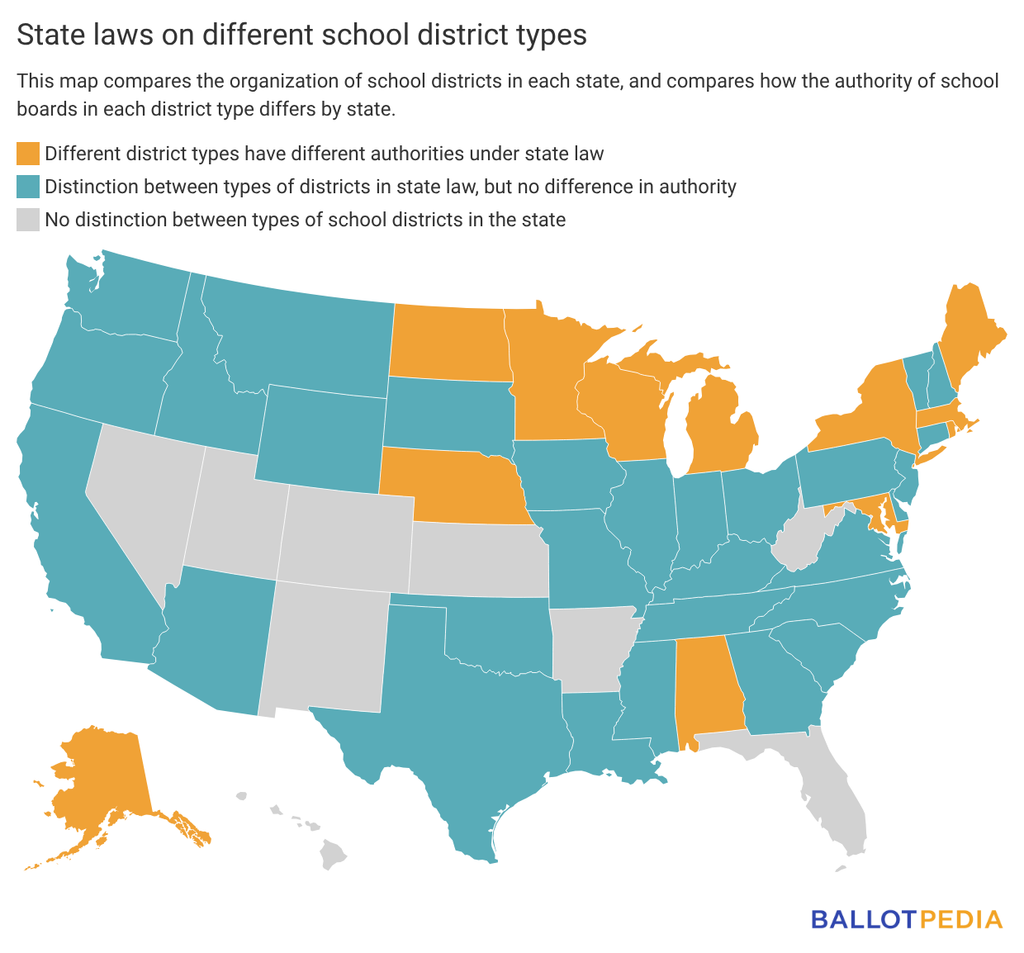
Most states either have only one type of school district or do not distinguish between powers and duties for different types of school boards. However, 12 states have different types of school districts with distinct powers and duties under state law. Boards with different authorities may have unique control over district taxing or financing, and they can have different numbers of elected members.
States differentiate school districts based on government structure (city or county), grades served (e.g., elementary, secondary, or K-12), or the student population size. Differences between powers and duties for boards in these districts generally align with the differences in student populations or district structure.
Examples of how state laws address different district types:
- Alabama: Recognizes two district types (city and county), but enumerates different powers and duties of county and city boards of education. For example, Alabama law requires county boards of education to fix a uniform start date for schools in the county each year, with specific requirements for any schools that must start later. State law does not require this of city school boards.
- Maine: Recognizes four school district types (regional school units, school administrative districts, community school districts, and municipal school units). Maine state law applies a set of powers and duties for all districts, but also maintains four separate sections with additional powers and duties specific to the boards of each of the four district types. State laws specific to each district type authorize different committees for each of their boards.
- Maryland and North Dakota: Specifically establish school districts and boards in their most populous cities — Baltimore and Fargo, respectively — with separate powers and duties from all other school districts in the two states. Maryland state law also includes some powers, duties, and limitations for the Prince George's County Board of Education.
Here's a breakdown of the landscape of district types in the 50 states:
- 29 distinguish between types of school districts in state law, but do not distinguish between the powers and duties of boards in each district type.
- 12 have different types of districts, and give the boards of those districts distinct authorities.
- 9 do not distinguish between types of school districts.
Of the 12 that grant different powers and duties to the school boards governing each district type:
- Nine — Alaska, Maine, Massachusetts, Michigan, Nebraska, New York, Rhode Island, North Dakota, and Wisconsin — have one statute enumerating the powers and duties of all school boards in the state, then have separate statutes granting additional authorities for one or more district types.
- Three — Alabama, Minnesota, and Maryland — enumerate the powers and duties of each type of school district separately.
Below is a map comparing how states organize their school districts.
School board authority
Ballotpedia conducted this research as part of its school board authority project. The project seeks to lay out the authority for school boards in each state, as well as constraints on that authority through state or federal law, collective bargaining, or case law.
The project includes restraints on school boards' authority in each state regarding the following topics:
- Curriculum requirements
- Curriculum restrictions
- Book bans, removals, and restrictions
- Parental notification
- Discipline
- School board election timing
- Public school choice and open enrollment
- Charter schools
- Cellphone bans and classroom screen time limits
- Collective bargaining agreements
- Parents' bill of rights