


Welcome to the Wednesday, Aug. 26, 2026, Brew.
By: Lara Bonatesta
Here’s what’s in store for you as you start your day:
- Voters to decide on at least eight statewide measures on the initiative and referendum process in 2026 — the most since 2000
- Vermont’s state legislative supermajority status could be decided on Nov. 3, two years after Democrats lost supermajority in 2024
- Eleven U.S. House incumbents have lost primary elections so far this year — the second-highest since 2014
Voters to decide on at least eight statewide measures on the initiative and referendum process in 2026 — the most since 2000
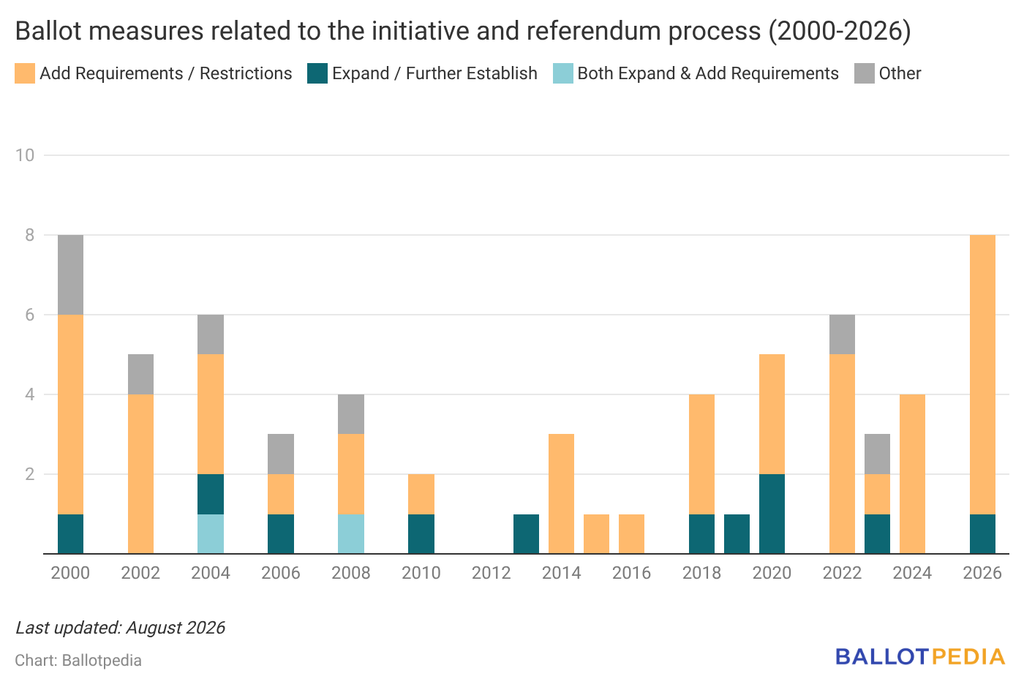
In 2026, voters will decide on at least eight ballot measures related to the initiative and referendum process, which is the most since 2000, when voters also decided on eight. Seven measures would add requirements or restrictions to the process, including two that voters decided earlier this year in North Dakota and Missouri. One measure would expand constitutional provisions related to the initiative and referendum process. Two measures in Missouri and Nebraska that would expand or further establish the process in state constitutions are pending signature verification or judicial review for the 2026 ballot.
The ballot measures are grouped into two categories: those that add requirements or restrictions to the process, and those that expand or further establish the process in state constitutions. Click here to learn more about the types of policies included in these categories.
Measures to add requirements or restrictions to the process
Two measures proposing additional requirements or restrictions were decided earlier this year in North Dakota and Missouri. Voters approved the North Dakota measure 66% to 34%, creating a single-subject requirement for initiated constitutional amendments and a separate-vote requirement for legislatively referred constitutional amendments. The Missouri measure was defeated 80.3% to 19.7%. It would have required voter approval of citizen-initiated constitutional amendments in each congressional district, rather than statewide.
Voters in California, North Dakota, South Dakota, and Utah will all decide on measures that would create supermajority requirements to approve certain types of measures. The California measure would require a two-thirds vote by the electorate to enact, extend, or increase local special tax initiatives, rather than a simple majority. North Dakota and South Dakota will decide amendments that would require a 60% supermajority vote to approve citizen-initiated or legislatively referred constitutional amendments. The measure in Utah would require a 60% supermajority vote to approve citizen initiatives that create new taxes, increase existing tax rates, or impose a property tax.
The Idaho Legislature put an amendment on the ballot governing the subjects initiatives can address. The amendment would prohibit citizens from using the initiative process to alter state law related to marijuana and other psychoactive substances and says that only the Legislature has the authority to legalize marijuana, narcotics, or other psychoactive substances.
Measures to expand or further establish the process in state constitutions
Montana CI-133 would amend the Montana Constitution to add the initiative and referendum power to the state's Declaration of Rights; require government abridgment of the right to meet the judicial standard of strict scrutiny; and provide that the initiative process is "impartial, predictable, transparent, and expeditious."
Background
State legislatures put all seven measures to add requirements or restrictions on the ballot. The measure that expands or preserves the initiative process is a citizen initiative.
Between 2000 and August 2026, voters in 18 of the 26 states that have the initiative and referendum power decided on 59 ballot measures that:
- 39 added requirements or restrictions to the initiative and referendum process (17 were approved and 22 were defeated).
- 10 expanded or preserved the use of the initiative and referendum process (five were approved and five were defeated).
- Two measures that would have both added requirements or restrictions and expanded and preserved the process were defeated.
- Of the eight measures that were neutral in their effect, seven were approved, and one was defeated.
The chart below shows the timeline of when the measures appeared on the ballot and their policy classification.
Click here to learn more about ballot measures related to initiative and referendum in 2026.
Vermont’s state legislative supermajority status could be decided on Nov. 3, two years after Democrats lost supermajority in 2024

Welcome to our next installment of our 50 states in 50 days series, covering Vermont. To view our archive of past editions, click here.
Vermont’s state legislative supermajority status could be decided in the Nov. 3 elections. Democrats have majorities in both chambers of the General Assembly. The governor, who is running for re-election, is a Republican.
There are currently only two states with a veto-proof state legislative majority and an opposing party governor. Vermont lost this status in 2024.
Governor Phil Scott (R) is running for a sixth two-year term this year. Major election forecasters have rated the general election as Solid/Safe Republican.
Want to see what’s on your ballot this November? Click here to use our Sample Ballot Lookup Tool. Now let’s take a closer look at what’s happening in Vermont.
Voters must register in person, via mail, or online by Nov. 3.
Early voting opens Sept. 19 and ends Nov. 2
Polls open on Election Day between 5 a.m. and 10 a.m and close at 7 p.m.
Voter ID is not required in Vermont in most cases. The federal Help America Vote Act requires that individuals in all 50 states who register to vote by mail and who have not voted previously in a federal election in their state must provide either their driver's license or a paycheck, bank statement, current utility bill, or government document showing their name and address. Click here for the Vermont Secretary of State's page on accepted ID.
Absentee/mail-in ballots are mailed automatically to all active voters by Oct. 1. Ballots must be returned by Nov. 3.
Current party control
U.S Rep. Becca Balint (D) represents Vermont’s At-large Congressional District. Vermont has one independent U.S. Senator, Bernie Sanders, who caucuses with Democrats, and one Democratic U.S. Senator, Peter Welch.
Democrats have a 16-13-1 majority in the Vermont Senate and an 87-56-7 majority in the Vermont House of Representatives. Because Gov. Phil Scott is a Republican, Vermont is one of 11 states with a divided government. Vermont’s attorney general and secretary of state are Democrats. As a result, Vermont is one of five states where neither party has triplex control. Republican governors appointed four members of the Vermont Supreme Court, and a Democratic governor appointed one.
Offices on the ballot
Elections are taking place for the U.S. House of Representatives, six state executive offices, and all 180 seats in the Vermont General Assembly.
Notable elections
Governor Phil Scott (R) and Amanda Janoo (D) are running in the general election for governor. In 2024, Scott defeated Esther Charlestin (D) 73.4% to 21.8%, the largest margin in any gubernatorial election that year. Vermont and New Hampshire are the only states whose governors serve two-year terms rather than four-year terms. Vermont does not have a gubernatorial term limit.
As we mentioned above, supermajority status could be at stake in this year’s state legislative elections.
In Vermont, two-thirds of members present in both chambers must vote to override a gubernatorial veto. If all members are in attendance, this is 100 of the 150 members in the Vermont House and 20 of the 30 members in the Vermont Senate.
In the 2024 elections, the Vermont House’s Democratic majority decreased from 105-37 (with five minor-party legislators, two independents, and one vacancy) to 87-55 (with four minor-party legislators, three independents, and one vacancy). The Senate’s Democratic majority decreased from 22-7 with one minor-party member to 16-13 with one minor-party member. As a result, Democrats lost their veto-proof majority in both chambers.
Statewide ballot measures
There are two statewide measures on the ballot this year. From 1985-2024, Vermont voters decided on eight ballot measures. Seven were approved, and one was defeated.
Here's a closer look at the two measures.
Proposal 3 would establish a state constitutional right to organize or join a labor organization for the purpose of collective bargaining. Currently, five states—Florida, Hawaii, Illinois, Missouri, and New York—have a constitutional right to collectively bargain.
Proposal 4 would amend the constitution to prohibit the denial of rights to an individual based on their race, ethnicity, sex, religion, disability, sexual orientation, gender identity, gender expression, or national origin. Currently, 30 state constitutions have provisions that guarantee equal rights based on certain characteristics or for protected classes either in their original text or added later as an amendment.
Local ballot measures
We’ll be adding information about local measures in Vermont as they are certified ahead of the Nov. 3 election.
Join us again tomorrow when we'll preview elections in Illinois, the Prairie State.
Click here to see every edition of 50 States in 50 Days as we publish them, and here to use our Sample Ballot Lookup Tool.
Eleven U.S. House incumbents have lost primary elections so far this year — the second-highest since 2014
So far this year, 11 members of the U.S. House of Representatives have lost in a primary. That’s the second most since 2014.
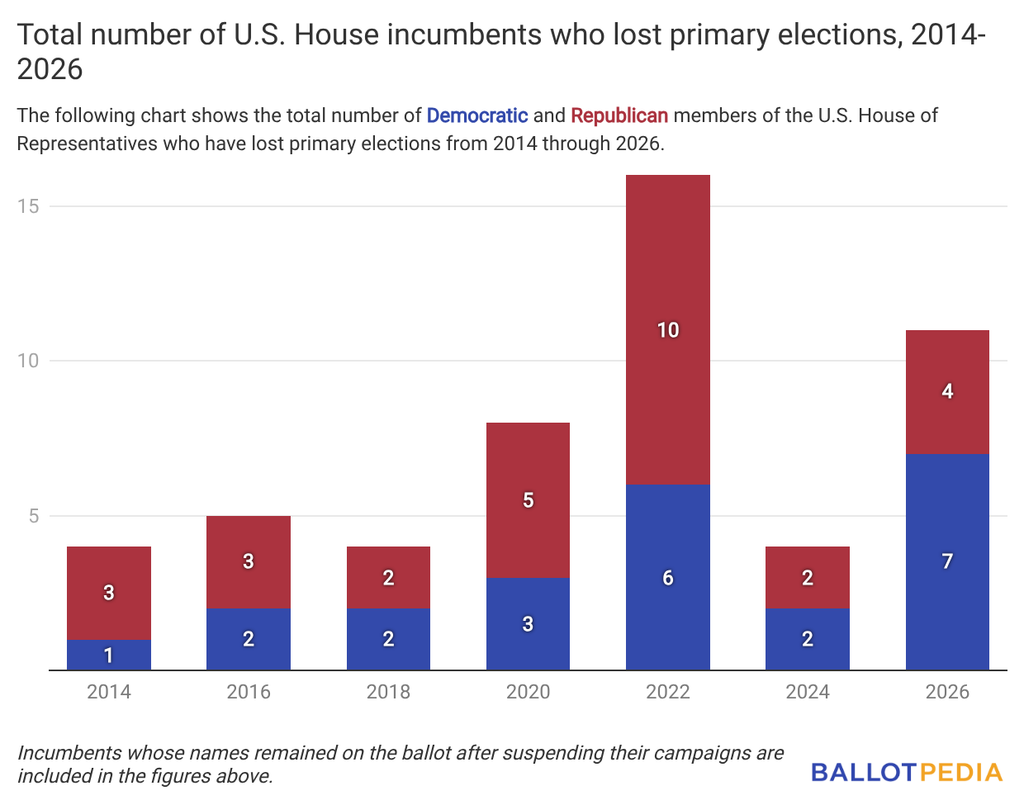
A contributing factor to the number of losses in 2022 was incumbents who ran against other incumbents due to redistricting. Looking only at incumbents who lost to non-incumbents, this year ties 2022 for the most losses since 2014.
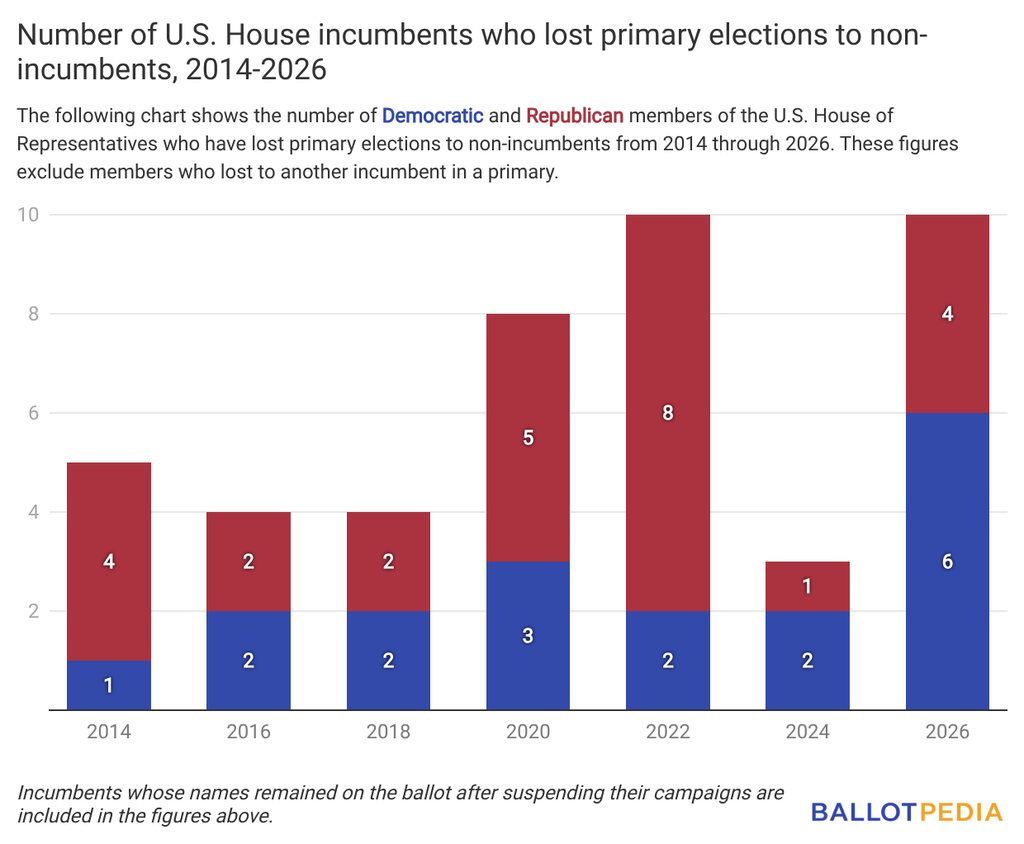
Here’s a closer look at the 11 primaries this year in which an incumbent lost.
Seven Democratic incumbents have lost in primaries
Two Texas incumbents lost re-election in the May 26 Democratic primary runoffs. They advanced to the runoffs after no candidate won at least 50% of the vote in the March 3 primaries. These primaries took place following congressional redistricting in Texas.
- Rep. Christian Menefee (D) defeated Rep. Al Green (D) in the primary runoff for Texas’ 18th Congressional District 69.3% to 30.7%. In the primary, Menefee won 46%, and Green won 44.2% in a field of four candidates.
- Colin Allred (D) defeated Rep. Julie Johnson (D) in the primary runoff for Texas’ 33rd Congressional District 54% to 46%. In the primary, Allred won 44%, and Johnson 33.2% in a field of four candidates.
Three Democratic incumbents lost to challengers whom the national chapter or a local chapter of the Democratic Socialists of America (DSA) endorsed.
- In the June 23 primary for New York’s 13th Congressional District, Darializa Avila Chevalier (D) defeated Rep. Adriano Espaillat (D) 49.4% to 45.9% in a field of four candidates.
- In the June 30 primary for Colorado’s 1st Congressional District, Melat Kiros (D) defeated Rep. Diana DeGette (D) 49.3% to 43.5% in a field of three candidates.
- In the Aug. 4 primary for Michigan’s 13th Congressional District, Donavan McKinney (D) defeated Rep. Shri Thanedar (D) 51.9% to 48.1%.
In the June 23 Democratic primary for New York’s 10th Congressional District, Brad Lander (D) defeated Rep. Daniel Goldman (D) 64.1% to 35.9%. This primary was also one of two in which New York City Mayor Zohran Mamdani (D) endorsed a challenger to a U.S. House incumbent. The other was the Democratic primary for New York’s 13th Congressional District.
In the Aug. 11 Democratic primary for Connecticut’s 1st Congressional District, Luke Bronin (D) defeated Rep. John Larson (D) 53.5% to 34.7% in a field of four candidates. According to the Connecticut Mirror’s Lisa Hagen and Ginny Monk, Bronin campaigned on the need for generational change. Bronin is 47 and Larson is 78.
Four Republican incumbents have lost in primaries
In the March 3 Republican primary for Texas’ 2nd Congressional District, Steve Toth (R) defeated Rep. Daniel Crenshaw (R) 55.8% to 40.7% in a field of four candidates. President Donald Trump (R) did not endorse a candidate in this primary, making Crenshaw the only Republican U.S. House incumbent in Texas whom Trump did not endorse.
In the May 19 Republican primary for Kentucky’s 4th Congressional District, Ed Gallrein (R) defeated Rep. Thomas Massie (R) 54.9% to 45.1%. This was the only U.S. House primary in which Trump endorsed a challenger to a Republican incumbent.
In the Aug. 6 Republican primary for Tennessee’s 5th Congressional District, Charlie Hunter (R) defeated Rep. Andy Ogles (R) 53.3% to 46.7%. According to Politico, redistricting and an endorsement from Tennessee Gov. Bill Lee (R) were contributing factors in Hunter defeating Ogles, whom Trump endorsed. Invest in Tomorrow Coalition PAC, a renewable energy super PAC, spent $2 million opposing Ogles and supporting Hunter.
In the Aug. 18 Republican primary for Florida’s 7th Congressional District, Ryan Elijah (R) defeated Rep. Cory Mills (R) 47.1% to 34.2% in a field of four candidates. This primary took place against the backdrop of a U.S. House Ethics Committee investigation into allegations of misconduct against Mills. Mills has denied any wrongdoing and said he complied with the investigation.
Click here to learn more about this year's U.S. House elections.