



Oklahoma Gov. Kevin Stitt (R) ordered a statewide vote on whether the legislature should call a constitutional convention. The Oklahoma Constitution requires the question to be submitted to voters at least once every 20 years, but it was last submitted in 1970. Stitt issued an executive proclamation on Aug. 25, scheduling the question for a special election on April 6, 2027.
“The Oklahoma Constitution is clear,” Stitt said. “At least every 20 years, Oklahomans have the right to decide whether it’s time to call a constitutional convention.”
Stitt's executive proclamation led to a dispute with the attorney general over who has the authority and responsibility to place the question on the ballot when the Legislature does not act. Oklahoma is one of 14 states that require voters to consider a constitutional convention question at regular intervals. Unlike the other 13 states, however, Oklahoma does not explicitly assign responsibility to a specific official or governmental body in its constitution or through state statute.
How the states differ
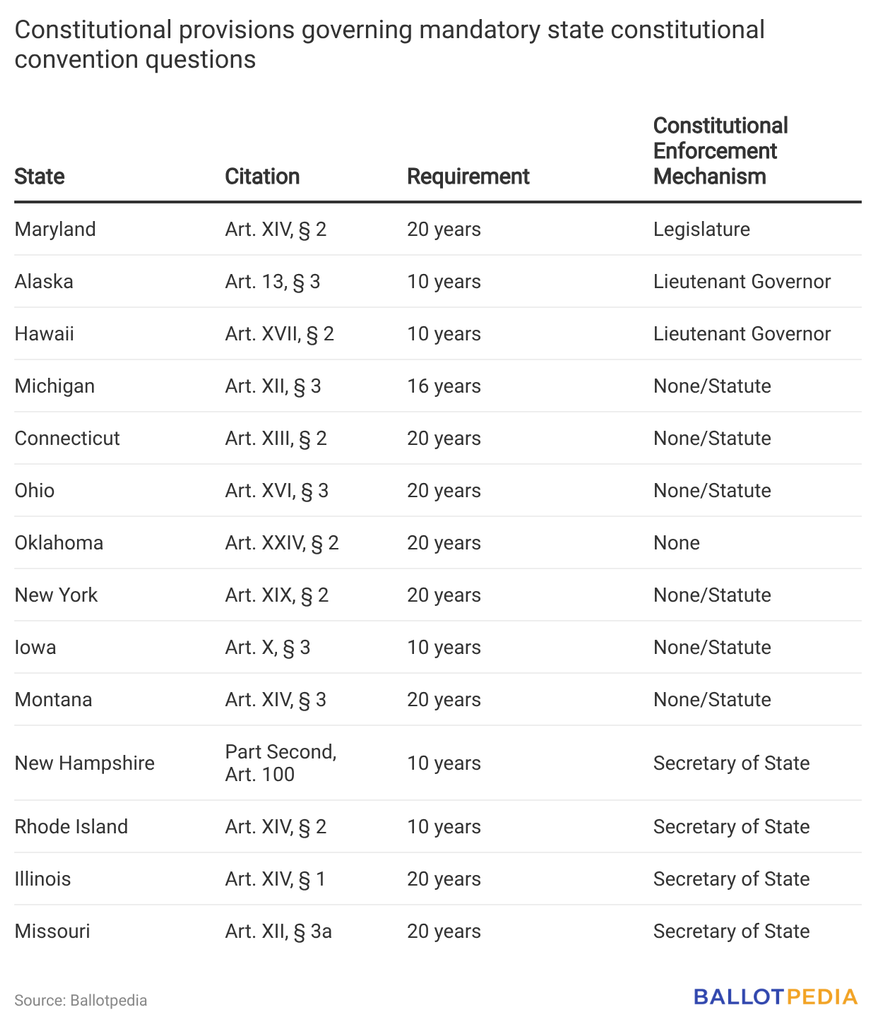
Oklahoma is one of 14 states whose constitutions require a constitutional convention question to be submitted to voters at regular intervals.
- Five states — Alaska, Hawaii, Iowa, New Hampshire, and Rhode Island — require the question every 10 years;
- Michigan requires it every 16 years; and
- Eight states — Connecticut, Illinois, Maryland, Missouri, Montana, New York, Ohio, and Oklahoma — require it every 20 years.
The provisions differ in how they assign responsibility.
The Alaska and Hawaii constitutions direct the lieutenant governor to act. New Hampshire, Rhode Island, Illinois, and Missouri assign the responsibility to the secretary of state. Maryland makes it the duty of the General Assembly to provide by law for the vote.
The constitutional convention provisions in Iowa, Michigan, Montana, Connecticut, New York, and Ohio do not identify a responsible official. However, election statutes or other implementing laws in those states assign ballot-preparation and certification duties to election officials.
The Oklahoma Constitution explains how the Legislature may submit a constitutional convention question to voters but does not identify an official responsible for placing it on the ballot if the Legislature does not act. It states, “Provided, That the question of such proposed convention shall be submitted to the people at least once in every twenty years.”
Gov. Stitt says the requirement is self-executing
Gov. Stitt directed the Oklahoma Secretary of State to take the actions necessary to submit the question to voters. He also created the Oklahoma Constitutional Convention Commission to study the state Constitution, examine conventions in other states, and recommend procedures and implementing legislation if voters approve the measure. The commission’s report is due by Dec. 31, 2026.
Stitt’s order states that the requirement to submit the question at least once every 20 years is “self-executing to the extent necessary to give effect to that mandatory constitutional obligation.” He said the constitution requires the governor to “cause the laws of the State to be faithfully executed.” The order states that the convention requirement “cannot be rendered ineffective by governmental inaction” and that the governor must take “such lawful action within his constitutional authority as is necessary to give effect to that command.” The order also cites Robert L. Williams (D), a delegate to Oklahoma’s constitutional convention who later served as chief justice of the Oklahoma Supreme Court from 1907 to 1914 and as governor from 1915 to 1919. Williams wrote, “It is the duty of the Secretary of State, without any additional legislation, to submit this question every 20 years to the electors of the state.”
Current and former attorneys general say Stitt lacks authority to order the vote
Oklahoma Attorney General Gentner Drummond (R) issued a statement disputing the governor’s authority, calling Stitt’s action “wholly inconsistent with the Oklahoma Constitution.” The statement said, “The Legislature must pass a bill or joint resolution that must be signed by the governor to be referred to a vote of the people.”
Former Oklahoma Attorney General Drew Edmondson (D), who ran unsuccessfully against Stitt for governor in 2018, also said, “There should not be anything on the ballot as a result of this order.”
Gov. Kevin Stitt’s and Attorney General Gentner Drummond’s terms both end on Jan. 11, 2027, which is before the special election would occur. Drummond sought the Republican nomination for governor but lost the Aug. 25 primary runoff to Mike Mazzei.
The dispute could reach state court if a challenger seeks to block the measure or if the secretary of state declines to implement Stitt’s order. A court may then determine whether the constitutional requirement is self-executing or requires legislative action.
Oklahoma voters rejected three previous convention questions
Oklahoma voters have considered and rejected three questions proposing a constitutional convention:
| Measure | Year | Yes | No |
| State Question 146 | 1926 | 16.5% | 83.5% |
| State Question 347 | 1950 | 31.5% | 68.5% |
| State Question 472 | 1970 | 23.7% | 76.3% |
In 1994, voters considered State Question 660, which would have removed the constitutional requirement that the convention question be submitted at least once every 20 years. Voters rejected that amendment, with 48.0% supporting it and 52.0% opposing it. The periodic-submission requirement therefore remained in the Constitution. No convention question appeared on the Oklahoma ballot in either 1990 or 2010.
Additional reading: