


Welcome to the Thursday, Aug. 27, 2026, Brew.
By: Briana Ryan
Here’s what’s in store for you as you start your day:
- States enact more than 400 election-related bills in first seven months of 2026
- Illinois is one of seven states with a data center-related local measure on the ballot in 2026
- Darline Graham defeats Ralph Norman in the Aug. 25 special Republican primary runoff for the U.S. Senate in South Carolina
States enact more than 400 election-related bills in first seven months of 2026
States have enacted 419 election-related bills so far this year — the most of any even-numbered session year since Ballotpedia launched its Election Policy Legislation Tracker in 2022.
These figures come from Ballotpedia's State of Election Policy Legislation 2026 Mid-Year Report, which covers election-related legislative activity captured in our legislation tracker through Aug. 14 of this year.
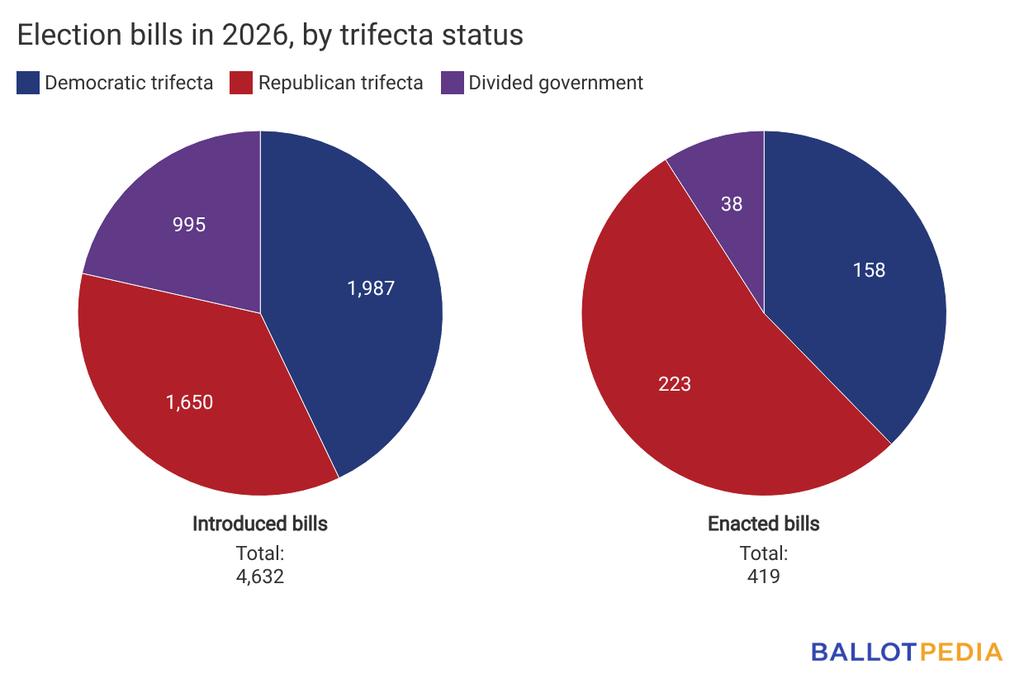
The 419 bills enacted in 44 states represent an 11% decline compared with this point in 2025. But when compared with past even-numbered session years, the 2026 total is 47% more than at this point in 2024, and roughly twice as many bills as were enacted in 2022. Montana, Nevada, North Dakota, and Texas do not hold regular legislative sessions in even-numbered years.
More than half of the bills — 53.2% — were enacted in states with Republican trifectas. Meanwhile, 37.7% were enacted in states with Democratic trifectas, roughly double the 2025 rate, and 9.1% of bills were enacted in states with divided governments.
Ballotpedia identified 4,632 election-related bills and resolutions as of Aug. 14 — nearly as many as were introduced in all of 2025. Of those measures, 42.9% were introduced in states with Democratic trifectas, 35.6% were introduced in states with Republican trifectas, and 21.5% were introduced in states with divided governments.
At this point in the 2024 session, states had introduced 3,635 election-related bills. In 2022, legislators had introduced 2,417 election bills at this point.
Lawmakers nationwide have considered bills related to each of the 127 election legislation categories Ballotpedia covers, including the following noteworthy policy topics:
Absentee/mail-in voting
All states allow for some form of absentee/mail-in voting. Connecticut became the 29th state to allow any eligible voter to cast an absentee/mail-in ballot after Gov. Ned Lamont (D) signed HB 5001 into law on May 15.
Thirteen states require voters to provide a valid excuse to vote absentee/by mail. Eight states have automatic mail-in ballot systems, also known as all-mail voting systems.
Delaware is now the only state with a Democratic trifecta that requires voters to provide an excuse to request an absentee/mail-in ballot. Legislators passed SB 3, a constitutional amendment that would require no-excuse absentee voting. It passed both legislative chambers this spring but will only take effect if approved again next session. Delaware is the only state where the legislature can amend the constitution without voter approval.
Eleven of the other 12 states that require voters to provide an excuse to vote absentee/by mail have Republican trifectas, while one, Kentucky, has a divided government. None of those states advanced bills to allow for no-excuse absentee/mail-in voting.
Lawmakers in 40 states introduced 320 bills and resolutions related to absentee/mail-in voting. These bills address different elements of the absentee/mail-in voting process, including how and when voters can request and return an absentee/mail-in ballot, when election officials must mail ballots, and deadlines and procedures for curing problems with an absentee/mail-in ballot.
Regulations governing law enforcement presence near polling places
Seven states with Democratic trifectas enacted 12 bills or resolutions on the presence of law enforcement, National Guard members, or immigration authorities at or near election sites.
The majority of the bills would prohibit law enforcement personnel from being within a set distance of polling places, tabulation sites, or election offices.
Lawmakers in California, Connecticut, Illinois, New Mexico, Oregon, Rhode Island, and Virginia enacted bills or resolutions related to this topic.
Changes to how primary elections are run
Currently, 14 states require open primaries, 13 require closed primaries, 10 require semi-closed primaries, and five require top-two style primaries for at least some federal or state-level offices. Eleven states give parties discretion to choose participation rules for their primaries.
Legislators introduced 193 bills related to primary elections in 2026. No states have enacted changes to these broader categories this year, but 11 states enacted bills to move a primary election date or change how primaries are administered.
Policies prohibiting or authorizing the use of ranked-choice voting
In 2026, two states with Republican trifectas, Indiana and Ohio, enacted legislation prohibiting the use of ranked-choice voting (RCV), bringing the total number of states with an RCV ban to 19.
Virginia became the first state since 2023 to approve legislation, SB 176, that allows or requires the statewide use of RCV for state or local elections.
Lawmakers have introduced 78 RCV-related bills. Forty-seven would authorize or require the use of RCV in at least some elections, while 20 bills would prohibit or repeal RCV.
Mid-decade redistricting
Florida, Louisiana, and Tennessee enacted new congressional maps ahead of the 2026 midterm elections. Virginia voters approved a legislatively referred constitutional amendment 51.7% to 48.3% on April 21 that would enact the maps contained in HB 29. The Virginia Supreme Court, however, ruled that the General Assembly violated procedural requirements when placing the measure on the ballot, overturning the result.
Bills in Indiana, Maryland, and South Carolina to enact new congressional maps passed one legislative chamber.
State-level voting rights acts
Delaware, Maryland, and New Jersey enacted new state-level voting rights acts, or laws that mirror or expand upon the provisions of the Voting Rights Act of 1965. Two other states, Washington and Virginia, amended or expanded their existing state-level voting rights acts in 2026.
This is the first year that multiple states enacted new state-level voting rights acts in the same year. Nationally, 15 states introduced 24 bills to enact or amend state-level voting rights acts.
Changes to voter ID requirements
Thirty-six states require voters to present identification to vote at the polls on election day. Of these states, 24 require voters to present identification containing a photograph, with certain exceptions, and 12 states do not require photo identification. The remaining 14 states do not generally require voters to present identification in order to vote at the polls on election day.
None of the 14 states without voter ID requirements have advanced bills in 2026 to require it. And no state that allows non-photo identification has enacted legislation to require photo identification.
Legislators in Arizona, Ohio, and Oklahoma put constitutional amendments on the ballot related to voter ID in 2026. California, Nevada, and North Carolina will also have ballot measures in November on new voter ID laws or placing existing requirements in the state constitution.
Eleven states enacted bills modifying their existing voter ID requirements. Notable bills include Louisiana SB 319 and Iowa HF 2501. Legislators have introduced 204 bills related to voter ID so far in 2026.
Policies related to voter registration
Legislators in 44 states introduced 627 bills related to voter registration, which accounts for 13% of all bills introduced in 2026.
These bills change various aspects of the voter registration process, including creating documentary proof of citizenship requirements, changing the data sources election officials are required to use when carrying out voter list maintenance, and expanding automatic voter registration systems.
A common legislative focus in 2026 has been on expanding the data sources that election officials are required to use for voter list maintenance. That includes requiring or authorizing officials to use federal or state datasets, such as the Systematic Alien Verification for Entitlements system (SAVE), to check the citizenship status of individuals who are currently registered to vote.
Six states have enacted legislation on that topic in 2026. Notable enacted bills include Kansas HB 2437 and Louisiana HB 691.
Ballotpedia publishes three reports each year that provide ongoing coverage of election-related legislative activity. Click here to read the mid-year report, and here to see our past reports.
Illinois is one of seven states with a data center-related local measure on the ballot in 2026
Welcome to our next installment of our 50 states in 50 days series, covering Illinois. To view our archive of past editions, click here.
On Nov. 3, voters in Joliet, Illinois, will decide on a measure to advise the city whether to approve the construction of AI data centers. This measure is one of 10 related to data centers that cities across the country will decide on this year.
Voters must register online by Oct. 18 or via mail by Oct. 6. Voters can also register in person through Nov. 3.
Early voting opens on Sep. 24 and closes on Nov. 2.
Polls open on Election Day at 6:00 a.m. and close at 7:00 p.m.
Voter ID is not required to vote in Illinois in most cases. The federal Help America Vote Act requires that individuals in all 50 states who register to vote by mail and have not previously voted in a federal election in their state must provide either their driver's license or a paycheck, bank statement, current utility bill, or government document showing their name and address.
Absentee/mail-in ballots must be requested by Oct. 29 and postmarked by Nov. 3.
Current party control
Democrats represent 14 congressional districts, and Republicans represent three. Both of Illinois' U.S. Senators are Democrats.
Democrats have a 40-19 majority in the Illinois Senate and a 78-40 majority in the Illinois House of Representatives. Because the governor is a Democrat, Illinois is one of 16 states with a Democratic trifecta. Illinois' attorney general and secretary of state are also Democrats. As a result, Illinois is one of 21 states with a Democratic triplex. Democrats have a 5-2 majority on the Illinois Supreme Court.
Offices on the ballot
Elections are taking place for the U.S. Senate and the U.S. House of Representatives.
There will also be elections for governor, lieutenant governor, attorney general, secretary of state, comptroller, and treasurer. Thirty-nine seats in the state Senate and all 118 seats in the state House are up for election.
Three seats on the Illinois intermediate appellate court are up for retention election. Another three seats are up for partisan election.
Illinois is one of 32 states where we are providing comprehensive election coverage down to the local level this November.
Notable elections
In Illinois' 4th Congressional District election, Patty Garcia (D), Lupe Castillo (R), Ed Hershey (Working Class Party), and Chris Getty (I) are running. Getty, a Democrat, is running as an independent. Central to the election are claims that the district's incumbent, Jesus Garcia (D), attempted to handpick his chief of staff, Patty Garcia, as his successor by announcing after the Democratic primary filing deadline that he would not run for re-election due to health and family issues. As a result, Patty Garcia was the only candidate in the primary.
Statewide ballot measures
There are no statewide measures on the ballot this year. From 1995 to 2025, Illinois voters have decided on 15 statewide measures, approving 12 and defeating three.
Local ballot measures
We'll be adding information about local measures in Illinois as they are certified ahead of the Nov. 3 election.
Tomorrow, we'll preview elections in North Dakota, the Peace Garden State.
Click here to see every edition of 50 States in 50 Days as we publish them, and here to use our Sample Ballot Lookup Tool.
Darline Graham defeats Ralph Norman in the Aug. 25 special Republican primary runoff for the U.S. Senate in South Carolina
Incumbent Sen. Darline Graham (R) defeated Ralph Norman (R) in the Aug. 25 special Republican primary runoff for the U.S. Senate in South Carolina. Graham defeated Norman 52.5% to 47.5% as of 10:36 a.m. EDT on Aug. 26.
Since none of the 10 candidates running in the Aug. 11 special Republican primary won more than 50% of the vote, the top two vote-getters — Graham and Norman — advanced to the runoff. Graham won 32.8% of the vote, and Norman won 23.5% in the primary.
The special primary was called following the July 11 death of incumbent Sen. Lindsey Graham (R), the Republican nominee selected at the June 9 Republican primary. South Carolina Gov. Henry McMaster (R) appointed Darline Graham, Lindsey Graham's sister, to fill the vacancy on July 13.
Lindsey Graham's death was one of six instances of a major or minor party nominee withdrawing from a U.S. Senate general election this year. Mike Marvin (Legal Marijuana Now Party) is the most recent nominee to withdraw from a U.S. Senate general election this year.
Marvin announced on Aug. 21 that he was withdrawing from the U.S. Senate general election in Nebraska due to health issues. However, his name will remain on the ballot because he announced after the Aug. 3 deadline for Nebraska candidates to withdraw and have their names removed from the ballot.
The special Republican primary runoff in South Carolina was also one of two instances this year in which a nominee was replaced following a candidate's withdrawal. The other instance was in Maine.
Click here to read more about the special Republican primary runoff in South Carolina.