


Welcome to the Wednesday, Sept. 2, 2026, Brew.
By: Briana Ryan
Here’s what’s in store for you as you start your day:
- Oklahoma officials disagree over who can call a vote on a constitutional convention question
- California to hold its first general elections since voters approved a redistricting measure in 2025
- Healthcare becomes a key issue in the Sept. 8 Democratic primary for New Hampshire's 1st Congressional District
Oklahoma officials disagree over who can call a vote on a constitutional convention question
On Aug. 25, Oklahoma Gov. Kevin Stitt (R) issued an executive proclamation scheduling a measure calling for a state constitutional convention for a special election on April 6, 2027. The Oklahoma Constitution requires the question to be submitted to voters at least once every 20 years, but it was last submitted in 1970.
Stitt's executive proclamation led to a dispute with the Oklahoma Attorney General over who has the authority and responsibility to put the question on the ballot when the Oklahoma Legislature does not act.
Oklahoma is one of 14 states that require voters to consider a constitutional convention question at regular intervals. However, Oklahoma is the only one of those states that does not explicitly assign responsibility to a specific official or governmental body in its constitution or through state law.
Five of the 14 states require the question every 10 years. One state requires it every 16 years. Eight states require it every 20 years.
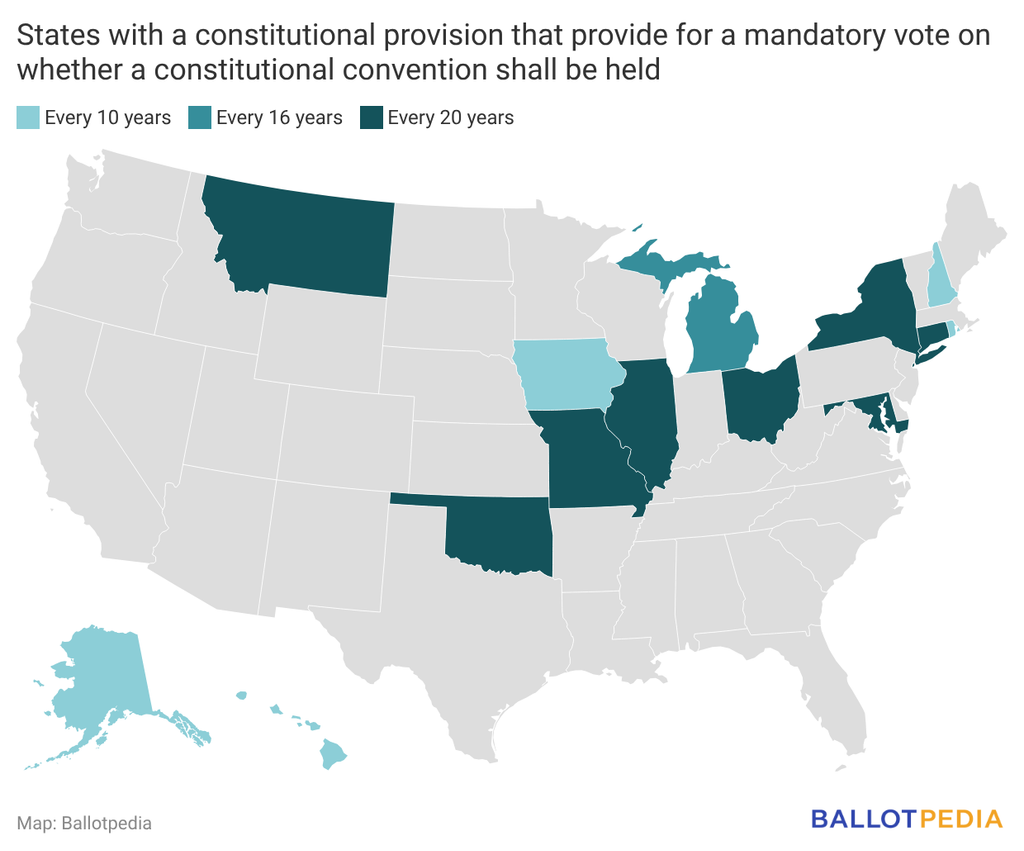
The provisions differ in how they assign responsibility.
The Alaska and Hawaii constitutions direct the lieutenant governor to act. New Hampshire, Rhode Island, Illinois, and Missouri assign the responsibility to the secretary of state. Maryland makes it the duty of the General Assembly to pass a law for the vote.
The constitutional convention provisions in Iowa, Michigan, Montana, Connecticut, New York, and Ohio do not identify a responsible official. However, laws in those states assign ballot preparation and certification duties to election officials.
The Oklahoma Constitution explains how the Legislature may submit a constitutional convention question to voters. It does not identify an official responsible for placing it on the ballot if the Legislature does not act. It states, "Provided, That the question of such proposed convention shall be submitted to the people at least once in every twenty years."
Stitt directed the Oklahoma Secretary of State to take the actions necessary to submit the question to voters. He also created the Oklahoma Constitutional Convention Commission to study the state constitution, examine other states' conventions, and recommend procedures and implementing legislation if voters approve the measure. The commission's report is due by Dec. 31, 2026.
Stitt's order states that the requirement to submit the question at least once every 20 years is "self-executing to the extent necessary to give effect to that mandatory constitutional obligation."
The order also cites Robert L. Williams (D), a delegate to Oklahoma's 1906 constitutional convention who later served as chief justice of the Oklahoma Supreme Court from 1907 to 1914 and as governor from 1915 to 1919. Williams wrote, "It is the duty of the Secretary of State, without any additional legislation, to submit this question every 20 years to the electors of the state."
Oklahoma Attorney General Gentner Drummond (R) issued a statement that said, "The Legislature must pass a bill or joint resolution that must be signed by the governor to be referred to a vote of the people."
Stitt's and Drummond's terms both end on Jan. 11, 2027, which is before the special election would occur.
Previously, Oklahoma voters have rejected three questions proposing a constitutional convention.
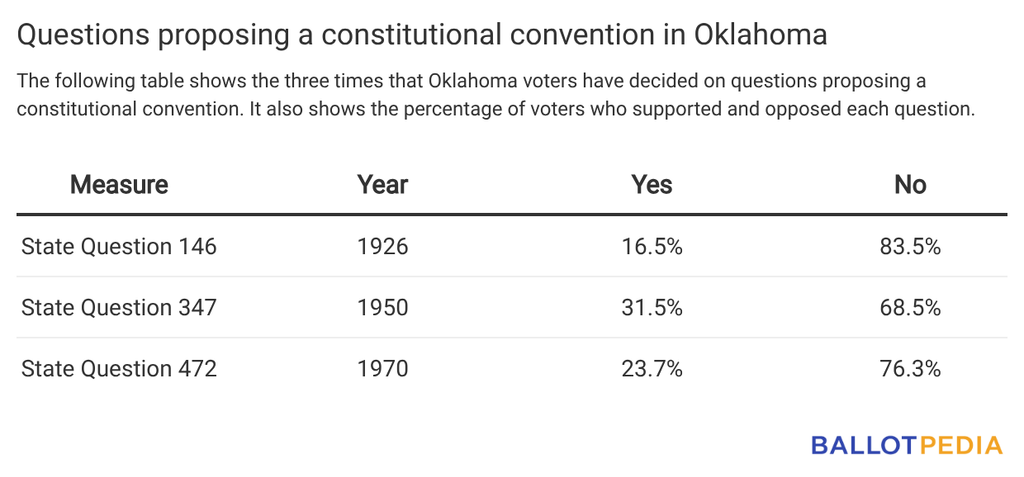
In 1994, voters defeated State Question 660 52% to 48%. It would have removed the constitutional requirement that the convention question be submitted at least once every 20 years.
Click here for more information on mandatory votes about holding a statewide constitutional convention.
California to hold its first general elections since voters approved a redistricting measure in 2025

Welcome to our next installment of our 50 States in 50 Days series, covering California. To view our archive of past editions, click here.
California will use a different congressional map than it did in 2022 and 2024, after voters approved Proposition 50 64.4% to 35.6%. The measure amended the California Constitution to allow the state to use a new, legislature-drawn congressional district map for 2026 through 2030. In California, a non-politician commission, called the Citizens Redistricting Commission, has been responsible for congressional and state legislative redistricting since 2011. Based on the 2024 presidential election results, the new map would result in Democrats winning five Republican-held districts in November.
Want to see what's on your ballot this November? Click here to use our Sample Ballot Lookup Tool. Now let's take a closer look at what's happening in California.
Voters must register online or via mail by Oct. 19. Voters can also register in person through Nov. 3.
Early voting opens Oct. 5 and ends Nov. 2.
Polls open on Election Day at 7:00 a.m. and close at 8 p.m.
Voter ID is not required to vote in California in most cases. The federal Help America Vote Act requires that individuals in all 50 states who register to vote by mail and who have not voted previously in a federal election in their state must provide either their driver's license or a paycheck, bank statement, current utility bill, or government document showing their name and address.
Absentee/mail-in ballots are automatically mailed to all registered voters. Under a 2025 law, ballots are counted if they are postmarked by Election Day (Nov. 3) and received within seven days (Nov. 10), up from three days previously.
Voters whose absentee/mail-in ballot is unsigned or whose signature does not match what is on file now have until 5 p.m., 22 days after the election, to cure the issue. Absentee/mail-in voters can now cast their ballots in person at an elections office or a satellite location starting 29 days before the election.
Election officials must now, under a 2025 law, finish counting all ballots within 13 days of the election, with exceptions for provisional ballots, absentee/mail-in ballots arriving after the fourth day following election day, or ballots cast by same-day registrants.
Current party control
Democrats represent 42 congressional districts, Republicans represent eight, and an independent who caucuses with Republicans represents one. One district is currently vacant. Both of California’s U.S. Senators are Democrats.
Democrats have a 30-10 majority in the California Senate and a 60-19 majority with one vacancy in the California Assembly. Because the governor is a Democrat, California is one of 16 states with a Democratic trifecta. California's attorney general and secretary of state are also Democrats. As a result, California is one of 21 states with a Democratic triplex. Democratic governors appointed six members of the California Supreme Court, and a Republican governor appointed one.
Offices on the ballot
Elections are taking place for the U.S. House of Representatives.
There will be elections for governor, lieutenant governor, attorney general, secretary of state, controller, insurance commissioner, superintendent of public instruction, treasurer, and four seats on the state board of equalization. Twenty seats in the state Senate and all 80 seats in the state Assembly are also on the ballot.
Two state supreme court justices and 52 intermediate appellate court judges are up for retention elections.
California is one of 32 states this year where we are providing comprehensive election coverage down to the local level. This year’s ballot includes elections for municipal and county offices as well as for school boards.
Notable elections
In the open gubernatorial election, Xavier Becerra (D) and Steve Hilton (R) are running. According to the Associated Press’ Sophie Austin, "The race for California governor this fall will be a battle between a Democrat [Becerra] promising to cement the state’s status as a stronghold of liberal policies and a Republican [Hilton] pledging to dramatically reverse course in the nation’s most populous state."
In the Los Angeles mayoral election, incumbent Karen Bass and Nithya Raman are running. Although the city's mayoral election is officially nonpartisan, both candidates are Democrats. Raman is running to the left of Bass. In their Candidate Connection Surveys, both candidates reference homelessness and housing affordability as key issues.
In the 40th Congressional District, incumbent Reps. Ken Calvert (R) and Young Kim (R) are running. The two incumbents were drawn into the same district due to Proposition 50. According to ABC7's Josh Haskell, Calvert represents 51% of the new district, and Kim represents 35%.
Statewide ballot measures
There are 14 statewide measures on the ballot this year. From 1910 to 2025, California voters decided on 1,307 ballot measures, or 21 per even-numbered year. During that period, voters approved 753 measures and defeated 554. For more information about the history of California’s ballot measures, visit its Historical Ballot Measures Factbook.
Here’s a closer look at four of the measures on the ballot:
Proposition 40 would levy a one-time 5% tax on the accumulated wealth of taxpayers and trusts with covered assets valued over $1 billion to fund state healthcare programs, food assistance programs, and public education.
Opponents of the billionaire tax qualified two initiatives that target provisions of the wealth tax and contain competing measure provisions that would nullify measures on the same ballot deemed in conflict with Propositions 41 and 42. Proposition 41 states that ballot measures appearing on the same statewide election ballot that either impose different audit rules or levy a state tax exempt from the state spending limit would be deemed in conflict with Proposition 41. The billionaires’ tax contains a provision that exempts the revenue from the state’s General Fund when calculating the state minimum guarantee for education funding. If Proposition 41 is approved and receives more affirmative votes than the competing measure, it would prevail over the other measure in its entirety. If both measures are approved and the competing measure receives more affirmative votes but is later ruled invalid, Proposition 41 would take effect. Proposition 42 states that if it receives more votes than a competing measure related to taxing personal assets on the 2026 ballot, Proposition 42 would prevail in its entirety over the measure.
Proposition 39 is one of six statewide measures nationwide this year on voter identification requirements. It would require voters to present a government-issued ID for in-person voting or provide the last four digits of a government-issued ID designated during voter registration for mail-in voting. The measure would also require the secretary of state and county election officials to maintain accurate voter registration lists, including verifying citizenship attestations and reporting the percentage of voter rolls that have been citizenship-verified.
Local ballot measures
We’re also covering local measures in California. One of those measures, Measure D in Irvine, would establish single-winner instant runoff ranked-choice voting (RCV) for all mayoral and city council elections.
From 2014 through 2024, California voters decided on 4,249 local measures, or 708 per even-numbered year. During that period, voters approved 3,077 measures and defeated 1,172.
Tomorrow, we'll preview elections in Montana, the Treasure State.
Click here to see every edition of 50 States in 50 Days as we publish them, and here to use our Sample Ballot Lookup Tool.
Healthcare becomes a key issue in the Sept. 8 Democratic primary for New Hampshire's 1st Congressional District
Nine candidates are running in the open Democratic primary for New Hampshire's 1st Congressional District on Sept. 8 — a race in which healthcare has become a key issue. Stefany Shaheen (D), Maura Sullivan (D), and Christian Urrutia (D) lead in endorsements, fundraising, and media attention.
The New Hampshire Bulletin's William Skipworth wrote that "At the heart of the election's healthcare debate has been expanding Medicare, the country's public health coverage program, which mainly covers seniors over age 65."
According to Skipworth, Sullivan supports "offering access to Medicare to everyone but allowing those who don't want Medicare to keep their private insurance." Shaheen and Urrutia support "single-payer systems in which the private insurers are replaced by Medicare and governmental programs."
Shaheen, the daughter of U.S. Sen. Jeanne Shaheen (D-N.H.), is a healthcare advocate, entrepreneur, and author. She also served as a Portsmouth City Councilor and as chair of the Portsmouth Police Commission.
Sullivan is a former Marine captain and served as assistant secretary of Veterans Affairs during President Barack Obama's (D) administration. She also served as assistant to the Secretary of Defense and as senior advisor to the Secretary of the Navy.
Urrutia is an attorney and Army National Guard officer. He also served as a senior national security leader at the Pentagon and worked as Director of Community Policy at Airbnb.
As of Aug. 25, The Cook Political Report and DDHQ/The Hill rated the general election as Likely Democratic. Inside Elections and Sabato's Crystal Ball rated it as Lean Democratic.
Click here to read more about the Democratic primary for New Hampshire's 1st Congressional District. Also, if you're a New Hampshire voter, check out our Sample Ballot Lookup here to prepare for Election Day.