


Welcome to the Thursday, Sept. 3, 2026, Brew.
By: Lara Bonatesta
Here’s what’s in store for you as you start your day:
- Independence, Missouri, city councilmember becomes first official recalled over a data center project this year
- In Montana’s first open U.S. Senate race in 50 years, Democratic lawmakers asked candidates to drop out
- U.S. District Court judge temporarily blocks Ohio documentary proof of citizenship requirement
Independence, Missouri city councilmember becomes first official recalled over a data center project this year
On Sept. 1, voters in Independence, Missouri recalled First District Councilman John Perkins, making him the first official to be removed from office in a data center-related recall this year.
Independence resident McKenna Cobb, who led the recall effort, cited Perkins' vote to approve a 90% tax abatement for technology company Nebius, in order to build a 2.1-million-square-foot data center in the Little Blue Valley district of Independence.
Following the recall vote, Perkins said he wouldn’t challenge the result and said, “This [the Nebius data center] is going to be an economic benefit to the city that will have long lasting, economic benefits. It’s a privilege to be able to serve the people of the city of Independence. I’m very proud of the work that I’ve done. I have laid foundations that have never been laid before. The work, the economic benefit that will have a generational impact. I am proud of that.”
Through Sept. 2, Ballotpedia identified 42 recall efforts targeting 79 officials related to data center projects so far in 2026. Of those, efforts against 41 officials are still underway, efforts against 33 officials did not go to a vote, and one official resigned. Recall elections against three officials in Michigan, Oklahoma, and Texas are scheduled on Nov. 3.
In total, Ballotpedia has 250 recall efforts against 402 officials so far this year. To learn more about recalls this year, check out our Mid-Year Recall report.
Here’s a look at the other elections we covered on Sept. 1.
U.S. Sen. Ed Markey (D) is the second-oldest U.S. Senator to win a contested primary this year
Eighty-year-old incumbent U.S. Sen. Ed Markey defeated 47-year-old Seth Moulton 64.8% to 35.2% in the Democratic primary for U.S. Senate in Massachusetts. Markey’s win makes him the second-oldest senator, after 83-year-old Jim Risch (R-Idaho), to defeat a primary challenger this year.
Incumbents won all five contested U.S. House primaries
In addition to Markey’s win in the Senate primary, all five of the incumbent U.S. House members who ran in contested primaries on Sept. 1 won their primaries in Massachusetts. As we mentioned in our Aug. 18 and Aug. 20 editions of the Daily Brew, this year ties with 2018 for the most U.S. House members in Massachusetts to face primary challengers since at least 2014. Nationally, there are more contested Democratic primaries for U.S. House than in any year in that same period.
Age was a theme in two other U.S. House primaries on Sept. 1. Incumbents Richard Neal (D) and Stephen Lynch (D) also both defeated primary challengers who were more than three decades younger than them.
- Neal defeated Jeromie Whalen 54.1% to 45.9% in the Democratic primary in Massachusetts’s 1st District. Neal, who is 77, was first elected to Congress in 1988 and is the ranking Democrat on the U.S. House Ways and Means Committee. Whalen, who is 39, is a communications and media production high school teacher who describes himself as a progressive.
- Lynch defeated Patrick Roath (D) 55.8% to 44.2% in the Democratic primary in Massachusetts' 8th Congressional District. Lynch, who is 71, was first elected to Congress via a special election in 2001. He campaigned on his background in Congress as well as his background as a former ironworker. Roath was a lawyer and aide to former Gov. Deval Patrick (D). Roath, who is 39, campaigned on supporting a federal paid leave plan based on Massachusetts' state program.
Click here to learn more about the ages of members of the 119th Congress.
In the one other battleground primary we were watching on Sept. 1, Dan Koh defeated Beth Andres-Beck, John Beccia, Tram Nguyen, and Jamie Zahlaway Belsito in the Democratic primary for Massachusetts' 6th Congressional District. This is one of 64 open U.S. House races this year. Koh will face Micah Jones (R) in the general election on Nov. 3. The winner of that election will succeed Moulton, the current incumbent.
State legislative elections
As of 2 p.m. on Sept. 2, no Massachusetts’ General Court incumbents lost their primaries in a year that featured the most incumbents in contested primaries since at least 2010. Eighteen races featuring incumbents were still uncalled. Twenty-six incumbents – 25 Democrats and one Republican – ran in contested primaries.
As we mentioned in our Aug. 25 edition of the Daily Brew, these primaries took place in the context of a conflict between the Legislature and the state auditor.
In 2024, Massachusetts voters approved Question 1 72% to 28% authorizing the state Auditor to audit the Legislature's operations. In February 2026, Auditor Diana DiZoglio (D) sued the Legislature, saying it had not complied with her efforts to initiate an audit. On June 2, the state House voted 125-28 to approve a bill limiting the auditor's authority to audit the legislature. 124 Democrats and one independent voted in favor of the bill. Three Democrats and 25 Republicans voted against it. The state Senate approved it 34-6 on July 30, with 34 Democrats voting in favor and one Democrat and five Republicans voting against it.
In seven primaries, Democratic challengers to incumbents who voted for the bill limiting audits mentioned transparency in their campaign materials. As of 2 p.m., none of those primaries had been called.
The Democratic Socialists of America endorsed two state House candidates, Evan MacKay in the 25th Middlesex District and Michael Lachenmeyer in the 12th Hampden District. As of 2 p.m. on Sept. 2:
- The primary in the 25th Middlesex District was still uncalled. Incumbent Marjorie Decker had received 53.3% to MacKay’s 46.7%.
- Incumbent Angelo Puppolo Jr. defeated Michael Lachenmeyer. 64.2% to 35.84% in the 12th Hampden District.
Click here to see more election results from Sept. 1.
In Montana’s first open U.S. Senate race in 50 years, Democratic lawmakers asked candidates to drop out

Welcome to our next installment of our 50 States in 50 Days series, covering Montana. To view our archive of past editions, click here.
Montana’s 2026 U.S. Senate election will be the first open Senate race in the state in 50 years. Incumbent Steve Daines (R) is not running and endorsed Kurt Alme (R). In July, Democratic state lawmakers sent a letter to Democratic nominee Alani Bankhead (D) and independent candidate Seth Bodnar, asking for one of them to withdraw. Neither did so before the Aug. 10 deadline, meaning both are on the ballot.
Want to see what’s on your ballot this November? Click here to use our Sample Ballot Lookup Tool. Now let’s take a closer look at what’s happening in Montana.
Early voting opens Oct. 5 and ends Nov. 2.
Polls open on Election Day at 7:00 a.m. and close at 8:00 p.m.
Voter ID is required. Acceptable forms of ID include a valid driver’s license, state ID card, REAL ID, military ID, or U.S. passport. According to a 2025 law, acceptable forms of ID include those issued to students who are enrolled in the Montana University System or are a part of the National Association of Intercollegiate Athletics. Click here for a full list of accepted IDs.
Absentee/mail-in ballots must be requested by Nov. 2 and returned by Nov. 3.
According to a 2025 law, voters must provide their date of birth when registering to vote. They must also write their date of birth on their absentee ballot signature envelope in order for the ballot to be counted. Voters must be notified if they did not provide their date of birth or if the date provided does not match what was on their voter registration form.
Current party control
Republicans represent both of Montana’s congressional districts. Both of Montana’s U.S. Senators are also Republicans.
Republicans have a 32-18 majority in the Montana Senate and a 58-42 majority in the Montana House of Representatives. Because the governor is a Republican, Montana is one of 23 states with a Republican trifecta. Montana’s attorney general and secretary of state are also Republicans. As a result, Montana is one of 24 states with a Republican triplex. Four judges on the state supreme court were initially elected in nonpartisan elections. A Democratic governor initially appointed two judges and a Republican governor appointed one.
Offices on the ballot
Elections are taking place for the U.S. Senate, the U.S. House of Representatives, 25 seats in the Montana Senate, and all 100 seats in the Montana House of Representatives are up for election. Two seats on the Montana Public Service Commission are also up for election.
Montana is one of 32 states this year in which we are covering all local elections for school boards and municipal offices.
Battleground elections
U.S. Senate: Alani Bankhead (D), Kurt Alme (R), Kyle Austin (L), and Seth Bodnar (I) are running. On March 4, incumbent Steve Daines (R), who first took office in 2013, withdrew his candidacy and endorsed Alme. This is the first open Senate election in Montana in 50 years. On July 8, 17 Democratic state legislators sent a letter to Bankhead and Bodnar asking one of them to end their campaign. The last day for candidates to withdraw from the race and not have their name appear on the ballot was Aug. 10. Neither Bankhead nor Bodnar did so, meaning both are on the ballot.
As we mentioned in our Sept. 1 edition of the Daily Brew, there have been six instances of a major or minor party nominee withdrawing from a U.S. Senate general election this year. In one of those cases – the Senate election in Nebraska – the Democratic nominee withdrew and the state Democratic Party endorsed an independent candidate.
Montana's 1st Congressional District: Sam Forstag (D), Aaron Flint (R), Nick Sheedy (L), and Kimberly Persico (I) are running. Incumbent Rep. Ryan Zinke (R) is not running. The Democratic Congressional Campaign Committee (DCCC) named Forstag to its Red to Blue program. The National Republican Congressional Committee (NRCC) named Flint to its MAGA Majority program.
Montana Supreme Court elections: Amy Eddy and Dan Wilson are running in the open nonpartisan election. Incumbent Beth Baker, who originally joined the court through a nonpartisan election, is not running. Both candidates are currently judges on the Montana 11th Judicial District Court. According to State Court Report, when he previously ran for the court in 2024, Wilson described himself as a judicial conservative, while Eddy, who temporarily served on the court in 2025, joined a decision striking down certain abortion restrictions. Eddy completed Ballotpedia’s candidate connection survey. Click here to read her response.
Also according to State Court Report, this election is happening in the context of several rulings on abortion, voting rights, and the environment, which led to criticism from the state’s Republican lawmakers. It is also taking place as there are several cases that may make their way to the state supreme court relating to the environment and a 2023 bill that sought to define sex in state law and said that “In human beings, there are exactly two sexes, male and female.”
Montana’s 2024 state supreme court elections were the two most expensive judicial elections in state history, with candidates and satellite groups spending nearly $12.7 million.
Statewide ballot measures
There are three statewide measures on the ballot in Montana this year. From 1889 to 2024, Montana voters decided on 269 ballot measures, or three per even-numbered year, approving 167 and defeating 102. For more information about the history of Montana’s ballot measures, visit its Historical Measures Factbook.
Here’s a closer look at the three measures.
CI-132 would provide that judicial elections remain nonpartisan. Montana has used nonpartisan judicial elections since 1936. If the amendment is approved, any future effort to make judicial elections partisan would require another voter-approved constitutional amendment. Montana is one of four states that use nonpartisan elections to initially select judges and then use retention elections to determine whether judges should remain on the bench. Thirteen states have nonpartisan elections for their state supreme courts and 16 states have them for their intermediate appellate and general jurisdiction courts.
CI-133 would add the initiative and referendum power to the state's Declaration of Rights, require any government abridgment of the right to meet the judicial standard of strict scrutiny, and provide that the initiative process is "impartial, predictable, transparent, and expeditious." In 2026, voters will decide on at least eight measures related to the initiative and referendum process. Seven measures would add requirements or restrictions to the initiative and referendum process. The Montana measure is the only one that would expand or preserve the use of the initiative and referendum process.
I-194 would prohibit artificial persons, including nonprofits, trusts, partnerships, corporations, trade associations, or unincorporated associations, and all entities doing business in Montana, from contributing to campaigns, ballot measure elections, or political parties.
Local ballot measures
We’ll be adding information about local measures in Montana as they are certified ahead of the Nov. 3 election.
Other notable elections
There are four elections for seats in the state legislature in which each candidate has completed Ballotpedia’s Candidate Connection survey. Click on each candidate’s name to find their survey responses.
- Montana House of Representatives District 60: Incumbent Alanah Griffith (D) and Greg Leman (R) are running.
- Montana House of Representatives District 64: Brady Bremer (D) and Daniel Martinez (R) are running.
- In Montana Senate District 10, Margaret Mitchell (D) and Jessica Dyrdahl (R) are running.
- In Montana Senate District 41, Erin Farris-Olsen (D) and Dru Koester (L) are running.
Join us again tomorrow when we'll preview elections in New Mexico, the Land of Enchantment.
Click here to see every edition of 50 States in 50 Days as we publish them, and here to use our Sample Ballot Lookup Tool.
U.S. District Court judge temporarily blocks Ohio documentary proof of citizenship requirement
On Aug. 25, a U.S. District Court judge temporarily blocked an Ohio law requiring individuals registering to vote at the Bureau of Motor Vehicles (BMV) to provide documentary proof of citizenship.
This is not the only documentary proof of citizenship law that has been the subject of recent litigation. As we mentioned in our July 3 edition of the Daily Brew, the U.S. Supreme Court has agreed to review a case disputing whether Arizona's documentary proof of citizenship and noncitizen voter removal laws violate the National Voter Registration Act (NVRA).
Ohio is one of 12 states with laws requiring documentary proof of citizenship for voter registration, though it is the only one where the requirement applies only to voters registering to vote at a motor vehicle agency. Ohio allows individuals to register to vote at the BMV when applying for or renewing a driver’s license or state identification card. Documents accepted as proof of citizenship include a birth certificate, passport, certificate of naturalization, or driver’s license or state ID card issued after April 2023.
Governor Mike DeWine (R) signed HB 54, which enacted the requirement, in 2025. Individuals registering to vote online or via a paper form are not required to provide documentary proof of citizenship.
Two groups, Red Wine & Blue and the Ohio Alliance for Retired Americans, filed a lawsuit in August 2025 alleging that the requirement violated the NVRA. This law requires states to offer individuals the opportunity to register to vote at the department of motor vehicles.
U.S. District Court Judge Solomon Oliver Jr. wrote that the proof of citizenship requirement and Ohio’s procedures for registering to vote at the BMV likely violate the NVRA.
Oliver wrote that the policy conflicts with an NVRA requirement that states may require only the minimum amount of information necessary to determine a person’s eligibility to vote, since the state accepts a sworn statement that the registrant is a citizen for other methods of voter registration.
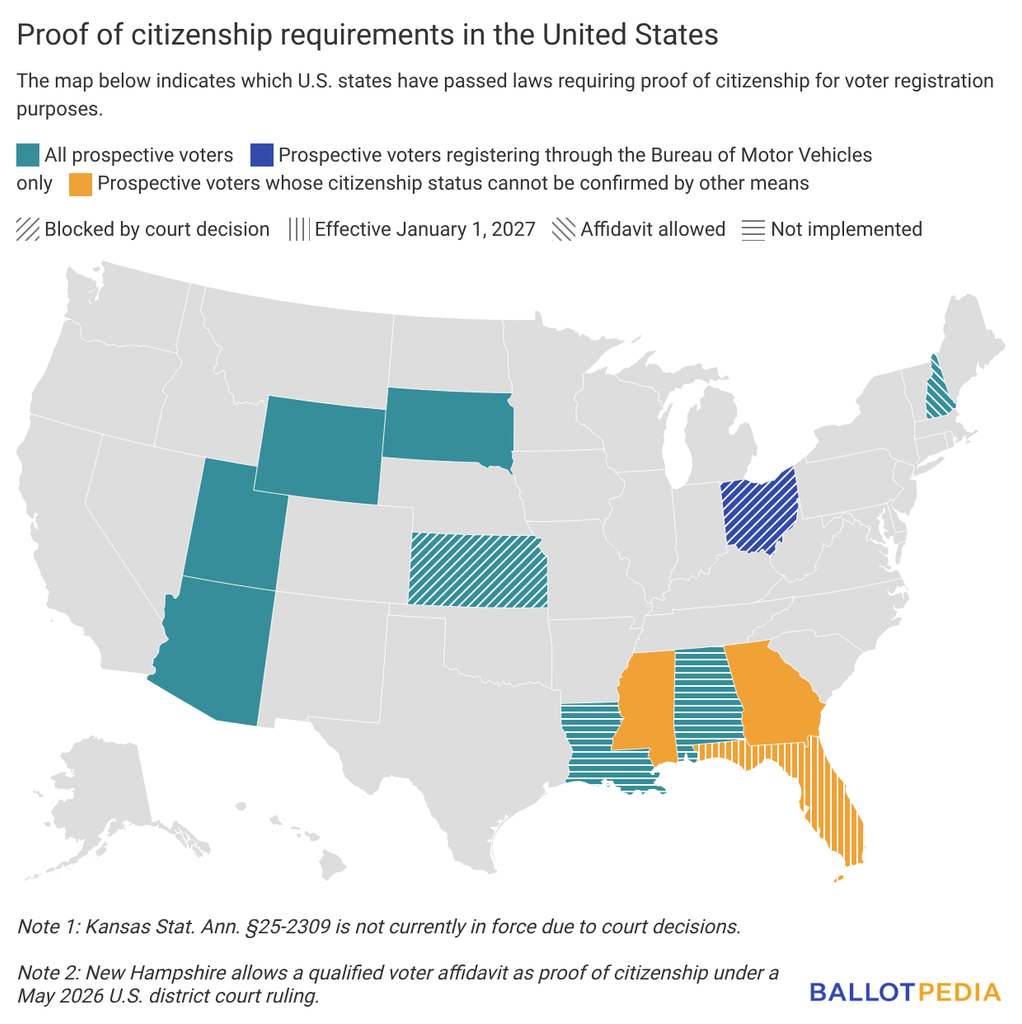
Ohio and Wyoming enacted documentary proof of citizenship requirements in 2025. Florida, Mississippi, South Dakota, and Utah did so in 2026.
For more information on proof of citizenship requirements nationally, click here.