


Welcome to the Tuesday, Sept. 8, 2026, Brew.
By: Briana Ryan
Here’s what’s in store for you as you start your day:
- Three states have changed election canvassing deadlines in 2026
- Ohio to use a new congressional map in this year's elections
- On the Ballot breaks down the debate over data centers happening in local governments
Three states have changed election canvassing deadlines in 2026
Idaho, Nebraska, and Wisconsin passed laws this year to change deadlines related to compiling, reviewing, and certifying election results, a process called canvassing. The laws in Idaho and Nebraska will be in effect for the Nov. 3 midterm elections, and the law in Wisconsin will be in effect for the 2028 presidential election.
Idaho H 873 moved the county canvass deadline from 10 days to nine days after the election.
Nebraska LB 1075 requires county officials to submit the official election results to the state by the third Monday after the election. Previously, there was no deadline for this to occur.
In 49 states, canvassing is a dual-level process, with state and local election officials compiling, reviewing, and certifying vote totals. In Rhode Island, canvassing happens entirely at the state level.
In the first step of the process, local officials review election results in their jurisdiction and certify the results to the state. In all 49 states, the law sets a deadline for this step to occur.
After the local election results are sent to state officials, those officials compile, review, and officially certify the results, completing the final step of the canvassing process. Forty-two states have a statutory deadline for state officials to certify the canvass, although in some states, state officials may pause the process due to a recount or if a county or municipality has not submitted its election results.
After the canvassing process is complete, state or local officials will issue certificates of election to the winning candidates.
States' canvassing deadlines fall within the following timeframes:
- Two states require the state canvass to take place within one week of the general election.
- Four states require it to occur within two weeks.
- Thirteen states require it to occur within three weeks.
- Six states require it to occur within four weeks.
- Six states require it to occur within five weeks.
- Three states require it to occur within six weeks.
- Eight states have different deadlines depending on the office.
- Eight states have no statutory deadline.
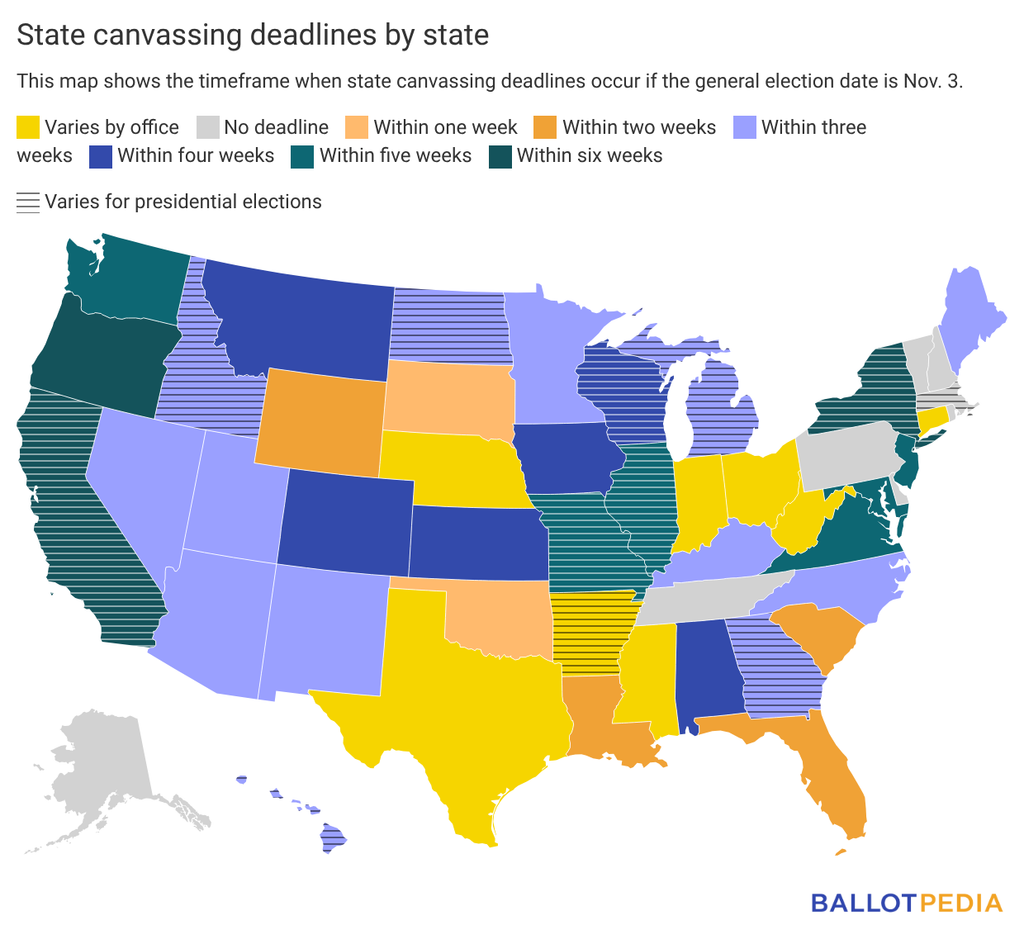
Wisconsin requires the county canvass to take place before noon on the Saturday after a presidential election. The state canvass must then occur within 21 days of a presidential election. Previously, Wisconsin held the state canvass on Dec. 1 for all general elections, including presidential elections.
Wisconsin’s law was intended to bring the state into compliance with the federal Electoral Count Reform and Presidential Transition Improvement Act (ECRA). President Joe Biden (D) signed the ECRA into law in 2022. ECRA made changes to state and federal procedures for certifying presidential electors and counting electoral college votes. According to the National Conference of State Legislatures, 19 states have passed laws modifying their post-election procedures — including their canvassing procedures — to comply with ECRA.
Nine other states have enacted 17 bills in 2026 to amend other aspects of their canvassing or vote-counting processes. In 2025, 15 states enacted 32 bills related to election canvassing and counting.
Click here for more information about state election result canvassing.
Ohio to use a new congressional map in this year's elections

Welcome to our next installment of our 50 States in 50 Days series, covering Ohio. To view our archive of past editions, click here.
Ohio will use a different congressional map than it did in 2022 and 2024. Ohio was required to redraw its congressional district boundaries ahead of this year’s elections due to a constitutional amendment that gave shorter expiration dates to maps passed without bipartisan support on the Ohio Redistricting Commission. On Oct. 31, 2025, the commission voted unanimously to approve a new congressional map. Based on the 2024 presidential election results, the new map would result in Republicans winning two Democratic-held districts in November.
Want to see what's on your ballot this November? Click here to use our Sample Ballot Lookup Tool. Now let's take a closer look at what's happening in Ohio.
Voters must register online, in person, or via mail by Oct. 5.
Early voting opens Oct. 6 and ends Nov. 1.
Polls open on Election Day at 6:30 a.m. and close at 7:30 p.m.
Voter ID is required. Acceptable forms of ID include an Ohio driver's license or ID card, a U.S. passport, or a military ID card. Click here for a full list of accepted IDs. Voters who do not have a photo ID because of a religious objection to being photographed must fill out a provisional ballot and complete an affidavit of religious objection for their ballot to be counted.
Absentee/mail-in ballots must be requested by Oct. 27 and received by Nov. 3.
Under a 2025 law, absentee/mail-in ballots must be received by the close of polls on election night. Previously, ballots were counted if they were postmarked by Election Day and received within four days of the election. Overseas and military voters will still have their ballots counted if they arrive within four days of Election Day.
Current party control
Republicans represent 10 congressional districts, and Democrats represent five. Both of Ohio’s U.S. Senators are Republicans.
Republicans have a 23-9 majority, with one vacancy, in the Ohio Senate and a 65-34 majority in the Ohio House of Representatives. Because the governor is a Republican, Ohio is one of 23 states with a Republican trifecta. Ohio’s attorney general and secretary of state are also Republicans. As a result, Ohio is one of 24 states with a Republican triplex. Republicans have a 6-1 majority on the Ohio Supreme Court.
Offices on the ballot
Elections are taking place for the U.S. Senate and U.S. House of Representatives.
There will also be elections for governor, lieutenant governor, attorney general, secretary of state, auditor, and treasurer. Seventeen seats in the state Senate and all 99 seats in the state House are up for election.
Two state supreme court justices and 22 intermediate appellate court judges are up for partisan election.
Ohio is one of 32 states this year where we are providing comprehensive election coverage down to the local level. This year’s ballot includes elections for municipal and county offices as well as for school boards.
One recall election is taking place against Urbana Mayor Bill Bean. Urbana resident James Cropper, who started the recall effort, said it was in response to plans to build a $1 billion data center in Urbana. Voters will decide whether to recall Bean and, if the effort passes, which candidate they want to succeed him.
Notable elections
U.S. Senate: Incumbent Sen. Jon Husted (R), Sherrod Brown (D), Bill Redpath (L), and Gregory Levy (I) are running. Brown is a former three-term senator who lost re-election in 2024. On Jan. 17, 2025, Gov. Mike DeWine (R) appointed Husted to replace Vice President J.D. Vance (R) in the Senate. The winner of this election will serve the remaining two years of the term Vance was elected to in 2022.
9th Congressional District: Incumbent Rep. Marcy Kaptur (D), Derek Merrin (R), and Matthew Althaus (L) are running. This district is one of 23 that Democrats are defending this year that President Donald Trump (R) won in 2024. In 2024, Kaptur defeated Merrin 48.3% to 47.6%. Based on how the new district lines would have affected the 2024 presidential election results, Trump would have defeated Kamala Harris (D) in the district 54.8% to 44.2%. This district — along with the 1st Congressional District — became more favorable to Republicans after redistricting.
Statewide ballot measures
There is one statewide measure on the ballot this year. Between 1910 and 2025, Ohio voters decided on 307 ballot measures, or five per even-numbered year. During that period, voters approved 170 measures and defeated 137. For more information about the history of Ohio's ballot measures, visit its Historical Ballot Measures Factbook.
Here’s a closer look at the measure:
Issue 3 would add a provision to the Ohio Constitution to require a photo ID to vote. This year, there are seven statewide measures nationwide related to voter identification requirements. Voters will decide six of those measures on Nov. 3. On Aug. 25, Oklahoma voters approved the seventh measure 54.6% to 45.4%.
Local ballot measures
We’re also covering local measures in Ohio. Two of those measures — one in Sunbury and another in Hubbard — would prohibit the construction of data centers. Voters nationwide will decide at least 10 other local ballot measures on data centers on Nov. 3.
Click here to see every edition of 50 States in 50 Days as we publish them, and here to use our Sample Ballot Lookup Tool.
On the Ballot breaks down the debate over data centers happening in local governments
AI infrastructure has become a political issue at the local level, with recalls, ballot measures, and state preemption emerging as tools that communities use to weigh in on data center development.
In this episode of On the Ballot, Ballotpedia CEO Leslie Graves and host Norman Leahy explore why data center decisions fall primarily to city councils and county commissions rather than state or federal officials, what candidate surveys reveal about voter concern, and what to expect as communities head to the polls this fall.
Graves said that one of the interesting aspects of data centers is that local control plays more of a role in this issue than some of the others that voters may be thinking about heading into November: "The people who have the say over that usually live four blocks away from you. And so when there's a national issue that many people across the country are very concerned about, it's not common for that to overlap with an issue that is almost all local control."
To listen to this episode and more, click here. Also, don't forget to subscribe to On the Ballot on YouTube or wherever you get your podcast.