


Welcome to the Wednesday, Sept. 9, 2026, Brew.
By: Briana Ryan
Here’s what’s in store for you as you start your day:
- Voters will decide on 13 ballot measures related to state constitutional rights
- Ballotpedia update: Our expanding role in the artificial intelligence landscape
- Indiana voters to decide on a constitutional amendment for the first time since 2018
Voters will decide on 13 ballot measures related to state constitutional rights
On Nov. 3, voters in nine states will decide on 13 ballot measures to establish, expand, or repeal rights in state constitutions.
The U.S. Constitution sets a minimum level of protection that states cannot violate, while state constitutions may exceed federal protections or cover areas the federal Constitution doesn't address. As a result, establishing, expanding, or repealing a right in a state constitution can affect which government actions are permitted and the legal protections available within that state.
We classified the 13 measures according to ideological orientation based on our partisanship analysis of votes on legislative referrals or endorsements by state political parties and officials.
- Progressive/Liberal: Measures that lean Democratic or Democratic majorities in state legislatures approved and initiatives that state Democratic parties or officials endorsed.
- Conservative: Measures that lean Republican or Republican majorities in state legislatures approved and initiatives that state Republican parties or officials endorsed.
- Other: Measures that received bipartisan support in state legislatures, or initiatives backed by both political parties or a similar number of officials from each.
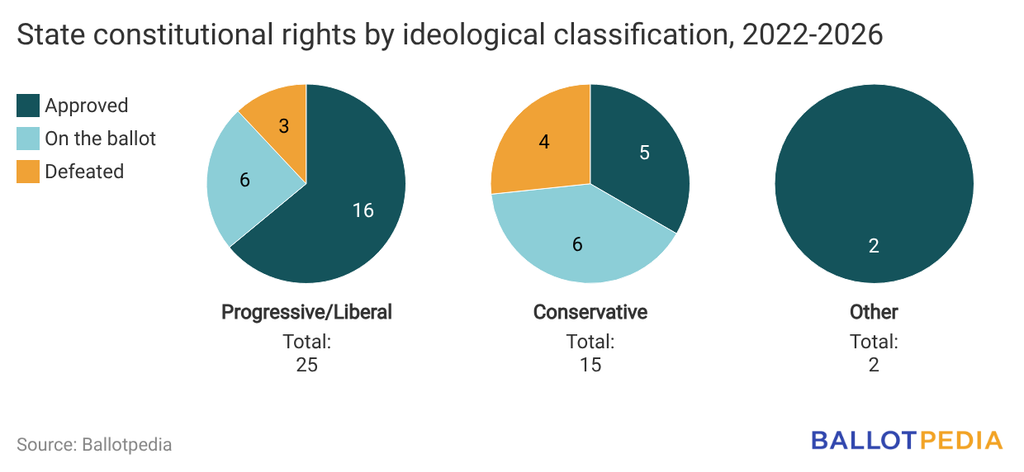
From 2022 through 2026, we identified 43 measures on 26 statewide ballots related to state constitutional rights. Twenty-eight of those measures were legislative referrals, and 15 were citizen initiatives. Referrals were evenly split between progressive/liberal and conservative measures. All but three of the initiatives were progressive/liberal.
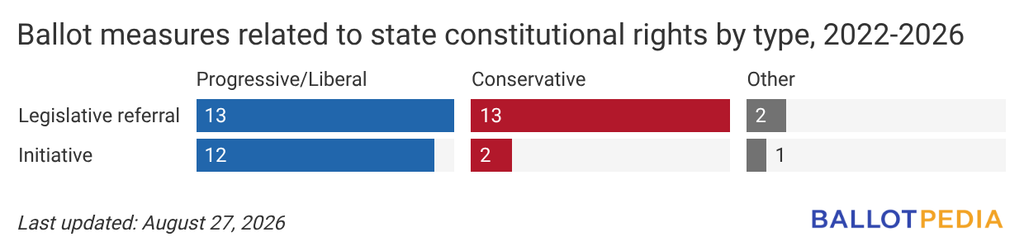
Voters decided 12 initiatives, approving eight and rejecting four. Legislative referrals were approved at a higher rate with 15 of the 18 approved. Three were defeated.
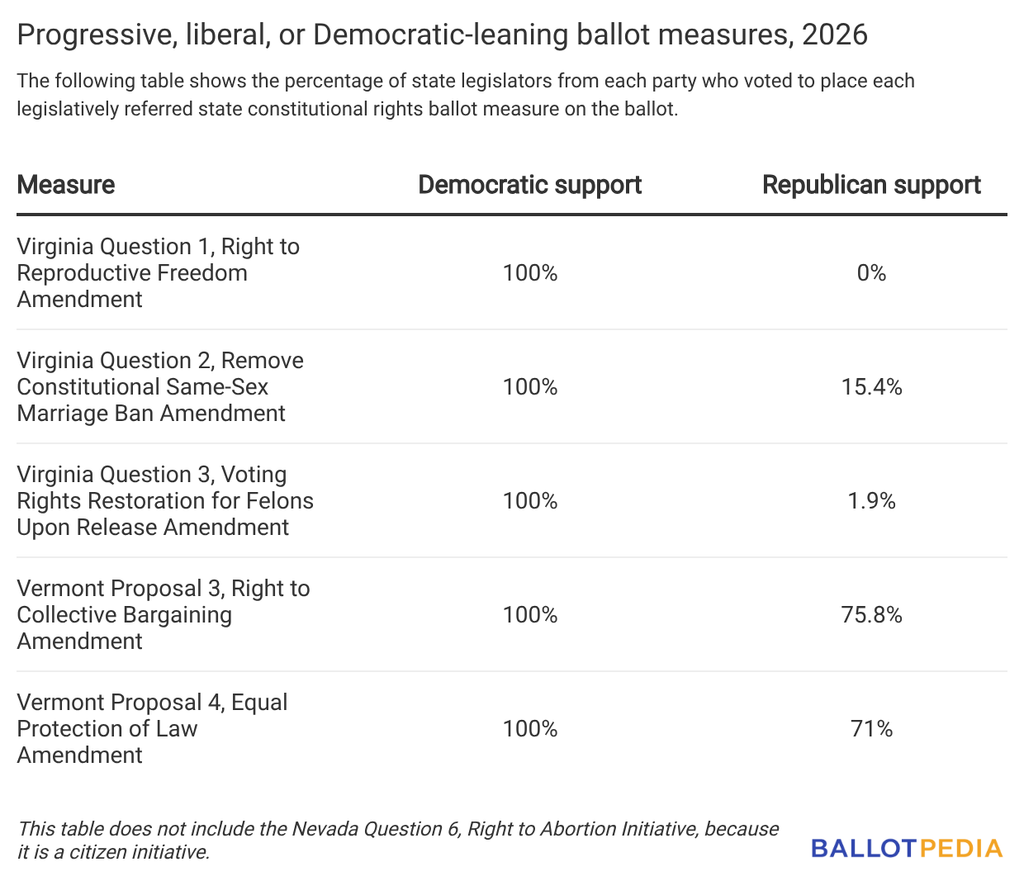
Voters in three states will decide on six progressive, liberal, or Democratic-leaning measures
Nevada voters will decide on Question 6, which they approved 64.4% to 35.6% in 2024. Voters need to approve the amendment, which would provide a right to abortion, in two even-numbered years to be added to the state constitution. Former Vice President Kamala D. Harris (D), U.S. Sen. Jacky Rosen (D-Nev.), and Planned Parenthood Votes Nevada.
Virginia voters will decide on three measures:
- Question 1 would establish a right to reproductive freedom in the state constitution. Currently, abortion is legal up until the third trimester based on a woman's last menstrual period in Virginia.
- Question 2 would remove a provision in the state constitution that states marriage is between one man and one woman. It would also add a provision stating that "marriage is one of the vital personal rights essential to the orderly pursuit of happiness" and prohibit the state from denying a marriage license to two adults based on their sex, gender, or race. Since 2020, four states have approved measures to repeal same-sex marriage bans in their state constitutions.
- Question 3 would state that persons convicted of felonies lose their right to vote only while incarcerated and have their political rights, including voting, restored upon release.
Vermont voters will decide on two measures:
- Proposal 3 would establish a state constitutional right for employees to organize or join a labor organization for collective bargaining and prohibit laws that ban agreements requiring union membership as a condition of employment.
- Proposal 4 would prohibit denying rights to an individual based on race, ethnicity, sex, religion, disability, sexual orientation, gender identity, gender expression, or national origin.
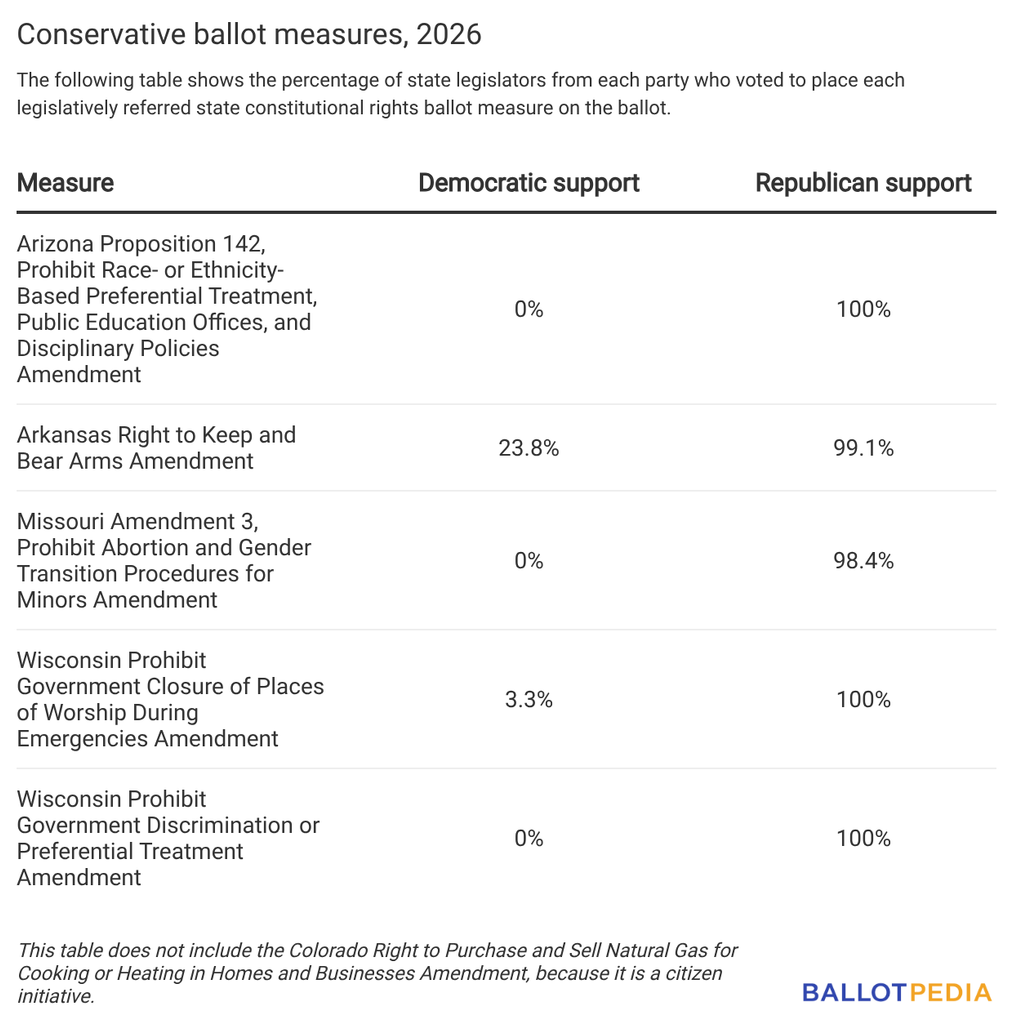
Voters in five states will decide on six conservative measures
Colorado voters will decide on an initiative granting consumers the right to purchase natural gas for cooking or heating in homes or businesses, and allowing distributors and utilities to sell natural gas to consumers. Advance Colorado, which describes itself as a "team of professionals and allies [who] are at work every day to push back on the progressive policies that have put our state on the wrong track," sponsored the amendment.
Arizona voters will decide Proposition 142, which would prohibit the state and government agencies from requiring an individual to endorse preferential treatment toward or discrimination against another individual based on race or ethnicity.
Arkansas voters will decide on an amendment to provide that the right to keep and bear arms is "a natural, fundamental, and individual right that shall not be infringed." Forty-five states have a right to bear arms in their state constitutions. California, Maryland, Minnesota, New Jersey, and New York do not.
Missouri voters will decide on Amendment 3, which would repeal the constitutional right to reproductive freedom that voters ratified in 2024, 51.6% to 48.4%. It would also prohibit gender transition surgeries for minors.
Wisconsin voters will decide on two measures:
- The first would prohibit the state or any political subdivision from ordering the closure of or forbidding gatherings in places of worship in response to a state of emergency.
- The second would prohibit any governmental entity from discriminating or granting preferential treatment based on race, sex, color, ethnicity, or national origin in public employment, public education, public contracting, or public administration.
One measure is a citizen initiative that has not received enough endorsements to be classified
Montana CI-133 would add the initiative and referendum power to the state's Declaration of Rights.
Click here for more information about this year's ballot measures related to state constitutional rights.
Ballotpedia update: Our expanding role in the artificial intelligence landscape
For years, the most common tool people used to get answers to political questions like “who’s on my ballot,” or “what ID do I need in order to vote,” was an internet search engine. And at the top of the results, more often than not, was a link to Ballotpedia. But that’s changing in two ways:
People are increasingly asking artificial intelligence chatbots questions about politics, elections, and policy.
Google now places an AI-generated summary at the top of a large share of its results, whether you asked for one or not. According to Similarweb data, these AI overviews appeared in roughly 43% of Google searches, up from about 15% a year earlier.
Where do chatbots and AI overviews get their information? According to two peer-reviewed papers, they get it from Ballotpedia's more than 700,000 original articles.
A similar story is emerging among political consultants, who use AI to help candidates manage the information chatbots draw on. This is sometimes called “answer engine optimization,” but it’s really a modern twist on a very old political goal: helping a candidate leave a favorable impression on a voter.
In an article for The Bulwark, Rob Flaherty, the former deputy campaign manager for Kamala Harris’ 2024 presidential campaign, wrote that what matters most for campaigns today occurs upstream of the chatbots. It’s what information is being researched and published on the sites that chatbots turn to for their answers — including Ballotpedia.
When a voter asks a chatbot what a candidate stands for, the chatbot answers with whatever it can find, and if the candidate hasn't said it anywhere, it falls back on someone else's characterization. That's why consultants and candidates alike have started treating Ballotpedia's Candidate Connection survey as an essential campaign tool. And because chatbots rely on Ballotpedia more than other sources, completing the survey is the most reliable way for a candidate to make sure the answer a voter reads is their answer rather than someone else's summary of it.
None of this works without the underlying content. We have more than 710,000 articles on our site today — all of them researched, written, and edited by our staff. AI won't change how we gather and present information. What it's doing is adding a new avenue for us to put our information in front of far more people at the moment they're deciding how to vote.
Indiana voters to decide on a constitutional amendment for the first time since 2018

Welcome to our next installment of our 50 States in 50 Days series, covering Indiana. To view our archive of past editions, click here.
This year marks the first time that Indiana voters will decide on a constitutional amendment since 2018, when voters approved Public Question 1 by 71.3% to 28.7%.
From 2000 through 2024, Indiana voters decided on eight statewide ballot measures — approving all of them. Here's a closer look at the two measures that voters will decide on this year.
One measure would deny bail for individuals charged with crimes when the proof of the charge is evident, or the presumption is strong, and the accused individual poses a substantial risk to any other person or the community. This measure is one of four that voters will decide nationwide this year that would deny bail in more situations.
The other measure would require city and town court judges to reside in either the county where the court is located or the bordering county closest to the court.
We'll also be adding information about local measures in Indiana as they are certified ahead of the Nov. 3 election.
Want to see what's on your ballot this November? Click here to use our Sample Ballot Lookup Tool. Now let's take a closer look at what's happening in Indiana.
Voters must register online, in person, or via mail by Oct. 5.
Early voting opens Oct. 6 and ends Nov. 2.
Polls open on Election Day at 6:00 a.m. and close at 6:00 p.m.
Voter ID is required. To be accepted, an ID must include a person's photo, conform to their name as it appears in their voter registration record, be current or have expired after the date of the last general election, and be issued by the state of Indiana or the U.S. government. Under a 2025 law, IDs issued by an educational institution may not be used for voting. For more information on Indiana's voter ID law, click here.
Absentee/mail-in ballots must be requested by Oct. 22 and received by Nov. 3.
Current party control
Republicans represent seven congressional districts, and Democrats represent two. Both of Indiana's U.S. Senators are Republicans.
Republicans have a 40-10 majority in the Indiana Senate and a 70-30 majority in the Indiana House of Representatives. Because the governor is a Republican, Indiana is one of 23 states with a Republican trifecta. Indiana's attorney general and secretary of state are also Republicans. As a result, Indiana is one of 24 states with a Republican triplex. Republican governors appointed all five members of the Indiana Supreme Court.
Offices on the ballot
Elections are taking place for the U.S. House of Representatives.
There will also be elections for secretary of state, comptroller, and treasurer. Twenty-five seats in the state Senate and all 100 seats in the state House are up for election.
Three Indiana intermediate appellate court judges are up for retention elections.
Indiana is one of 32 states where we are providing comprehensive election coverage down to the local level this November. This year's ballot includes elections for municipal and county offices as well as for school boards.
Notable election
Indiana Secretary of State: Beau Bayh (D), Max Engling (R), Greg Ballard (I), and Lauri Shillings (L) are running. Republicans have controlled the secretary's office since 1994. Engling defeated incumbent Diego Morales (R) at the June 20 Republican convention. Indiana Capital Chronicle's Leslie Bonilla Muñiz wrote, "What is typically a low-interest, down-ballot contest has gained prominence in recent years as state leaders take cues from President Donald Trump's administration and toughen voting laws."
Tomorrow, we'll preview elections in Wyoming, the Equality State.
Click here to see every edition of 50 States in 50 Days as we publish them, and here to use our Sample Ballot Lookup Tool.