



On Nov. 3, Colorado voters will decide on 14 ballot measures, including seven state statutes, six constitutional amendments, and one combined constitutional amendment and state statute.
Of the proposed state statutes, six were led by citizen initiatives, and one was a legislative referral and would require a simple majority vote to be approved:
- Proposition 132, a citizen initiative, would increase felony penalties for the distribution, manufacturing, dispensing, sale, or possession of fentanyl; require court-ordered treatment for Level 4 drug felonies for possessing fentanyl; and remove drug possession exceptions in determining whether an individual is considered a habitual criminal.
- Proposition 133, a citizen initiative, would require life in prison without parole or release for persons convicted of human trafficking a child for sexual servitude.
- Proposition 134, a citizen initiative, would require student athletes to participate on men's or women's school and collegiate athletic teams that match their sex, defined by biological reproductive systems. The measure would not limit participation in teams designated as coeducational or mixed.
- Proposition 135, a citizen initiative, would prohibit healthcare professionals from performing or providing surgeries to anyone under the age of 18 for the purpose of changing the person's sex characteristics based on their perception of sex or gender. Additionally, the measure would prohibit state and federal funds — such as Medicaid or insurance coverage — from paying for these surgeries.
- Proposition 136, a citizen initiative, would cap individual and corporate income tax at 4.4% of a taxpayer's federal taxable income. This measure competes with Amendment 87, which would establish a graduated income tax ranging from 3.7% to 8.4%.
- Proposition 137, a citizen initiative, would exempt sales tax revenue generated from the sale of sporting goods and equipment from the provision in the Taxpayer's Bill of Rights (TABOR), which requires excess funds to be refunded to voters. Instead, the initiative would allocate the revenue to a newly created fund for environmental protection and wildfire prevention, called the Conserve and Protect Colorado's Water, Land, and Forests Fund.
- Proposition NN, a legislative referral, would increase the TABOR cap and use surplus funds — totaling about $4.6 billion — for K-12 education expenses, as well as dedicate at least half of the total surplus and an additional 2% of the state's K-12 education expenditures to K-12 schools.
Of the proposed constitutional amendments, all six were led by citizen initiatives and would require a 55% supermajority vote to be approved:
- Amendment 81 would require state and local law enforcement to notify the U.S. Department of Homeland Security within 72 hours when an individual being charged is not lawfully in the United States, and the individual is charged with a crime of violence, as defined by law, or the individual has been convicted of a prior felony.
- Amendment 82 would grant consumers the right to purchase natural gas for cooking or heating in homes or businesses, and for distributors and utilities to sell natural gas to consumers.
- Amendment 83 would establish a right to hunt, fish, and take fish and wildlife through traditional methods.
- Amendment 84 would require voters casting ballots by mail to provide both their signature and an identification number, such as the last four digits of their Social Security number or an identification number meeting federal REAL ID requirements, as well as require election officials to compare the submitted information to the statewide voter registration database to determine if there are any discrepancies.
- Amendment 85 would require ballot questions to be in plain language at no more than an eighth-grade reading level. Additionally, the amendment would prohibit any state statute from mandating language preceding, following, or in a ballot title of a measure that is not in plain language or exceeds an eighth-grade reading level.
- Amendment 86 would require both the state's independent redistricting commission and the Colorado Supreme Court to approve any mid-decade redistricting maps. Additionally, the amendment would prohibit approving maps drawn purposefully to favor one political party.
One measure, Amendment 87, is a combined initiated constitutional amendment and state statute and would require a 55% supermajority vote to pass. Amendment 87 would:
- establish a graduated income tax, ranging from 3.7% to 8.4%;
- remove the uniform tax rate requirement from TABOR; and
- allocate the revenue to the Colorado Future's Account, which funds K-12 public school education, health care, and early child care programs.
Amendment 87 is competing with Proposition 136, which would cap individual and corporate income tax at 4.4% of a taxpayer's federal taxable income. If voters approve both measures, the conflicting provisions of whichever measure receives more votes would take effect.
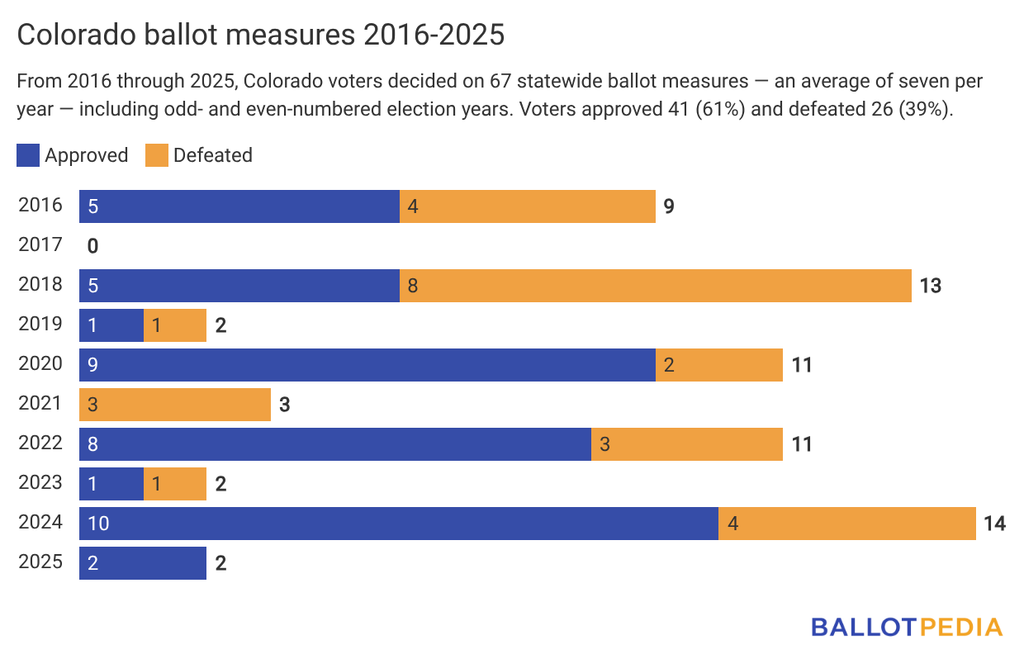
From 2016 through 2025, Colorado voters decided on 67 statewide ballot measures — an average of seven per year — including odd- and even-numbered election years. Voters approved 41 (61%) and defeated 26 (39%).
Additional reading: