


Welcome to the Monday, Sept. 14, 2026, Brew.
By: Briana Ryan
Here’s what’s in store for you as you start your day:
- New York's commissioner of education was the highest-paid state executive official in 2025
- Georgia’s trifecta status will be decided in the Nov. 3 elections
- Voters in 40 states will decide on at least 164 statewide ballot measures this year
New York's commissioner of education was the highest-paid state executive official in 2025
In a Ballotpedia analysis of 2025 compensation data for statewide executive officers, we found that the highest-paid state executive official was New York's commissioner of education, with a salary of $489,000. The lowest-paid state executive official was the lieutenant governor of Texas, with a base salary of $7,113. However, the lieutenant governor receives additional compensation when serving as acting governor.
Our analysis covered the following offices in each state, where applicable: governor, lieutenant governor, attorney general, secretary of state, treasurer, controller, auditor, superintendent of schools, insurance commissioner, agriculture commissioner, natural resources commissioner, labor commissioner, and public service commissioner.
Among those offices, the Kansas secretary of state received the largest salary increase from 2024 to 2025, at 81.5%. The attorney general of Louisiana received the largest salary decrease, at 17.7%.
The state with the highest gubernatorial salary was New York at $250,000, and the state with the lowest was Maine at $70,000.
In 16 states, gubernatorial salaries increased from 2024 to 2025. Gubernatorial salaries in seven states decreased from 2024 to 2025.
The gubernatorial salary in Kansas had the largest increase, at 53.4%, while the gubernatorial salary in Minnesota had the largest decrease, at 14.65%.
State constitutions or statutes often determine state executive officers' pay. In some states, a department of personnel or administration establishes a compensation scheme. Most often, laws define the salary portion of an officer's compensation. But state agencies, customs, or other factors may establish additional benefits. In some cases, salaries automatically increase each year either at the rate of inflation or by some other percentage that the state legislature chooses.
Click here for more information about the compensation of state executive officials.
Georgia’s trifecta status will be decided in the Nov. 3 elections

Welcome to our next installment of our 50 States in 50 Days series, covering Georgia. To view our archive of past editions, click here.
Georgia's trifecta status will be decided in the Nov. 3 elections. The state has an open governor's race, and all 56 seats in the Georgia Senate and all 180 seats in the Georgia House of Representatives are up for election.
Republicans have a 33-22 majority with one vacancy in the state Senate and a 99-81 majority in the state House. Because the governor is a Republican, Georgia is one of 23 states with a Republican trifecta.
We categorize Georgia's trifecta as moderately exposed to breaking. Democrats would need to win at least seven seats to gain control of the state Senate, and Republicans would need to lose no more than four seats to maintain their majority. Democrats would need to win at least 10 seats to gain control of the state House, and Republicans would need to lose no more than eight seats to maintain their majority.
Want to see what's on your ballot this November? Click here to use our Sample Ballot Lookup Tool. Now let's take a closer look at what's happening in Georgia.
Voters must register online, in person, or via mail by Oct. 5.
Early voting opens Oct. 13 and ends Oct. 30.
Polls open on Election Day at 7:00 a.m. and close at 7:00 p.m.
Voter ID is required. Acceptable forms of ID include a Georgia driver's license, student ID, U.S. passport, or military photo ID. Under a 2025 law, digital driver's licenses are not allowed as acceptable forms of identification. Click here for more information on voter ID in Georgia.
Absentee/mail-in ballots must be requested by Oct. 23 and received by Nov. 3.
Current party control
Democrats represent five congressional districts, and Republicans represent nine. Both of Georgia's U.S. Senators are Democrats.
In addition to having a Republican trifecta, Georgia is one of 24 states with a Republican triplex. That's because the state's governor, attorney general, and secretary of state are all Republicans. Republican governors appointed eight justices on the Georgia Supreme Court, and one justice initially won a nonpartisan election.
Offices on the ballot
U.S. Senate and U.S. House of Representatives elections will be on the ballot.
In addition to the gubernatorial and legislative offices mentioned above, there will also be elections for lieutenant governor, attorney general, secretary of state, agriculture commissioner, insurance and safety fire commissioner, labor commissioner, superintendent of public instruction, and two seats on the Public Service Commission.
Georgia is one of 32 states where we are providing comprehensive election coverage down to the local level this year.
Notable elections
U.S. Senate: Incumbent Sen. Jon Ossoff (D), Mike Collins (R), and four other candidates are running. Ossoff is the only Democrat running for re-election in a state that President Donald Trump (R) won in 2024. Trump also won the state in 2016, and Joe Biden won it in 2020. Four independent election forecasters have rated the general election as lean Democratic, tilt Democratic, or likely Democratic.
Governor: Keisha Lance Bottoms (D) and Rick Jackson (R) are running. Incumbent Gov. Brian Kemp (R) is term-limited. Three independent election forecasters have rated the general election as a toss-up.
Public Service Commission: Incumbent Peter Hubbard (D) and Fitz Johnson (R) are running in District 3. Shelia Edwards (D), Josh Tolbert (R), and Thomas Blooming (L) are running in the open race for District 5. In the 2025 elections, Republicans' 5-0 majority on the commission decreased to 3-2. If both Hubbard and Edwards win, Democrats will gain a 3-2 majority on the commission. If either Johnson or Tolbert wins, Republicans will maintain their majority.
Statewide ballot measures
There are three statewide measures on the ballot this year. From 2000 through 2024, Georgia voters decided on 69 ballot measures, or five per even-numbered year. During that period, voters approved 59 measures and defeated 10.
Here's a closer look at the measures:
One measure would require that all probate judges in the state be elected on a nonpartisan basis. Currently, the Georgia Constitution requires that state supreme court and Georgia Court of Appeals judges be elected on a nonpartisan basis. Probate judges are excluded from that requirement.
A second measure would allow the Georgia General Assembly to create and dedicate revenue to a fund titled the Georgia Next Generation 9-1-1 Fund. The revenue in the fund could only be used to update and operate the state's 9-1-1 systems, including transitioning the state's existing system to a new, IP-based network.
The third measure would increase the maximum amount of land that a single owner can enroll in Georgia's Conservation Use Valuation Assessment (CUVA) program from 2,000 to 4,000 acres. Under CUVA, land used for farming, timber production, or conservation is taxed at 40% of its current use value instead of its full market value.
Join us again tomorrow when we'll preview elections in Idaho, the Gem State.
Click here to see every edition of 50 States in 50 Days as we publish them, and here to use our Sample Ballot Lookup Tool.
Voters in 40 states will decide on at least 164 statewide ballot measures this year
As of Sept. 9, voters in 40 states will decide on at least 164 statewide ballot measures this year. That’s more than the historical average of 152 at this point in even-numbered years from 2014 through 2024. From 2014 through 2024, an average of 153 measures were certified per year in even-numbered years.
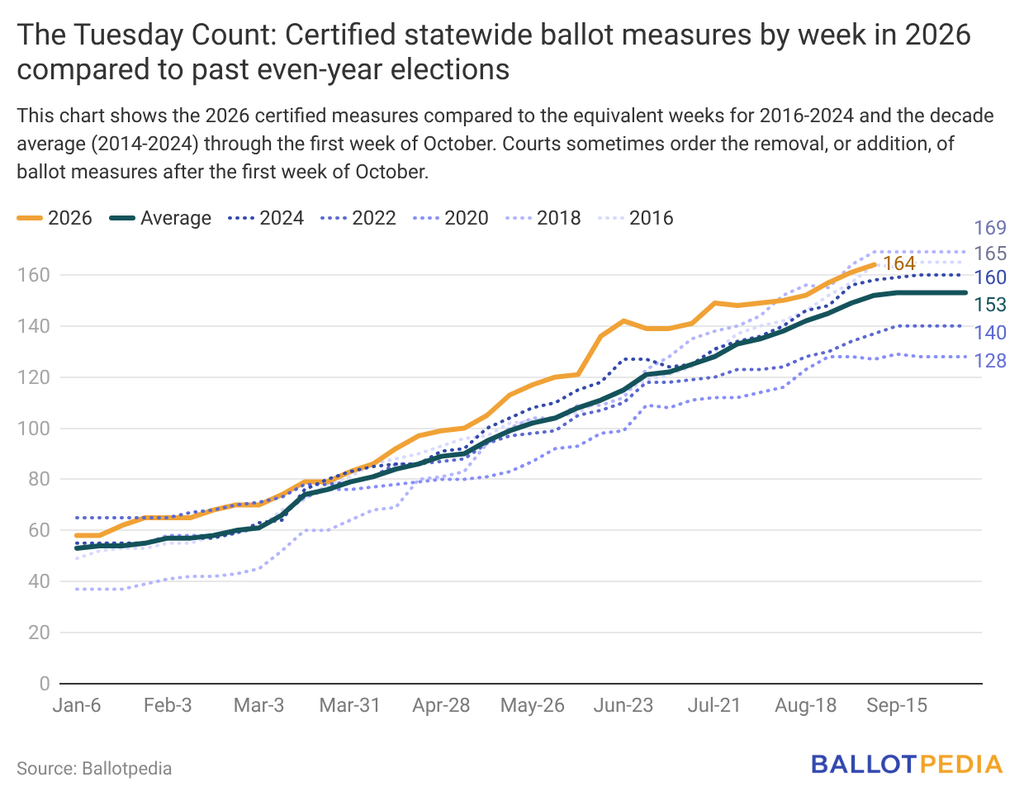
One reason for this total is that three states have more citizen initiatives on this year's ballot than their historical averages for even-numbered years from 2014 through 2024:
- There are 14 initiatives on the California ballot, above its average of 12.
- There are 14 initiatives on the Colorado ballot, above its average of 10.
- There are nine initiatives on the Massachusetts ballot, above its average of three.
The 164 measures address a variety of topics, with three topics having a record number of such measures on the ballot this year.
Initiative and referendum process
Voters in seven states will decide on nine measures that address the initiative and referendum process this year — the most such measures in any year in the 21st century.
On Nov. 3, voters in California, Idaho, North Dakota, South Dakota, and Utah will decide on five measures that would add requirements or restrictions to the initiative and referendum process. Voters in Missouri and Montana will decide on two measures to preserve petition and qualification requirements and limit government changes to the initiative process.
Voters in Missouri and North Dakota have already decided on two measures that proposed adding requirements or restrictions to the initiative and referendum process. In June, North Dakota voters approved Measure 1 66.4% to 33.6%. In August, Missouri voters defeated Amendment 4 80.3% to 19.7%.
Voter identification requirements
Voters in seven states will decide on seven measures that would establish or expand voter ID requirements in state constitutions — the most since 2004.
On Nov. 3, voters in Arizona, California, Colorado, Nevada, North Carolina, and Ohio will decide on voter ID measures. In August, Oklahoma voters approved State Question 846 54.6% to 45.4%.
Housing policy
On Nov. 3, voters in four states will decide on six housing policy measures — the most since 2006.
Measures in Hawaii and Rhode Island would provide public funding or incentives for housing development. Two measures in California — Proposition 1 and Proposition 37 — would provide public funding and support for housing aid. Measures in California and Massachusetts would address local land development regulations, zoning, restrictions, and planning.
Click here to check out our ballot measure hub for a full list of measures that have qualified in each state this year.