


Welcome to Ballot Bulletin: Ballotpedia's Weekly Election Policy Digest. Every Tuesday, we deliver the latest updates on election policy around the country, including nationwide trends and recent legislative activity.
In this week’s edition, we cover 15 bills state legislatures acted on last week and look at legal developments regarding President Donald Trump’s executive order on absentee/mail-in voting.
The state of election legislation in the U.S.
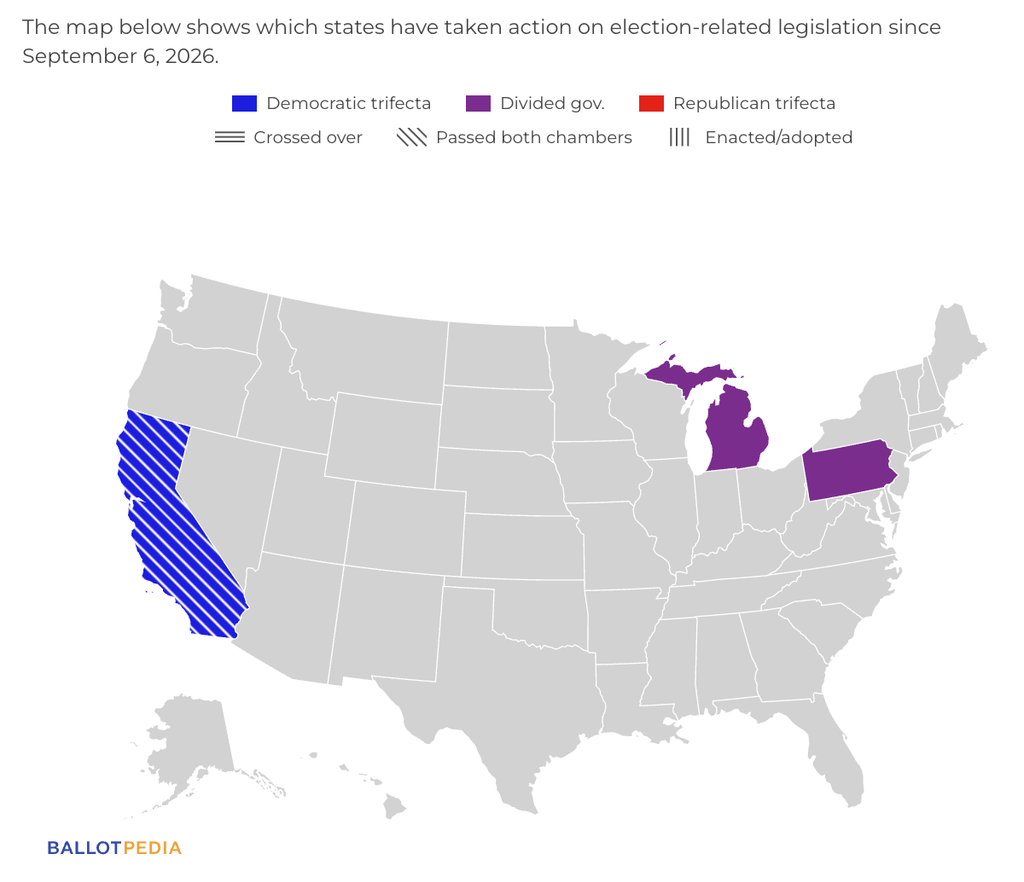
Lawmakers in three states acted on 15 election-related bills last week. Five state legislatures are in regular or special sessions. Last week, no bills were enacted, no bills passed both chambers of a state legislature, and no bills were vetoed.
Of the bills acted on last week, 10 (66.7%) are in states with Democratic trifectas, none are in states with Republican trifectas, and five (33.3%) are in states with divided government. The most active bill categories last week were campaign finance (6), enforcement and election fraud (6), and ballot measures (5).
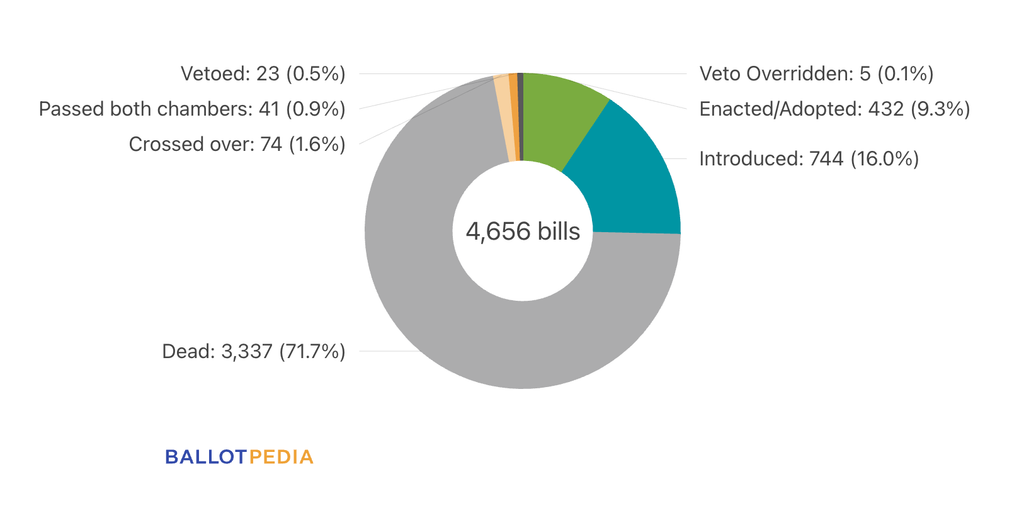
We are currently tracking 4,656 election-related bills across the country. The chart below breaks down the status of those bills based on where they stand in the legislative process:
Enacted bills
No bills were enacted or adopted last week.
Bills passing both chambers
No bills passed both chambers of a state legislature last week.
To see a full list of bills awaiting gubernatorial action, click here.
Vetoed bills
No bills were vetoed last week.
To see a list of all bills vetoed this session, click here.
All bills
The chart below shows all bills Ballotpedia is currently tracking, broken down by partisan sponsor.
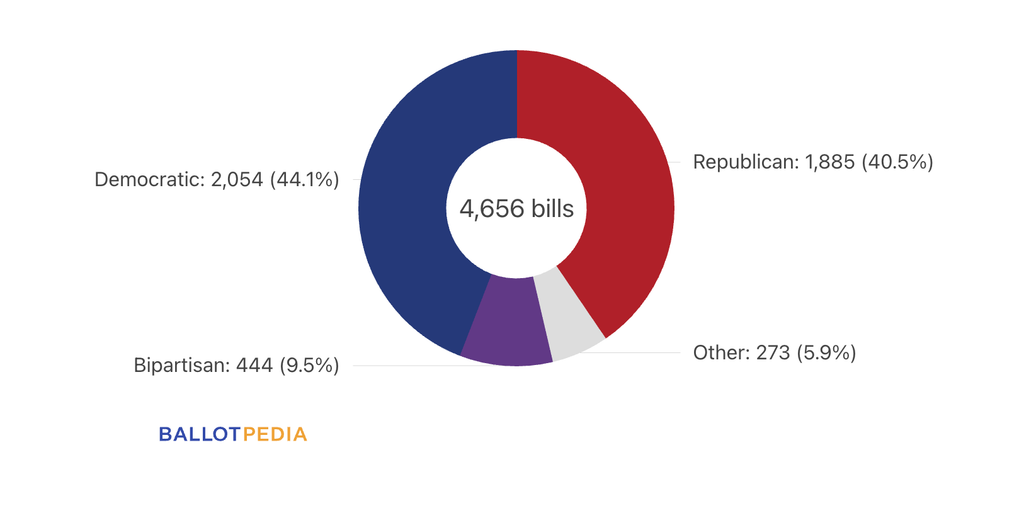
We are currently following 4,656 election-related bills, including bills carried over from the previous year.
- Trifecta status
- Democratic: 2,002 (43%)
- Republican: 1,651 (35.5%)
- Divided: 1,003 (21.5%)
- Partisan sponsorship
- Democratic: 2,054 (44.1%)
- Republican: 1,885 (40.5%)
- Bipartisan: 444 (9.5%)
- Other: 273 (5.9%)
In the news
On Sept. 10, Missouri Secretary of State Denny Hoskins (R) said he was directing local election officials to use the congressional map the state legislature adopted in 2022 in the state’s November general election.
Due to ongoing legal challenges, it has been uncertain in recent weeks whether Missouri’s 2026 congressional elections would be held under the new districts adopted by the state legislature in 2025 or under the districts adopted by the legislature in 2022. Missouri voters nominated candidates under the 2025 map in the state’s Aug. 4 primary.
Under the 2022 map, Missouri’s U.S. House delegation includes two Democrats and six Republicans. Based on the 2024 presidential election results in the state, the 2025 map would likely result in one Democrat and seven Republicans being elected.
On Sept. 10, the U.S. Supreme Court stayed a federal district court order in conflict with a Missouri Supreme Court ruling, which ordered that the 2025 map would not be in effect unless it was approved by voters. The U.S. Court of Appeals for the Eighth Circuit is scheduled to hear oral arguments in the case on Sept. 17.
Here are other news stories from across the country:
- On Sept. 9, U.S. Solicitor General D. John Sauer filed a motion with the U.S. Supreme Court to stay an order from the U.S. District Court for the District of Columbia in League of Women Voters v. U.S. Department of Homeland Security. The case concerns the implementation of a modified version of the Systematic Alien Verification for Entitlements (SAVE) database adopted in response to an executive order President Donald Trump (R) issued in March. To comply with the executive order, DHS modified the SAVE system to include information on natural-born citizens, be capable of accessing Social Security numbers, and permit bulk record searches in the database. On June 22, the district court issued an order blocking implementation of the overhauled SAVE system. In the court’s opinion, Judge Sparkle Sooknannan said that by using the modified SAVE database, “the federal government has knowingly trampled on the privacy rights of American citizens in a manner that threatens the sacred right to vote.” On Sept. 4, in a 2-1 decision, the U.S. Court of Appeals for the District of Columbia Circuit upheld the district court’s order. In the government’s motion for a stay, Sauer wrote that the district court’s order “threatens the integrity of upcoming elections by vacating the federal government’s authority to internally use Social Security data when fulfilling its duty to respond to requests by States to verify the citizenship of individuals for voting and other purposes.”
- On Sept. 10, the U.S. District Court for the Southern District of Indiana dismissed a lawsuit challenging new Indiana laws requiring individuals who registered to vote with temporary driver’s licenses issued to noncitizens to provide proof of citizenship before being registered to vote. The laws also require crosschecks of voter registration records with data from the Bureau of Motor Vehicles to identify individuals who registered using temporary licenses. On Oct. 21, 2025, four nonprofit organizations sued Indiana Secretary of State Diego Morales (R) and the state’s Election Directors, saying that the laws violate the National Voter Registration Act and Civil Rights Act. Writing for the court, Judge Matthew Brookman dismissed the plaintiffs’ complaint due to lack of standing and gave them 28 days to submit an amended complaint.
Policy spotlight: U.S. Supreme Court leaves order blocking USPS absentee/mail-in voting rules in place for 2026 election
The story below is adapted from a recent Ballotpedia News story by Andrew Bahl.
On Sept. 14, the U.S. Supreme Court declined to reverse a lower court order blocking the implementation of an executive order President Donald Trump (R) issued in March that would prohibit the delivery of absentee/mail-in ballots to anyone not enrolled by state election officials in a U.S. Postal Service portal.
The ruling means that the rules implementing the order, issued by the USPS in August, will not be in effect for the Nov. 3 election. Those rules require state officials to enroll voters in a USPS portal in order for them to receive a ballot in the mail. The physical mail must also meet set standards and contain certain information, such as a unique barcode for each ballot envelope.
U.S. District Judge Indira Talwani issued a preliminary injunction on Sept. 4 blocking the rules from being implemented for the 2026 election. The ruling came in response to two lawsuits filed by multiple states and organizations.
The U.S. Department of Justice then appealed that decision to the U.S. Court of Appeals for the First Circuit and the Supreme Court, arguing the rules fell within the authority Congress has given to USPS. On Sept. 10, the First Circuit denied the government's request for a stay, and on Sept. 13, a second district court judge issued a preliminary injunction blocking the rules.
In an unsigned order, the Supreme Court held that the “Government is unlikely to succeed on the merits of its challenge to the District Court’s preliminary injunction. And the equitable factors applicable for obtaining emergency relief from this Court do not favor a stay.”
Justice Brett Kavanaugh wrote in a concurring opinion that “applying the rule in the 2026 elections would be arbitrary and capricious in violation of the Administrative Procedure Act because state and local election officials do not have sufficient time to reasonably implement the rule before the elections.” However, Kavanaugh wrote that there was “at least a fair prospect that the final rule falls within the Postal Service’s statutory authority.”
In a dissenting opinion, Justice Samuel Alito said that he believed the government had demonstrated the need for a stay. He was joined in the opinion by Justice Clarence Thomas.
Alito wrote that some of the plaintiffs likely do not have standing to sue and that the rules likely fall within USPS’s statutory authority. He wrote that the government has “a strong interest in enforcing the rule, and implementing it will also ‘enhance the visibility of federal ballot mail’ in order to better detect election fraud.”
At least three states — Alabama, North Carolina, and Wisconsin — have mailed ballots to voters in recent days. While the order blocks the rules from being implemented for the 2026 elections, states may voluntarily comply with its provisions if they wish.