


Welcome to the Wednesday, Sept. 16, 2026, Brew.
By: Briana Ryan
Here’s what’s in store for you as you start your day:
- Voters in six states are deciding on nine income or wealth tax measures this year — the most since 2000
- Iowa’s trifecta status will be decided in the Nov. 3 elections
- Three Arizona candidates are running for two at-large seats on the Higley Unified School District’s Governing Board
Voters in six states are deciding on nine income or wealth tax measures this year — the most since 2000
This year, voters in six states will decide or have already decided on nine statewide ballot measures regarding income or wealth taxes — the most such measures since 2000.
Income tax measures include taxes on wages, business earnings, investment income, and capital gains. Wealth tax measures concern taxes based on the ownership or value of assets or net worth.
The first of these measures was decided on Aug. 4 when Missouri voters defeated Amendment 5, 83.3% to 16.7%. It would have, among other changes, amended the state constitution to reduce the state individual income tax, based on revenue growth, until the tax was eliminated.
The remaining eight measures will appear on the Nov. 3 ballot in California, Colorado, Iowa, North Carolina, and Washington.
The nine measures cover the following policy areas:
- Two would allow, create, or increase income taxes.
- Five would prohibit, cap, or decrease income taxes.
- One would allow, create, or increase wealth taxes.
- One would prohibit, cap, or decrease wealth taxes.
State legislatures put three of the nine measures on the ballot, all of which would prohibit, cap, or decrease income taxes. The three measures that would allow, create, or increase income or wealth taxes are citizen initiatives. Three measures that would prohibit, cap, or decrease income or wealth taxes are also citizen initiatives.
Between 2000 and 2025, voters decided on 40 income or wealth tax measures, approving 20 and defeating 20.
During that period, voters approved nine measures and defeated nine others that would allow, create, or increase income taxes. Voters also approved nine measures and defeated 11 others that would prohibit, cap, and decrease income taxes. Voters approved both measures with mixed income tax policies.
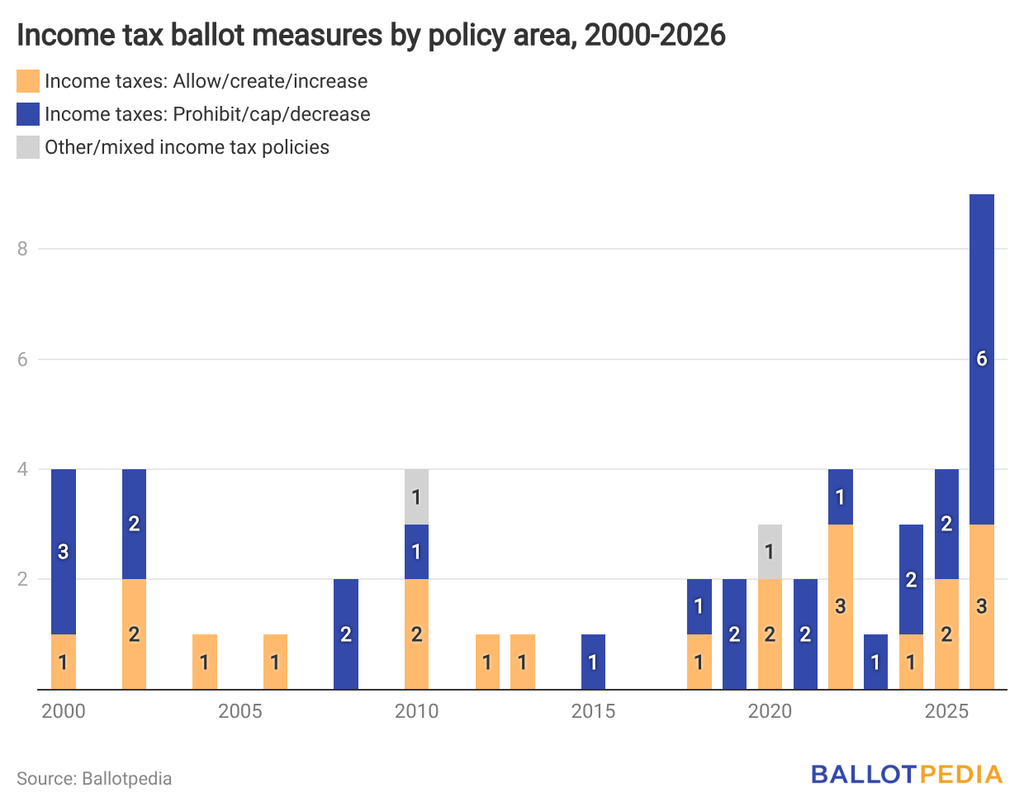
Voters in California and Colorado will decide on multiple income or wealth tax measures this year.
California Proposition 3 would indefinitely extend the top marginal income tax rates of 10.3% to 12.3% on higher incomes and allocate the revenue primarily to K–12 schools and community colleges. Proposition 40 would impose a one-time 5% tax on the accumulated wealth of taxpayers and trusts with covered assets valued at more than $1 billion and allocate the revenue to healthcare, education, and food assistance programs. Proposition 42 would prohibit new taxes on the ownership or control of retirement holdings, individually owned assets, and personal savings, and prohibit taxes that impose retroactive liability.
Proposition 40 contains a competing measure provision that would nullify Proposition 42 if both measures are approved but Proposition 40 receives more votes. Proposition 42 also contains a competing measure provision that would nullify Proposition 40 if both are approved but Proposition 42 receives more votes.
Colorado Initiative 195 would establish a graduated income tax, ranging from 3.7% to 8.4%, and remove the uniform tax rate requirement from the Taxpayer's Bill of Rights (TABOR). Additionally, the revenue generated from this change would be allocated towards the Colorado Future's Account. Initiative 232 would establish a 4.4% cap on individual and corporate income tax rates, the current rate.
The campaigns supporting California Proposition 42 have raised the most money among the nine measures. Yes on 42 - Protect Retirement & Life Savings and Building a Better California, the two campaigns backing the measure, have raised a combined $52.7 million through June 30.
Of the three measures that we have not already mentioned:
- Iowa Amendment 1 would require a two-thirds vote in each chamber of the state legislature to increase individual or corporate income tax rates or create a new state income tax.
- North Carolina Income Tax Rate Cap from 7% to 3.5% Amendment would lower the maximum allowable state income tax rate in the state constitution from 7% to 3.5%.
- Washington Repeal Tax on Household Income Over $1 Million and Prohibit State and Local Taxes on Income Initiative would repeal the 9.9% tax on individual and household income above $1 million and prohibit state and local governments from imposing taxes on individual income.
Click here to read more about income and wealth tax measures on the ballot this year.
Iowa’s trifecta status will be decided in the Nov. 3 elections

Welcome to our next installment of our 50 States in 50 Days series, covering Iowa. To view our archive of past editions, click here.
Iowa’s trifecta status will be decided in the Nov. 3 elections. Rob Sand (D) and Zach Lahn (R) are running in the open governor’s race that three independent race forecasters have rated as Tilt or Lean Democratic. The Hill's Caroline Vakil wrote that "While Iowa hasn't elected a Democrat for governor in two decades, Democrats see an unusually strong candidate in Sand. He is currently the only member of the party to hold a statewide office in Iowa ... Lahn has touted his background as a six-generation Iowan and positioned himself as the anti-establishment Republican candidate."
Twenty-five seats in the Iowa Senate and all 100 seats in the Iowa House of Representatives are also up for election. Republicans have a 32-17 majority with one vacancy in the state Senate and a 67-33 majority in the state House. Because the governor is a Republican, Iowa is one of 23 states with a Republican trifecta.
We categorize Iowa's trifecta as somewhat exposed to breaking. Democrats would need to win at least eight seats to gain control of the state Senate, and Republicans would need to lose no more than seven seats to maintain their majority. Democrats would need to win at least 17 seats to gain control of the state House, and Republicans would need to lose no more than 17 seats to maintain their majority.
Want to see what's on your ballot this November? Click here to use our Sample Ballot Lookup Tool. Now let's take a closer look at what's happening in Iowa.
Voters must register online or via mail by Oct. 19. Voters can also register in person through Nov. 3.
Early voting opens on Oct. 14 and ends Nov. 2.
Polls open on Election Day at 7:00 a.m. and close at 8:00 p.m.
Voter ID is required. Acceptable forms of ID include an Iowa driver’s license or non-operator ID, a U.S. passport, or a U.S. military or veterans ID. A voter without a listed form of ID may provide a signed voter registration card or a form of ID that is acceptable for same-day voter registration, such as an out-of-state driver’s license or student ID. A 2026 law removed the option for a person without an ID to have another registered voter attest to their identity. Click here for more information on voter ID in Iowa.
Absentee/mail-in ballots must be requested by Oct. 19 and returned by Nov. 3.
Current party control
Republicans represent all four congressional districts and both U.S. Senate seats.
In addition to having a Republican trifecta, Iowa is one of 24 states with a Republican triplex. That's because the state's governor, attorney general, and secretary of state are all Republicans. Republican governors appointed all seven members of the Iowa Supreme Court.
Offices on the ballot
Elections are taking place for the U.S. Senate and the U.S. House of Representatives.
In addition to the gubernatorial and legislative offices mentioned above, there will also be elections for lieutenant governor, attorney general, secretary of state, auditor, agriculture commissioner, and treasurer.
Three intermediate appellate court judges are up for retention elections.
Iowa is one of 32 states this year where we are providing comprehensive election coverage down to the local level. This year’s ballot includes elections for municipal, county, and judicial offices.
Notable elections
U.S. Senate: Josh Turek (D), Ashley Hinson (R), and Thomas Laehn (L) are running in the open race. According to CBS News' Kaia Hubbard, "Democrats have been hopeful about their chances, as affordability issues and the Trump tariff policies weigh on Iowans. ... It will be challenging for a Democrat to flip the seat in a state that's become a Republican stronghold in recent years."
1st Congressional District: Incumbent Rep. Mariannette Miller-Meeks (R), Christina Bohannan (D), and Michael Bridgford (I) are running. This race is the third rematch between Miller-Meeks and Bohannan. Miller-Meeks defeated Bohannan 53.4% to 46.6% in 2022 and 50.0% to 49.8% in 2024.
Statewide ballot measures
There is one statewide measure on the ballot this year. From 2000 to 2025, Iowa voters decided a total of eight measures — approving five measures and defeating three.
Amendment 1 would require a two-thirds vote of both chambers of the Iowa General Assembly to pass a bill that would increase the individual or corporate income tax rate or create a new income tax. It would not require local option taxes to be approved by a two-thirds majority. Amendment 1 is one of five measures on statewide ballots this year that would prohibit, cap, or decrease income taxes.
Join us again tomorrow when we'll preview elections in Rhode Island, the Ocean State.
Click here to see every edition of 50 States in 50 Days as we publish them, and here to use our Sample Ballot Lookup Tool.
Three Arizona candidates are running for two at-large seats on the Higley Unified School District’s Governing Board
Southeast of Phoenix, Arizona, the Higley Unified School District covers parts of Gilbert, Mesa, and Queen Creek, in one of the fastest-growing regions in the country. This year, three of the five seats on the district’s Governing Board are on the ballot, including a special election to fill a vacancy.
Today, we’re going to look at the race for two at-large seats on the board, and the three candidates running in it. All three candidates completed Ballotpedia’s Candidate Connection survey. Ballotpedia’s Candidate Connection helps voters better understand how their candidates think about the world and intend to govern. The survey becomes even more valuable when every candidate in a race completes it, allowing voters to compare and contrast the choices before them.
Higley Unified School District is the 20th-largest district in Arizona. Roughly 13,000 students attended the district's 16 schools in the 2023-24 school year. The election is taking place amidst declining student enrollment and budgetary challenges.
Two incumbents and a challenger
Incumbents Anna Van Hoek and Amanda Wade and challenger Michelle Morris are running in the election. Both Van Hoek and Wade were elected in 2022. Van Hoek has worked in banking, television, law enforcement, and insurance, while Wade has worked as a teacher. Morris has worked as a certified public accountant.
In her survey, Van Hoek said, “The public policy areas I care most about are education, parental rights, government transparency, and fiscal accountability. As a school board member, I believe parents are a child's first and most important teacher, taxpayers deserve openness and responsible stewardship, and every decision should be measured by whether it helps students succeed academically. My focus has always been on putting students first while ensuring the community's trust is earned through transparency and sound governance.”
Van Hoek signed Moms for Liberty’s Parents Pledge, which states that candidates will “honor the fundamental rights of parents including, but not limited to the right to direct the education, medical care, and moral upbringing of their children.” She wrote, “We have seen the damage that teachers unions and political agendas have done to public education across this country. Supporting teachers does not require supporting a union's political agenda. Those are two very different things.”
The Student First Coalition, which says that it supports conservative school board candidates, endorsed Van Hoek.
Wade is the president of the Governing Board. In her survey, Wade said, “Schools should be represented by individuals that know and understand how schools work. Public education has been constantly attacked by individuals who have no experience in education and have no interest in taking the time to see what is actually happening in our classrooms. Higley schools constantly perform amongst the top schools in the state and yet we still have folks claiming that Higley isn't doing its job. Higley needs champions to help keep our staff and students supported as the continue to provide the best possible education to our community.”
The Higley Education Association, the local teachers union, endorsed Wade, as did Save Our Schools Arizona, which says it is “fighting for strong public schools for a strong Arizona” and opposes Arizona’s private school choice programs.
Morris, in her survey, said, “I am passionate about ensuring all students have the opportunity, support and resources needed to reach their full potential knowing every child has unique strengths, needs and abilities. I am equally committed to being fiscally responsible and transparent with our community. The community deserves open communication and confidence that every decision is made with integrity and accountability. Finally I believe teachers and staff are the foundation of student success. They deserve to feel valued, respected and supported.”
The Higley Education Association and Save our Schools Arizona also endorsed Morris.
District challenges
The Higley Unified School District faces declining student enrollment and the expiration of a 15% maintenance-and-operations (M&O) budget override that voters approved in 2019. The override allowed the district to increase its maintenance and operations budget through 2026. Voters rejected the district’s request to extend the M&O in 2024 and 2025. According to the Gilbert Sun News, the “board earlier this year cut 37 teacher and teacher-support positions and 8.5 non-teaching positions, and eliminated an estimated $3.5 million in expenses.” The district cut 80 staff positions in 2024.
Van Hoek was the only member of the board to vote against placing a measure extending the M&O in 2024. She said the district would need to “look at budget reductions because we have to go back to functioning without ESSER [Elementary and Secondary School Emergency Relief] funds.” In a June 2026 op-ed in the AZ Free News, Van Hoek said the district should develop a 10-year facilities plan to deal with underutilized school facilities: “I believe the next step is for the district to begin a formal long-range facilities planning process. Whether through a board committee, community task force, or strategic planning effort, we need to start having honest discussions about enrollment trends, facility utilization, future land use, and the long-term costs associated with maintaining excess capacity.”
Wade supported the M&O in 2024 and 2025. In 2024, Wade said, “For those individuals who may feel as if they don't see the benefits of this, I challenge you to take a step back and look at some of the things that not only that schools provide for the community but how that reflects on your neighborhood, your home value and the desire for individuals to be here.”
Ballotpedia has not been able to identify whether Morris has taken a position on the M&O, but she did write: “With my background in accounting, I understand the financial challenges facing the district, especially following the recent override outcome, and I am prepared to help make thoughtful, responsible decisions about the district spending moving forward.”
Click here to learn more about the Higley Unified School District elections this year. If you’re running for school board, complete the survey to tell voters what you stand for.