This edition of Checks and Balances features a federal plan that cuts Colorado River water usage by three states, and a North Carolina law that restricts administrative law judges’ use of judicial deference
In Washington
Interior Department cuts three states’ Colorado River water usage
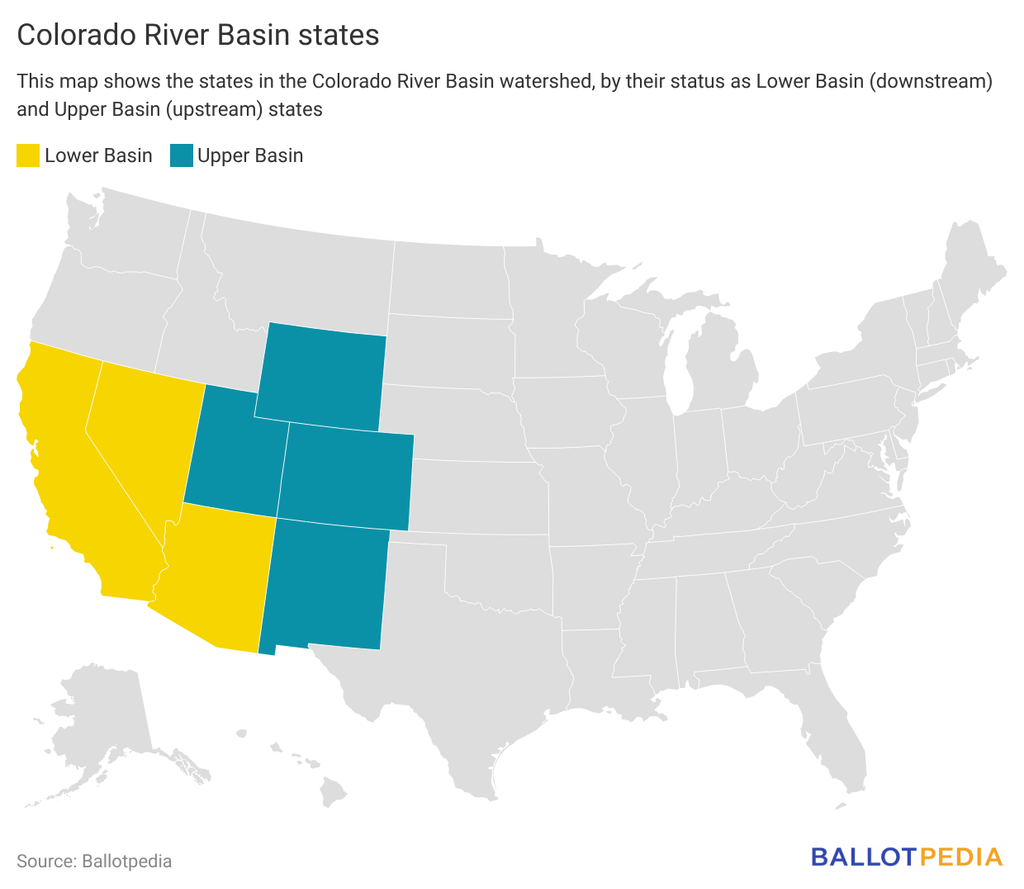
On Aug. 21, the U.S. Department of the Interior’s Bureau of Reclamation released an operating framework for Colorado River water that cuts the allotment of water for California, Nevada, and Arizona’s by 21%. New Mexico, Utah, Colorado, and Wyoming, the other states that draw water from the river did not face cuts to their allotment. This move comes after talks between the two sets of states — called “Lower Basin” and “Upper Basin” states due to their position in the Colorado River Basin watershed — failed earlier this year. The Bureau began restricting water releases to the Lower Basin states in 2021 amidst an ongoing historic drought, drawing on authority from a 2006 U.S. Supreme Court decree.
What was the dispute?
A complex set of compacts, federal laws, court decisions, a treaty with Mexico, and other documents collectively known as the Law of the River governs management of the river’s water. The 1922 Colorado River Compact, a foundational document in this set, divided water allocations equally between California, Nevada, and Arizona (the three Lower Basin states) and New Mexico, Utah, Colorado, and Wyoming (the four Upper Basin states). The Lower Basin states, which are more populous than the Upper Basin states, have historically used a higher percentage of their allocated water, though Upper Basin usage has increased in recent years.
The Colorado River has lost about 20% of its flow since 2000, when the Southwest began experiencing a drought which in 2022 became the worst in 1,200 years. The Bureau of Reclamation and state officials made agreements in 2003, 2007, 2019, and 2024 that coordinated Upper Basin conservation efforts and tied Lower Basin water cuts to the federally-managed level of the Lake Mead storage reservoir. The 2007 agreement, which set specific water release thresholds for the lake, officially expired Dec. 31, 2025, although the Bureau has continued operating under these rules and plans to do so until December 2026.
With the 2007 agreement set to expire, the Upper and Lower Basin states released dueling replacement plans in March 2024. Years of negotiations between state officials, which were not public, failed to meet the December 2025 deadline. On Feb. 14, the Department of the Interior announced that without an agreement between the states, it would create a plan for the post-2026 period before Oct. 1.
What role does the Department of the Interior have?
The Interior Department’s Bureau of Reclamation manages water releases from Lakes Powell and Mead, which serve as storage reservoirs for the Lower Basin. Releasing less water from these reservoirs, both of which reached record low levels in August, lowers the available river water for the downstream Lower Basin states. The Bureau also administers the Hoover and Glen Canyon Dams, which depend on water released from the reservoirs to generate electricity. A formal operating plan like the one ending this December determines the amount of water that the Bureau releases in different water level scenarios.
In 2006, the U.S. Supreme Court issued a Consolidated Decree which compiled its various rulings on the Law of the River since its 1964 case of Arizona v. California. Under the 2006 Consolidated Decree, the Secretary of the Interior (who serves as “water master” for releases from the lakes) may determine that a drought exists and order reductions in water releases to maintain water levels in the reservoirs and keep the dams operating. Federal officials first used this power in 2021, cutting allotments to Arizona by 18%, to Nevada by 7%, and cutting deliveries to Mexico by 5%. The August 2026 operating framework is based on this authority.
The Lower Basin states proposed voluntary allotment cuts for 2027-2028 which are partially incorporated in the 10-year framework. If river levels continue to decline, however, subsequent cuts to the Lower Basin states under the framework may be twice as large. Under the plan, California is expected to reduce its usage of Colorado River water by 12%, Nevada by 28%, and Arizona by 31%. Arizona and Nevada face this greater effect in part because their water users tend to have newer claims on the water than those in California, giving them lesser priority under western water rights law.
What were the reactions?
On Aug. 24, Nevada sued to challenge the federal plan. Nevada Gov. Joe Lombardo (R) said that “The Department of the Interior can’t roll Nevada and solve the entire Colorado River shortage on the backs of the Lower Basin states.” After a draft version of the plan was released in July, Arizona Gov. Katie Hobbs (D) said it contained “unacceptable options that include the federal government forcing Arizona to take the majority of draconian water cutbacks.” In the wake of the plan’s official release, Arizona has also threatened to sue.
Andrea Travnicek, Interior Department assistant secretary for water and science, said that “we’ve been in this 26-year prolonged drought period. We continue to see a prolonged drought in our future. So continuing to work together as a whole within the basin is going to be extremely important.” California river commissioner and lead negotiator JB Hamby called the federal plan “a bridge, not a permanent solution,” and said that “California, Arizona, and Nevada have shown that states can compromise, make difficult decisions, and reduce water use when the river demands it. But three states cannot carry the responsibility of all seven.”
Colorado Gov. Jared Polis (D) said that Colorado officials “remain hopeful that a longer-term seven-state agreement can be reached over the coming months.” Amy Ostdiek, a section chief at the Colorado Water Conservation Board, said that “we cannot provide certainty to our lower basin neighbors that we as upper basin water users have never had ourselves” about river levels. (The river in the Upper Basin is largely fed by annual snowpack melt.)
Addressing the prospect of litigation reaching the Supreme Court, Anne Castle, former chair of the Upper Colorado River Commission, said that “handing the ability to decide really important questions about the operation of the Colorado River to nine people — who don't know much about it — is very risky business.”
Want to learn more?
Pick of the news
Judge again orders VA to restore collective bargaining agreement. A U.S. district court judge ordered the Department of Veterans Affairs (VA) to restore a collective bargaining agreement with the American Federation of Government Employees (AFGE). This is the third judicial order this year directing the VA to restore agreements with AFGE, after two previous orders in March. Federal News Network
OPM memo makes it easier for agencies to use AI in hiring. The Office of Personnel Management issued a memo to agencies, stating that a number of common HR tasks like writing job announcements and evaluating hiring metrics are not “high impact” for the purposes of federal AI governance, allowing agencies to more-easily use AI to perform these tasks. The “high-impact” category was created in an earlier April 3, 2025 Office of Management and Budget memo on AI governance. FedScoop
MSPB issues regulation granting “substantial deference” to agencies. The Merit Systems Protection Board issued a regulation loosening its longstanding “Douglas Factors” for assessing the termination or disciplining of a federal employee. The regulation instead states that an “agency’s choice of penalty is entitled to substantial deference” by the Board. Bloomberg Law
In the states
North Carolina enacts bill that restricts administrative law judges’ use of judicial deference
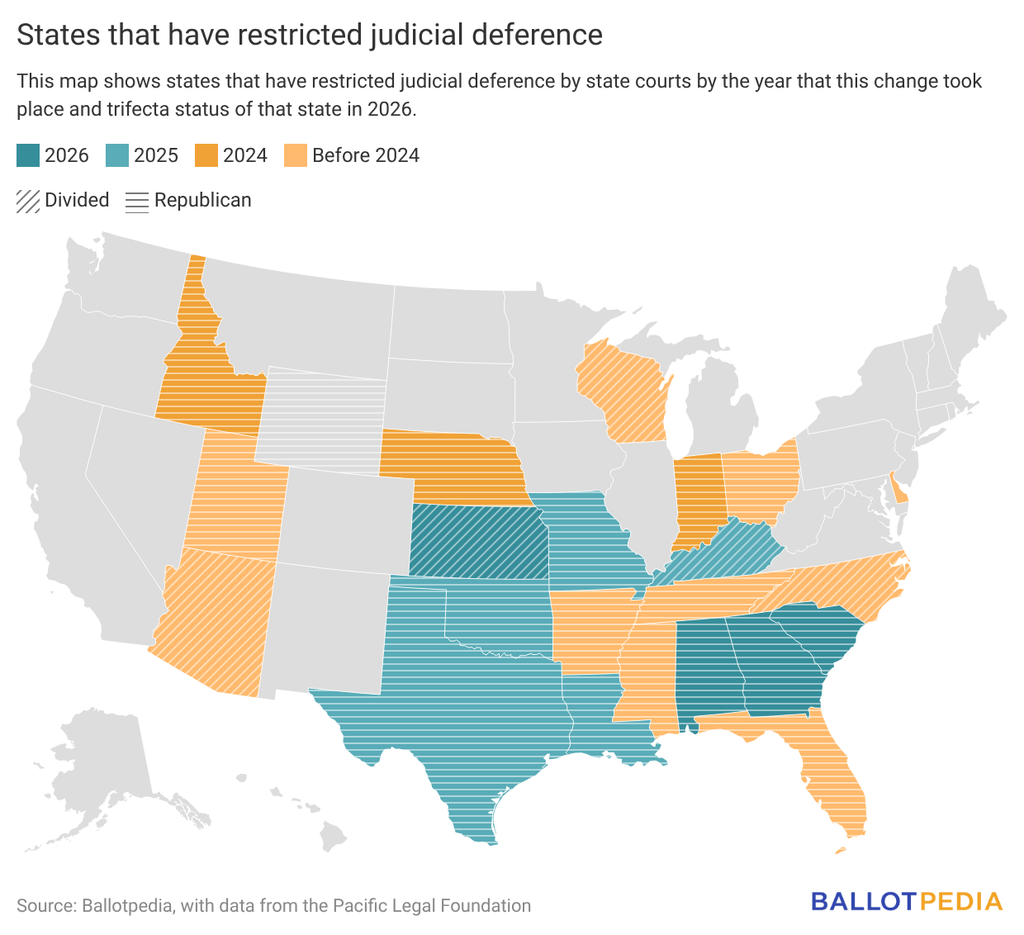
On Aug. 11, North Carolina Gov. Josh Stein (D) signed Senate Bill (SB) 445, titled the Regulatory Review Act of 2026, into law. The new law prohibits administrative law judges (ALJs) from engaging in the practice of judicial deference to agencies’ interpretations of regulations, among other provisions. Instead of deferring to an agency’s reading of an ambiguous regulatory text, the law requires ALJs to use their own reading of the text, in what is called de novo review. North Carolina is the fifth state to enact a statute ending judicial deference practices in 2026.
The bill was first introduced in 2025, with language focused on allowing state hospital regulations to automatically conform to federal waivers. The North Carolina Senate passed this version of the bill 46-0 on April 30, 2025, with 17 Democrats joining 29 Republicans in support of the bill. Three Democrats and one Republican were absent. The North Carolina House of Representatives did not take up the bill until 2026, adding the requirement that ALJs use the de novo review standard. The House also added a number of amendments affecting regulations of water pipes, gasoline storage, and education, and retitled the bill the Regulatory Reform Act of 2026. The House passed this amended bill 83-28 on June 3, 2026, with 21 Democrats joining 62 Republicans in supporting the bill. Two Republicans joined 26 Democrats in voting no.
The Senate rejected this House-amended bill 45-0 on June 6. The bill went to a conference committee, which amended it further, including inserting that a “court may be informed by the agency's interpretation of its own rules or regulations but shall apply traditional de novo review to the interpretation of State rules and regulations.” The Senate passed this conference committee version 37-0 on July 29, with 11 Democrats joining 26 Republicans in supporting the bill.. The House passed the conference committee version 81-28 on Aug. 4, with 18 Democrats joining 63 Republicans in supporting the bill, 28 Democrats voting no, two Republicans not voting, and seven absences.
Governor Stein did not address the judicial deference portion of the bill in a statement but said — referencing housing regulatory changes in the bill — that "North Carolina is growing rapidly, and the cost of housing is increasing. We need to build more housing units of all types to drive down rents and mortgages. This bill cuts red tape to help produce more houses and apartments and deliver results for North Carolinians."
What is judicial deference?
Judicial deference is the practice of courts adopting an executive agency’s interpretation of an ambiguous text, such as a statute or regulation. Deference practices are enshrined in specific legal doctrines at both the federal and state levels, such as federal-level Auer deference and the now-defunct Chevron deference. The U.S. Supreme Court struck down Chevron deference doctrine, under which a federal court would defer to an agency’s interpretation of ambiguous statutory text, in the 2024 Loper Bright Enterprises v. Raimondo decision.
Although Loper Bright struck down a federal-level doctrine, it did not affect state-level deference doctrines, even if they are analogous to Chevron. North Carolina had one such Chevron-like doctrine (articulated in the 1998 case County of Durham v. North Carolina Department of Environmental and Natural Resources) until 2025. That year, the North Carolina Supreme Court struck down the County of Durham precedent in the case of Savage v. North Carolina Department of Transportation. In a 5-2 decision, the Court ruled that state courts should instead use de novo review, meaning that they should use their own interpretation of statutory text when deciding a case notwithstanding an agency’s interpretation. In the separate 2025 case of Mitchell v. University of North Carolina Board of Governors, the Court also struck down the precedent that state courts should defer to agencies’ interpretation of regulations articulated in the 1994 Morrell v. Flaherty decision. This precedent was similar to federal-level Auer deference doctrine, which remains in force in federal courts. SB 445’s enactment reinforces the precedent of the Mitchell decision, which did not explicitly mention ALJs.
While the Loper Bright decision did not directly affect state-level deference doctrines, at least 12 states (including North Carolina) have restricted judicial deference since the case was decided in 2024.
Want to learn more?
Pick of the news
Kansas Supreme Court overturns felony convictions over $20 fees. On Aug. 14, the Kansas Supreme Court reversed a misdemeanor and two felony convictions stemming from a plaintiff’s failure to pay three $20 administrative fees. The fees were a mandatory part of offender registration forms that the plaintiff completed in 2013 and 2014. Kansas Reflector
Idaho Department of Correction signs agreement with ICE. The Idaho Department of Correction, responsible for administering state prisons, signed a 287(g) agreement with Immigrations and Customs Enforcement (ICE). This formal agreement allows state law enforcement officials to engage in immigration enforcement in cooperation with federal authorities. Idaho Capital Sun
Featured commentary
Can unilateral executive action durably change policy? University of California, San Francisco law professor Zachary Price argues that while future presidents can reverse the second Trump administration’s executive actions, several administration trends are making that more difficult. He identifies structural deregulation, high-profile deterrent strategies, and private litigation as behaviors which tend to increase the durability of unilateral executive actions. Click here to read the full article.
In the Media:
- New York Times, “Trump Fired the Watchdogs. Their Replacements Have a Different Mission”
- SCOTUSblog, “The tenth justice’s strategy”
- NPR, “Inside the failed mission to eliminate FEMA”
Regulatory highlight
In this section, we highlight a few of the several regulations reviewed by the Office of Information and Regulatory Affairs (OIRA) each month and discuss an aspect of the federal Congressional Review Act (CRA), an increasingly used mechanism for repealing executive agency regulations. In this edition, we provide an update on how federal legislators have used the Congressional Review Act in the 119th Congress and how it looks for the rest of the legislative session.
Notable regulations
- The Regulatory Information Service Center of the General Services Administration published its 2026 Unified Agenda of Federal Regulatory and Deregulatory Actions. This semiannual publication compiles recently completed and anticipated economically significant regulatory actions by agencies across the executive branch.
Congressional Review Act
The Congressional Review Act (CRA) allows Congress to repeal executive agency rules with joint resolutions of disapproval. Under the CRA, Congress has 60 working days after a rule has been submitted to Congress to introduce a joint resolution of disapproval.
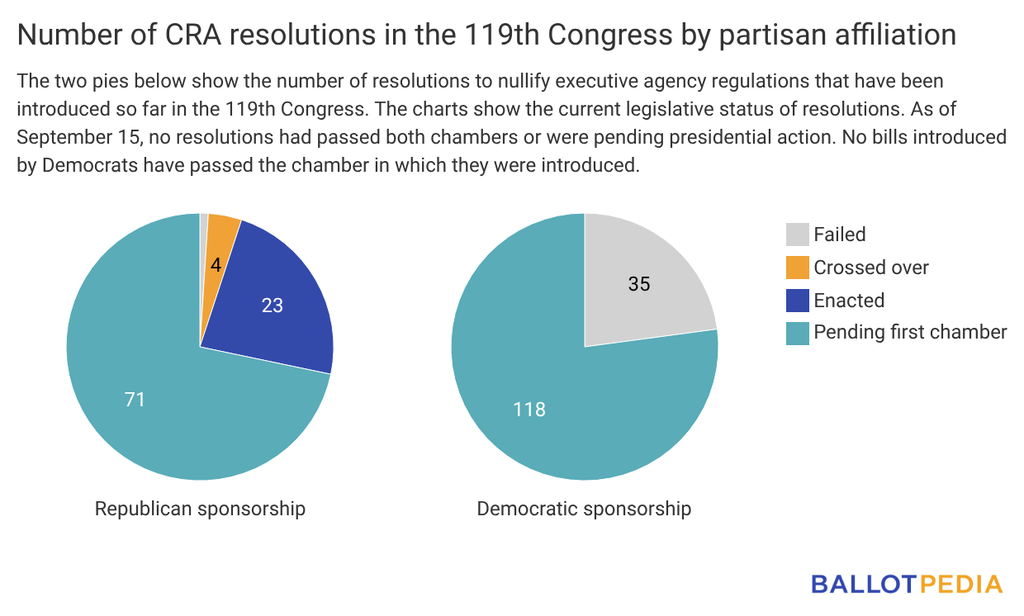
As of Sept. 15, federal legislators have introduced 232 resolutions of disapproval to nullify agency regulations so far in the 119th Congress. Since our last edition, no resolutions have advanced.
Want to learn more?
- Introduction to the Unified Agenda of Federal Regulatory and Deregulatory Actions-2026
- Unified Agenda of Federal Regulatory and Deregulatory Actions
- Congressional Review Act
Legislative Tracking Update
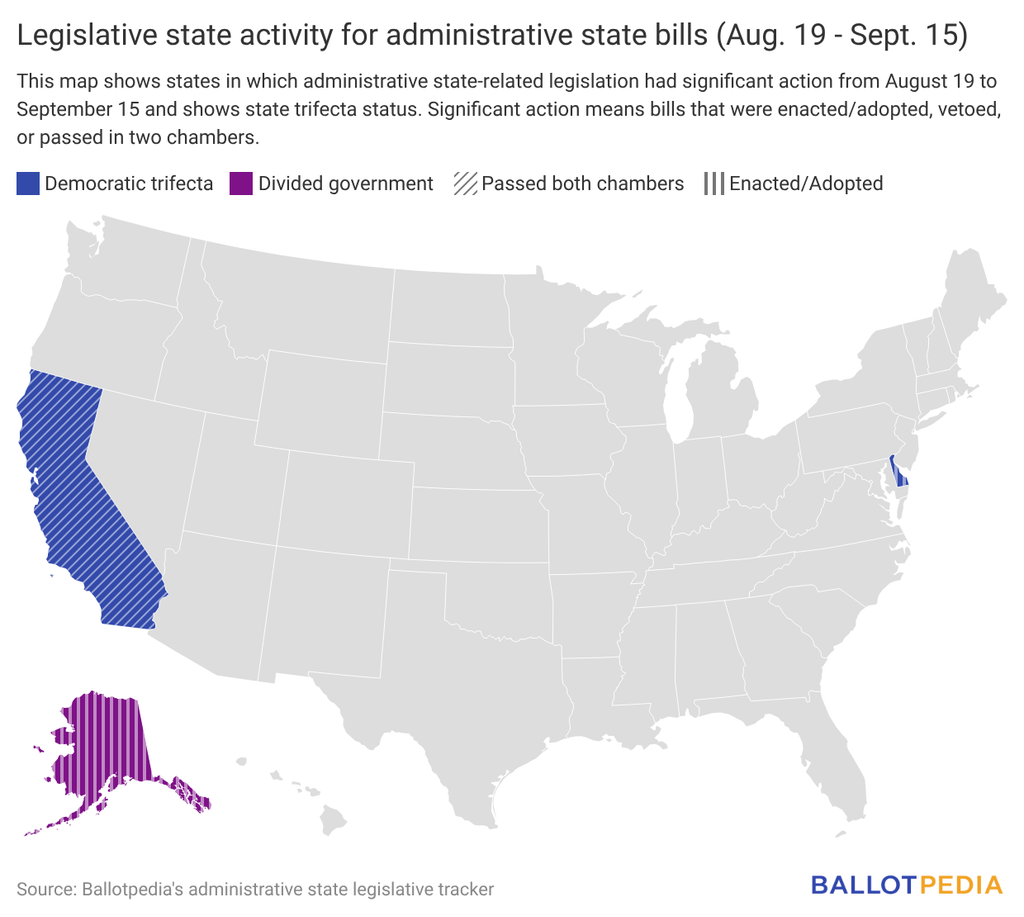
Since our last newsletter edition, Ballotpedia tracked significant legislative action (enactments, vetoes, and passage through both chambers) in three states on eleven bills related to the administrative state, as of Sept. 15.
Alaska Gov. Mike Dunleavy (R) signed three bills. The California legislature passed seven bills. Delaware Gov. Matt Meyer (D) signed one bill.
Ballotpedia tracked a total of 1,916 bills related to the administrative state in 2026, as of Sept. 15.