


Welcome to the Thursday, Sept. 17, 2026, Brew.
By: Lara Bonatesta
Here’s what’s in store for you as you start your day:
- Seven former U.S. House members will be on the ballot this November
- Rhode Island has an open governor's race and state legislative elections in November, with a split Supreme Court with one vacancy on the line
- U.S. Supreme Court leaves order blocking USPS absentee/mail-in voting rules in place for 2026 election
Seven former U.S. House members will be on the ballot this November
The final U.S. House primaries wrapped up on Sept. 15 in Delaware, with a total of seven former House members advancing to the general elections across the country in November. This is down from 10 former members who appeared on general election ballots in 2024 but up from three who did so in 2022.
During this year’s primaries, a record-high 22 former members ran for the House after leaving office, either due to defeat, to run for another office, or resignation. This is the most former members running in data Ballotpedia has collected going back to 2016.
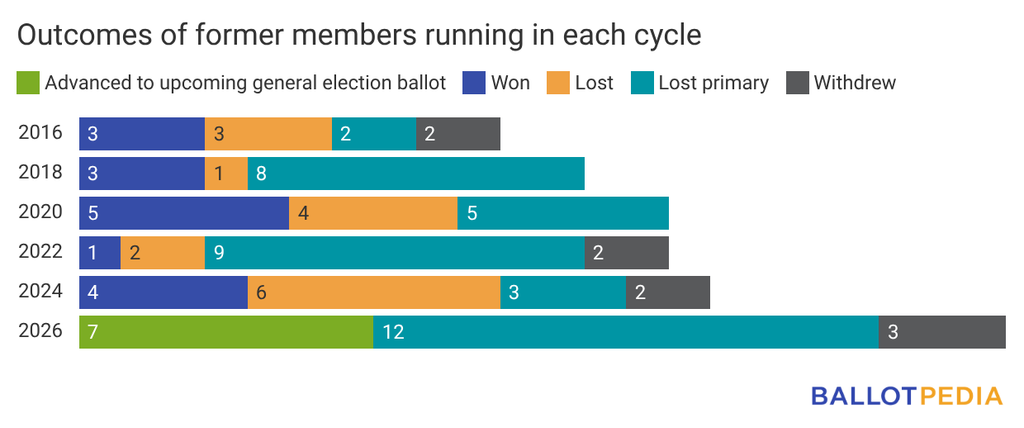
Of the seven who have advanced to the general election, six are Democrats and one is a Republican. The highest number of former members to win in a single cycle is five, which happened in 2020.
A few notable members advancing include:
- Jerry Carl (R-Ala.), who advanced in the Republican primary for Alabama’s 1st Congressional District. Alabama redrew its maps, and Carl ran in two separate primaries.
- Colin Allred (D-Texas), who previously ran for U.S. Senate before switching to running for Texas’ 33rd Congressional District, defeated incumbent Julie Johnson (D-Texas) in the May 26 primary runoff.
- Elaine Luria (D-Va.), who is running for Virginia’s 2nd Congressional District in a rematch of 2022 against incumbent Jennifer Kiggans (R).
The other four members who advanced include Hilda Solis (D) in California’s 38th Congressional District, Melissa Bean (D) in Illinois’ 8th Congressional District, Ben McAdams (D) in Utah’s 1st Congressional District, and Tom Perriello (D) in Virginia’s 5th Congressional District.
This year, 12 former members lost in primaries, seven advanced to the general election, and three withdrew before the primary. Of the former members who ran or are running this year, 13 are Democrats and nine are Republicans.
A few notable defeats include:
- Cori Bush (D-Mo.), who was defeated in a rematch with Wesley Bell (D-Mo.) in Missouri’s 1st Congressional District.
- Van Hilleary (R-Tenn.), who lost the primary for Tennessee’s 6th Congressional District nearly 24 years after leaving office.
- Sheila Cherfilus-McCormick (D-Fla.), who resigned from office four months before her primary in Florida’s 20th Congressional District amidst a House Ethics Committee Investigation. In this analysis, Cherfilus-McCormick is counted among former members who lost primaries because she did not withdraw her 2026 candidacy when she resigned.
One state – Virginia – had two former members advance to the general election this year. The states with the most former members running this cycle were Florida and Texas, with four members each. Florida has had the most former members running since 2016, with nine. One of those ran multiple years.
To read more about the 2026 U.S. House elections, click here. To read more about former members running in 2026, click here.
Rhode Island has an open governor's race and state legislative elections in November, with a split Supreme Court with one vacancy on the line
Welcome to our next installment of our 50 States in 50 days Series, covering Rhode Island. To view our archive of past editions, click here.
In Rhode Island – the only state where Supreme Court justices serve lifetime terms – the outcome of this year’s open governor’s race, and all 113 state legislative elections could determine who will become the fifth justice on the Court, which is currently made up of two judges that Democratic governors appointed and two that Republican governors appointed.
In the Sept. 9 Democratic gubernatorial primary, Helena Foulkes defeated incumbent Gov. Daniel McKee 62.3% to 37.7%. The last incumbent governor in Rhode Island to lose in a primary was Bruce Sundlun (D) in 1994. In the Republican primary, which went to a recount, Aaron Guckian defeated Elaine Pelino 50.6%.
Want to see what’s on your ballot this November? Click here to use our Sample Ballot Lookup Tool. Now let’s take a closer look at what’s happening in Rhode Island.
Early voting opens Oct. 14 and ends Nov. 2.
Polls open on Election Day at 7:00 a.m. and close at 8:00 p.m.
Voter ID is required. Acceptable forms of ID include a Rhode Island driver’s license, a voter ID card, a U.S. passport, or an ID issued by a U.S. education institution. Click here for more information on voter ID in Rhode Island.
Absentee/mail-in ballots must be requested by Oct. 13 and returned by Nov. 3. Under a 2025 law, any person may apply to receive a mail ballot for every election automatically. Previously, this option was reserved only for individuals with disabilities or who were confined to a nursing home.
Current party control
Democrats represent both congressional districts. Both of Rhode Island’s U.S. Senators are also Democrats.
Democrats have a 34-4 majority in the Rhode Island Senate and a 63-10-1 majority with one vacancy in the Rhode Island House of Representatives. Because the governor is a Democrat, Rhode Island is one of 16 states with a Democratic trifecta. Rhode Island’s attorney general and secretary of state are also Democrats. As a result, Rhode Island is one of 21 states with a Democratic triplex.
As we mentioned above, Democratic and Republican governors have each appointed two members of the Rhode Island Supreme Court. On Aug. 12, McKee nominated Luis M. Matos to replace Maureen McKenna Goldberg, who Gov. Lincoln Almond (R) appointed and who retired in March. Supreme Court nominations are subject to state legislative confirmation. According to RINewsToday’s Nancy Thomas, state legislative leaders have said that the nomination will not be formally submitted or considered until after the Nov. 3 elections.
In a joint statement, Rhode Island House Speaker Christopher Blazejewski and Senate President Valarie Lawson said, “In keeping with past practice and regardless of who he has selected, we will work with the Governor on a timeline so that the nomination is officially submitted to the General Assembly for consideration after the November 3rd general election.”
According to Thomas, “Waiting until after November 3 means Rhode Islanders will have chosen a governor and elected a new General Assembly before consideration begins—even though those newly elected officials may not yet have taken office. The delay does not mean Matos will be rejected. He could receive hearings and be confirmed by both chambers after the election. But confirmation cannot be assumed.”
Offices on the ballot
Elections are taking place for the U.S. Senate and the U.S. House of Representatives.
The state executives up for election include the governor, lieutenant governor, attorney general, secretary of state, and treasurer. All 38 seats in the state Senate and all 75 seats in the state House are up for election.
Rhode Island is one of 32 states this year in which we are covering all local elections for school boards and municipal offices.
Notable elections
Governor: Foulkes, Guckian, Ken Block (I), and Julian J. Smith (I) are running in the general election. Foulkes, Guckian, and Block lead in media attention. Here’s a bit of background on those candidates:
- Foulkes worked for CVS Pharmacy for 25 years, serving as president from 2014 to 2018. She was CEO of Hudson’s Bay Company from 2018 to 2020 and executive chair of Follett Higher Education from 2023 to 2026. Foulkes' campaign website said, "We have a state government that is not fixing our biggest challenges, like affordable housing and the Washington Bridge. ... As governor, Helena will fight back against Donald Trump’s attacks on our state, create more good-paying jobs and make living in Rhode Island more affordable for every single Rhode Islander."
- Guckian's experience includes working for the Rhode Island Foundation, Bank Newport, and the Washington Trust Company. He was also a special assistant to former Governor Donald Carcieri (R). Guckian’s campaign website said, “I’m running for Governor because our state has too many taxes, too many fees, and not enough opportunity for families who are working harder than ever.”
- Block is a software engineer and the president of Simpatico Software Systems and Cross Alert Systems. After the 2020 presidential election, Donald Trump’s campaign hired Block to search for voter fraud in the election. In 2024, Block wrote in an op-ed in USA Today that his company found no evidence of voter fraud sufficient to change the outcome of the election. Block previously ran for governor in 2014 as a Republican and in 2010 on the Moderate Party label. His campaign website said, “I have decided to run for governor as an independent candidate because, like so many of you, I can no longer tolerate the dysfunction, waste, and warped priorities of our state government.”
Statewide ballot measures
Rhode Island voters will decide on five statewide bond measures that the General Assembly put on the ballot. Between 2008 and 2025, voters in Rhode Island decided on 36 bond measures and approved all of them. Voters have not rejected a bond measure since 2006, when 50.6% of electors rejected a $4 million bond measure for improvements in Fort Adams State Park. Since 2000, Rhode Island voters have decided on an average of about six ballot measures each year.
The five bond measures would issue:
- $100 million in bonds to fund site development and economic infrastructure projects and improvements to ocean and life sciences facilities
- $55 million in bonds to fund environmental preservation, recreation facilities, and water infrastructure projects
- $275 million in bonds to fund the construction and improvement of a new integrated health building for the University of Rhode Island, a workforce innovation center at the Community College of Rhode Island, Warwick campus, and a student success and career readiness center at Rhode Island College
- $50 million in bonds to fund the construction of a new Rhode Island State History Center and matching grants administered by the Rhode Island Historical Preservation and Heritage Commission
- $120 million in bonds to fund the construction and development of affordable housing projects
Local ballot measures
We’ll be adding information about local measures in Rhode Island as they are certified ahead of the Nov. 3 election.
Join us again tomorrow when we'll preview elections in Kansas, the Sunflower State.
Click here to see every edition of 50 States in 50 Days as we publish them, and here to use our Sample Ballot Lookup Tool.
U.S. Supreme Court leaves order blocking USPS absentee/mail-in voting rules in place for 2026 election
On Sept. 14, the U.S. Supreme Court declined to reverse a lower court order blocking the implementation of an executive order President Donald Trump (R) issued in March that would prohibit the delivery of absentee/mail-in ballots to anyone state election officials have not enrolled in a U.S. Postal Service portal.
The decision means that the rules implementing the order, which the USPS issued in August, will not be in effect for the Nov. 3 election. Those rules require state officials to enroll voters in a USPS portal in order for them to receive a ballot in the mail. The physical mail must also meet set standards and contain certain information, such as a unique barcode for each ballot envelope.
U.S. District Judge Indira Talwani issued a preliminary injunction on Sept. 4 blocking the rules from being implemented for the 2026 election. The ruling came in response to two lawsuits that multiple states and organizations filed.
The U.S. Department of Justice appealed Talwani’s decision to the U.S. Court of Appeals for the First Circuit and the Supreme Court, arguing the rules fell within the authority Congress has given to USPS to manage the postal system. On Sept. 10, the First Circuit judges Gustavo Gelpí, Julie Rikelman, and Seth Aframe denied the government's request for a stay, and on Sept. 13, a second district court judge issued a preliminary injunction blocking the rules.
In an unsigned order, the Supreme Court held that the “Government is unlikely to succeed on the merits of its challenge to the District Court’s preliminary injunction. And the equitable factors applicable for obtaining emergency relief from this Court do not favor a stay.”
Justice Brett Kavanaugh wrote in a concurring opinion that “applying the rule in the 2026 elections would be arbitrary and capricious in violation of the Administrative Procedure Act because state and local election officials do not have sufficient time to reasonably implement the rule before the elections.” However, Kavanaugh wrote that there was “at least a fair prospect that the final rule falls within the Postal Service’s statutory authority.”
In a dissenting opinion, Justice Samuel Alito said that he believed the government had demonstrated the need for a stay. Justice Clarence Thomas joined Alito’s opinion.
Alito wrote that some of the plaintiffs likely do not have standing to sue and that the rules likely fall within USPS’s statutory authority. He wrote that the government has “a strong interest in enforcing the rule, and implementing it will also ‘enhance the visibility of federal ballot mail’ in order to better detect election fraud.”
This was the second time the Supreme Court ruled on litigation related to Trump’s absentee/mail-in voting executive order. On August 24, the Court stayed Talwani's previous June 25 injunction halting implementation of parts of the executive order in 23 states and the District of Columbia. The ruling stated that the plaintiffs lacked standing to challenge the order and that the lawsuit wasn’t ripe, as the rules were not published when it was filed. Plaintiffs proceeded to file or amend their lawsuits to challenge the rules, rather than the executive order. To read our coverage on that decision, click here.
At least three states — Alabama, North Carolina, and Wisconsin — have mailed ballots to voters in recent days. While the order blocks the rules from being implemented for the 2026 elections, states may voluntarily comply with its provisions.
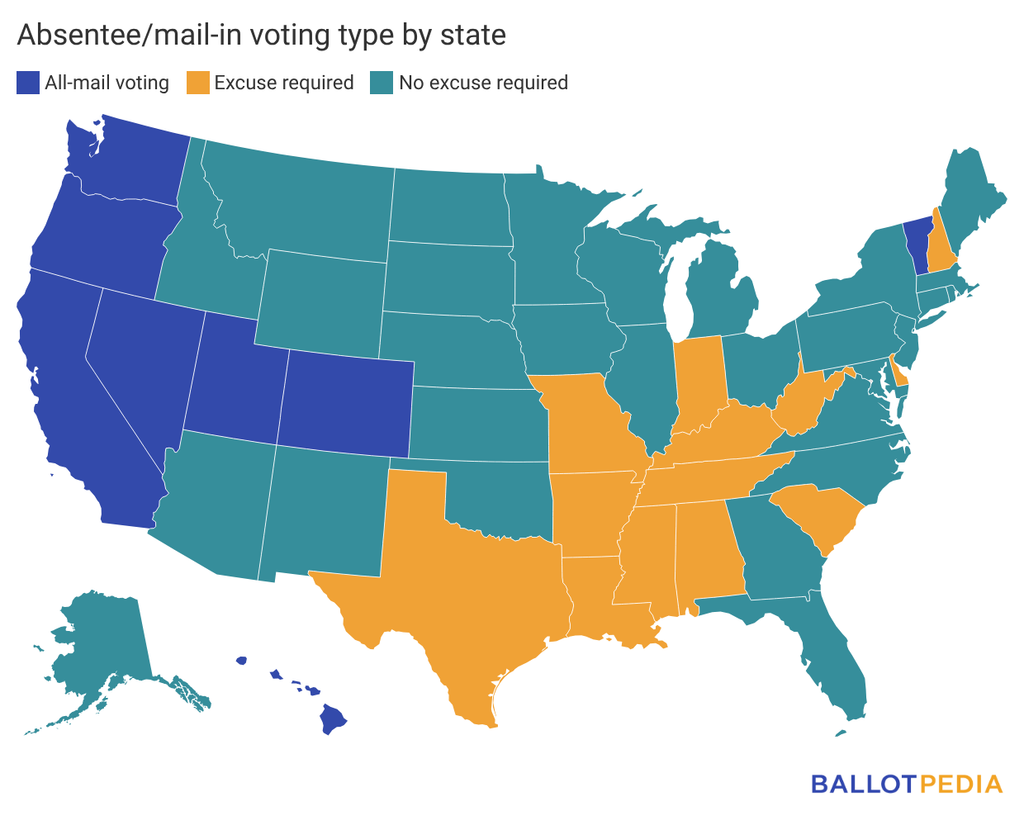
All states allow for some form of absentee/mail-in voting. Thirteen states require voters to provide a valid excuse to vote absentee/by mail. Twenty-nine states allow any eligible voter to cast an absentee/mail-in ballot. Eight states have automatic mail-in ballot systems, also known as all-mail voting systems.
Click here to learn more about the litigation over Trump’s absentee/mail-in voting executive order.