

Welcome to the Friday, Sept. 18, 2026, Brew.
By: Briana Ryan
Here’s what’s in store for you as you start your day:
- The American experiment in direct democracy
- Kansas is one of six states that will decide on a ballot measure regarding citizenship requirements for voting
- St. Paul, Minnesota, tenant repair and rent-deduction ballot initiative will be on November ballot
The American experiment in direct democracy
Today, we're sharing the eighth installment in our project marking America's 250th anniversary: The Blueprints of Democracy.
When voters get ready to head to the polls this November, many of them will discover that they will have the opportunity to decide on a variety of issues ranging from local bond issues to state constitutional amendments.
These issues — collectively called ballot measures — have been a feature of American governance from the nation’s earliest days. But unlike elections, where we choose between candidates running for offices in which they will propose, debate, and decide on policy, ballot measures put those decisions directly in voters’ hands.
One interesting feature of ballot measures is that they do not exist at the federal level. Ballot measures, as we know them, are created and largely controlled by various state and local laws.
Ballot measures fall into two major categories:
- Citizen initiatives, in which people gather a legally required number of valid signatures in order to place a measure on the ballot. A citizen initiative can be an initiated state statute, an initiated constitutional amendment, or a veto referendum.
- Legislative ballot measures, in which legislators vote to place a proposed statute, constitutional amendment, bond measure, or advisory question on the ballot.
While citizen initiatives and legislative referrals are the most common types of ballot measures, there are also automatic ballot referrals, constitutional convention-referred amendments, and commission-referred measures.
As a rule, all states require that voters approve proposed constitutional amendments. The only exception is Delaware, where the Legislature can approve amendments without consulting voters.
The New England roots of ballot measures
Ballot measures are generally thought of as a form of direct democracy, where the people decide on laws themselves rather than through their elected representatives. The roots of this system were developed in the newly founded colonies of New England:
In 1622, Governor William Bradford convened what is widely recognized as New England’s first town meeting to equitably divide land among the surviving families of the Mayflower. By 1633, the town of Dorchester had formalized the practice, ordering that inhabitants gather every Monday morning at the sound of a bell to “settle and establish such orders as may tend to the general good".
In 1778, Massachusetts became the first of the newly independent states to hold a referendum on a proposed constitution. It was defeated. According to the University of Missouri’s William B. Fisch:
In the following year the legislature then submitted to popular vote the questions whether (i) a new constitution should be made, and (ii) the legislature should call a new convention for that purpose. The vote was affirmative on both questions, and the call for convention issued, the delegates to be popularly elected. In 1780 the convention agreed on a proposed constitution which was approved by the voters.
States would ask for voter approval of a number of measures over the next century. But it wasn't until 1898 that voters acquired the power to propose their own ballot measures.
The birth of initiative and referendum
Beginning in 1898, voters in 30 states have decided on 42 constitutional amendments to create state initiative and referendum processes. South Dakota was the first state to adopt an initiative and referendum process in 1898. Amendments were adopted in 22 states between 1898 and 1918.
There were no further efforts to adopt initiative and referendum until 1956, when Alaska voters approved a state constitution that included both. In 1992, Mississippi became the most recent state to pass a constitutional amendment for an initiative process. No measures have been on the ballot to establish an initiative or referendum process since then.
Voters in Minnesota, Rhode Island, Texas, and Wisconsin considered constitutional amendments to establish initiative and referendum processes, but none were approved. Voters in Mississippi, Missouri, and Wyoming initially rejected constitutional amendments on initiative and referendum before approving them on second attempts.
Today, 26 states allow citizen initiatives, with 18 allowing the people to propose constitutional amendments, 21 allowing them to propose statutes, and Maryland and New Mexico allowing only veto referendums.
This November, voters in 40 states will be deciding on at least 164 statewide ballot measures, and a number of local questions, too. Voters have decided on more than 15,500 state ballot measures, including more than 3,270 measures that people put directly on the ballot through the citizen initiative process.
A comprehensive resource for understanding ballot measures
Ballotpedia’s new ballot measures hub brings together our entire library of ballot measure articles and research. It connects readers with more than 200 years of ballot measure history, including the issues, campaigns, trends, and laws governing the process.
Click here to see our past installments of our Blueprints of Democracy series.
Kansas is one of six states that will decide on a ballot measure regarding citizenship requirements for voting
Welcome to our next installment of our 50 States in 50 Days series, covering Kansas. To view our archive of past editions, click here.
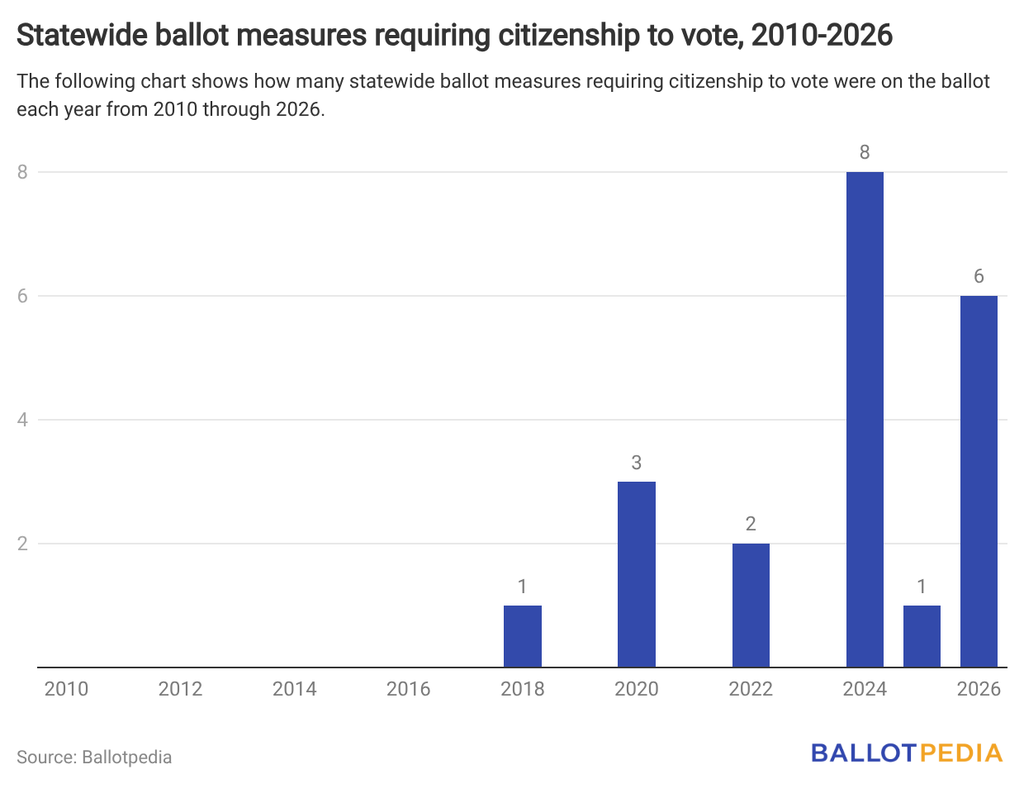
Kansas is one of six states that will decide on ballot measures on Nov. 3 that would amend their constitutions or enact laws allowing only U.S. citizens to vote in state and local elections. From 2010 through 2025, voters nationwide decided on 15 such measures — approving all of them.
The Citizenship Voting Requirement Amendment is the only statewide measure that Kansas voters will decide on Nov. 3. From 2000 through 2025, Kansas voters decided on 12 statewide measures, or 0.9 per even-numbered year. During that period, voters approved nine measures and defeated three.
We'll also be adding information about local measures in Kansas as they are certified ahead of the Nov. 3 election.
Voters must register online, in person, or via mail by Oct. 13.
Early voting opens Oct. 14 and ends Nov. 2.
Polls open on Election Day at 7:00 a.m. and close at 7:00 p.m.
Voter ID is required. Acceptable forms of identification include a driver's license or a nondriver's ID card, a concealed carry license, a passport, or a student ID. Click here for more information on voter ID in Kansas.
Absentee/mail-in ballots must be requested by Oct. 27.
Current party control
Republicans represent three congressional districts, and a Democrat represents one. Both of Kansas' U.S. Senators are Republicans.
Republicans have a 31-9 majority in the Kansas Senate and an 88-37 majority in the Kansas House of Representatives. Because the governor is a Democrat, Kansas is one of 11 states with two legislative chambers controlled by one party and a governor from the other party. Kansas is also one of two states with a governor of one party and a supermajority of the opposing party. We’ve identified the state’s supermajority as being highly exposed to breaking this year.
Kansas' attorney general and secretary of state are both Republicans. As a result, Kansas is one of five states in which neither party has a triplex. Democratic governors appointed six members of the Kansas Supreme Court, and a Republican governor appointed one.
Offices on the ballot
Elections are taking place for the U.S. Senate and U.S. House of Representatives.
There will also be elections for governor, lieutenant governor, attorney general, secretary of state, insurance commissioner, treasurer, and five seats on the Kansas Board of Education. All 125 seats in the state House are up for election, and there will be special elections for two seats in the state Senate.
Two state supreme court justices and five Kansas Court of Appeals judges are up for retention elections.
We're also following the election for three seats on the Sedgwick County Commission.
Notable elections
Governor: Cindy Holscher (D) and Ty Masterson (R) are running in the open race. This governorship is one of five that Democrats are defending this year in a state that President Donald Trump (R) won in the 2024 presidential election. Trump defeated Kamala Harris (D) in the state 57.2% to 41.0%. incumbent Gov. Laura Kelly (D) defeated Derek Schmidt (R) in the 2022 gubernatorial election, 49.5% to 47.3%. Three independent race forecasters have rated the general election as Tilt or Lean Republican.
On Monday, we'll preview elections in Oregon, the Beaver State.
Click here to see every edition of 50 States in 50 Days as we publish them, and here to use our Sample Ballot Lookup Tool.
St. Paul, Minnesota, tenant repair and rent-deduction ballot initiative will be on November ballot
In St. Paul, Minnesota, a ballot initiative described as establishing a tenant's right to repair will appear on the Nov. 3 ballot, but it's unclear whether any votes it gets will count.
In October, the Minnesota Court of Appeals will hear oral arguments over whether the initiative should remain on the ballot after the St. Paul City Council voted to remove it, and a court ordered the city to keep it on the ballot. Absentee and mail-in voting in Minnesota begins on Sept. 18.
The initiative would allow tenants to arrange certain repairs to their residences when their landlords do not complete them within 14 days after receiving written notice from the tenant. The landlord would then be required to either reimburse the tenant for the repair costs or allow the tenant to deduct them from the monthly rent. The amount would be limited to $500 or one-half of one month's rent, whichever is less.
The campaign supporting the initiative, Safe Homes St. Paul, submitted 5,440 valid signatures to Ramsey County Elections, surpassing the necessary threshold of 5,342.
On Aug. 5, the City Council voted 5-2 to block the initiative from the ballot. After the vote, the City Council released a statement saying the decision was based on legal concerns about the initiative's wording.
In response, Safe Homes St. Paul filed a lawsuit, arguing the city lacked the authority to keep the initiative off the ballot. On Aug. 10, Ramsey County District Court Judge Mark Ireland ruled that the initiative must be put on the ballot.
On Aug. 11, the city appealed the Court's decision to the Minnesota Supreme Court and requested that they block the initiative from the ballot. The Minnesota Supreme Court denied the request, stating that the city needed to file any appeal with the Minnesota Court of Appeals instead. The city then appealed to the Minnesota Court of Appeals.
Click here to read more about the Allow Tenants to Deduct the Cost of Repairs From Rental Payments Initiative.