


Welcome to the Tuesday, Sept. 22, 2026, Brew.
By: Briana Ryan
Here’s what’s in store for you as you start your day:
- This year's congressional primaries drew the most candidates since 2014
- Tennessee to use a new congressional map in this year's elections
- Primaries in Providence, Rhode Island, highlight information that endorsements can provide voters
This year's congressional primaries drew the most candidates since 2014
More candidates ran in primaries for the U.S. Congress this year than in any election cycle since 2014, according to our analysis of all 468 congressional seats on the ballot this year. There was also a record share of open seats and a record number of contested primaries.
The driving factor behind the record number of candidates who ran for the U.S. Congress (2,497) was a record number of U.S. House candidates (2,232).
Not among those candidates were 75 incumbents. As a result, 16% of seats were open this year. Most of those seats (70) were open because the incumbent decided to retire from public office or run for another office. Three were open because an incumbent resigned before the primary, and two were open because incumbents ran against each other in the same primary.
There were 547 contested primaries this year. A record number of contested Democratic primaries (272) accounted for most of those primaries. There were also 209 contested Republican primaries and 66 top-two primaries.
There were 222 incumbents who ran in those contested primaries, or 56.5% of the 393 incumbents who ran for re-election this year. That’s the second-highest percentage of such incumbents since 2014, behind 61.8% in 2022.
Thirteen of those 222 incumbents (5.9%) lost re-election. That is below the 6.4% recorded in 2022 — the highest rate since 2014.
Here’s a closer look at this year’s primaries by chambers.
U.S. Senate
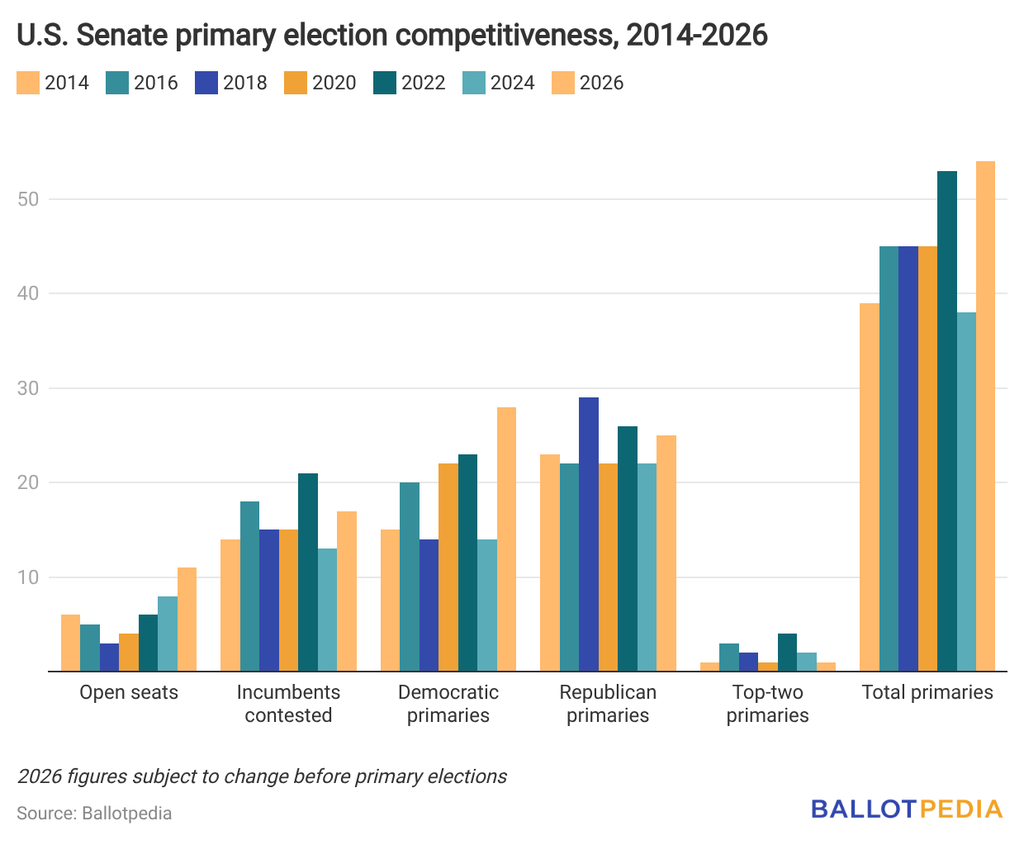
This year had the third-most U.S. Senate candidates since 2014, at 265, trailing 2022 (335) and 2016 (266).
A record number of Democratic primaries (28), dating back to 2014, led to the most contested primaries in that period. There were also 25 contested Republican primaries and one top-two primary.
Among the candidates who ran in those contested primaries were 17 incumbents. That’s the third-highest number of incumbents since 2014. The 2022 election cycle had the highest number of incumbents, at 21, and the 2016 election cycle had the second-highest, at 18.
U.S. House
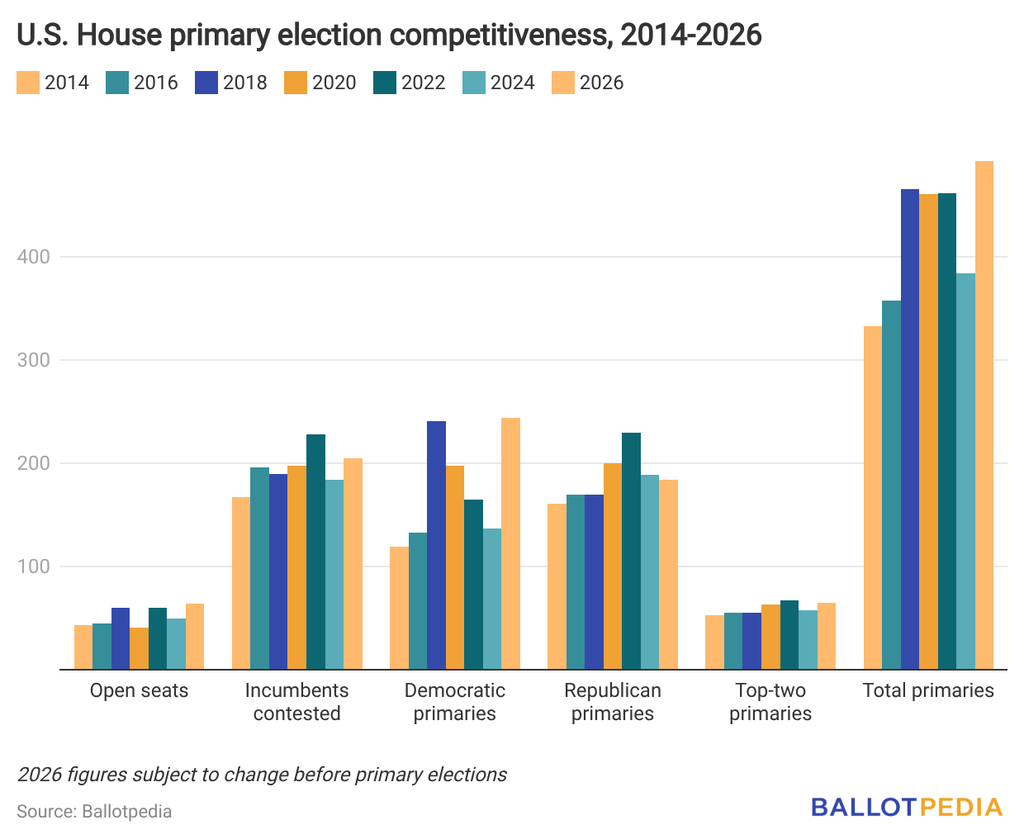
This year had the most U.S. House candidates since 2014, at 2,232.
Like in primaries for the U.S. Senate, a record number of Democratic primaries (244) dating back to 2014 drove the most total contested primaries in that time. There were also 184 contested Republican primaries and 65 top-two primaries.
Among the candidates who ran in those contested primaries were 205 incumbents. That’s the second-highest number of incumbents since 2014. The 2022 election cycle had the highest number of incumbents, at 228.
Click here to read our Annual Congressional Competitiveness Report.
Tennessee to use a new congressional map in this year's elections

Welcome to our next installment of our 50 States in 50 Days series, covering Tennessee. To view our archive of past editions, click here.
Tennessee will use a different congressional map than it did in 2022 and 2024. Tennessee redrew its congressional district boundaries following the U.S. Supreme Court ruling in Louisiana v. Callais. The decision affected how Section 2 of the Voting Rights Act (VRA), which prohibits voting practices and procedures that discriminate on the basis of race, is applied in disputes over district boundaries.
Based on the 2024 presidential election results, the new map would result in Republicans winning the state’s sole Democratic-held congressional district — the 9th Congressional District — in November. Before redistricting, it was also the state’s only majority-Black congressional district.
Voters must register online, in person, or via mail by Oct. 5.
Early voting opens Oct. 14 and ends Oct. 29.
Polls open on Election Day at different times, depending on the county. Polls close statewide at 7:00 p.m.
Voter ID is required. Acceptable forms of identification include a Tennessee driver’s license with a photo, a U.S. passport, a military ID, or a handgun carry permit with a photo. Click here for more information on voter ID in Tennessee.
Absentee/mail-in ballots must be requested by Oct. 24 and received by Nov. 3.
A 2026 law removed a requirement that individuals convicted of a felony pay all court costs and be current on all child support payments to be eligible for a court order restoring their voting rights. Instead, the new law requires individuals to comply with all child support orders for the previous 12 months before they can regain their voting rights.
Current party control
Republicans represent eight congressional districts, and a Democrat represents one. Both of Tennessee’s U.S. Senators are Republicans.
Republicans have a 27-6 majority in the Tennessee Senate and a 75-23 majority, with one vacancy, in the Tennessee House of Representatives. Republicans also have a veto-proof majority in the Tennessee General Assembly meaning they control enough seats to overturn a gubernatorial veto without any support from the other party. Because the governor is a Republican, Tennessee is one of 23 states with a Republican trifecta. Tennessee’s attorney general and secretary of state are also Republicans. As a result, Tennessee is one of 24 states with a Republican triplex. Republican governors appointed all five members of the Tennessee Supreme Court.
Offices on the ballot
Elections are taking place for the U.S. Senate and U.S. House of Representatives.
There will also be an election for governor. Seventeen seats in the state Senate and all 99 seats in the state House are up for election.
Notable elections
5th Congressional District: Chaz Molder (D), Charlie Hatcher (R), James Johnson (I), and Micheál O'Leary (I) are running. Hatcher defeated incumbent Rep. Andy Ogles (R) in the Republican primary. According to the Cook Political Report’s Erin Covey, “Molder has raised a considerable amount of cash — he has $1.5 million in his campaign account — and has a record of winning over support from Republican voters in Maury County. But under the new lines, Trump carried the district by 23 points, and it would be incredibly difficult for any Democrat to win — particularly now that Ogles isn't on the ballot.”
9th Congressional District: Justin Pearson (D), Brent Taylor (R), Dennis Jeffrey Clark (I), and Michelle Head (I) are running in the open district. In the 2024 presidential election, using the district’s old boundaries, Kamala Harris (D) defeated President Donald Trump (R) in the district 70.4% to 27.8%. Based on the new boundaries, Trump would have defeated Harris 59.9% to 38.8%. As a result, this district is one of 23 Democratic-held districts that Trump won in 2024.
Statewide ballot measures
There are three statewide measures on the ballot this year. Between 2000 and 2025, Tennessee voters decided on 14 ballot measures, or one per even-numbered year. During that period, voters approved 13 measures and defeated one.
Here’s a closer look at the measures:
Amendment 1 would create a list of criminal offenses for which a judge could deny bail. Judges could only deny bail if sufficient proof of the crime is evident or the presumption of the accused individual’s guilt is great.
Amendment 2 would prohibit the Tennessee General Assembly from establishing a property tax. This year, voters in seven states will decide on, or have already decided, 13 measures regarding property taxes. Twelve of those measures would prohibit or limit property taxes.
Amendment 3 would expand the list of rights for victims of crimes in the Tennessee Constitution. Tennessee is the first state to decide on a Marsy's Law measure since 2020. Marsy's Law describes a set of constitutional protections for crime victims that have been proposed and adopted in some states.
Local ballot measures
We'll also be adding information about local measures in Tennessee as they are certified ahead of the Nov. 3 election.
Join us again tomorrow when we'll preview elections in North Carolina, the Tar Heel State.
Click here to see every edition of 50 States in 50 Days as we publish them, and here to use our Sample Ballot Lookup Tool.
Primaries in Providence, Rhode Island, highlight information that endorsements can provide voters
Across Rhode Island on Sept. 9, Democratic incumbents lost the gubernatorial primary and primaries in several of the state's largest cities.
Democratic voter registration outpaces Republican registration in Rhode Island by 24 percentage points — meaning that in some heavily Democratic areas, these primaries might in effect decide who wins the general election.
Endorsements are a particularly useful tool for voters participating in primaries, when they may find it difficult to discern differences between candidates of the same party. The Sept. 9 primaries in Providence illustrate this point. There were three Democratic primaries where organizations endorsed multiple candidates.
We follow endorsements from organizations we call Recognized Endorsement Contributors (RECs): groups including political action committees, local associations, unions, media editorial boards, and more that publicly support candidates and communicate those choices to voters. In the Sept. 9 Rhode Island elections, we identified 253 endorsements from 41 organizations.
Mayor of Providence
David Morales (D) defeated incumbent Brett Smiley (D) in a primary that has mirrored many across the country this cycle. Morales identifies as a Democratic socialist, while Smiley identifies as a moderate Democrat.
U.S. Sen. Bernie Sanders (I-Vt.), the state Service Employees International Union, and the Working Families Party endorsed Morales. Former U.S. Secretary of Commerce Gina Raimondo and former U.S. Secretary of Transportation Pete Buttigieg endorsed Smiley.
Since we began following mayoral competitiveness data in 2020, incumbents have run for re-election across the nation's 100 largest cities and state capitals 64% of the time. Of those incumbents who ran for re-election, 16% lost.
On the Nov. 3 ballot, there are two general elections that feature similar Democrat-vs-Democrat contests. In Los Angeles, Mayor Karen Bass (D) faces City Councilmember Nithya Raman (D). In St. Petersburg, Mayor Kenneth Welch (D) faces former U.S. Rep. Charlie Crist (D).
Providence Council Ward 1
In the Ward 1 primary for city council, Miguel Youngs defeated incumbent John Goncalves 51.4% to 48.6%. Eight of the city's 15 city council members, the Working Families Party, and the Mamdanification Sway voting group endorsed Youngs. The ward's Democratic committee, the Young Democrats of Rhode Island, and Minneapolis Mayor Jacob Frey endorsed Goncalves.
Providence Council Ward 5
In the Ward 5 primary for city council, Jacqueline Goldman defeated Michael Solomon and Simon Sarkisian with 53.1% of the vote. The Working Families Party, the Providence Teachers Union, and the Mamdanification Sway voting group endorsed Goldman. The ward's Democratic committee and the Rhode Island Building & Construction Trades Council endorsed Solomon. We did not identify any endorsements for Sarkisian.
Rhode Island endorsements
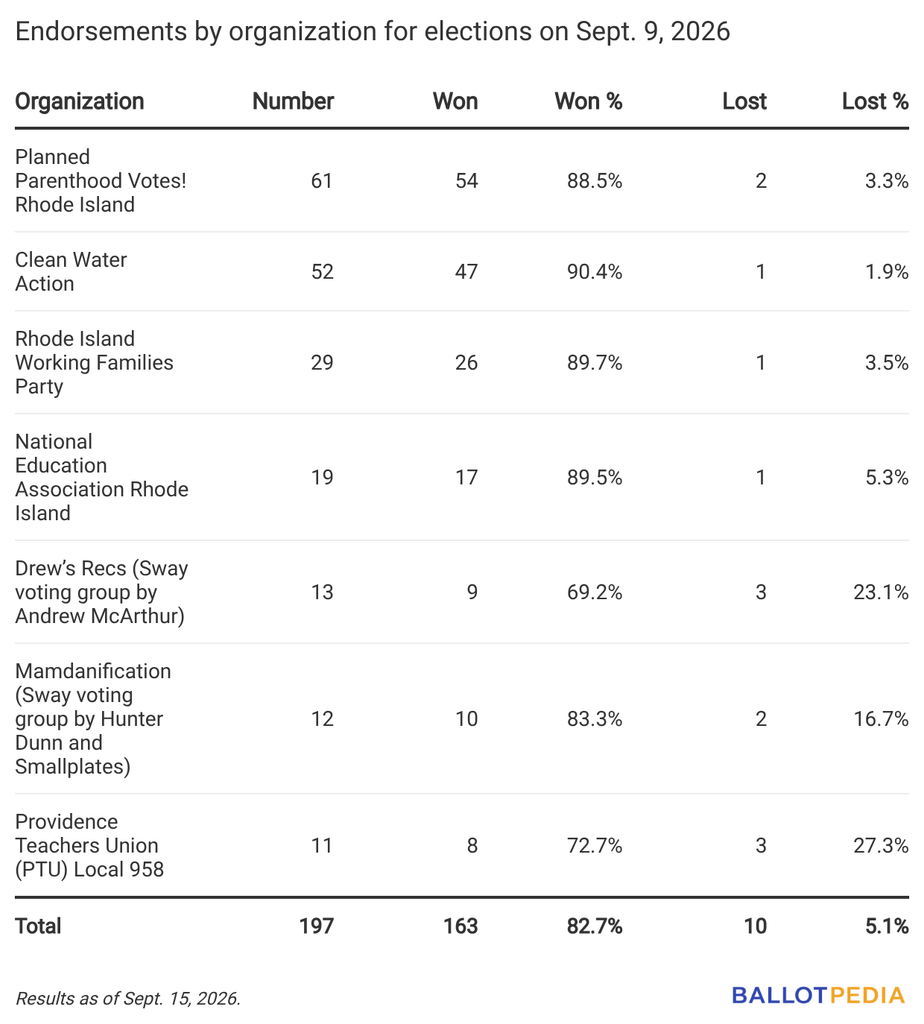
We identified seven RECs that issued more than 10 endorsements each in these primary elections. The table below displays the organizations and their endorsee success rates. Candidates that these organizations endorsed won 83% of their races and lost 5%. The remaining races were uncalled.
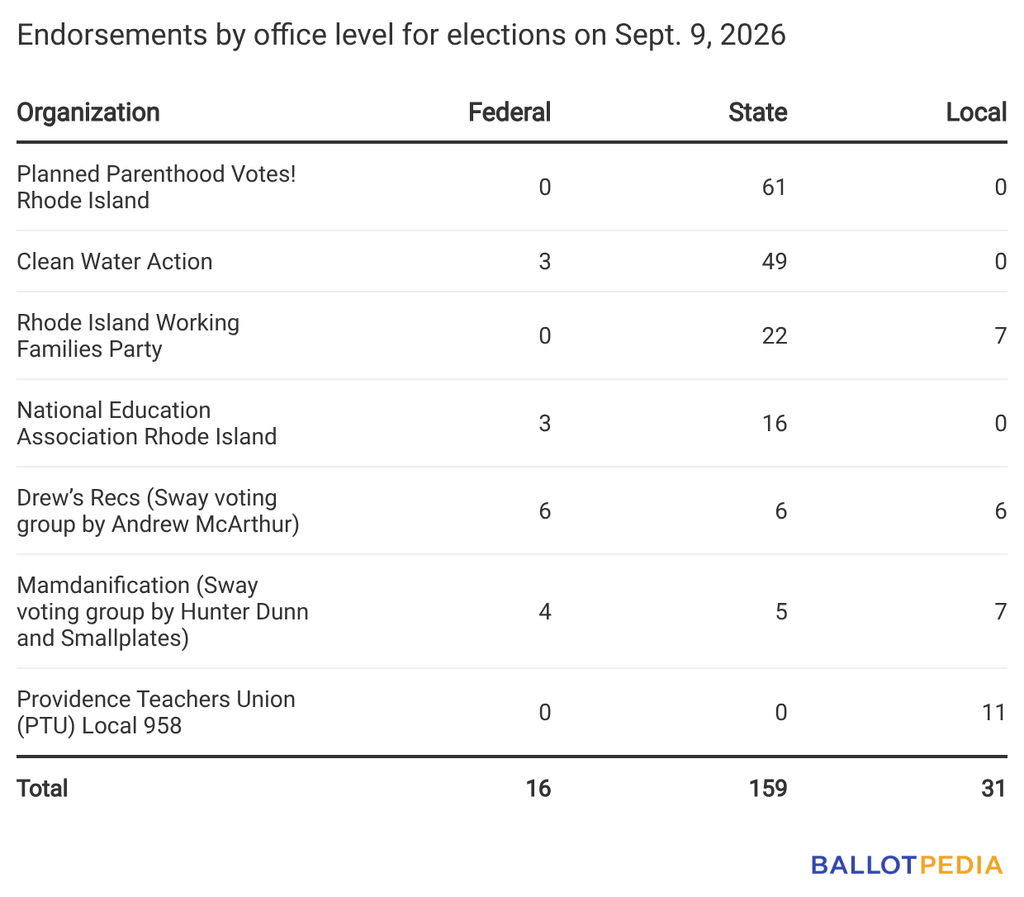
These RECs' endorsements were mostly in state primaries (159), followed by local (31) and then federal (16). The table below displays these RECs' endorsements by level of government.
Endorsements are statements or actions that an individual or group provides in support of a candidate, but they are also much more than that. Endorsements reveal alliances, ideological leanings, and potential policy priorities in ways that campaign platforms and a candidate's quotes sometimes can't. Endorsements also play a practical role in campaigns. Many endorsers — especially for statewide and national candidates — can provide candidates with volunteer support, access to potential campaign donors, and a degree of credibility and notoriety.
Ballotpedia is tracking endorsements made by organizations in races at all levels of government, with a particular focus on groups that endorse candidates at the local level. Endorsements are one component of Ballotpedia's goal to provide robust information — data that helps voters understand who a candidate is and what their political philosophy is — for every office on the ballot.
Click here to read more about Recognized Endorsement Contributors (RECs).