



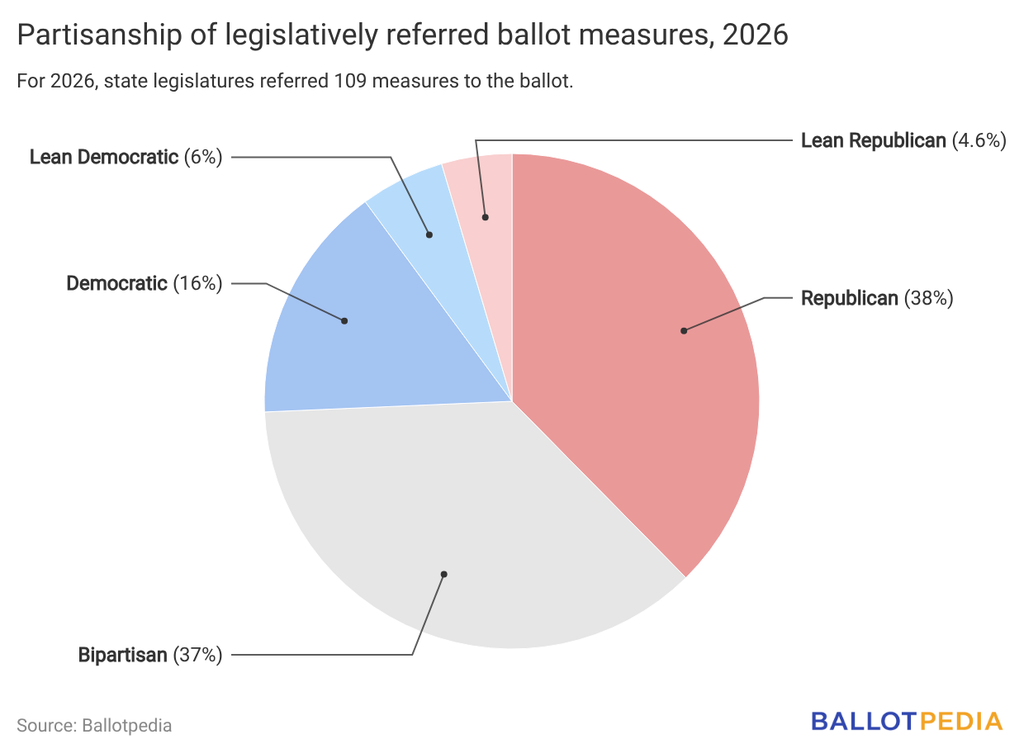
State legislatures in 32 states referred 109 constitutional amendments and statutes to statewide ballots in 2026. Nearly two-thirds (63%) of those referrals reflect partisan divisions in the legislative votes that sent them to the ballot.
Ballotpedia analyzed how Democrats and Republicans voted on each referral. Of the 109 legislatively referred measures on the ballot this year:
- 41 (37.6%) were classified as Republican, which was the single largest category. Twenty-one of those received unanimous Democratic opposition.
- 40 (36.7%) were classified as Bipartisan, with the two parties' support levels within 20 percentage points of each other. Twenty-one received unanimous support from all voting members of both parties.
- 17 (15.6%) were classified as Democratic, including 11 that received unanimous Republican opposition.
- Six (5.5%) were classified as Lean Democratic.
- Five (4.6%) were classified as Lean Republican.
The Republican and Democratic categories together account for 58 measures, or 53% of all referrals. For these measures, the parties’ support levels differed by more than 60 percentage points. Adding the two Lean categories brings the total to 69 measures, or 63% of all referrals.
Which topics appeared most often?
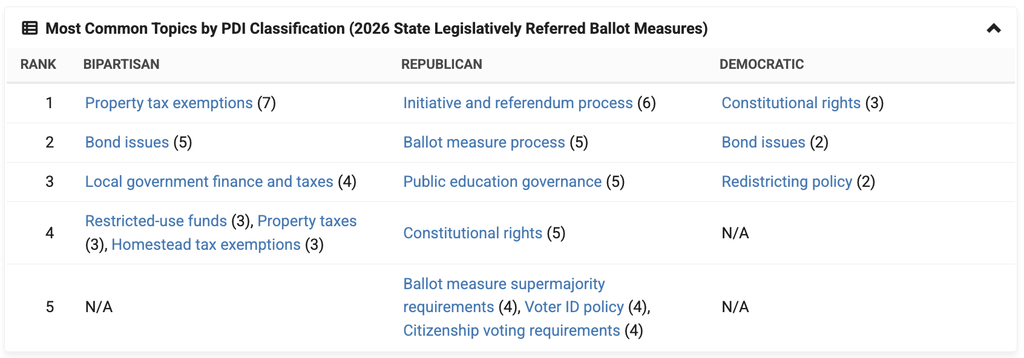
The most common topics differed across the three largest classifications. Among bipartisan referrals, property tax exemptions appeared in seven measures, bond issues in five, and local government finance and taxes in four.
Among Republican-classified referrals, the initiative and referendum process appeared in six measures. Ballot measure procedures, public education governance, and constitutional rights appeared in five each. Voter identification, citizenship voting requirements, and ballot measure supermajority requirements each appeared in four.
Among Democratic-classified referrals, constitutional rights appeared in three measures. Bond issues and redistricting appeared in two each. No other topic appeared in more than one Democratic referral.
What have voters decided so far?
As of September, voters had decided 20 of the 109 referrals. The other 89 measures are on the ballot for Nov. 3. So far, voters approved two of eight (25%) Republican-classified measures, three of six (50%) bipartisan measures, and all six (100%) Democratic-classified measures. No Lean Republican or Lean Democratic measure had been decided. With 89 measures still awaiting a vote, the results provide a limited basis for comparing approval rates across classifications.
How does 2026 compare with 2025?
Legislatures in eight states referred 28 measures to statewide ballots in 2025, including 17 from Texas. The smaller total reflects the election calendar: odd-numbered years average 28 legislative referrals, compared with 106 in even-numbered years.
Texas often plays a large role in odd-numbered-year legislative referral counts. Its legislature meets in regular session every other year, in odd-numbered years, and the November election that year usually decides the constitutional amendments lawmakers referred during the session.
The 2025 measures also had a different mix of legislative support. Twelve were classified as bipartisan, eight as Lean Republican, and four as Republican. In 2026, the corresponding counts are 40, five, and 41. Texas accounted for 61% of the 2025 total, and its requirement for a two-thirds vote to refer a constitutional amendment meant Republicans needed some Democratic support.
Voter approval also varied by classification in 2025.
- All 12 (100%) bipartisan referrals passed, as did seven of eight (88%) Lean Republican referrals and one of four (25%) Republican-classified referrals.
- Voters approved all three (100%) Democratic referrals and the one (100%) Lean Democratic referral.
Republican-classified measures were approved at a rate of 25% in both 2025 and in the eight 2026 measures decided so far, although most 2026 referrals remain undecided.
How were measures classified?
Ballotpedia's Partisan Direction Index (PDI) measures the gap between the share of Republican and Democratic legislators who voted yes on a given referral, producing a score from -100% (only Democrats) to +100% (only Republicans). Scores within 20 points of zero in either direction are classified as Bipartisan; beyond that threshold, measures are classified as Lean Democratic, Democratic, Lean Republican, or Republican depending on the direction and size of the gap. For example, when the Vermont legislature referred Proposal 3 to the ballot in 2026, 100% of Democrats and 75.8% of Republicans voted yes, a -24.2% gap classified as Lean Democratic.
Additional reading: