


Welcome to the Sept. 30, 2026, Brew.
By: Briana Ryan
Here’s what’s in store for you as you start your day:
- 17,205 major party candidates ran for Congress and state offices in 2026, including the most U.S. House candidates since 2018
- Connecticut to hold its first midterms since becoming the 29th state to offer no-excuse absentee/mail-in voting
- Tiffany Moore Russell and Chris Messina are running in the open race for mayor of Orange County, Florida
17,205 major party candidates ran for Congress and state offices in 2026, including the most U.S. House candidates since 2018
This year, 17,205 major party candidates ran in regularly scheduled primaries for congressional, state legislative, state executive, and state judicial offices. Among those candidates were 8,824 Democrats and 8,381 Republicans.
Here’s a closer look at the number of major party candidates who ran in this year’s primaries by office type.
U.S. Congress
Let’s start off with major party candidates who appeared on primary ballots for 473 seats in the U.S. Congress. Those seats include 33 U.S. Senate seats, all 435 U.S. House seats, and five non-voting delegate seats in the U.S. House. There were 474 seats up for election in 2024, 474 in 2022, 474 in 2020, and 473 in 2018.
There were 2,554 major party candidates on primary ballots this year, including 1,383 Democrats and 1,171 Republicans. That’s a 26.1% increase from 2024 when 2,026 candidates ran, a 5.5% increase from 2022 when 2,422 candidates ran, a 14.6% increase from 2020 when 2,229 candidates ran, and a 17.5% increase from 2018 when 2,174 candidates ran.
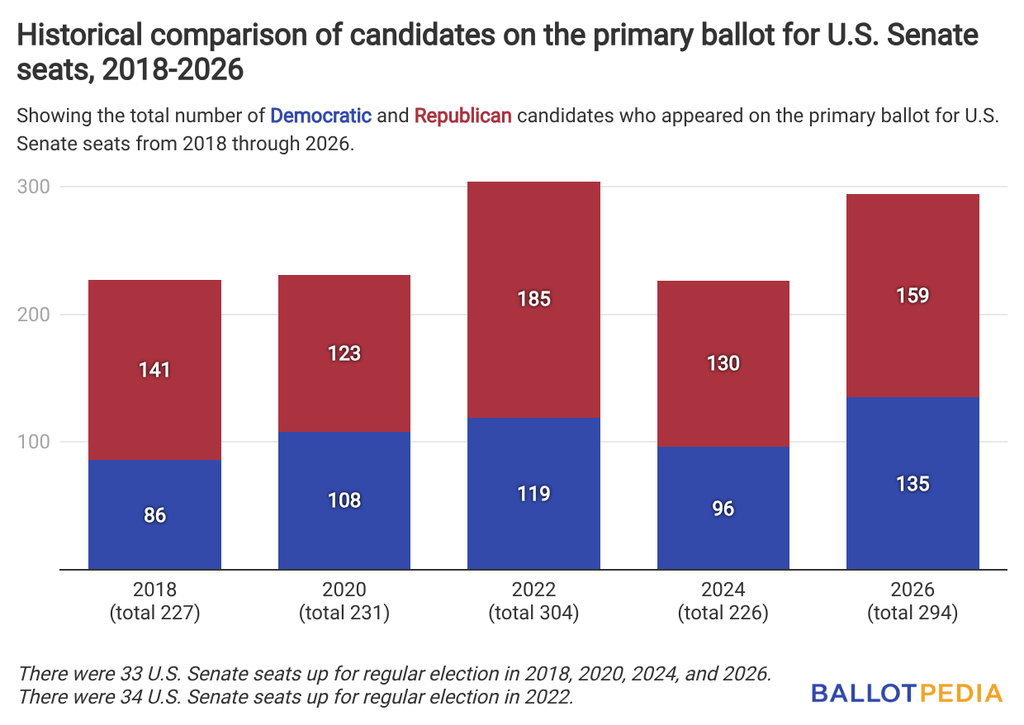
The 294 major party candidates who ran for the U.S. Senate included 135 Democrats and 159 Republicans. That’s the second-highest total of major party candidates since 2018.
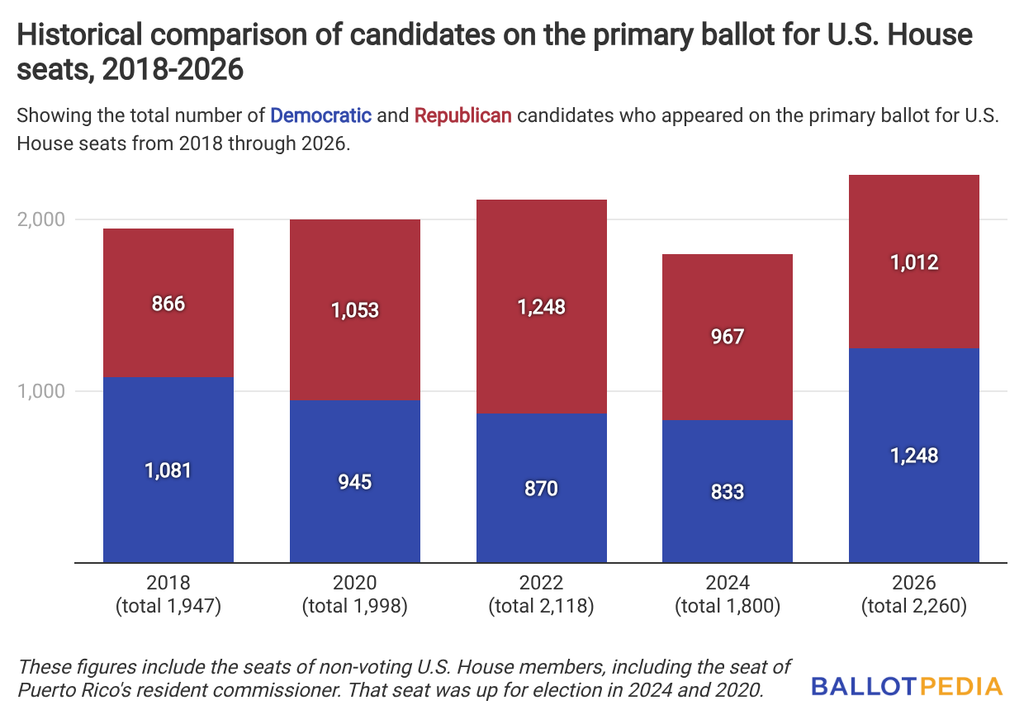
The 2,260 major party candidates who ran for the U.S. House included 1,248 Democrats and 1,012 Republicans. That’s the highest total of major party candidates since 2018.
State legislatures
There were 13,325 major party candidates on primary ballots this year for 6,137 state legislative seats. There were 5,807 seats up for election in 2024, 6,278 in 2022, 5,875 in 2020, and 6,073 in 2018.
Among the 13,325 candidates were 6,852 Democrats and 6,473 Republicans. That’s a 10.4% increase from 2024 when 12,072 candidates ran, a 1.2% decrease from 2022 when 13,491 candidates ran, a 7.5% increase from 2020 when 12,399 candidates ran, and a 0.9% decrease from 2018 when 13,441 candidates ran.
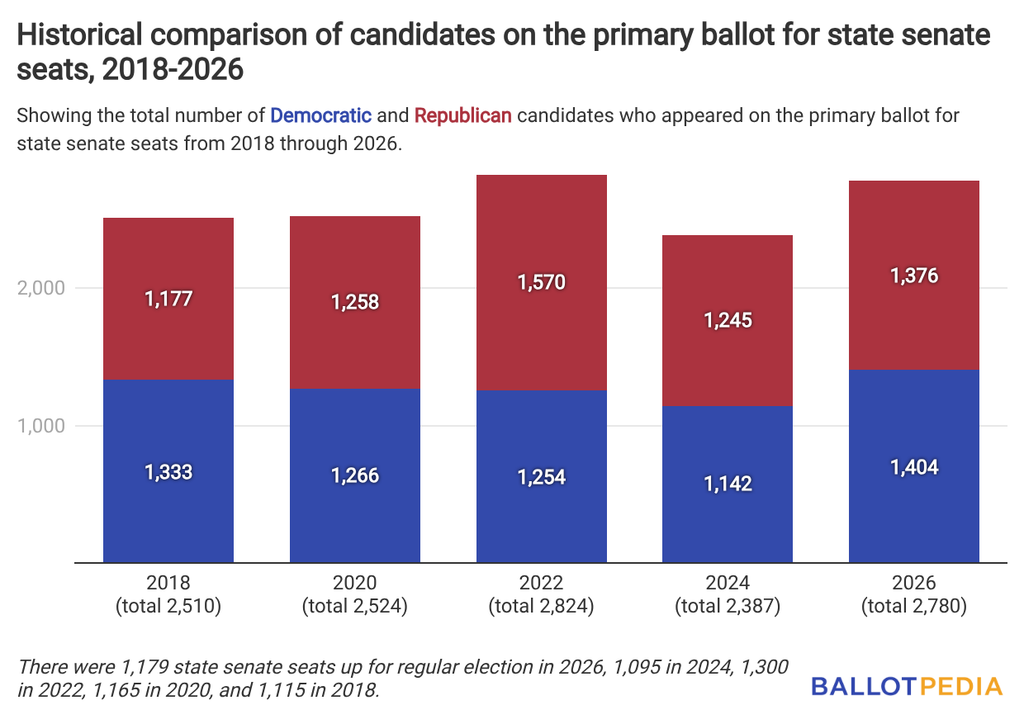
The 2,780 major party candidates who ran for state senate seats included 1,404 Democrats and 1,376 Republicans. That’s the second-highest total of major party candidates since 2018.
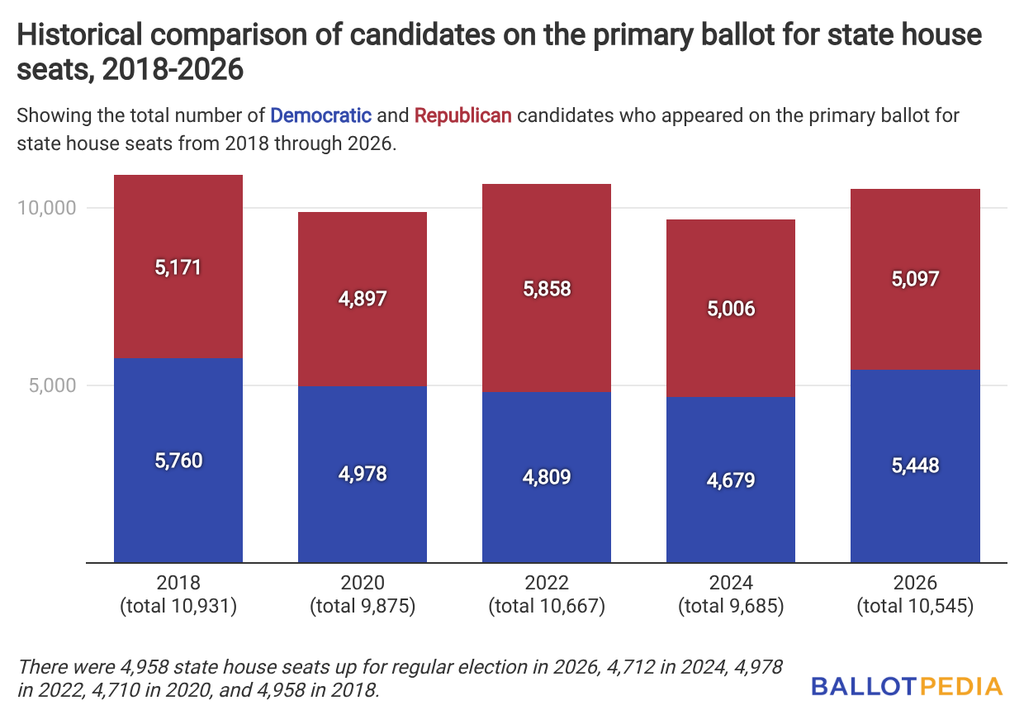
The 10,545 major party candidates who ran for the state house seats included 5,448 Democrats and 5,097 Republicans. That’s the third-highest total of major party candidates since 2018.
State executive offices
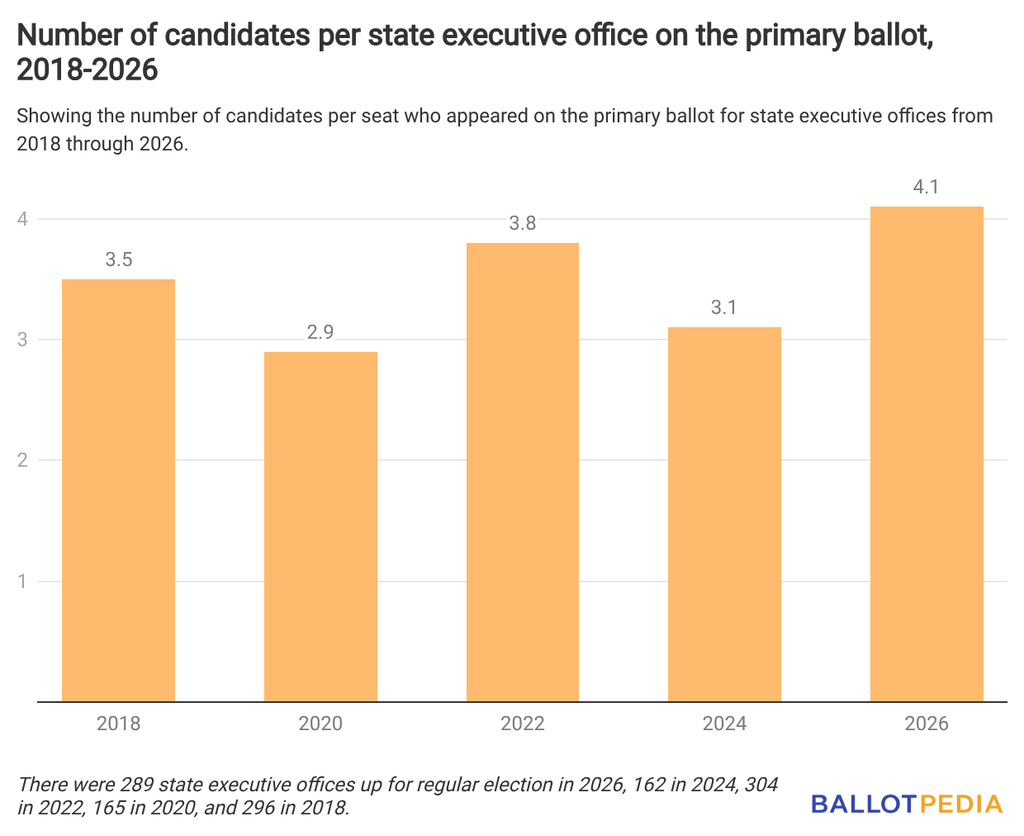
There were 1,185 major party candidates on primary ballots this year for 289 state executive offices, including 533 Democrats and 652 Republicans. There were 162 seats up for election in 2024, 304 in 2022, 165 in 2020, and 296 in 2018.
This year there were 4.1 candidates per seat. There were 3.1 candidates per seat in 2024, 3.8 in 2022, 2.9 in 2020, and 3.5 in 2018.
State judicial offices
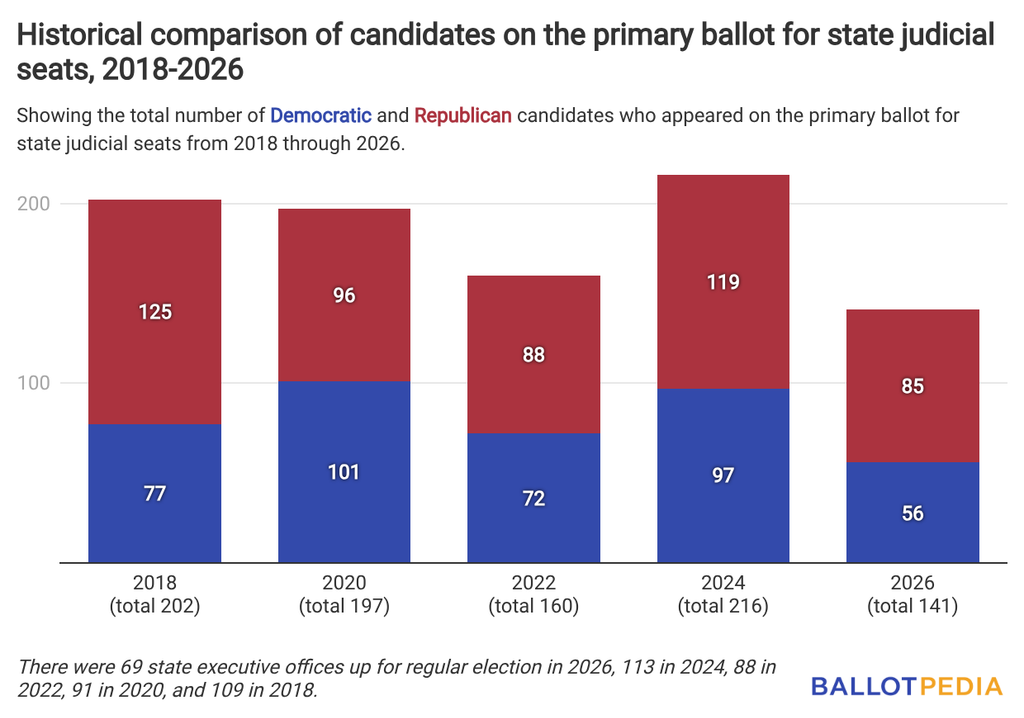
There were 141 major party candidates on primary ballots for 69 state judicial seats up for partisan election in states that use this method to select judges. There were 113 state judicial offices up for regular election in 2024, 88 in 2022, 91 in 2020, and 109 in 2018.
Among the 141 candidates were 56 Democrats and 85 Republicans. That’s a 34.7% decrease from 2024 when 216 candidates ran, an 11.9% decrease from 2022 when 160 candidates ran, a 28.4% decrease from 2020 when 197 candidates ran, and a 30.2% decrease from 2018 when 202 candidates ran.
Click here for more information about the number of major party candidates who were on primary ballots this year.
Connecticut to hold its first midterms since becoming the 29th state to offer no-excuse absentee/mail-in voting

Welcome to our next installment of our 50 States in 50 Days series, covering Connecticut. To view our archive of past editions, click here.
Under a 2026 law, all Connecticut voters are now eligible to request an absentee ballot. In 2024, voters approved a constitutional amendment 58% to 42% that removed excuse requirements for absentee voting from the Connecticut Constitution and authorized legislators to enact no-excuse absentee voting.
Previously, voters had to provide an excuse, such as illness, disability, or serving in the armed forces, to request an absentee ballot. Connecticut is the 29th state to offer no-excuse absentee/mail-in voting.
The same 2026 law also allows voters to request to automatically receive absentee ballot applications for each election and establishes a cure process for voters who fail to sign the statement on their absentee ballot return envelope. Ballots may be cured beginning on the first day absentee ballots are issued until the close of polls on election night. Previously, Connecticut was one of 17 states that did not have a cure period, during which voters must be notified and allowed to correct issues with their absentee/mail-in ballots.
Voters must register online or via mail by Oct. 16. Voters can also register in person through Nov. 3.
Early voting begins Oct. 19 and ends Nov. 1.
Polls open on Election Day at 6:00 a.m. and close at 8:00 p.m.
Voter ID is required. Acceptable forms of ID include any pre-printed form of identification that shows the voter's name and address, or name and signature, or name and photograph, or a Social Security card. Voters without an ID may sign an affidavit instead. For more information on voter ID in Connecticut, click here.
Absentee/mail-in ballots must be requested by Nov. 2 and received by Nov. 3.
Current party control
Democrats represent all five congressional districts. Both of Connecticut’s U.S. Senators are Democrats.
Democrats have a 25-11 majority in the Connecticut Senate and a 102-49 majority in the Connecticut House of Representatives. Because the governor is a Democrat, Connecticut is one of 16 states with a Democratic trifecta. Connecticut’s attorney general and secretary of state are also Democrats. As a result, Connecticut is one of 21 states with a Democratic triplex. Democratic governors appointed six members of the Connecticut Supreme Court. There is also one vacancy on the Court.
Offices on the ballot
Elections are taking place for the U.S. House of Representatives.
There will also be an election for governor, lieutenant governor, attorney general, secretary of state, comptroller, and treasurer. All 36 seats in the state Senate and all 151 seats in the state House are up for election.
Notable elections
Governor: Incumbent Gov. Ned Lamont (D/Working Families Party), Ryan Fazio (R/Independent Party of Connecticut), Zenobia Adgers (I), and Christian Noe (I) are running. According to CT Insider's Alex Putterman, "[Lamont's] moderate approach to fiscal policy and liberal stances on most social issues have earned him solid approval ratings in recent years. … [Fazio] has served in the legislature since 2021, earning a reputation as a committed conservative who's nonetheless open to working across the aisle."
Statewide ballot measures
There are no statewide measures on the ballot this year. Between 1845 and 2025, voters have decided on 85 measures, or an average of one per even-numbered year. For more information about the history of Connecticut’s ballot measures, visit its Historical Measures Factbook.
Join us again tomorrow when we'll preview elections in Arkansas, the Natural State.
Click here to see every edition of 50 States in 50 Days as we publish them, and here to use our Sample Ballot Lookup Tool.
Tiffany Moore Russell and Chris Messina are running in the open race for mayor of Orange County, Florida
Tiffany Moore Russell and Chris Messina are running in the Nov. 3 general election for mayor of Orange County, Florida. Incumbent Mayor Jerry Demings, who was first elected in 2018, is term-limited.
Since no candidate received at least 50% of the vote in the Aug. 18 primary election, the top two vote-getters — Moore Russell and Messina — advanced to the general election. Moore Russell won 31.8% of the vote, Messina won 27.5%, Stephanie Murphy won 26.1%, and Mayra Uribe won 14.6%.
Although the race is officially nonpartisan, Moore Russell is a Democrat, and Messina is a Republican.
Both Moore Russell and Messina completed Ballotpedia's Candidate Connection survey. Below is a selection from their surveys. Click here (Moore Russell) and here (Messina) to read their full responses.
Moore Russell is an attorney who served as the Orange County Clerk of Court from 2014 to 2026. In her survey response, she wrote, "As Mayor, I will focus on expanding affordable housing, improving transportation, and investing in workforce development."
Messina is the CEO of a medical technology business. In his survey response, he wrote that his "vision for greater Orlando and Orange County is to see it become one of the top metropolitan areas in America with a diversified economic base, vibrant, safe neighborhoods and efficient, transparent government."
Ballotpedia's Candidate Connection helps voters better understand how their candidates think about the world and how they intend to govern — information they need to feel confident in their choice. Click here to learn more about our survey, and here to learn more about elections happening in Orange County this year.