


Welcome to the Friday, Oct. 2, 2026, Brew.
By: Briana Ryan
Here’s what’s in store for you as you start your day:
- Voters in six states are deciding on seven campaign finance ballot measures this year
- Colorado is one of five states that will decide on ballot measures regarding sex-based sports eligibility and medical procedures for transgender minors on Nov. 3
- On the Ballot looks at why cutting through complexity matters with Axios’ Mike Allen
Voters in six states are deciding on seven campaign finance ballot measures this year
This year, voters in six states will decide or have already decided on seven statewide ballot measures regarding campaign finance. This year ties with 2018 for the most such measures in a single year since 2000.
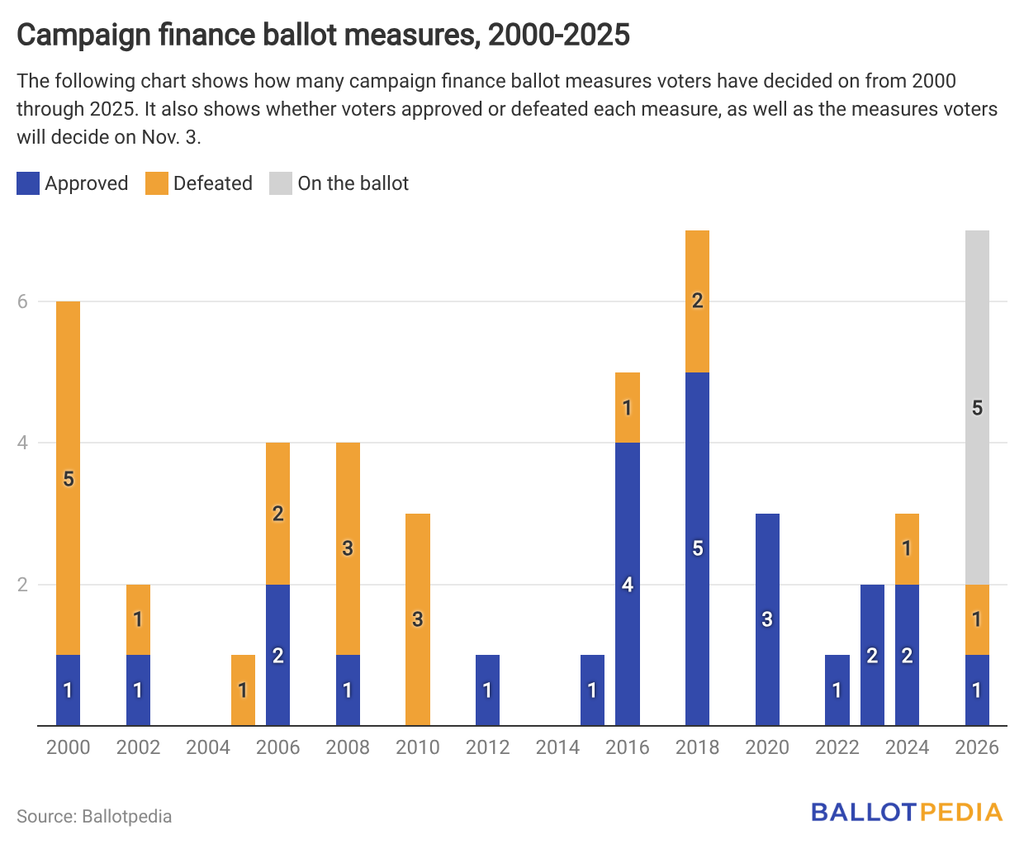
Missouri voters decided the first of these measures on Aug. 4, defeating Amendment 4 80.3% to 19.7%. It would have added language to the Missouri Constitution prohibiting foreign nationals and foreign adversaries, as defined in law, from spending to support or oppose ballot measures, with penalties for violations. The measure would also have changed the state’s initiative process, including requiring voter approval of citizen-initiated constitutional amendments in each congressional district rather than statewide.
On Aug. 18, Alaska voters approved Ballot Measure 1 72.2% to 27.8%. It caps individual contributions per election cycle at $2,000 to candidates, $4,000 to a joint governor and lieutenant governor ticket, and $5,000 to a political party. It also caps political party contributions at $4,000 to candidates and $5,000 to other parties or political groups.
The remaining five measures will be on the Nov. 3 ballot in Alaska, Arizona, California, Michigan, and Montana.
Alaska’s Ballot Measure 2 would eliminate campaign finance provisions that require persons and entities that contribute more than $2,000 and that were themselves derived from donations, contributions, dues, or gifts to disclose the true sources (as defined in law) of the political contributions. It would also repeal the top-four primaries and ranked-choice voting (RCV) general elections that voters approved in 2020.
President Donald Trump (R), U.S. Rep. Nick Begich (R), and Gov. Mike Dunleavy (R) support the measure. Alaska Senate President Gary Stevens (R), Speaker of the House Bryce Edgmon (I), and the Alaska AFL-CIO oppose it.
Arizona’s Proposition 144 would amend the state constitution to prohibit a foreign national from making contributions to influence an Arizona election and prohibit others from knowingly accepting such contributions. It would also provide that "only citizens may register and vote in Arizona elections" and require voters to provide government-issued identification to cast a ballot.
The Arizona Legislature put it on the ballot with unanimous Republican support, and no support from voting Democrats.
California’s Proposition 4 would repeal the ban on public financing of campaigns, enacted in 1988, and allow state and local governments to create programs that provide candidates with public funds under spending limits and eligibility rules. Currently, 14 states provide some form of public campaign financing for state offices.
The California Legislature placed it on the ballot with unanimous Democratic support and no support from voting Republicans.
Michigan’s Proposal 2 would prohibit regulated electric and gas utilities, government contractors with more than $250,000 in annual government contracts, and organizations or individuals with substantial connections to those utilities or contractors from making direct or indirect campaign contributions to candidates for governor, attorney general, secretary of state, the state legislature, and certain local offices, as well as to ballot measure committees.
State Rep. Donavan McKinney (D), Michigan Secretary of State Jocelyn Benson (D), and Lt. Gov. Garlin Gilchrist II (D) support the measure. The Michigan Chamber of Commerce and Blue Cross Blue Shield of Michigan oppose it.
Montana’s I-194 would prohibit artificial persons, including nonprofits, trusts, partnerships, corporations, trade associations, or unincorporated associations, and all entities doing business in Montana, from contributing to campaigns, ballot measure elections, or political parties.
Former U.S. Sen. Jon Tester (D), former Gov. Steve Bullock (D), and former Gov. Marc Racicot (R) support the measure. The Montana Chamber of Commerce opposes it.
Click here to read more about campaign finance ballot measures.
Colorado is one of five states that will decide on ballot measures regarding sex-based sports eligibility and medical procedures for transgender minors on Nov. 3

Welcome to our next installment of our 50 States in 50 Days series, covering Colorado. To view our archive of past editions, click here.
Colorado is one of four states where voters will decide on a ballot measure that would establish sex-based requirements for participation on school athletic teams, with specific regulations and methods for determining sex varying.
Proposition 134 would require student athletes to participate on men's or women's school and collegiate athletic teams that match their sex, defined as biological reproductive systems.
Proposition 135 would prohibit healthcare professionals from providing surgeries to persons under age 18 for the purpose of “treatment in response to a minor’s perception of sex or gender.” Colorado is one of two states that will decide on a ballot measure to prohibit certain medical and surgical procedures for transgender minors when provided to alter sex characteristics.
Colorado voters will decide on 14 ballot measures on Nov. 3. Between 2000 and 2025, Colorado voters decided on 150 measures, or an average of six per year. During that period, voters approved 73 and defeated 77.
Here's a closer look at three of the 13 other measures:
Proposition 136 would cap individual and corporate income tax at 4.4% of a taxpayer's federal taxable income. This measure competes with Amendment 87, which would establish a graduated income tax ranging from 3.7% to 8.4%. Since the initiatives conflict with one another, if both measures are approved, the conflicting provisions of whichever measure receives more votes would take effect.
Amendment 84 would require voters casting mail-in ballots to provide both a signature and either a state identification number that meets federal REAL ID requirements or a Social Security number. Colorado is one of six states that will decide on measures on Nov. 3 that would establish or expand voter identification requirements in state constitutions.
Voters must register online or via mail by Oct. 26. Voters can also register in person through Nov. 3.
Early voting opens Oct. 19 and ends Nov. 3.
Colorado is an all-mail voting state. Voters wishing to vote in person may do so on Election Day between 7:00 a.m. and 7:00 p.m.
Voter ID is required when voting in person. If voting by mail for the first time, a voter may also need to return a photocopy of their identification with their mail-in ballot. Acceptable forms of ID include a valid driver's license or ID card, a passport, a military ID, or a birth certificate. Under a 2025 law, non-photo identification and cards issued by the Bureau of Indian Affairs, the Indian Health Service, or another federal agency are acceptable forms of ID. Click here for more information on voter ID in Colorado.
Absentee/mail-in ballots are automatically mailed to each registered voter beginning 25 to 29 days before the election. Ballots must be received by Nov. 3.
Current party control
Democrats and Republicans each represent four congressional districts. Both of Colorado's U.S. Senators are Democrats.
Democrats have a 23-12 majority in the Colorado Senate and a 42-22 majority in the Colorado House of Representatives, with one vacancy. Because the governor is a Democrat, Colorado is one of 16 states with a Democratic trifecta. Colorado's attorney general and secretary of state are also Democrats. As a result, Colorado is one of 21 states with a Democratic triplex. Democratic governors appointed all seven members of the Colorado Supreme Court.
Offices on the ballot
Elections are taking place for the U.S. Senate and U.S. House of Representatives.
There will also be elections for governor, lieutenant governor, attorney general, secretary of state, treasurer, and three seats on the Colorado Board of Education and three seats on the Colorado Board of Regents.
Eighteen seats in the state Senate and all 65 seats in the state House are up for election. There will also be special elections for four state Senate seats.
One state supreme court justice and six intermediate appellate court judges are up for retention elections.
Municipal elections are also taking place in Denver, Adams County, Arapahoe County, and El Paso County.
Notable elections
5th Congressional District: Incumbent Rep. Jeff Crank (R), Jessica Killin (D), Christopher Mitchell (American Constitution Party), Mark Elworth Jr. (L), and Steven Fuller (Unaffiliated) are running. Since the district's creation in 1972, no Democrat has represented it. However, the district has trended towards Democrats in the last three presidential elections. President Donald Trump (R) won the district by nine percentage points in 2024, 10 percentage points in 2020, and 22 percentage points in 2016.
8th Congressional District: Incumbent Rep. Gabe Evans (R), Manny Rutinel (D), and David Wood (L) are running. The district’s 2024 general election was the seventh-closest House race in the country. Evans defeated then-incumbent Rep. Yadira Caraveo (D) 49% to 48.2%. Four election forecasters have rated this year's race as a Toss-up or Likely Democratic.
Next, we'll preview elections in Alaska, the Last Frontier.
Click here to see every edition of 50 States in 50 Days as we publish them, and here to use our Sample Ballot Lookup Tool.
On the Ballot looks at why cutting through complexity matters with Axios’ Mike Allen
In this episode of On the Ballot, Axios co-founder Mike Allen joins host Norm Leahy to talk about his new book, Simplify: Do 50% More with 50% Less.
The two also discussed data centers as a growing local political issue in Virginia and across the country, the three big shifts reshaping American technology, politics, and media, and why the days after the midterms could prove more eventful than election night itself.
To listen to this episode and more, click here. Also, don't forget to subscribe to On the Ballot on YouTube or wherever you get your podcast.