


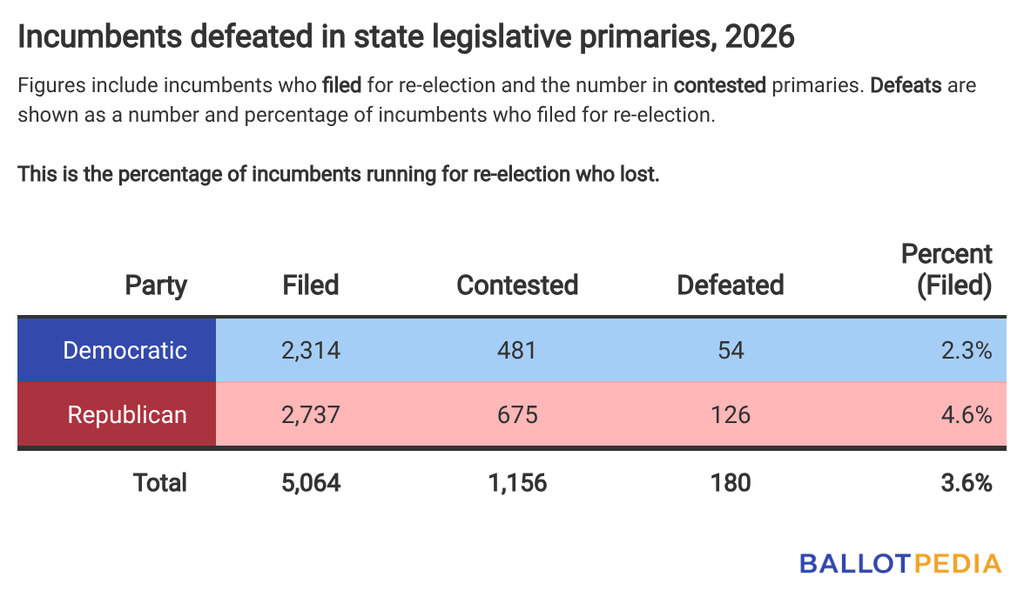
Republican state legislators lost re-election in this year’s primaries at twice the rate of Democrats. Of the 2,737 Republicans who ran for re-election, 126 (4.6%) lost primaries. Of the 2,314 Democrats who ran, 54 (2.3%) did.
The partisan split follows a pattern we reported in the June 22 Daily Brew that incumbents had more primary challengers than usual this year, mostly in Republican-controlled states. There was a 5.5 percentage point increase in the average number of incumbents who ran in contested primaries in states with Republican trifectas from 2010 through 2024. There was a 0.9% increase in the average number of incumbents who ran in contested primaries in states with Democratic trifectas from 2010 through 2024.
In all, 180 of the 5,064 incumbents (3.6%) who ran for re-election lost primaries this year — the third-highest total since 2010 and more than the average of 161 per even-numbered year from 2010 through 2024.
The election cycles with higher totals were 2012 (197) and 2022 (229). Both cycles were the first after states redrew district lines following the U.S. Census, which resulted in some incumbents running against each other.
Where incumbents lost primaries most often
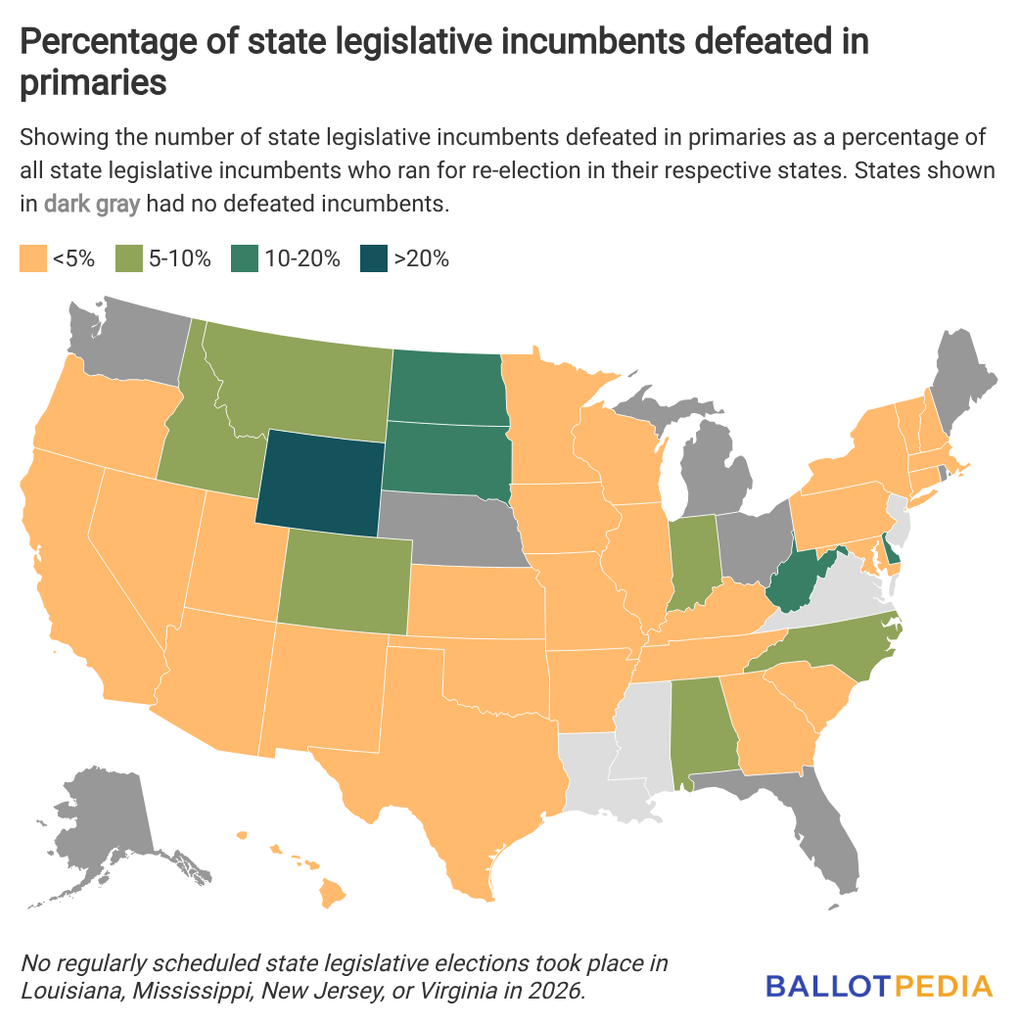
In five states, at least 10% of incumbents who ran for re-election lost in primaries this year:
- Wyoming: Fourteen of 54 incumbents who ran (25.9%) lost primaries. All 14 incumbents are Republicans.
- South Dakota: Fourteen of the 78 incumbents who ran (17.9%) lost primaries. All 14 incumbents are Republicans.
- West Virginia: Fifteen of the 98 incumbents who ran (15.3%) lost primaries. All 15 incumbents are Republicans.
- Delaware: Five of the 43 incumbents who ran (11.6%) lost primaries. All five incumbents are Democrats.
- North Dakota: Six of the 52 incumbents who ran (11.5%) lost primaries. One incumbent is a Democrat, and the other five are Republicans.
Delaware has a Democratic trifecta, and the four other states have Republican trifectas.
Notable incumbents who lost primaries
Two incumbents who hold leadership positions in their state legislatures lost primaries this year:
- North Carolina Senate President Pro Tempore Phil Berger (R) lost to Sam Page (R) by 23 votes out of 26,247 cast.
- Maryland Senate Majority Leader Nancy King (D) lost to Amar Mukunda (D), 48.9% to 37.2%, in a field of three candidates.
Three incumbents who first assumed office before 2000 lost primaries this year:
- Connecticut Rep. Patricia Dillon (D) lost to Eli Sabin (D), 44.3% to 35.7%, in a field of three candidates. Dillon, who first assumed office in 1985, is the longest-serving state legislator to lose a primary this year.
- Pennsylvania Rep. Gregory Vitali (D) lost to Judy Trombetta (D) 61.9% to 38.1%. Vitali first assumed office in 1992.
- Vermont Rep. James Masland (D), who first assumed office in 1999, finished third in a primary where the top two vote-getters advanced to the general election. Dee Gish (D) received 41.4% of the vote, Lauren Morando Rhim (D) received 32.4%, and Masland received 26.2%.
There are 6,137 seats up for election this year across 88 state legislative chambers. We will report how many incumbents lost across all elections once the Nov. 3 results are known.