


Welcome to the Tuesday, Oct. 6, 2026, Brew.
By: Briana Ryan
Here’s what’s in store for you as you start your day:
- Republican incumbents lost primaries at twice the rate of Democrats in this year’s state legislative elections
- South Carolina voters will decide whether to maintain or break the Republican state legislative supermajority
- You can help us put candidate information in voters’ hands
Republican incumbents lost primaries at twice the rate of Democrats in this year’s state legislative elections
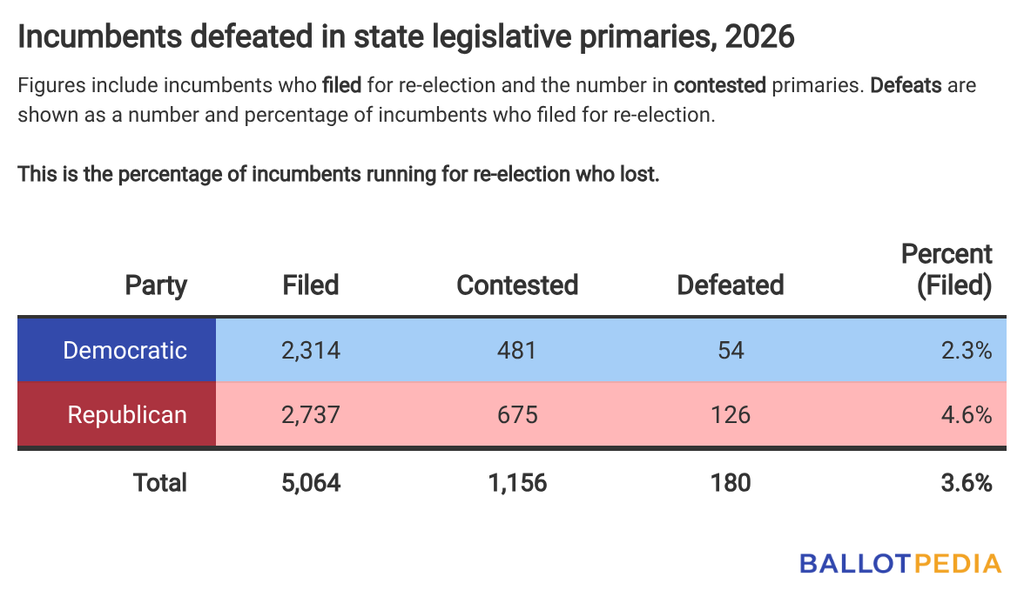
Republican state legislators lost re-election in this year’s primaries at twice the rate of Democrats. Of the 2,737 Republicans who ran for re-election, 126 (4.6%) lost primaries. Of the 2,314 Democrats who ran, 54 (2.3%) did.
The partisan split follows a pattern we reported in the June 22 Daily Brew that incumbents had more primary challengers than usual this year, mostly in Republican-controlled states. There was a 5.5 percentage point increase in the average number of incumbents who ran in contested primaries in states with Republican trifectas from 2010 through 2024. There was a 0.9% increase in the average number of incumbents who ran in contested primaries in states with Democratic trifectas from 2010 through 2024.
In all, 180 of the 5,064 incumbents (3.6%) who ran for re-election lost primaries this year — the third-highest total since 2010 and more than the average of 161 per even-numbered year from 2010 through 2024.
The election cycles with higher totals were 2012 (197) and 2022 (229). Both cycles were the first after states redrew district lines following the U.S. Census, which resulted in some incumbents running against each other.
Where incumbents lost primaries most often
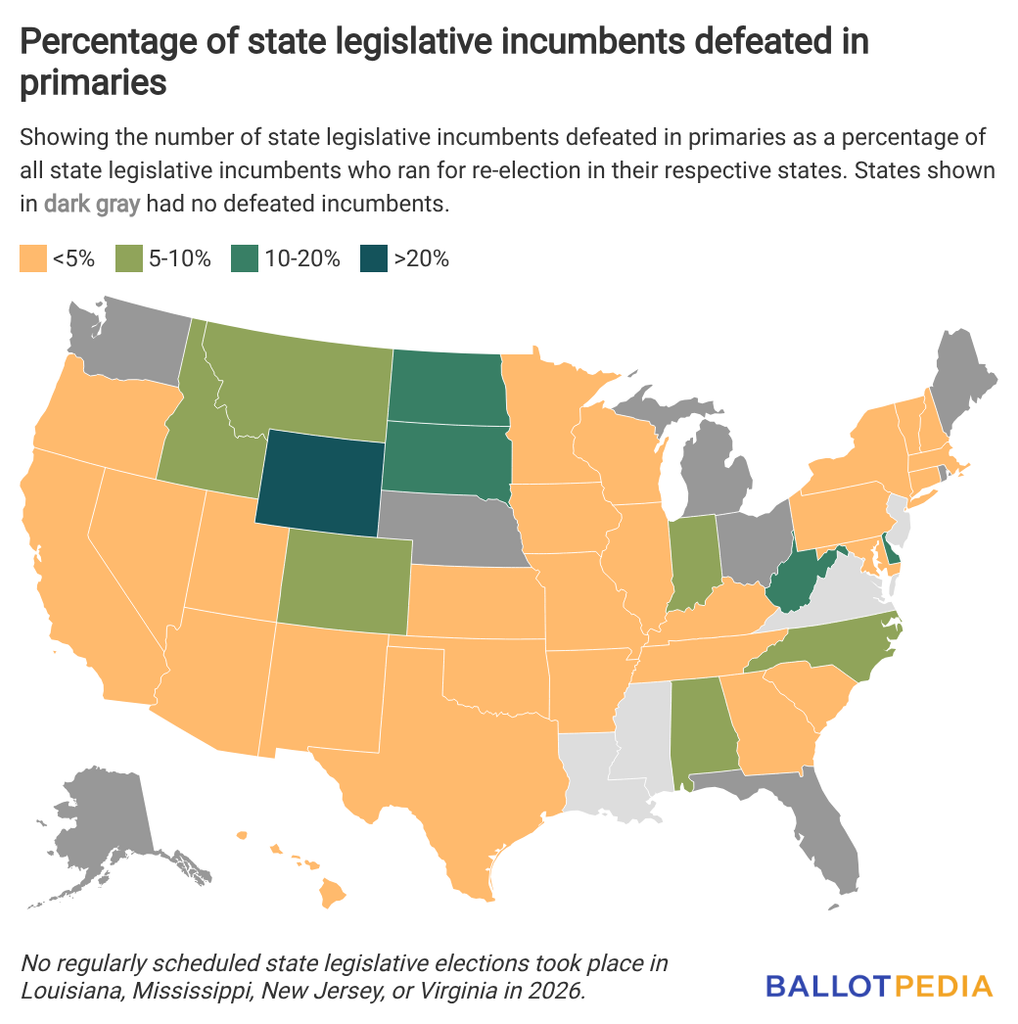
In five states, at least 10% of incumbents who ran for re-election lost in primaries this year:
- Wyoming: Fourteen of 54 incumbents who ran (25.9%) lost primaries. All 14 incumbents are Republicans.
- South Dakota: Fourteen of the 78 incumbents who ran (17.9%) lost primaries. All 14 incumbents are Republicans.
- West Virginia: Fifteen of the 98 incumbents who ran (15.3%) lost primaries. All 15 incumbents are Republicans.
- Delaware: Five of the 43 incumbents who ran (11.6%) lost primaries. All five incumbents are Democrats.
- North Dakota: Six of the 52 incumbents who ran (11.5%) lost primaries. One incumbent is a Democrat, and the other five are Republicans.
Delaware has a Democratic trifecta, and the four other states have Republican trifectas.
Notable incumbents who lost primaries
Two incumbents who hold leadership positions in their state legislatures lost primaries this year:
- North Carolina Senate President Pro Tempore Phil Berger (R) lost to Sam Page (R) by 23 votes out of 26,247 cast.
- Maryland Senate Majority Leader Nancy King (D) lost to Amar Mukunda (D), 48.9% to 37.2%, in a field of three candidates.
Three incumbents who first assumed office before 2000 lost primaries this year:
- Connecticut Rep. Patricia Dillon (D) lost to Eli Sabin (D), 44.3% to 35.7%, in a field of three candidates. Dillon, who first assumed office in 1985, is the longest-serving state legislator to lose a primary this year.
- Pennsylvania Rep. Gregory Vitali (D) lost to Judy Trombetta (D) 61.9% to 38.1%. Vitali first assumed office in 1992.
- Vermont Rep. James Masland (D), who first assumed office in 1999, finished third in a primary where the top two vote-getters advanced to the general election. Dee Gish (D) received 41.4% of the vote, Lauren Morando Rhim (D) received 32.4%, and Masland received 26.2%.
There are 6,137 seats up for election this year across 88 state legislative chambers. We will report how many incumbents lost across all elections once the Nov. 3 results are known.
Click here to see a full list of state legislators who lost primaries this year.
South Carolina voters will decide whether to maintain or break the Republican state legislative supermajority

Welcome to the next installment of our 50 States in 50 Days series, covering South Carolina. To view our archive of past editions, click here.
Whether Republicans maintain a supermajority in the South Carolina Legislature will be decided in the Nov. 3 elections.
A supermajority is when one party has enough members in the state legislature to override a gubernatorial veto without any votes from members of the minority party. In South Carolina, a party must control two-thirds of the seats in each legislative chamber to have a supermajority. That’s 31 seats in the South Carolina Senate and 83 in the South Carolina House of Representatives. Republicans currently have a 34-12 majority in the state Senate and an 89-35 majority in the state House.
All 124 seats in the state House are up for election this year. There will also be a special election for Senate District 15.
We categorize South Carolina’s Republican supermajority as highly exposed to breaking. Democrats would need to gain at least seven seats to break the supermajority in the state House, and Republicans would need to lose no more than six seats to maintain their supermajority.
Voters must register in person by Oct. 2, online by Oct. 4, or via mail by Oct. 5.
Early voting opens Oct. 19 and ends Oct. 31.
Polls open on Election Day at 7 a.m. and close at 7 p.m.
Voter ID is required. Acceptable forms of ID include a South Carolina driver’s license, ID card, or voter registration card with photo, a federal military ID, or a U.S. passport. Voters who have a reasonable impediment to obtaining a photo ID may bring their non-photo voter registration card to the polling place, fill out a reasonable impediment affidavit, and vote a provisional ballot. The ballot will be counted unless there is proof that the person is lying about their identity or impediment. For more information on voter ID in South Carolina, click here.
Absentee/mail-in ballots must be requested by Oct. 23 and received by Nov. 3.
Current party control
Republicans represent six congressional districts, and a Democrat represents one. Both of South Carolina’s U.S. Senators are Republicans.
Republicans control the governorship and both state legislative chambers, making South Carolina one of 23 states with a Republican trifecta. South Carolina’s attorney general and secretary of state are also Republicans. As a result, South Carolina is one of 24 states with a Republican triplex.
The Legislature directly appointed four members of the South Carolina Supreme Court. Republicans controlled the Legislature at the time of the members’ appointments. There is also one vacancy on the Court.
Offices on the ballot
Elections are taking place for the U.S. Senate and U.S. House of Representatives.
In addition to the state legislative elections mentioned above, there will also be elections for governor, lieutenant governor, attorney general, secretary of state, agriculture commissioner, comptroller, superintendent of education, and treasurer.
South Carolina is one of 32 states this year where we are providing comprehensive election coverage down to the local level. This year's ballot includes elections for municipal and county offices as well as for school boards.
Notable elections
U.S. Senate: Incumbent Sen. Darline Graham (R), Annie Andrews (D), and eight other candidates are running. Governor Henry McMaster (R) appointed Graham to serve the remainder of her late brother Lindsey Graham's (R) term. Andrews is a pediatrician. This general election marks the first time that two women from the major parties will face each other in a U.S. Senate election in state history.
Statewide ballot measures
There are no statewide measures on the ballot this year. From 2000 to 2025, voters decided on 27 measures, or an average of two per even-numbered year. During that period, voters approved 22 measures and defeated five.
Join us again tomorrow when we'll preview elections in Hawaii, the Aloha State.
Click here to see every edition of 50 States in 50 Days as we publish them, and here to use our Sample Ballot Lookup Tool.
You can help us put candidate information in voters’ hands
Election Day is fast approaching, and millions of voters will be turning to us to help them find out more about the candidates and issues on their ballots.
You can help us provide that important information to voters as they seek to learn more about candidates who align with their values. Your tax-deductible gift of $13 a month, or $150 one-time gift, will help ensure we’ll be there for every voter, every time. Please click here to donate today!