


Welcome to the Wednesday, Oct. 7, 2026, Brew.
By: Lara Bonatesta
Here’s what’s in store for you as you start your day:
- 8% of officials named in recall efforts have been removed from office so far this year, lower than the 16-year average
- Hawaii is one of four states that will decide on six ballot measures related to housing policy this year
- Internal Revenue Service issues regulations for Education Freedom Tax Credit
8% of officials named in recall efforts have been removed from office so far this year, lower than the 16-year average
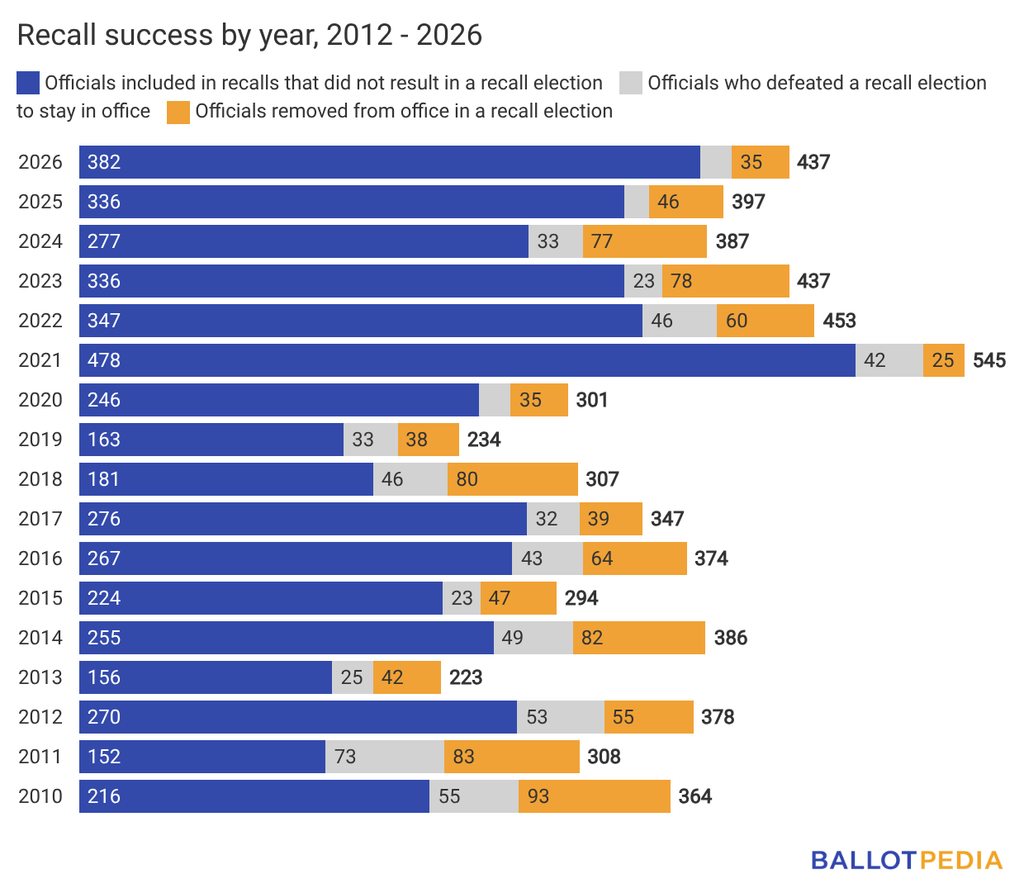
Through Oct. 2, a total of 35 officials have been removed from office in recall efforts nationwide this year. This amounts to 8% of the 437 elected officials named in recall efforts. That rate is lower than the 16% success rate Ballotpedia tracked from 2010 to 2025.
The highest recall success rate was 27% in 2011. In that year, 83 of the 308 officials targeted for recall were removed from office. The lowest success rate was 5% in 2021. In that year, 25 of the 545 officials targeted for recall were removed from office.
The details of the recall process vary by state. Click here to learn about the laws governing recalls in each state.
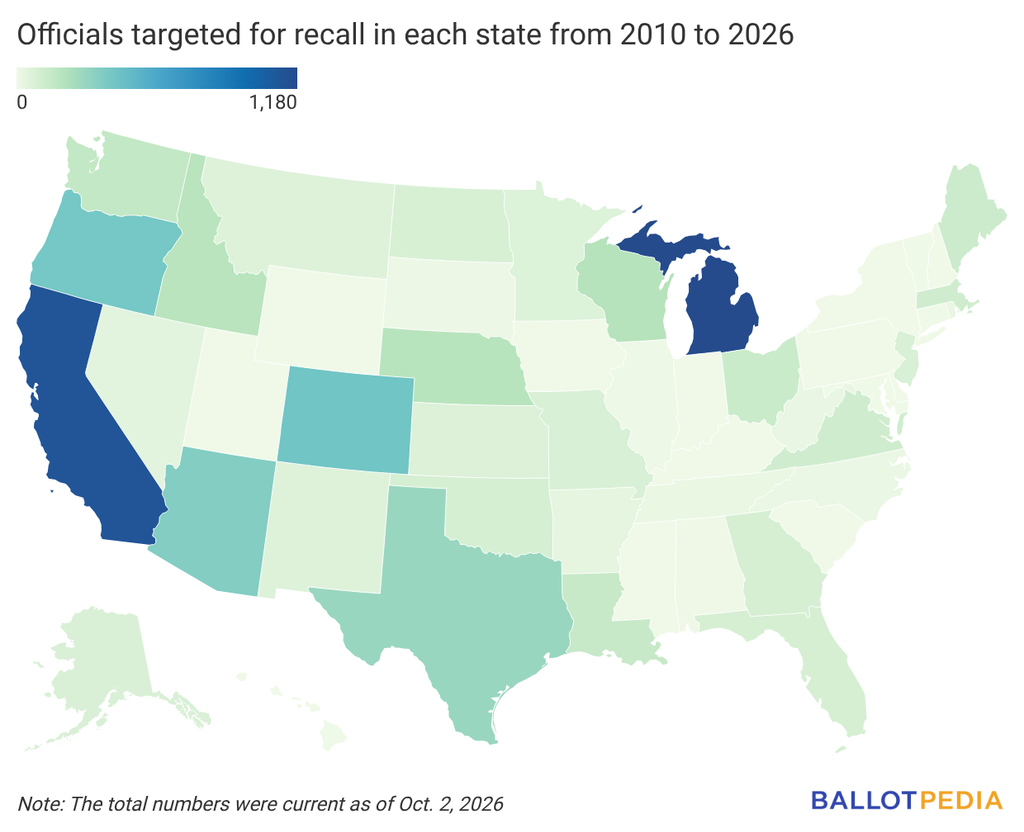
Michigan had the highest number of officials included in recall efforts since 2010, with 1,180. Those officials account for 19% of all recalls Ballotpedia had identified as of Oct. 2. California had the second-highest with 1,115 (18%), and Colorado was third-highest with 413 (7%).
The map below shows the total number of officials targeted for recall in each state from 2010 to Oct. 2, 2026.
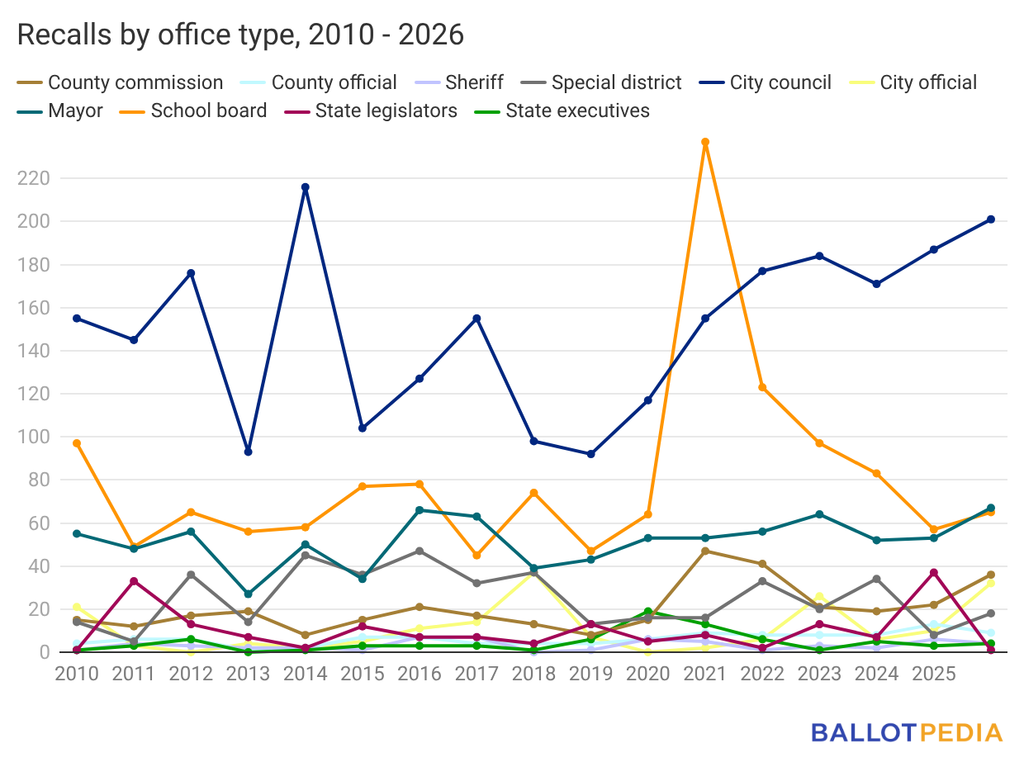
City council members had the most recall petitions filed against them, with 201. Mayors had 67, and school board members had 65.
From 2010 to 2025, city council members had the most recall petitions filed against them, except in 2021 when school board members had the most.
The recall process is a form of direct democracy, and a way for citizens to respond to moments of social and political stress.
We've identified 15 recall efforts targeting 18 officials on the Nov. 3 ballot in five states: Oklahoma, Michigan, Texas, Ohio, and Kansas. Michigan has the bulk of these, with eight efforts targeting 10 officials. Click here to learn more about upcoming recall elections.
This year, for the first time, we tracked recall efforts related to data center development. So far this year, there have been 42 data center-related recall efforts targeting 80 officials. Of those, efforts against 41 officials are still underway; efforts against 33 officials did not go to a vote; one official resigned; one official was removed from office; and recall elections against four officials are scheduled.
Click here to learn more about political recall efforts and here to see Ballotpedia’s recall reports.
Hawaii is one of four states that will decide on six ballot measures related to housing policy this year
Welcome to our next installment of our 50 States in 50 Days series, covering Hawaii. To view our archive of past editions, click here.
When Hawaii voters go to the polls on Nov. 3, they will decide on two statewide ballot measures. One of them – Question 2 – is one of six measures nationwide this November related to housing policy. As we mentioned in the Aug. 18 Daily Brew, this is the most housing policy measures in a single year since 2006.
State ballot measures on housing were uncommon before 2024. Between 2006 and 2025, voters decided nine statewide housing policy measures. Voters approved three and defeated six. No more than one such measure appeared on the ballot in any year from 2006 to 2023. There were three such measures in 2024.
Hawaii’s Question 2 would authorize the Legislature to permit counties and municipalities to issue housing infrastructure growth bonds for specified public works, public improvements, and community development. The measure would also make the bonds payable from real property taxable and include them on a list of exemptions used to calculate a county’s debt limit, meaning that such bonds would not count towards a county’s debt limit.
Want to see what’s on your ballot this November? Click here to use our Sample Ballot Lookup Tool. Now let’s take a closer look at what’s happening in Hawaii.
Voting in the Nov. 3 elections
Early voting opens Oct. 20 and ends Nov. 3.
Hawaii is an all-mail voting state. Voters wishing to vote in person may do so on Election Day at a voter service center between 7:00 a.m. and 7:00 p.m.
Voter ID is not required to vote in Hawaii in most cases. The federal Help America Vote Act requires that individuals in all 50 states who register to vote by mail and who have not voted previously in a federal election in their state must provide either their driver's license or a paycheck, bank statement, current utility bill, or government document showing their name and address.
All voters are mailed an absentee/mail-in ballot approximately 18 days before Election Day. Ballots must be received by Nov. 3.
Under a 2025 law, voters may register by mail up to 10 days before the election. The previous deadline was 30 days before the election.
Current party control
Democrats represent both congressional districts. Both of Hawaii’s U.S. Senators are also Democrats.
Democrats have a 22-3 majority in the Hawaii Senate and a 41-10 majority in the Hawaii House of Representatives. Because the governor is a Democrat, Hawaii is one of 16 states with a Democratic trifecta. Hawaii’s attorney general is also a Democrat. Hawaii is one of three states with no secretary of state. Democratic governors have appointed four justices on the Hawaii Supreme Court. One seat is vacant.
Offices on the ballot
Elections are taking place for the U.S. House of Representatives, seven state executive offices, 13 seats in the state Senate, and all 51 seats in the state House.
Hawaii is one of 32 states this year in which we are covering all local elections for school boards and municipal offices.
Battleground elections
As of Oct. 5, Ballotpedia had not identified any congressional or statewide races in Hawaii in November as battlegrounds. Major election forecasters rated both the state’s congressional elections and gubernatorial elections as Solid/Safe Democratic.
Statewide ballot measures
There are two statewide measures on the ballot in Hawaii this year – both of which are legislatively referred constitutional amendments. From 1950 to 2024, Hawaii voters decided on 144 ballot measures, or three to four per even-numbered year. Voters approved 121 (84%) and defeated 23 (16%). For more information about the history of Hawaii’s ballot measures, visit its Historical Measures Factbook.
We mentioned Question 2 above.
Question 1 would increase the timeframe for the state senate to consider and act on appointments of judges and justices from 30 days to 60 days for those made between April 1 and Dec. 31, when the chamber is not in a regular session or is close to adjourning. Currently, the Legislature must convene annually on the third Wednesday in January and meets for 60 legislative days, typically adjourning in May.
Local ballot measures
Ballotpedia is also covering local ballot measures in Honolulu, where there are 20 measures on the ballot. Here is a look at three of those.
Honolulu Question 5 would amend the city charter to adopt ranked-choice voting (RCV) to elect the mayor, city council, and prosecuting attorney. Hawaii currently uses RCV for certain statewide elections. To learn more about where RCV is used, click here.
Honolulu Question 6 would require the police department to "adopt policies to ensure the constitutional rights of all persons, regardless of immigration or citizenship status." It would also only authorize compliance with federal immigration officers when the state, federal statute, or court order requires it.
Honolulu Question 15 would establish the Office of Data and Innovation to conduct research on data standards, data privacy, AI, and innovation in city services.
Join us next edition when we'll preview elections in Wisconsin, the Badger State.
Click here to see every edition of 50 States in 50 Days as we publish them, and here to use our Sample Ballot Lookup Tool.
Internal Revenue Service issues regulations for Education Freedom Tax Credit
On Oct. 2, the Internal Revenue Service (IRS) issued regulations that determine how the Education Freedom Tax Credit (EFTC) will run and, in turn, how many states participate.
The EFTC — also known as the Federal Scholarship Tax Credit (FSTC) — will allow individuals to receive federal tax credits for donations up to $1,700 to authorized scholarship-granting organizations (SGOs), but states must opt in annually to participate. The program is set to begin on Jan. 1, 2027.
The regulations came in two parts. The IRS proposed regulations related to student eligibility, calculating taxpayer credits, SGO operations, and state operations and requirements. It also issued temporary regulations that will implement some provisions of the proposed regulations early. The temporary regulations include procedural requirements for states and SGOs listed in the proposed regulations, which the IRS said must be effective for the program to begin in 2027.
The proposed rule has a 60-day comment period and a public hearing scheduled for Dec. 15, 2026. The temporary regulation also has a 60-day comment period and will take effect on Dec. 1.
Notable provisions of the proposed and temporary regulations included:
- Married couples filing jointly may receive up to $3,400 in federal tax credits under the program. Each spouse may claim the $1,700 tax credit for qualified contributions.
- Some students will be categorically eligible for scholarships. This includes need-based benefit recipients, those in foster care, and those schools selected as needing academic or special needs services if the school is located in low-income areas. Schools may select students for scholarships based on academic or special needs.
- Students may use scholarships based on future enrollment in schools. Expenses are eligible contingent on a student's school enrollment, but the regulations said students may use a scholarship in the summer if they are enrolled in the school year starting in the fall. Students may also be able to use scholarships for services before and after school.
- SGOs may have some financial flexibility. If 85% of an SGO's activities are scholarship-granting (either related to the EFTC, state tax credit scholarship programs, or any other scholarship organizations), then the SGO may apply the federal requirement that 90% of its income be used for scholarships solely to a segregated EFTC account. This helps SGOs that already provided scholarships under different programs participate in the federal program.
- "School" means any K-12 school that provides elementary or secondary education, as determined under state law. Depending on the state, homeschooled students or microschool students may be eligible for scholarships.
- States may not impose restrictions on SGOs more stringent than federal requirements. States must include on their list all SGOs that meet federal requirements and are requesting to participate.
- SGOs "located in the state" are defined as those authorized to do business in the state. They are not required to be physically located in the state. This enables multi-state SGOs.
- The credit is nonrefundable, but unused credits can be carried forward for five years. For donors with a tax liability of less than $1,700, credits not used in one year may roll over to the next.
- States may include SGOs with pending nonprofit designations on their SGOs list. They are only listed on the federal SGO list once the IRS approves their nonprofit status.
- States can officially elect to participate in the program, but can only complete their election by submitting a list of qualified SGOs. Many states have already made advance elections for 2027, but are not fully opted in until they submit a list of qualified SGOs.
Learn more about the program and its regulations here.
Previously, several Democratic governors indicated that they would wait until the IRS released regulations before deciding whether to participate. No governor has opted in since last week.
As of Oct. 2, 30 states had officially elected to participate. This includes:
- All 23 states with a Republican trifecta.
- Five states with divided governments.
- Colorado and Virginia, which both have Democratic trifectas. (New York has signaled its intent to participate, but has not completed an advance election form).
Governors, state legislators, or any entity under state law with the authority to make tax decisions may opt a state into the program. Thirty-six states have gubernatorial elections in 2026. Because the IRS issued the regulations less than 90 days before the program start date, the IRS gave states until Feb. 15, 2027, to submit SGO lists, which completes their decision to participate. Newly elected governors who want to reverse their state's decision to participate could decide not to submit an SGO list and effectively opt out of the program.
In the 30 states that have completed an advance election form:
- 19 have gubernatorial elections.
- Eleven governors are term-limited.
- Seven governors are running for reelection.
- Iowa Gov. Kim Reynolds (R) is not running for reelection, but is not term-limited.
Click here to read more about the Federal Scholarship Tax Credit rule.