


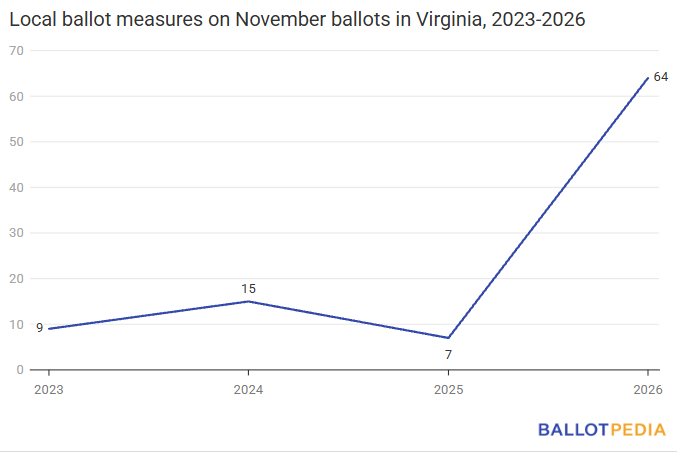
Voters across Virginia will decide on 64 local ballot measures on Nov. 3, more than four times as much as the November 2024 election.
Ballotpedia has covered every local ballot measure in Virginia beginning in 2023. Between 2023 and 2026, an average of about 24 measures were on the November ballot in Virginia.
1% sales tax measures
Of the 64 measures, 47 would create a 1% sales tax. The state budget, approved by the Virginia General Assembly in June 2026, included language granting local jurisdictions the ability to levy an additional 1% sales tax and use the revenue to fund capital improvements to public schools, if approved by a majority of voters. Forty-seven local jurisdictions opted to place a 1% sales tax on the 2026 ballot.
In Loudoun, Prince William, Fairfax, and Arlington Counties, as well as all independent cities enclosed by those counties, the revenue from the proposed sales tax can be used to fund both public transportation systems and school districts. In the rest of the state, the revenue can only be used to fund capital improvements to school districts. To see a full list of the 47 districts where the 1% sales tax is on the November ballot, click here.
Local bond measures
Virginia voters in four counties will decide on 14 ballot measures that would issue a combined total of $1.28 billion in bonds. A bond is debt that is backed by a unit of government. The unit of government that issued the bond is obligated to pay the principal and interest costs on such bonds. Typically, the general budget or general fund of the unit of government that issued the bonds is used to pay these costs.
The largest single bond measure is in Loudoun County, where a measure would issue $280.848 million in bonds to fund improvements for road and transportation projects. Spotsylvania County, where voters will decide four bond measures, has the largest combined bond package on the ballot. If all four measures are approved, the county would issue $400.5 million in bonds.
Other ballot measures
Voters in three localities will decide on ballot measures that are not sales tax or bond issues.
Two of the measures concern gambling policy. In Amherst County and Pulaski, voters will decide on a ballot measure that would permit pari-mutuel wagering at satellite facilities. In 1988, Virginia voters approved a ballot measure that authorized pari-mutuel betting on horse racing in the state. However, before a license for a horse racetrack or satellite facility can be issued, voters in the locality must vote to permit pari-mutuel wagering in the city or county. According to the Virginia Gaming Commission, there are 12 racetracks or satellite facilities in the state as of 2026.
Voters in Iron Gate will decide on a ballot measure that would amend the town charter. The measure would decrease the size of the town council to four council members and the mayor. As of 2026, the town council consists of six council members and the mayor.
Statewide ballot measures
There are three statewide measures on the Virginia ballot this year. From 1927 to 2024, Virginia voters decided on 107 ballot measures, or about two per even-numbered year. During that period, voters approved 92 measures and defeated 15.
Question 1 would establish a right to reproductive freedom. It is one of four measures nationwide related to abortion this year, after a record year for abortion-related measures in 2024, when 11 were on the ballot nationwide.
Question 2 would repeal the provision in the state constitution defining marriage as between one man and one woman and prohibit the state from denying a marriage license to two adults based on sex, gender, or race. If approved, Virginia would be the fifth state to repeal a constitutional provision defining marriage as between one man and one woman.
Question 3 would amend the state constitution to state that persons convicted of felonies lose their right to vote only while incarcerated and have their political rights, including voting, restored upon release from incarceration. Currently, Virginia is one of three states in which voting rights are never restored for individuals convicted of any felony without the state acting to restore the person's rights.