


Welcome to the Tuesday, Oct. 13, 2026, Brew.
By: Lara Bonatesta
Here’s what’s in store for you as you start your day:
- Republicans cannot lose more than two seats to keep control of the U.S. Senate, Democrats need to gain four for a majority
- Missouri voters to decide on abortion and congressional redistricting on Nov. 3
- Virginia voters will decide 64 local ballot measures on Election Day, more than the last three Novembers combined
Republicans cannot lose more than two seats to keep control of the U.S. Senate, Democrats need to gain four for a majority
Every weekday until Election Day, the Daily Brew will preview the elections happening for a different office type happening on Nov. 3. These 14 office types include those for the federal, state, and local levels of government. First up: the U.S. Senate.
Republicans are defending 22 seats in this year’s U.S. Senate elections, including two that are up for special election, and Democrats are defending 13. The outcomes will determine whether Republicans can hold on to the majority they gained in the 2024 elections or whether Democrats will regain a majority.
The chart below shows how the partisan breakdown of the seats up for election this year compares to other recent years.
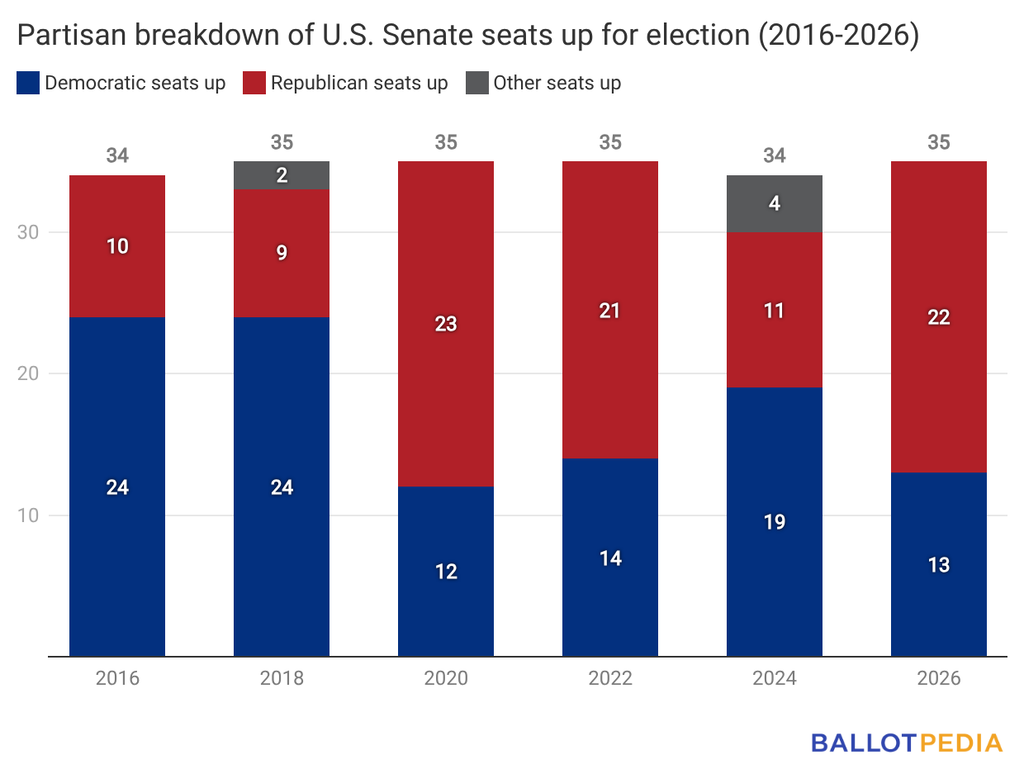
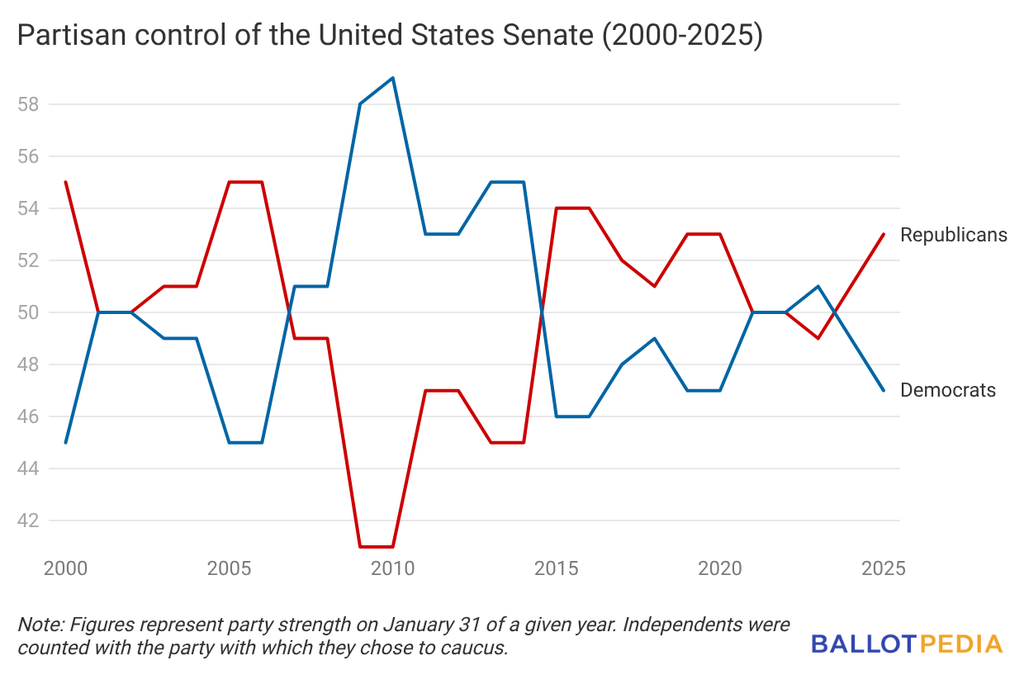
Currently, Republicans have a 53-45 majority in the Senate, with two independents caucusing with Democrats. To win back the majority, Democrats need a net gain of four seats. Republicans can afford to lose only two seats and still maintain control.
Democrats are defending two seats in states that President Donald Trump (R) won in the 2024 presidential election: Georgia and Michigan. Republicans are defending one seat in a state that Kamala Harris (D) won in the 2024 presidential election: Maine.
In the event of a tie, Vice President J.D. Vance’s (R) tiebreaking vote would allow Republicans to win any simple majority votes that are held across partisan lines. A power-sharing agreement between the leaders of both caucuses would determine the specifics of U.S. Senate control in an evenly divided chamber, including decisions on committee chairmanships and Senate-wide staff positions.
One of the biggest storylines we’ve been tracking this cycle is the number of retirements. The 11 incumbents —four Democrats and seven Republicans — not seeking re-election is the most in any election year since Ballotpedia began tracking this data in 2012.
Battlegrounds
Ballotpedia has identified 13 Senate seats as battlegrounds this year. Republicans are defending 10 seats in Alaska, Florida, Iowa, Kansas, Maine, Montana, Nebraska, North Carolina, Ohio, and Texas. Democrats are defending three seats in Georgia, Michigan, and New Hampshire.
Key trends to watch
- The retirement wave: The 11 retirements created open seats, which generally have more competitive elections.
- Special elections: Two special elections in Florida and Ohio will fill the remaining terms of Vice President J.D. Vance (R-Ohio) and Secretary of State Marco Rubio (R-Fla.). The Ohio race pits incumbent Jon Husted (R) and Sherrod Brown (D), a former three-term senator who lost re-election in 2024, against each other. The Florida race pits incumbent Ashley B. Moody (R) against Angie Nixon (D), a state representative and a member of the Democratic Socialists of America (DSA).
- Presidential election aftermath: This year’s elections will be the first since the 2024 presidential election. In the lead-up to Election Day, there has been some media speculation about whether there will be a wave election. In 2018, Ballotpedia published a study of wave elections examining the results of the 50 election cycles between 1918 and 2016. In that study, we defined wave elections as the 20 percent of elections resulting in the greatest swing against the president’s party. For the U.S. Senate, the president's party needed to lose seven seats for the year to historically qualify as a wave election. Including both presidential and midterm years, the president's party has lost seven or more U.S. Senate seats in 10 of the 52 election cycles between 1918 and 2024. The president’s party gained seats in 13 election cycles. There were three election cycles in which the president's party gained more than seven seats.
- Record number of candidate withdrawals: Six major party or minor party nominees have withdrawn ahead of this year’s U.S. Senate general elections. Three of those candidates are Democrats who left the race, leaving independent candidates to run against Republican incumbents.
Recent election history
In the 2024 Senate elections, Republicans gained four seats to secure their current majority. Four Democratic incumbents lost re-election that year.
For more information on the U.S. Senate elections in 2026, click here.
Missouri voters to decide on abortion and congressional redistricting on Nov. 3
Welcome to our next installment of our 50 States in 50 Days series, covering Missouri. To view our archive of past editions, click here.
Missouri voters will decide on five statewide ballot measures on Nov. 3, including one that would prohibit abortion and gender transition surgeries for minors under 18 and one that would redraw the state's eight congressional districts.
Amendment 3 would repeal the section of the constitution titled, "The Right to Reproductive Freedom Initiative," which voters approved 51.6% to 48.4% in 2024. Amendment 3 would prohibit abortion, except in cases of medical emergency, fetal anomaly, rape, or incest. For cases of rape and incest, the abortion could be performed no later than 12 weeks of gestation. The amendment would also prohibit gender transition surgeries for minors under 18, and prohibit the prescribing of cross-sex hormones or puberty-blocking drugs to minors under 18. Currently in Missouri, abortion is legal up to the point of fetal viability, and gender transition surgeries for minors are statutorily prohibited. Voters in Idaho, Nevada, and Virginia are deciding on three other abortion-related measures in November.
Proposition A would uphold House Bill 1, Missouri's 2025 congressional district map, which would redraw the state's eight congressional districts. If voters vote against Proposition A, it would repeal the 2025 congressional district map, keeping the map enacted in 2022. Currently, Missouri’s congressional delegation has six Republicans and two Democrats. The 2025 map would divide parts of Kansas City into surrounding rural districts with the goal of netting one additional Republican U.S. House seat.
Missouri’s 2025 map was used in the state's 2026 congressional primaries on Aug. 4. On Sept. 3, the Missouri Supreme Court ruled that a veto referendum on the new map must go on the Nov. 3 ballot, meaning the map passed in 2022 would be used for the 2026 general election. Litigation over the new map made its way to the U.S. Supreme Court. We’ll provide more detail on that below.
Missouri is one of three states deciding on redistricting-related ballot measures on Nov. 3. To read more about redistricting in Missouri ahead of the 2026 elections, click here.
Want to see what’s on your ballot this November? Click here to use our Sample Ballot Lookup Tool. Now let’s take a closer look at what’s happening in Missouri.
Early voting opens Oct. 20 and ends Nov. 2.
Polling places open on Election Day at 6:00 a.m. and close at 7:00 p.m.
Voter ID is required. Acceptable forms of ID include a non-expired Missouri driver’s or non-driver's license, an unexpired military ID, an unexpired passport, or another U.S. or Missouri-issued photo ID, which is either not expired or expired after the date of the most recent general election. For more information on voter ID in Missouri, click here.
Absentee/mail-in ballots must be requested by Oct. 21 and received by Nov. 3.
Under a 2026 law, voting rights are automatically restored to people convicted of certain felonies upon completion of their prison sentences. Previously, an individual had to complete their prison sentence and any parole or probation before being able to register to vote. For 11 crimes, voting rights are still restored to people upon completion of prison time, parole, and probation.
Current party control
Republicans represent six congressional districts, and Democrats represent two. Both of Missouri’s U.S. Senators are also Republicans.
Republicans have a 23-10 majority with one vacancy in the Missouri Senate and a 106-52 majority with five vacancies in the Missouri House of Representatives. Because the governor is a Republican, Missouri is one of 23 states with a Republican trifecta. Missouri’s attorney general and secretary of state are also Republicans. As a result, Missouri is one of 24 states with a Republican triplex. Republican governors appointed five members of the Missouri Supreme Court, and Democratic governors appointed two.
Offices on the ballot
Elections are taking place for the U.S. House of Representatives, the state auditor, 17 seats in the state Senate, and all 163 seats in the state house.
One justice on the Missouri Supreme Court is up for retention.
Notable elections
U.S. House: As we mentioned above, Missouri will use a different congressional map for the 2026 general elections than it did for the Aug. 4 primaries. The Legislature passed, and Gov. Mike Kehoe (R) signed the new map into law in 2025. Following the state Supreme Court’s September 2026 ruling requiring a veto referendum on the new map go on the November ballot, Missouri Secretary of State Denny Hoskins (R) appealed to the U.S. Supreme Court. Justice Brett Kavanaugh denied the application. On Sept. 21, the Eighth Circuit ordered Missouri to use the new map for the 2026 general election. An application for a stay of that decision was filed with the Supreme Court on Sept. 22. On Sept. 25, the Court granted the application for a stay, saying, "as a matter of state law, the 2022 map—not the 2025 map—must be used in the 2026 congressional election."
State Senate: Republicans won a 24-10 supermajority in the 2024 elections. Currently, one previously Republican-held seat is vacant, bringing the Republican majority to 23 seats – the threshold required for a supermajority. Republicans need to retain all their seats or gain seats to keep their supermajority. Democrats need to gain at least two seats to prevent a Republican supermajority.
State House: As we mentioned above, Republicans have a 106-52 majority with five vacancies. Republicans last represented all five seats that are currently vacant. The threshold for a supermajority in the chamber is 109. This means Republicans need to retain all of their seats and win at least three of the vacant seats to maintain their supermajority. Democrats need to gain at least two seats to prevent a Republican supermajority.
Statewide ballot measures
There are five measures on the ballot in November. Between 1908 and 2026, Missouri voters decided on 424 ballot measures – an average of seven per even-numbered year – approving 197 (46.5%) and defeating 227 (53.5%). For a complete look and analysis of Missouri’s ballot measure history, click here.
We mentioned two of these measures above. Here’s a closer look at the other three measures on the ballot this November.
Amendment 6 would prohibit the Legislature from repealing or amending a citizen initiative unless at least 80% of both the House and Senate vote to refer a proposed change to the ballot, and voters then approve the change. It would also prohibit the Legislature from making changes to the citizen initiative and referendum process, among other changes. Amendment 6 is one of nine ballot measures in 2026 related to the initiative and referendum process.
Amendment 7 would create a permanent public endowment fund that the state would manage to generate revenue, and use the earnings to eliminate state-imposed taxes when sufficient to replace them. For a look at the eight other measures related to income and wealth taxes on the ballot in 2026, click here.
Amendment 8 would require the election of county sheriffs to four-year terms in most counties, with the exception of St. Louis, St. Louis County, and St. Charles County. While most sheriffs are already elected in Missouri, this amendment would add the requirement to the state constitution.
Local ballot measures
We are covering four local ballot measures in Missouri on Nov. 3. Here are three notable ones:
Question 1 in Jackson County would continue Jackson County’s 0.25% Community Backed Anti-Crime Tax, also known as the COMBAT sales tax, for 10 years to fund public safety, drug use prevention and treatment, and efforts to address violent crime and drug dealing.
St. Louis City Proposition 1 would amend the city charter to adopt a nonpartisan top-two runoff system for special elections.
St. Louis City Proposition B would impose a 0.5% sales tax to fund a newly established Early Childhood Education Fund. According to the measure, the fund would be used to “support programs and services relating to the quality, affordability, and access to early childhood education for children aged 5 (five) years and younger.”
Join us next edition when we'll preview elections in Pennsylvania, the Keystone State.
Click here to see every edition of 50 States in 50 Days as we publish them, and here to use our Sample Ballot Lookup Tool.
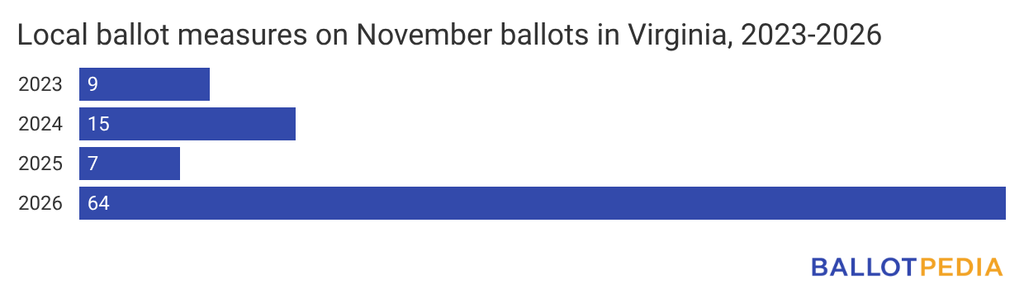
Virginia voters will decide 64 local ballot measures on Election Day, more than the last three Novembers combined
Voters across Virginia will decide on 64 local ballot measures on Nov. 3. That is more measures than the last three Novembers combined and more than four times as many measures as the previous record of 15 in November 2024.
Ballotpedia has covered every local ballot measure in Virginia beginning in 2023. Between 2023 and 2026, an average of about 24 measures were on the November ballot in Virginia.
1% sales tax measures
Forty-seven local jurisdictions have measures on the ballot that would create a 1% sales tax. The state budget, which the Virginia General Assembly approved in June, included language granting local jurisdictions the ability to levy an additional 1% sales tax to fund capital improvements to public schools. These taxes are subject to voter approval. The budget passed along party lines, with Democrats voting in favor and Republicans voting against. Governor Abigail Spanberger (D) signed the budget on Feb. 20. Democrats secured a trifecta in Virginia following the Nov. 2025 elections.
In Loudoun, Prince William, Fairfax, and Arlington Counties, as well as all independent cities in those counties, the revenue from the proposed sales tax can be used to fund both public transportation systems and school districts. In the rest of the state, the revenue can only be used to fund capital improvements to school districts. To see a full list of districts where the 1% sales tax is on the November ballot, click here.
Local bond measures
Voters in four counties will decide on 14 measures that would issue a combined total of $1.28 billion in bonds. The largest single bond measure is in Loudoun County, where a measure would issue almost $881 million in bonds to fund improvements for road and transportation projects. Spotsylvania County has the largest combined bond package, with four measures that would issue $400.5 million in bonds.
Other ballot measures
Voters in three localities will decide on measures that are not sales tax or bond issues.
Two measures concern gambling policy. In Amherst County and the town of Pulaski, voters will decide on measures that would permit pari-mutuel wagering at satellite facilities. In 1988, Virginia voters approved a measure that authorized pari-mutuel betting on horse racing in the state. However, before a license for a horse racetrack or satellite facility can be issued, voters in the locality must vote to permit pari-mutuel wagering in the city or county. According to the Virginia Gaming Commission, there are currently 12 racetracks or satellite facilities in the state.
Voters in Iron Gate will decide on a charter amendment that would decrease the size of the town council to four council members and the mayor. Currently, the town council has six members and the mayor.
Click here to learn more about local ballot measures in Virginia in 2026.