


Welcome to the Thursday, Oct. 15, 2026, Brew.
By: Lara Bonatesta
Here’s what’s in store for you as you start your day:
- Culver City, California could become the 16th municipality to allow 16-year-olds to vote in local or school board elections
- Democrats are defending five governorships in states Trump won in 2024, Republicans are defending two in states Harris won
- West Virginia is one of six states that will decide on a citizenship voting requirement ballot measure on Nov. 3
Culver City, California, could become the 16th municipality to allow 16-year-olds to vote in local or school board elections
On Nov. 3, voters in Culver City, California, will decide on a ballot measure that would allow 16- and 17-year-olds to vote in city and school district elections.
If approved, Culver City would become the fourth municipality in California and the 16th nationally to allow individuals younger than 18 to vote in at least some local elections. Culver City voters defeated a similar voting age measure in 2022, 50.05% to 49.95%.
Currently, 16-year-olds in Albany, Berkeley, and Oakland are permitted to vote in school board elections. Sixteen-year-olds in Newark, New Jersey, are also eligible to vote in school board races, while 16-year-olds in 10 Maryland municipalities, as well as Brattleboro, Vermont, are permitted to vote in local municipal elections.
Implementation of the Culver City ballot measure would be contingent on funding and logistical systems being in place.
The 26th Amendment to the U.S. Constitution lowered the minimum voting age in the U.S. from 21 to 18. This amendment does not prevent jurisdictions from allowing individuals to vote in local elections before the age of 18.
Seventeen-year-olds in 22 states and the District of Columbia are also permitted to vote in state, congressional, and presidential primaries if they will be 18 by the subsequent general election. In two other states, these voters can vote in Democratic presidential primaries or caucuses.
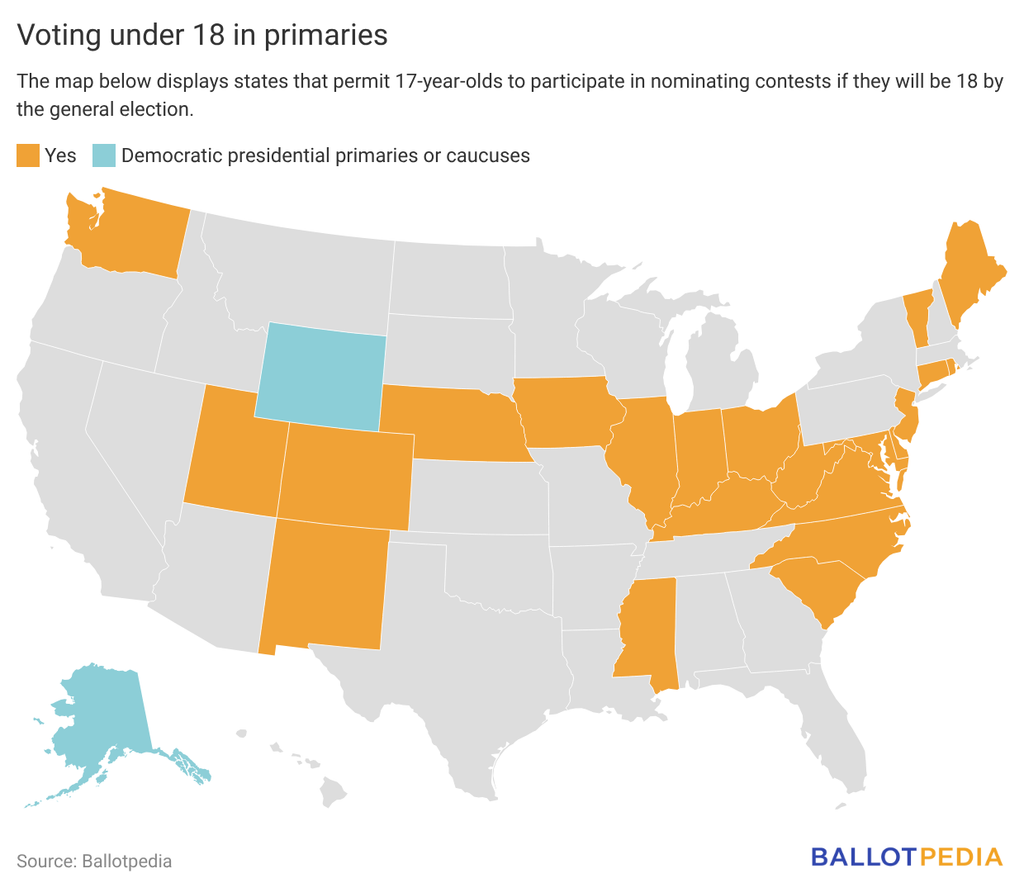
Laws in several of these states either require these voters to use a special ballot or prohibit them from voting on certain parts of a primary ballot, such as a public question or ballot measure.
In all 49 states with voter registration, individuals under 18 may pre-register to vote. They fill out a voter registration form that is on file with election officials. Once a person turns 18, they are registered to vote and able to cast a ballot.
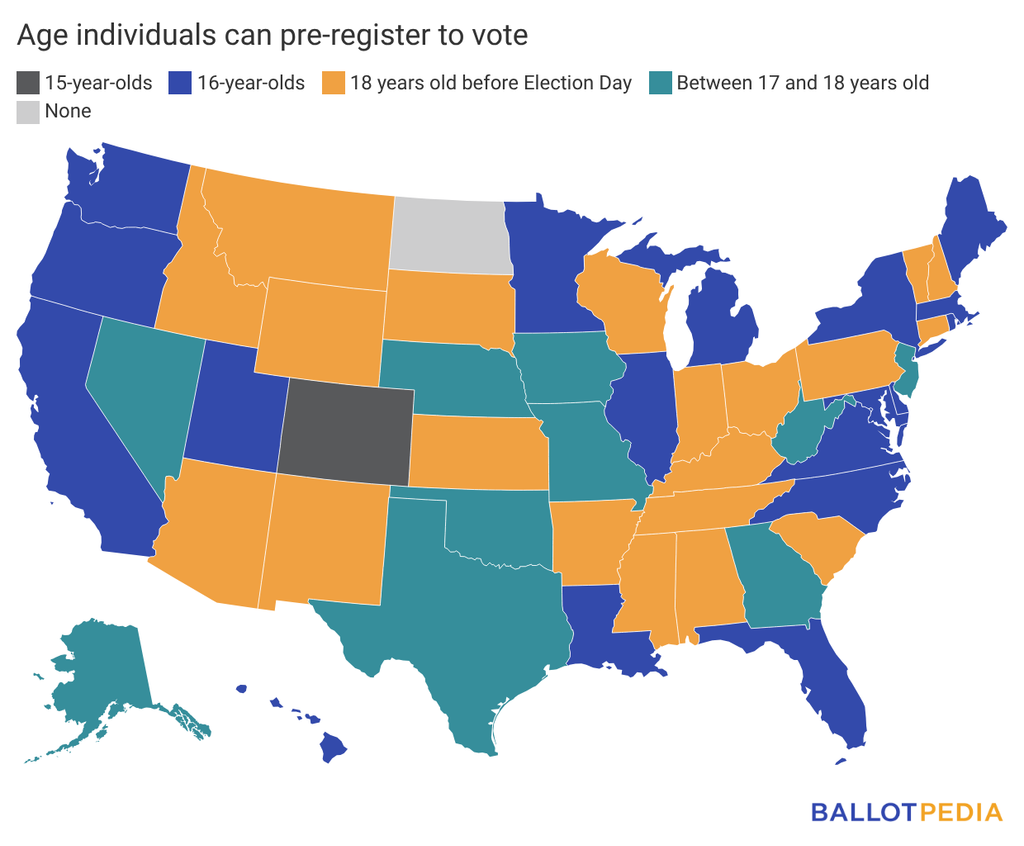
Twenty states allow anyone who will be 18 by the next election to pre-register, while 10 states allow at least some 17-year-olds to do so. Eighteen states and the District of Columbia allow 16-year-olds to pre-register, while Colorado allows pre-registration for 15-year-olds.
Click here to learn more about voting under age 18.
Democrats are defending five governorships in states Trump won in 2024, Republicans are defending two in states Harris won
Welcome to the next installment of our series previewing the Nov. 3 elections by office. Next up: Governors.
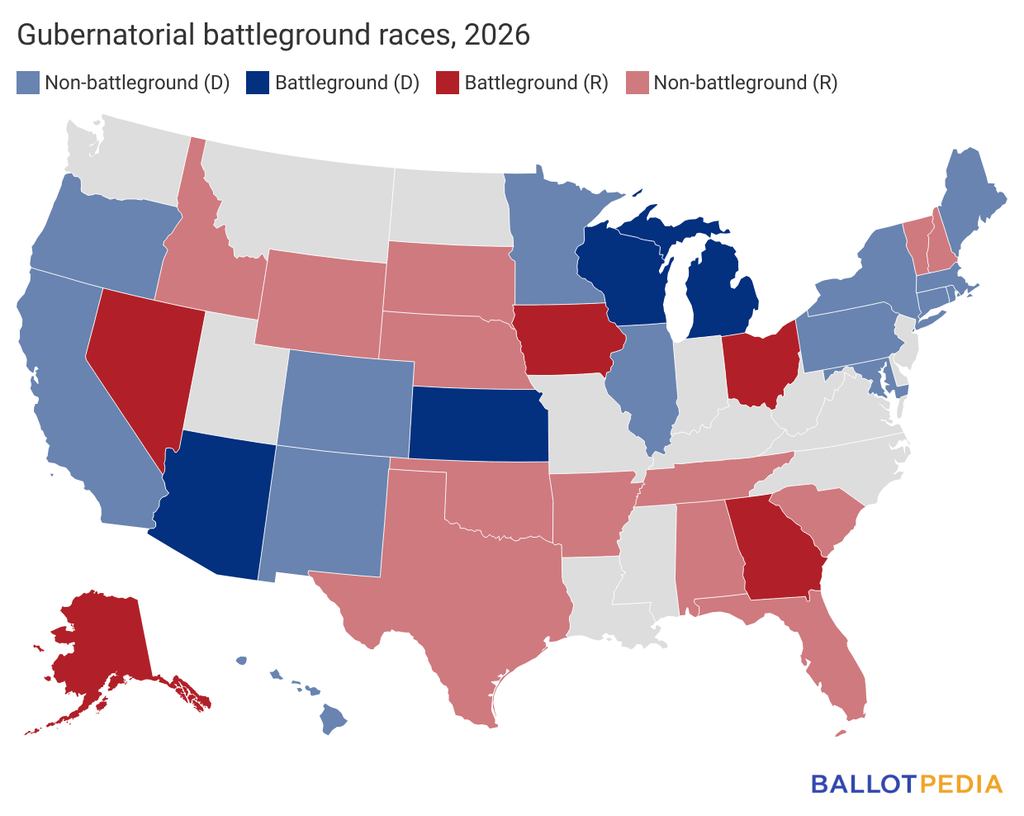
Democrats are defending five governorships in states President Donald Trump (R) won in the 2024 presidential election: Arizona, Kansas, Michigan, Pennsylvania, and Wisconsin. Republicans are defending two governorships in a state that Kamala Harris (D) won in 2024: New Hampshire and Vermont.
Thirty-six states are holding gubernatorial elections this year. Of the governorships on the ballot, Democrats and Republicans each hold 18.
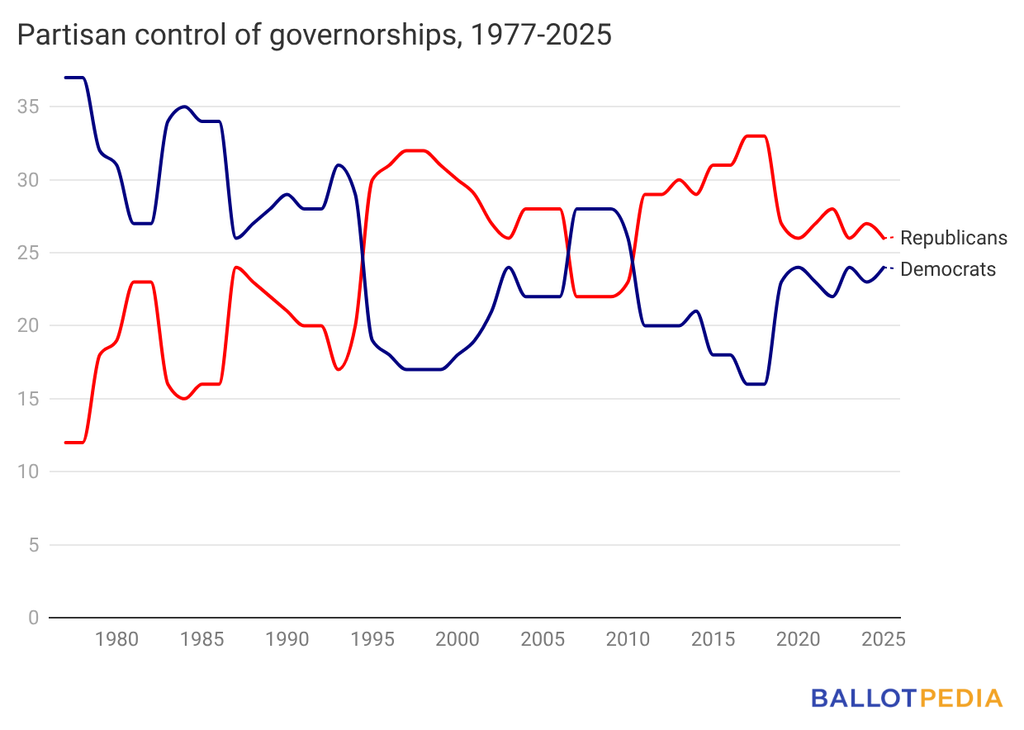
There are currently 26 Republican governors and 24 Democratic governors. Democrats would need to net two governorships to control a majority nationwide. Republicans need to retain all of the governorships they currently have or gain offices to keep their majority.
Republicans have held a majority of governorships nationwide since 2010, when they gained a net six offices and Democrats lost a net seven offices.
Between 2010 and 2017, the number of Republican governors continued to increase, reaching a high point of 33 when then-West Virginia Gov. Jim Justice switched to the Republican Party in August 2017. From 2017 to 2019, Democrats won nine Republican-held governorships, and Republicans won the governorship in Alaska previously held by independent Bill Walker. No governorships changed party hands in 2024. The last gubernatorial election that resulted in a change in party control was in Virginia in 2025, when Abigail Spanberger (D) defeated Winsome Earle-Sears (R).
Battlegrounds
Ballotpedia has identified nine races as battlegrounds, split between four Democratic-held and five Republican-held governorships. There are no incumbents running for seven of the nine governorships.
- Alaska: Jonathan Kreiss-Tomkins (D), David Bronson (R), Treg Taylor (R), and Bernadette Wilson (R) advanced to the general election from the top-four primary. Incumbent Gov. Mike Dunleavy (R) is term-limited. A Republican has held the governor’s office since Dunleavy was elected in 2018. Alaska's last Democratic governor, Tony Knowles, left office in 2002.
- Arizona: Incumbent Gov. Katie Hobbs (D), Andy Biggs (R), Risa Lombardo (G), and Teri Hourihan (No Labels Party) are running. In 2022, Hobbs was elected 50.3% to 49.6%. In the 2024 presidential election, President Donald Trump (R) defeated Kamala Harris (D) 52.2% to 46.7% in the state. This is one of five governorships Democrats are defending in states Trump won in 2024.
- Georgia: Keisha Lance Bottoms (D) and Rick Jackson (R) are running. Incumbent Gov. Brian Kemp (R) is term-limited. The last Democrat elected governor was Roy Barnes in 1998.
- Iowa: Rob Sand (D) and Zach Lahn (R) are running. Incumbent Gov. Kim Reynolds (R) is not running for re-election. The last Democrat elected governor of Iowa was Chet Culver (D) in 2006.
- Kansas: Cindy Holscher (D) and Ty Masterson (R) are running. Incumbent Gov. Laura Kelly (D) is term-limited. This governorship is one of five that Democrats are defending this year in a state that Trump won in the 2024 presidential election.
- Michigan: Jocelyn Benson (D), John James (R), and four other candidates are running in the general election. Incumbent Gov. Gretchen Whitmer (D) is term-limited. This is one of five governorships Democrats are defending in states Trump won in 2024. As of October 2026, major election forecasters rated the election Lean/Tilt Democratic.
- Nevada: Incumbent Gov. Joe Lombardo (R), Aaron Ford (D), and Danielle Ford (No Political Party) are running. In the 2024 presidential election, Trump became the first Republican to win Nevada since George W. Bush (R) in 2004. Trump defeated Harris 51% to 48% in Nevada. The state is one of 11 with a divided government, as Lombardo is a Republican while Democrats hold both chambers of the Legislature and the offices of attorney general and secretary of state.
- Ohio: Amy Acton (D), Vivek Ramaswamy (R), and Don Kissick (L) are running. Incumbent Gov. Mike DeWine (R) is term-limited. Ohio voters last elected a Democratic governor in 2006 when Ted Strickland (D) defeated J. Kenneth Blackwell (R) 61% to 37%.
- Wisconsin: David Crowley (D), Tom Tiffany (R), and Jamie Jo Carothers (Independent, write-in) are running. Incumbent Gov. Tony Evers (D) is not running for re-election. This is one of five governorships Democrats are defending in states Trump won in 2024. Trump defeated Harris 49.6% to 48.7% in the 2024 presidential election in Wisconsin. As of October 2026, major election forecasters rated the general election Toss-up or Lean Democratic.
Key Trends to Watch
- Open offices: A total of 19 gubernatorial elections have no incumbent on the general election ballot. In the midterm years between 1962 and 2026, an average of 14 offices were open. The last time there were more than 19 open gubernatorial offices was 2010, when there were 24.
Fifteen incumbent governors are term-limited: six Democrats and nine Republicans. Seven governors were term-limited in 2022, and 13 were term-limited in 2018. Three governors who were eligible to run for re-election did not: Iowa Gov. Kim Reynolds (R), Minnesota Gov. Tim Walz (D), and Wisconsin Gov. Tony Evers (D). Rhode Island Gov. Daniel McKee (D) ran for re-election and lost in a primary.
- Presidential election aftermath: This year’s elections will be the first since the 2024 presidential election. In the lead-up to Election Day, there has been some media speculation about whether there will be a wave election. In 2018, Ballotpedia published a study of wave elections examining the results of the 50 election cycles between 1918 and 2016. In that study, we defined wave elections as the 20 percent of elections resulting in the greatest swing against the president’s party. For governors, the president's party needed to lose seven seats for the year to historically qualify as a wave election. Looking at only even-numbered years, the president's party has lost seven or more governorships in 11 of the 54 elections since 1918. Eight of the 11 wave elections happened in a president's first midterm election. The president's party gained governorships in 11 years.
Recent election history
Four offices changed party hands in 2022. Partisan control changed from Republican to Democratic in Arizona, Maryland, and Massachusetts. Partisan control changed from Democratic to Republican in Nevada.
In 2022, Democrats were defending one governorship in a state that Trump won in 2020: Kansas. Republicans were defending governorships in six states President Joe Biden (D) won in 2020: Arizona, Georgia, Maryland, Massachusetts, New Hampshire, and Vermont.
Click here to read more about the 2026 gubernatorial elections.
West Virginia is one of six states that will decide on a citizenship voting requirement ballot measure on Nov. 3

Welcome to our next installment of our 50 States in 50 Days series, covering West Virginia. To view our archive of past editions, click here.
West Virginia is one of six states that will decide on a ballot measure related to citizenship requirements for voting on Nov. 3.
The West Virginia Citizenship Voting Requirement Amendment would add language to the constitution stating that "Only citizens of the state who are citizens of the United States are entitled to vote."
These citizenship voting measures are part of a recent move to add such requirements to state law. Between 2018 and 2025, voters decided on and approved 15 such measures, with an average of 73% of the vote. Eight of the 15 appeared on the ballot in 2024.
Federal law has prohibited noncitizens from voting in elections for president, the U.S. House, and the U.S. Senate since 1996. State constitutions and state and local laws govern eligibility for other elections.
Want to see what’s on your ballot this November? Click here to use our Sample Ballot Lookup Tool. Now let’s take a closer look at what’s happening in West Virginia.
Early voting opens Oct. 21 and ends Oct. 31.
Polling places open on Election Day at 6:30 a.m. and close at 7:30 p.m.
Voter ID is required. Acceptable forms of identification include a valid West Virginia driver’s license or ID card, a valid driver’s license issued by another state, a valid passport, or a valid student ID from a West Virginia institution of higher education or high school. A person without ID may have another registered voter or a poll worker attest to their identity, provided they have personally known the person for at least six months.
Absentee/mail-in ballots must be requested by Oct. 28 and postmarked by Nov. 3.
Current party control
Republicans represent both of West Virginia’s congressional districts. Both of West Virginia’s U.S. Senators are also Republicans.
Republicans have a 32-2 majority in the West Virginia Senate and a 91-9 majority in the West Virginia House of Delegates. Because the governor is a Republican, West Virginia is one of 23 states with a Republican trifecta. West Virginia's attorney general and secretary of state are also Republicans. As a result, West Virginia is one of 24 states with a Republican triplex. Four justices on West Virginia’s Supreme Court of Appeals joined the court in nonpartisan elections. A Republican governor appointed one member.
Offices on the ballot
Elections are taking place for the U.S. Senate and the U.S. House of Representatives, 17 seats in the state Senate, and all 100 seats in the state House.
Notable elections
U.S. Senate: Incumbent Sen. Shelley Moore Capito (R), Rachel Fetty Anderson (D), and two others are running. This is West Virginia’s only statewide election in November. Capito first took office in 2015. Anderson is an attorney. Major election forecasters rated the election Solid/Safe Republican. Anderson completed Ballotpedia’s Candidate Connection survey, click here to read her response.
1st Congressional District: Incumbent Rep. Carol Miller (R), Vince George (D), and Belinda Fox-Spencer (Constitution Party) are running. Major election forecasters rated the election Solid/Safe Republican. George and Fox-Spencer completed Ballotpedia’s Candidate Connection survey, click here and here to read their responses.
2nd Congressional District: Incumbent Rep. Riley Moore (R) and Ace Parsi (D) are running. Major election forecasters rated the election Solid/Safe Republican. Parsi completed Ballotpedia’s Candidate Connection survey, click here to read his response.
Statewide ballot measures
As we mentioned above, there is one statewide measure on the ballot this year. Between 2000 and 2024, voters decided on 15 ballot measures, an average of 1.3 per even year. Of these measures, nine were passed and six were defeated.
Local ballot measures
Ballotpedia is covering two local ballot measures in Kanawha County.
The Kanawha County Schools Property Tax Increase for County Public Library Funding Measure would authorize an additional property tax (in varying amounts by property class) to fund county public libraries from July 2030 to July 2034, generating an estimated $3.18 million annually.
The Kanawha County Schools Property Tax Increase for Education and School Funding Measure would authorize an additional property tax (in varied amounts depending on property class) for education funding from July 2030 to July 2034, generating an estimated $32.87 million annually.
Join us next edition when we'll preview elections in Maryland, the Old Line State.
Click here to see every edition of 50 States in 50 Days as we publish them, and here to use our Sample Ballot Lookup Tool.