Of the 31 lieutenant gubernatorial offices up for election this year, Democrats and Republicans each hold 15. The other office on the ballot is a new one.
Arizona is holding its first election for lieutenant governor after voters created the office in 2022. This means the total number of offices is increasing from 45 to 46 this year. Currently, there are 24 Republican lieutenant governors and 20 Democratic lieutenant governors. One office is vacant, after New Jersey Lt. Gov. Dale Caldwell (D) resigned on Sept. 26, 2026. Democrats would need to gain two offices to control a majority nationwide. Republicans can lose no more than one to retain their majority.
The powers and duties of the lieutenant governor vary from state to state. Lieutenant governors are responsible for filling vacancies in the office of the governor. In many states, lieutenant governors often sit on boards or commissions and are often involved in the proceedings of the state Senate.
The process for selecting a lieutenant governor varies by state. In Tennessee and West Virginia, the member of the state Senate chosen to serve as president of the Senate becomes the lieutenant governor. In the other 44 states with lieutenant governors, the officeholder is elected. This election is separate from the gubernatorial election in 17 states and is held on a joint ticket in the other 27.
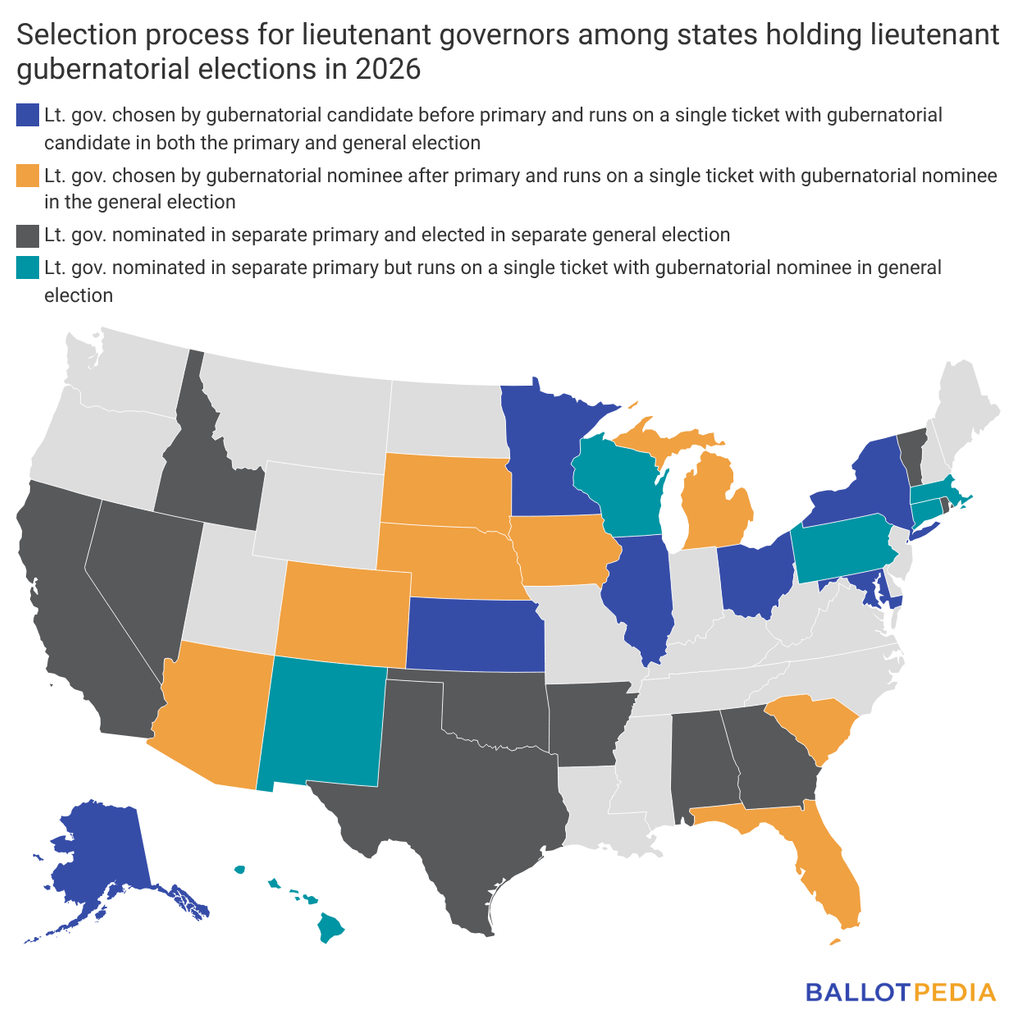
Of the states holding lieutenant gubernatorial elections this year:
- Ten lieutenant governors are nominated in separate primaries and elected in separate general elections.
- Six are nominated in a separate primary but run on a single ticket with the gubernatorial nominee in the general election.
- Seven are chosen by the gubernatorial candidate before the primary and run on a single ticket with the gubernatorial candidate in both the primary and general election.
- Eight are chosen by the gubernatorial nominee after the primary and run on a single ticket with the gubernatorial nominee in the general election.
Battlegrounds: Ballotpedia identified six elections in which the candidates for governor and lieutenant governor run on a single ticket as battlegrounds. Battlegrounds are the elections that we expect to have a meaningful effect on the balance of power or to be particularly competitive or compelling.
- Arizona: Incumbent Gov. Katie Hobbs (D) selected former Republican mayor of Mesa John Giles (R) as her running mate. Republican gubernatorial nominee Andy Biggs (R) selected former Republican state Sen. Sine Kerr (R) as his running mate.
- Iowa: Democratic gubernatorial nominee Rob Sand selected Crawford County Supervisor Dave Muhlbauer (D) as his running mate. Republican gubernatorial nominee Zach Lahn selected State Rep. Derek Wulf (R) as his running mate.
- Kansas: Democratic gubernatorial nominee Cindy Holscher selected state Rep. KC Ohaebosim (D) as her running mate. Republican gubernatorial nominee Ty Masterson selected state Sen. Jeff Klemp (R) as his running mate.
- Michigan: Democratic gubernatorial nominee Jocelyn Benson selected state Sen. Winnie Brinks (D). Republican gubernatorial nominee John James selected state Rep. Jay DeBoyer (R) as his running mate.
- Ohio: Democratic gubernatorial nominee Amy Acton selected former state Democratic party chair David Pepper (D) as her running mate. Republican gubernatorial nominee Vivek Ramaswamy selected state Senate president Robert McColley (R) as his running mate.
- Wisconsin: Democratic gubernatorial nominee David Crowley (D) and lieutenant gubernatorial nominee Sarah Godlewski (D) are running on a joint ticket. Republican gubernatorial nominee Tom Tiffany (R) and David Varnam (R) are running on a joint ticket. Godlewski is Wisconsin’s Secretary of State. Varnam is the former mayor of Lancaster, Wisconsin. Wisconsin holds separate gubernatorial and lieutenant gubernatorial primaries, but the nominees run together on a single ticket in the general election.
Key Trends to watch:
- Effect of term limits: Eight incumbent lieutenant governors are term-limited this year. This is the most since we started collecting this data in 2018. One was term limited in 2022 and six were term-limited in 2018, the last two times this set of offices were up for election.
- Related ballot measures: Two states are deciding on ballot measures related to lieutenant gubernatorial elections. Alabama Amendment 1 would require the office of lieutenant governor to be filled through an election if a vacancy occurs more than 60 days before the next general election. It would also authorize the state legislature to set the salaries of the lieutenant governor and members of the legislature. Massachusetts Question 3 would require candidates for governor and lieutenant governor to register as candidates together before the primary election. Currently, candidates for governor and lieutenant governor run separately in their primary parties and are then combined onto a ticket for the general election. Question 3 would also eliminate political party primaries for state elections and create a top-two primary system.
Recent election history:
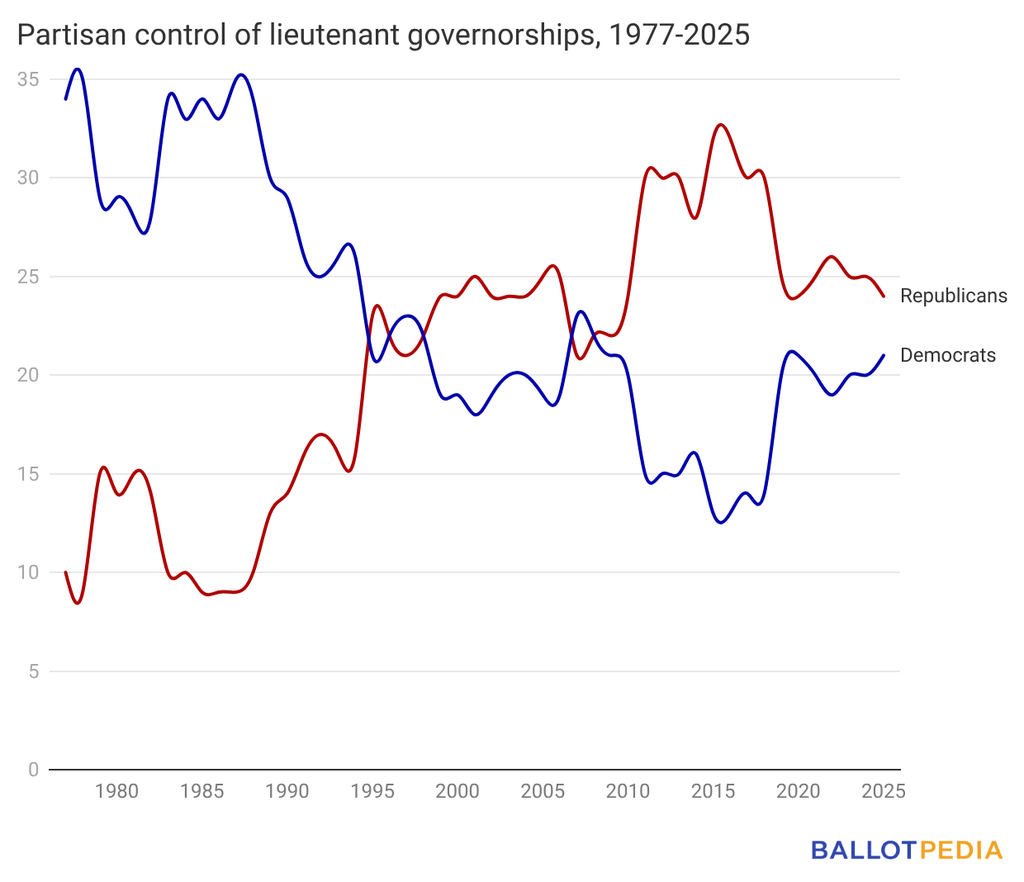
Republicans have held a majority of lieutenant gubernatorial offices nationwide since 2009. Control of lieutenant governorships trended Republican between 2009 and 2015, when the party reached a high of 32 lieutenant governorships to Democrats' 13 in 2015. In 2018, Democrats and Republicans each won 15 of the 30 seats up for election, narrowing the gap but keeping the Republican lead in place. The number of Republican lieutenant governors then continued to decline until 2020. Republicans gained one net lieutenant governorship each in 2020 and 2021, and Democrats gained one net lieutenant governorship in 2022. The total partisan balance of lieutenant governors didn’t change in 2023 or 2024. Democrats gained one lieutenant governorship in 2025 when Ghazala Hashmi (D) was elected to succeed incumbent Winsome Earle-Sears (R) in Virginia.