


Welcome to the Friday, Oct. 16, 2026, Brew.
By: Andrew Bahl
Here’s what’s in store for you as you start your day:
- A look at how elections are run in the U.S.
- Maryland voters to decide on the first statewide ballot measure on redistricting since 2012
- Arizona will elect its first lieutenant governor in 2026 alongside 30 other states
A look at how elections are run in the U.S.
Today, we're sharing the ninth installment in our project marking America's 250th anniversary: The Blueprints of Democracy.
One thing most voters won't have on their minds when they head to the polls on Nov. 3 is the many administrative processes, rules, and regulations that govern our elections.
But these rules are what make elections work. And they cover far more than just what happens on Election Day.
Who runs elections in your state?
The federal government plays a limited role in election administration, with the bulk of the responsibility for running elections residing in state and local authorities. In many, but not all, states, a secretary of state or another statewide official administers elections. In Alaska and Utah, the lieutenant governor oversees elections.
These officials are generally responsible for carrying out election laws and regulations, certifying voting machines and election results, and performing other duties. While these positions are usually elected, in some states, like Pennsylvania and Texas, they are gubernatorial appointees.
Some states have both a secretary of state and an elections board, which oversee various parts of election administration. For example, in Rhode Island, the secretary of state registers voters, prepares ballots, and administers oaths of office. The Rhode Island Board of Elections oversees campaign finance reporting, trains poll workers, tests and prepares voting machines, and tallies and certifies election results.
Other states rely solely on a board of elections, with the chief election official being either a board member or a gubernatorial appointee.
Recent changes in election administration
In 2024, North Carolina enacted legislation changing how positions on the state board of elections are appointed. This year, Utah legislators considered and ultimately rejected the idea of creating a secretary of state's office.
In 2026, several states have approved or considered legislation that would establish procedures for election officials in the event of a subpoena or warrant for election-related documents. In recent years, other states have enacted laws that make it a crime to harass or intimidate an election official or worker.
Some states have centralized election administration, with state officials performing most of the work. Other states give localities considerable autonomy in deciding how elections are run. In most states, voters elect their local clerk or auditor, meaning that local election officials are answerable to the electorate for their decisions.
For example, New Mexico does not have a voter ID law for statewide elections, but the city of Rio Rancho does require voters to present ID for local elections. Pennsylvania and Wisconsin allow localities to decide whether voters may cure defects in their absentee/mail-in ballots. In some states, local governments can decide whether to implement ranked-choice voting (RCV) or allow noncitizens to vote in local elections. Since 2024, 14 states have passed laws banning RCV at the local level, while others have passed constitutional amendments requiring voters to be U.S. citizens.
In some cases, the flexibility states have given to local governments includes the ability to choose when to hold elections for city, county, and school board positions. Since 2022, nine states have approved legislation to consolidate some or all local elections to align with statewide election days.
But even in states that have mandated consolidated elections, local control can still exist. Arizona has required municipal elections to be held alongside statewide elections in even-numbered years. The Arizona Supreme Court ruled in 2021 that some municipalities, such as Tempe, Tucson, and Winslow, are exempt from this requirement because their charters set other election dates.
The election administration mosaic
Thousands of election administration bills are introduced across the nation’s legislatures every year, touching on topics from voter ID to voting precinct boundary lines (all of which you can follow here).
What all of this activity shows is that our election system isn't just a (mostly) state and local responsibility. It's also constantly evolving. We won't notice many of those changes when we vote. But every phase of an election, from registering to vote to watching the returns on election night, is the result of a layered mosaic of laws, rules, and regulations that combine to make elections work.
Click here to see our past installments of our Blueprints of Democracy series.
Maryland voters to decide on the first statewide ballot measure on redistricting since 2012

Welcome to our next installment of our 50 States in 50 Days series, covering Maryland. To view our archive of past editions, click here.
On Nov. 3, Maryland voters will decide on the state’s first statewide ballot measure on redistricting since 2012, when they approved Question 5, which drew the boundaries of the state's eight U.S. Congressional districts, 64.1% to 35.9%.
This year's redistricting measure, Question 3, would amend the Maryland Constitution to provide that the existing constitutional requirements for drawing districts only apply to state legislative districts, not to congressional districts. Currently, the Constitution requires that districts be contiguous, compact, substantially equal in population, and consider natural and political subdivision boundaries. The amendment would also authorize the Maryland General Assembly to grant the Maryland Supreme Court original jurisdiction to review congressional redistricting maps. The amendment would also add a provision that nothing in the state constitution establishes criteria for congressional district boundaries.
The constitutional changes would nullify a 2022 decision in which Circuit Court Judge Lynne Battaglia ruled that the constitutional requirements for redistricting applied to both state legislative and congressional districts.
Want to see what's on your ballot this November? Click here to use our Sample Ballot Lookup Tool. Now let's take a closer look at what's happening in Maryland.
Early voting opens Oct. 22 and ends Oct. 29.
Polls open on Election Day at 7:00 a.m. and close at 8:00 p.m.
Voter ID is generally not required unless a person's identity is challenged or they register to vote or change their address during early voting. The federal Help America Vote Act also requires that individuals in all 50 states who register to vote by mail and who have not voted previously in a federal election in their state must provide either their driver's license or a paycheck, bank statement, current utility bill, or government document showing their name and address.
Absentee/mail-in ballots must be requested by Oct. 27 and postmarked by Nov. 3.
Current party control
Democrats represent seven congressional districts, and a Republican represents one. Both of Maryland's U.S. Senators are Democrats.
Democrats have a 34-13 majority in the Maryland Senate, and a 102-39 majority in the Maryland House of Delegates. Because the governor is a Democrat, Maryland is one of 16 states with a Democratic trifecta. Maryland's attorney general and secretary of state are also Democrats. As a result, Maryland is one of 21 states with a Democratic triplex. A Republican governor appointed five justices on the state supreme court, and Democratic governors appointed two.
Offices on the ballot
Elections are taking place for the U.S. House of Representatives.
There will also be elections for governor, lieutenant governor, attorney general, and comptroller. All 47 districts in the state Senate and all 141 districts in the state House are up for election.
One intermediate appellate court judge and one state supreme court justice are up for retention elections.
School board elections are taking place in the following districts: the Baltimore City Public School System, Baltimore County Public Schools, Cecil County Public Schools, Frederick County Public Schools, Harford County Public Schools, Howard County Public Schools, Montgomery County Public Schools, and Prince George's County Public Schools.
Annapolis voters will elect a county state's attorney. Meanwhile, voters in Baltimore City will elect a sheriff, state's attorney, register of wills, clerk of the circuit court, circuit court judges, and orphans' court judges.
Notable elections
Comptroller: Incumbent Brooke Elizabeth Lierman (D) and Sonya Dunn (R) are running. In Lierman's Candidate Connection survey, she wrote, "Through our revenue collection operations, we ensure we are engaging in proactive outreach to all those who need support and closing the tax gap that exists so we can fund our state priorities, including public education and the transition to clean energy." In Dunn's Candidate Connection survey, she wrote, "My goal is to restore public trust in government financial systems and management through responsible stewardship, operational efficiency, fiscal accountability, and the proactive prevention of fraud, waste, and abuse of taxpayers' hard-earned money."
Baltimore City Public School System: Incumbent Ashley Esposito, incumbent Kwame Kenyatta-Bey, Jamar Day, and Domonique Flowers are running for two of the nine seats on the school board. Although the race is officially nonpartisan, all four candidates are Democrats. Esposito is a Democratic Socialist. Kenyatta-Bey said his "political philosophy centers [on] what his community wants and needs." Day is a progressive Democrat. Flowers identifies with moderate liberalism.
Statewide ballot measures
In addition to Question 3, there are two other statewide measures on the ballot this year. Between 2000 and 2024, voters decided on 34 measures, or an average of three per even-numbered year. During that period, voters approved 32 measures and defeated two.
Here's a closer look at the other two measures:
Question 1 would require the governor's budget to include the funding required to implement all terms of employment agreed to in each memorandum of understanding covering state employees. It would also provide for statutory changes to collective bargaining for state employees, including the requirement to select a neutral arbitrator and the establishment of a binding arbitration process.
Question 2 would allow the chair of the Commission on Judicial Disabilities to appoint former members to temporarily fill vacancies or allow the governor to appoint a substitute member or extend the term of an existing member.
Join us again in our next edition when we'll preview elections in Delaware, the First State.
Click here to see every edition of 50 States in 50 Days as we publish them, and here to use our Sample Ballot Lookup Tool.
Arizona will elect its first lieutenant governor in 2026 alongside 30 other states
Thirty-one states will hold elections for lieutenant gubernatorial offices this year, with Democrats and Republicans holding 15 lieutenant governorships each.
Arizona is holding its first election for lieutenant governor after voters created the office in 2022. This means the total number of offices is increasing from 45 to 46 this year. Currently, there are 24 Republican lieutenant governors and 20 Democratic lieutenant governors. One office is vacant, after New Jersey Lt. Gov. Dale Caldwell (D) resigned on Sept. 26, 2026.
New Jersey Gov. Mikie Sherrill (D) has 45 days from the date of the vacancy to fill the lieutenant governorship. If Sherrill appoints a Democrat, Democrats would need to gain two offices to control a majority nationwide. Republicans could lose no more than one to retain their majority.
The powers and duties of the lieutenant governor vary from state to state. Lieutenant governors are responsible for filling vacancies in the office of the governor. In many states, lieutenant governors serve on boards or commissions and are often involved in the proceedings of the state Senate.
The process for selecting a lieutenant governor also varies by state. In Tennessee and West Virginia, the member of the state Senate chosen to serve as its president becomes the lieutenant governor. In the other 44 states with lieutenant governors, the officeholder is elected. This election is separate from the gubernatorial election in 17 states and is held on a joint ticket in the other 27.
Of the states holding lieutenant gubernatorial elections this year:
- Ten lieutenant governors are nominated in separate primaries and elected in separate general elections.
- Six are nominated in a separate primary but run on a single ticket with the gubernatorial nominee in the general election.
- Seven are chosen by the gubernatorial candidate before the primary and run on a single ticket with the gubernatorial candidate in both the primary and general election.
- Eight are chosen by the gubernatorial nominee after the primary and run on a single ticket with the gubernatorial nominee in the general election.
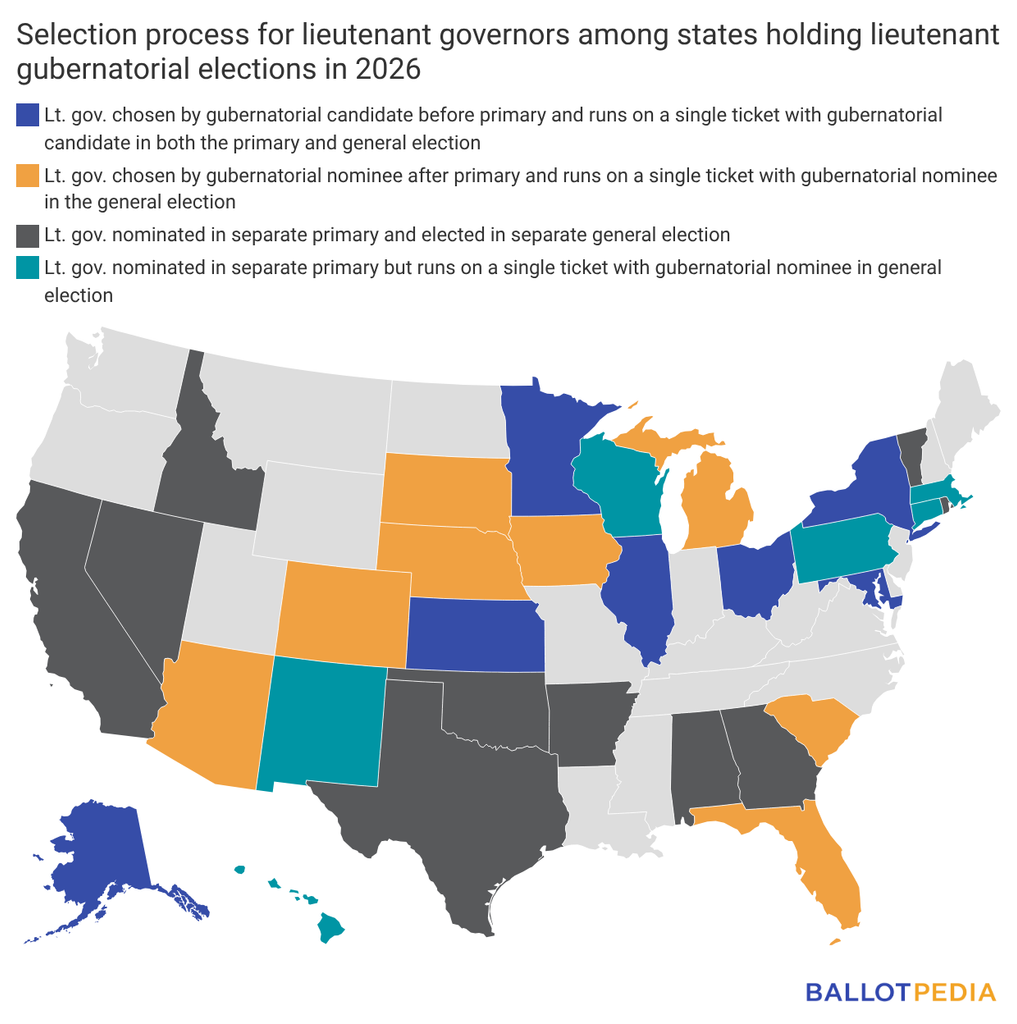
Battlegrounds: Ballotpedia identified six elections in which the candidates for governor and lieutenant governor run on a single ticket as battlegrounds. Battlegrounds are the elections that we expect to have a meaningful effect on the balance of power or to be particularly competitive or compelling.
- Arizona: Incumbent Gov. Katie Hobbs (D) selected former Republican mayor of Mesa John Giles as her running mate. Republican gubernatorial nominee Andy Biggs (R) selected former Republican state Sen. Sine Kerr (R) as his running mate.
- Iowa: Democratic gubernatorial nominee Rob Sand selected Crawford County Supervisor Dave Muhlbauer (D) as his running mate. Republican gubernatorial nominee Zach Lahn selected state Rep. Derek Wulf (R) as his running mate.
- Kansas: Democratic gubernatorial nominee Cindy Holscher selected state Rep. KC Ohaebosim (D) as her running mate. Republican gubernatorial nominee Ty Masterson selected state Sen. Jeff Klemp (R) as his running mate.
- Michigan: Democratic gubernatorial nominee Jocelyn Benson selected state Sen. Winnie Brinks (D) as her running mate. Republican gubernatorial nominee John James selected state Rep. Jay DeBoyer (R) as his running mate.
- Ohio: Democratic gubernatorial nominee Amy Acton selected former state Democratic Party chair David Pepper (D) as her running mate. Republican gubernatorial nominee Vivek Ramaswamy selected state Senate president Robert McColley (R) as his running mate.
- Wisconsin: Democratic gubernatorial nominee David Crowley (D) and lieutenant gubernatorial nominee Sarah Godlewski (D) are running on a joint ticket. Republican gubernatorial nominee Tom Tiffany (R) and David Varnam (R) are running on a joint ticket. Godlewski is Wisconsin’s Secretary of State. Varnam is the former mayor of Lancaster, Wisconsin. Wisconsin holds separate gubernatorial and lieutenant gubernatorial primaries, but the nominees run together on a single ticket in the general election.
Key Trends to watch:
- Effect of term limits: Eight incumbent lieutenant governors are term-limited this year. This is the most since we started collecting this data in 2018. One was term-limited in 2022, and six were term-limited in 2018, the last two times this set of offices were up for election.
- Related ballot measures: Two states are deciding on ballot measures related to lieutenant gubernatorial elections.
Alabama Amendment 1 would require that the office of lieutenant governor be filled by election if a vacancy occurs more than 60 days before the next general election. It would also authorize the state legislature to set the salaries of the lieutenant governor and members of the legislature.
Massachusetts Question 3 would require candidates for governor and lieutenant governor to register as candidates together before the primary election. Currently, candidates for governor and lieutenant governor run in separate primaries and are then combined on a ticket for the general election. Question 3 would also eliminate political party primaries for state elections and create a top-two primary system.
Recent election history:
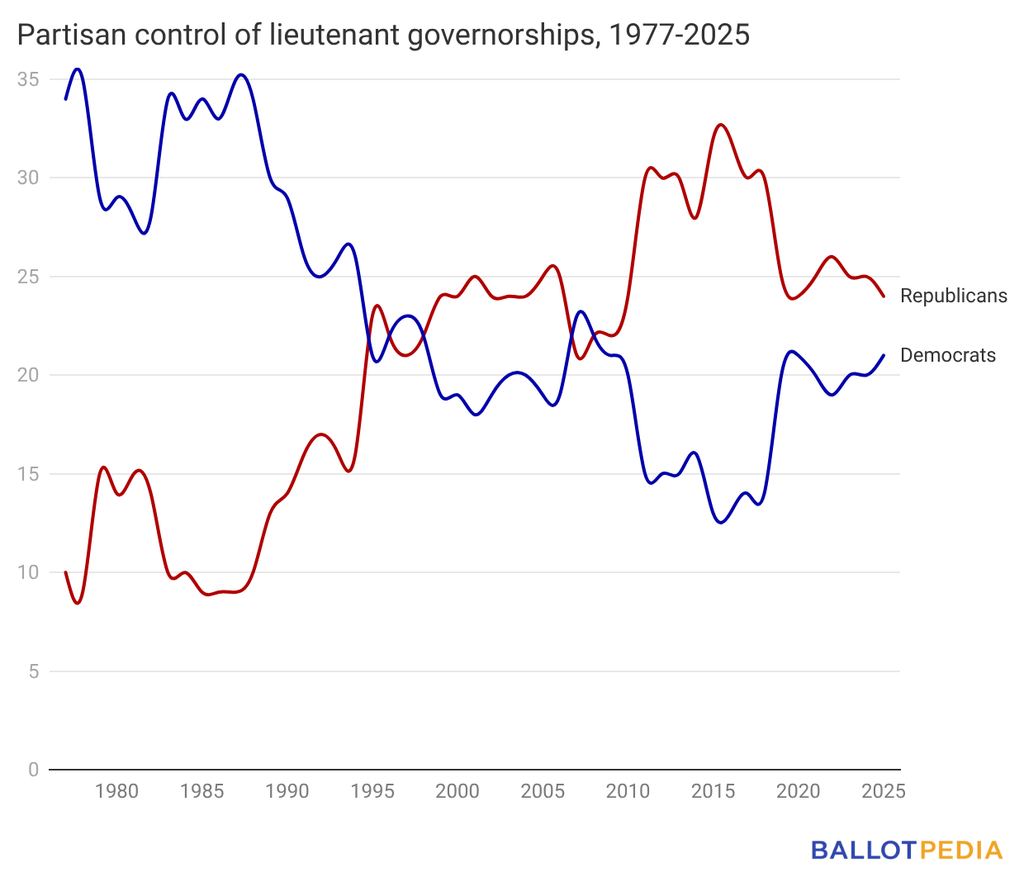
Republicans have held a majority of lieutenant gubernatorial offices nationwide since 2009. Control of lieutenant governorships trended Republican between 2009 and 2015, when the party reached a high of 32 lieutenant governorships to Democrats' 13 in 2015. In 2018, Democrats and Republicans each won 15 of the 30 seats up for election, narrowing the gap but keeping the Republican lead in place. The number of Republican lieutenant governors then continued to decline until 2020. Republicans gained one net lieutenant governorship each in 2020 and 2021, and Democrats gained one net lieutenant governorship in 2022.
The total partisan balance of lieutenant governors didn’t change in 2023 or 2024. Democrats gained one lieutenant governorship in 2025 when Ghazala Hashmi (D) was elected to succeed incumbent Winsome Earle-Sears (R) in Virginia.
Click here to read more about lieutenant gubernatorial elections in 2026.