


Welcome to the Tuesday, Oct. 20, 2026, Brew.
By: Briana Ryan
Here’s what’s in store for you as you start your day:
- Ballotpedia’s top 50 ballot measures and trends to watch on Election Day
- Michigan could gain a Democratic or Republican trifecta, or remain divided, after Nov. 3
- 26 states are holding elections for secretary of state this year, including 23 where that person oversees state elections
Ballotpedia’s top 50 ballot measures and trends on Election Day
On Nov. 3, voters will decide on 145 statewide ballot measures in 39 states — below the average of 163 statewide measures that appeared on November ballots in even-numbered years from 2000 to 2024
Today, we're covering our top 50 measures to watch on Election Day, which include 42 statewide measures and eight local measures. Here's a look at those measures by the trend they fall under this year.
Election and voting policy
Fourteen of our top 50 measures are on election policy. Voters will decide on 34 such statewide measures across the country on Nov. 3.
Four measures address voter eligibility. Measures in California and Nevada would establish or expand voter identification requirements in state constitutions. Alaska Ballot Measure 3 would provide in state law that "Only a person who is a citizen of the United States" may vote. Virginia Question 3 would automatically restore voting rights for people with felony convictions after they complete their prison sentence.
Three measures concern redistricting. Missouri Proposition A asks voters whether to keep the state's new congressional map. Maryland Question 3 would exempt congressional districts from the state constitution's district requirements. Colorado Amendment 86 would require a nonpolitical commission and the state supreme court to decide whether to approve any congressional maps drawn in 2028.
Others address the initiative process. Measures in North Dakota and South Dakota would increase the vote required to pass a constitutional amendment to 60%. Missouri Amendment 6 would preserve petition and qualification requirements and limit government changes to the initiative process.
Montana I-194 would prohibit artificial persons from contributing to campaigns, ballot measure elections, or political parties.
Voters will also decide how candidates are elected. Alaska Ballot Measure 2 would repeal the state's top-four ranked-choice voting (RCV) system. Massachusetts Question 3 would replace political party primaries for state elections with a single primary open to all candidates regardless of party.
There is also a notable local measure in Honolulu, Hawaii, that would amend the city charter to adopt RCV for mayoral, city council, and prosecuting attorney elections.
Abortion, sex, and gender policy
All 10 statewide measures that voters will decide on Nov. 3 on abortion, sex-based requirements for school sports, medical procedures for transgender minors, and parental review and notification in education are part of our top 50 measures.
Measures in Idaho, Nevada, and Virginia would establish a constitutional or legal right to abortion. Missouri Amendment 3 would repeal the reproductive freedom amendment, prohibit abortion with exceptions, and prohibit certain medical or surgical procedures for transgender minors. Colorado Proposition 135 would also prohibit certain procedures for transgender minors.
Measures in Arizona, Colorado, Nebraska, and Washington would establish sex-based requirements for school sports participation. Washington Initiative 1 would address parents' rights to review educational materials, receive notifications, and opt their children out of sexual-health education.
Taxes, spending, and business regulations
Ten of our top 50 measures are on taxes, spending, and business regulations. Voters will decide on 48 such statewide measures across the country on Nov. 3.
Measures in Colorado and Washington would prohibit, cap, or decrease income taxes. Another Colorado measure would establish a graduated income tax and dedicate the revenue to education, healthcare, and childcare.
California Proposition 40 would levy a one-time 5% tax on taxpayers and trusts with covered assets over $1 billion to fund healthcare, food assistance, and public education. Opponents qualified two initiatives with competing-measure provisions. Proposition 41 deems in conflict any measure on the same ballot that imposes different audit rules or levies a tax exempt from the state spending limit. Proposition 40 exempts its revenue from the General Fund when calculating the state's minimum education funding guarantee. If both pass and Proposition 41 received more votes, it would prevail entirely. If Proposition 40 receives more votes and is later ruled invalid, Proposition 41 would take effect. Proposition 42 would prevail over any competing measure to tax personal assets that receives fewer votes. Proposition 42 would prohibit taxes enacted via law or constitutional amendment on or after Jan. 1, 2026, on the ownership or control of retirement holdings, individually owned assets, and other forms of personal savings, whether held directly or indirectly. It would also prohibit retroactive taxes that authorize a tax on conduct, activities, or status that occurred or was present prior to the effective date of the state law or constitution.
Florida Amendment 3 would expand the homestead exemption for non-school property taxes to $150,000 in 2027 and $250,000 in 2028.
Notable local measures include city divestment from foreign countries conducting human rights violations in Providence, Rhode Island, the establishment of a municipal finance corporation and public bank in San Francisco, California, and a ban on force-feeding birds and on selling foie gras in Washington, D.C.
Energy, housing, and development
Seven of our top 50 measures are on housing development, environmental review, natural gas access, tenants' rights, and data center development.
Measures in California and Massachusetts would address local land development regulations, zoning, restrictions, and planning as they relate to housing. Colorado Amendment 82 would establish a constitutional right to purchase and sell natural gas for cooking or heating in homes and businesses.
Voters will decide on 41 local measures on data center development, including in Asheville, Ohio, Boulder City, Nevada, and Janesville, Wisconsin. Another notable local measure is in St. Paul, Minnesota, which would allow tenants to deduct repair costs from rent.
Constitutional rights
Five of our top 50 measures are on constitutional rights. Voters will decide on 14 such statewide measures across the country on Nov. 3.
Arizona Proposition 142 would prohibit the state and government agencies from requiring an individual to endorse preferential treatment toward or discrimination against an individual based on race or ethnicity. Wisconsin Question 3 would prohibit government discrimination or preferential treatment based on race, sex, color, ethnicity, or national origin in public employment, public education, public contracting, or public administration.
Vermont Proposal 4 would prohibit denying rights based on race, ethnicity, sex, religion, disability, sexual orientation, gender identity, gender expression, or national origin. Virginia Question 2 would repeal the provision defining marriage as between one man and one woman and prohibit denying a marriage license to two adult persons based on sex, gender, or race. Wisconsin Question 2 would prohibit governments from closing places of worship or forbidding gatherings there during a state of emergency.
Firearms
Both statewide measures on firearms that voters will decide on Nov. 3 are part of our top 50 measures.
Arkansas Issue 2 would provide that the right to keep and bear arms is "a natural, fundamental, and individual right that shall not be infringed." Massachusetts Question 9 would ask voters whether to uphold the House Bill 4885, which changed the state's firearm regulations.
Criminal justice and marijuana
Two of our top 50 measures are on criminal sentencing, penalties, and bail, and marijuana. Voters will decide on five statewide measures on criminal sentencing, penalties, and bail, and two measures on marijuana across the country on Nov. 3.
Tennessee Amendment 1 would expand the circumstances under which courts could deny bail. Massachusetts Question 8 would end recreational marijuana sales while allowing limited possession.
Click here to read more about the top 50 ballot measures to watch on Nov. 3.
Michigan could gain a Democratic or Republican trifecta, or remain divided, after Nov. 3
Welcome to our next installment of our 50 States in 50 Days series, covering Michigan. To view our archive of past editions, click here.
The Nov. 3 elections could result in Michigan having a Democratic or Republican trifecta. It could also result in Michigan retaining a divided government. Seven candidates are running in the open gubernatorial race. Additionally, all 38 seats in the Michigan Senate, and all 110 seats in the Michigan House of Representatives are up for election. Democrats have a 20-18 majority in the state Senate, and Republicans have a 58-52 majority in the state House. Because the governor is a Democrat, Michigan is one of 11 states with a divided government.
We assessed a moderate possibility that either party could form a trifecta in Michigan. Democrats would need to retain the governorship, and Republicans would need to gain it. Republicans need to win at least two seats to gain control of the state Senate, and Democrats need to lose no more than one seat to maintain their majority. Democrats need to win at least three seats to gain control of the state House, and Republicans need to lose no more than three seats to maintain their majority.
Want to see what’s on your ballot this November? Click here to use our Sample Ballot Lookup Tool. Now let’s take a closer look at what’s happening in Michigan.
Early voting opens Oct. 24 and ends Nov. 1.
Polls open on Election Day at 7:00 a.m. and close at 8:00 p.m.
Voter ID is required. Acceptable forms of ID include a Michigan driver’s license or state ID, a driver’s license or state ID issued by another state, a U.S. passport, or a photo ID from an educational institution. Voters may also sign an affidavit instead of providing ID. For more information on voter ID in Michigan, click here.
Absentee/mail-in ballots must be requested by Oct. 30 and received by Nov. 3.
Current party control
Republicans represent seven congressional districts, and Democrats represent six. Both of Michigan’s U.S. Senators are Democrats.
In addition to having a divided state government, Michigan is one of 21 states with a Democratic triplex. That’s because the governor, attorney general, and secretary of state are Democrats. Democrats have a 6-1 majority on the Michigan Supreme Court.
Offices on the ballot
Elections are happening for the U.S. Senate and the U.S. House of Representatives.
In addition to the gubernatorial and legislative offices mentioned above, there will also be elections for lieutenant governor, attorney general, secretary of state, two seats on the Michigan Board of Education, two seats on the Michigan State University Board of Trustees, two seats on the University of Michigan Board of Regents, and two seats on the Wayne State University Board of Governors.
Nonpartisan elections are happening for two state supreme court justices and 11 intermediate appellate court judges.
Michigan is one of 32 states this year where we are providing comprehensive election coverage down to the local level. This year's ballot includes elections for municipal, county, and judicial offices as well as for school boards.
There will also be nine recall elections against 10 local officeholders in Michigan.
Notable elections
U.S. Senate: Abdul El-Sayed (D), Mike Rogers (R), Douglas P. Marsh (G), Lydia Christensen (L), Walter Kristy (Natural Law Party in Michigan), and Timothy Long (U.S. Taxpayers Party) are running in the open race. This U.S. Senate seat is one of two that Democrats are defending in states that President Donald Trump (R) won in the 2024 presidential election. Trump defeated Kamala Harris (D) in the state 49.7% to 48.3%.
Governor: Jocelyn Benson (D), John James (R), Douglas Campbell (G), Anthony Hudson (L), Donna Brandenburg (U.S. Taxpayers Party), Joe Hunt (I), and Evan Space (I) are running in the open race. This governorship is one of five that Democrats are defending this year in states Trump won in the 2024 presidential election.
8th Congressional District: Incumbent Rep. Kristen McDonald Rivet (D), Thomas J. Smith (R), Jim Casha (G), C. Mia Pettus (L), and Kathy Goodwin (Working Class Party) are running. This district is one of 23 that Democrats are defending that Trump won in the 2024 presidential election. Trump defeated Harris in the district 50.3% to 48.3% in 2024. McDonald Rivet defeated Paul Junge (R) 51.3% to 44.6% in 2024.
Statewide ballot measures
There are two statewide measures on the ballot this year. Between 1880 and 2025, voters have decided on 319 measures, or an average of four per even-numbered year. During that period, voters approved 163 measures and defeated 156. For more information about the history of Michigan’s measures, visit its Historical Measures Factbook.
Here’s a closer look at the two measures.
Proposal 1 would ask voters whether to hold a state constitutional convention. Michigan is one of 14 states in which constitutional convention questions are automatically referred to the ballot after a certain number of years. Forty-two states have a process for deciding on a constitutional convention.
Proposal 2 would prohibit certain organizations and individuals from making direct or indirect contributions to candidates. These include regulated electric and gas utilities, contractors with more than $250,000 annually in government contracts, and people and organizations with substantial connections to those utilities or contractors. It would also add regulations to existing campaign finance laws and to spending on political communications.
Local ballot measures
Voters will decide local ballot measures in Ann Arbor, Lansing, Eaton County, and Wayne County.
Join us again in our next edition when we'll preview elections in New Jersey, the Garden State.
Click here to see every edition of 50 States in 50 Days as we publish them, and here to use our Sample Ballot Lookup Tool.
26 states are holding elections for secretary of state this year, including 23 where that person oversees state elections
Welcome to the next installment of our series previewing the Nov. 3 elections by office. Next up: the secretaries of state.
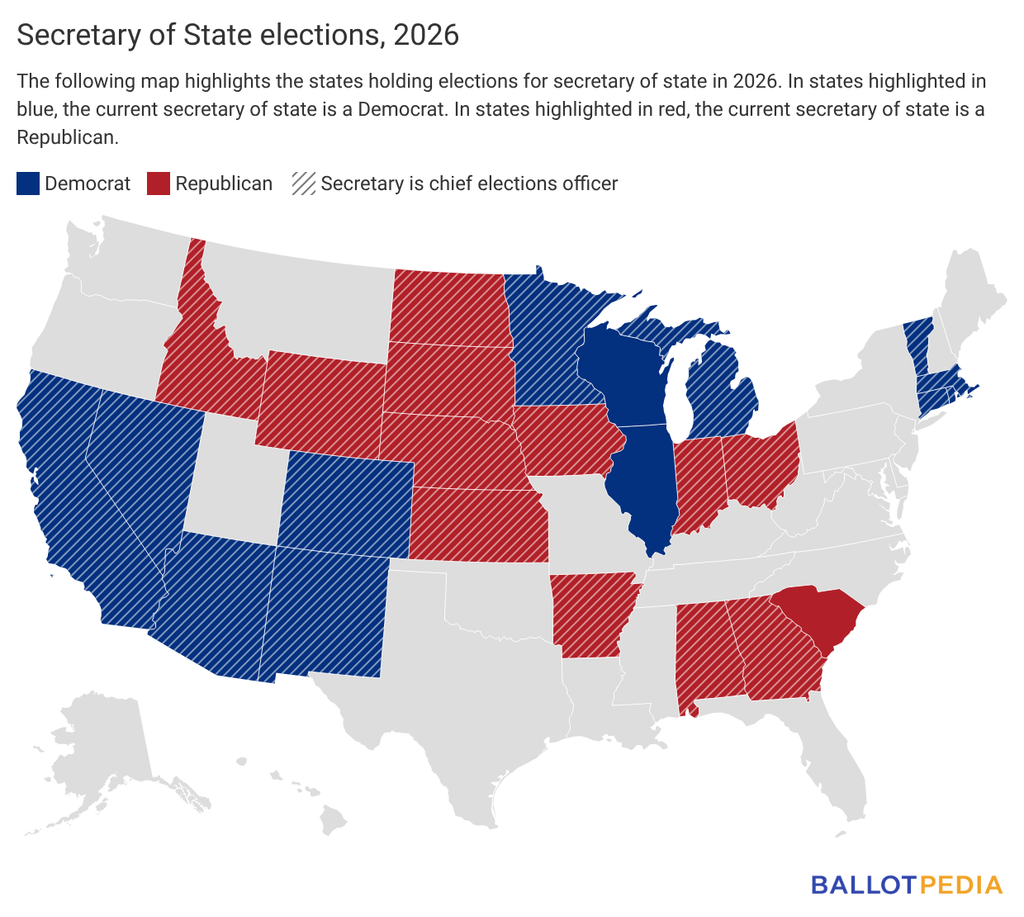
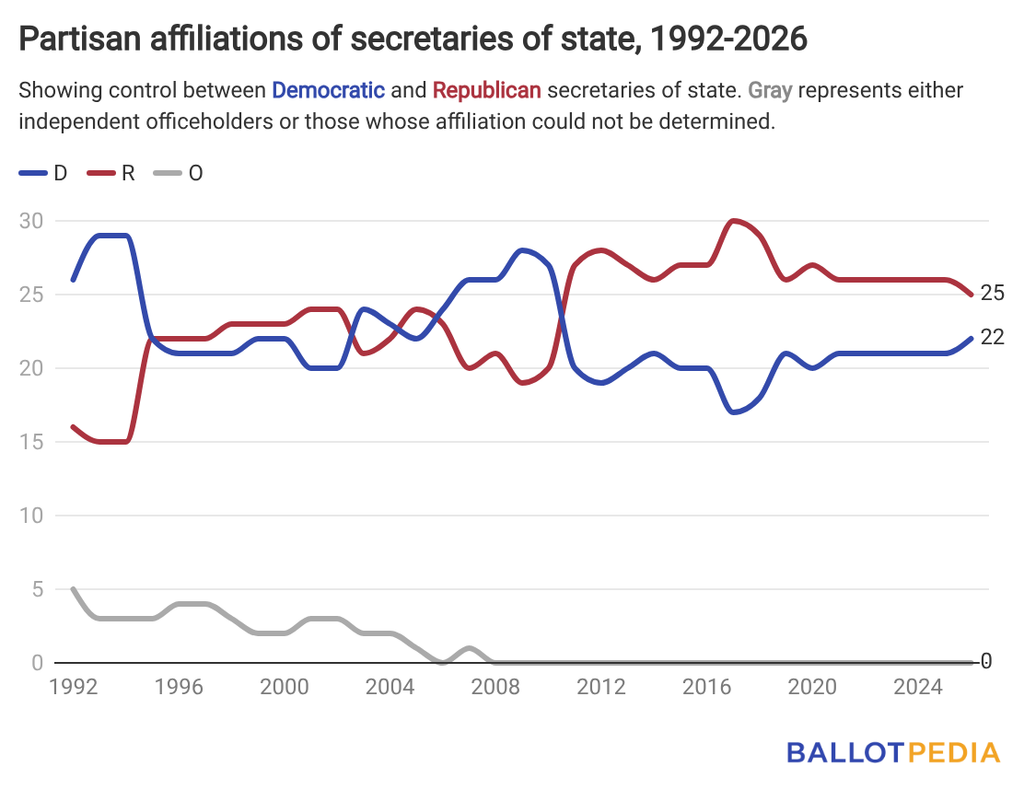
There are 26 secretary of state elections in 2026. Of these, Democrats and Republicans each control 13. Heading into the 2026 elections, there are 25 Republican secretaries of state and 22 Democratic secretaries of state nationally.
Democrats would need to gain two offices to control a majority of secretary of state offices nationally. Republicans can lose no more than one.
In 47 states — all except Alaska, Hawaii, and Utah — the secretary of state is among the top executive offices. Although the duties and powers of the secretary of state vary from state to state, a common responsibility is the management and oversight of elections and voter rolls. In 37 states, the secretary of state is the chief elections officer with ultimate oversight over state elections and voter registration. Other common responsibilities include registration of businesses, maintenance of state records, and certification of official documents.
This year, the secretary of state is the chief election officer in 23 of the states holding elections for the office. Republicans hold 12 of the offices up for election this year where the secretary of state is the chief elections officer, and Democrats hold 11. Nationally, Republicans hold 22 of the 37 secretary of state offices that oversee elections, and Democrats hold 15.
Battlegrounds
Ballotpedia identified five states’ elections for secretary of state as battlegrounds.
- Arizona: Incumbent Adrian Fontes (D), Alexander Kolodin (R), and Duwayne Collier (G) are running. Fontes was elected in 2022, defeating Mark Finchem (R) 52.4% to 47.6%. Kolodin has served in the Arizona House of Representatives since 2023. This race is for a Democratic-held seat in a state that President Donald Trump (R) won in the 2024 presidential election. Trump defeated Kamala Harris (D) 52.2% to 46.7% in the state.
- Indiana: Beau Bayh (D), Max Engling (R), Greg Ballard (Lincoln Party), and two other candidates are running in the open race. Engling, who was an advisor to U.S. Sen. Jim Banks (R-Ind.), defeated incumbent Diego Morales (R) at the June 20 Republican convention. Bayh is an attorney. His grandfather is a former U.S. Senator, and his father is a former U.S. Senator and governor. Ballard served as mayor of Indianapolis from 2008 to 2016.
- Michigan: Garlin Gilchrist II (D), Anthony Forlini (R), and three others are running in the open race. Gilchrist has served as lieutenant governor since 2019. Forlini has served as Macomb County Clerk since 2021. This race is for a Democratic-held seat in a state that Trump won in the 2024 presidential election. Trump defeated Harris 49.7% to 48.3% in the state. In 2022, incumbent Jocelyn Benson (D) defeated Kristina Karamo (R) 55.9% to 41.9%.
- Nevada: Incumbent Cisco Aguilar (D), Jim Marchant (R), Brad Barnhill (Independent American Party), and John T. Kennedy (L) are running. This race is a rematch from 2022, when Aguilar defeated Marchant, a former business owner, 48.9% to 46.7%. This race is for a Democratic-held seat in a state that Trump won in the 2024 presidential election. Trump defeated Harris 50.6% to 47.5% in the state.
- Wisconsin: JoCasta Zamarripa (D), Jay Schroeder (R), and Pete Karas (G) are running in the open race. Zamarripa has served on the Milwaukee Common Council since 2020. Schroeder is a real estate and stock market investor. This race is the first time in more than 40 years that the incumbent is not running for re-election. This race is for a Democratic-held seat in a state that Trump won in the 2024 presidential election. Trump defeated Harris 49.6% to 48.7% in the state. In 2022, Doug La Follette (D) defeated Amy Loudenbeck (R) 48.3% to 48%. After La Follette resigned, Wisconsin Gov. Tony Evers (D) appointed Sarah Godlewski (D) to the position.
Key Trends to watch
- Increased attention: In the years since the 2020 presidential election, secretary of state elections have had increased media attention for their election-related duties. According to MultiState, “The secretary of state was once among the least-noticed statewide offices. That changed after the 2020 presidential election, when President Trump's legal team and allied activists targeted state election officials with pressure campaigns to reject or delay certification of results. Secretaries of state found themselves at the center of a sustained, public dispute over election integrity that thrust an otherwise low-profile office into the national spotlight.”
- Incumbent defeats: Three incumbents lost their bids for re-election in primaries or conventions this year. They included Indiana’s Diego Morales (R), Nebraska’s Bob Evnen (R), and South Dakota’s Monae Johnson (R). The election-related duties of each office was an issue in all three contests. Two incumbent secretaries of state lost in conventions in 2022. One incumbent lost a primary in 2018.
- Triplex control: Secretaries of state play a role in determining triplex control. Nationally, there are 24 Republican triplexes, 21 Democratic triplexes, and 5 divided governments where neither party holds triplex control. State government triplex is a term that describes when one political party holds the following three positions in a state's government: governor, attorney general, and secretary of state. Ballotpedia highlights these offices because they are typically the most visible positions in states and serve important administrative functions.
- Open offices: Nine elections are open this year, including four in which the secretary of state is term-limited. Eleven elections were open in 2022 including three in which the secretary of state was term-limited. Eight elections were open in 2018, including three in which the secretary of state was term-limited.
Recent election history
In 2022, the last time this set of offices was up for election, the partisan control of one secretary of state changed from Republican to Democrat. Democrats also won appointment control over another secretary of state — in Maryland — after winning that state's gubernatorial election.
In Nevada, Aguilar was elected to succeed incumbent Barbara Cegavske (R), who was term-limited. Nevada remained a divided government after the 2022 elections because Joe Lombardo (R) defeated incumbent Gov. Steve Sisolak (D) in that year’s gubernatorial election.
In Maryland, Wes Moore (D) was elected to succeed incumbent Gov. Larry Hogan (R), who was term-limited. This gave Democrats appointment control over the secretary of state's office. At the time of the election, Maryland had a Republican secretary of state whom Hogan appointed. Maryland became a Democratic triplex after the 2022 elections.
Click here to read more about this year’s secretary of state elections.