


Welcome to the Wednesday, Oct. 21, 2026, Brew.
By: Lara Bonatesta
Here’s what’s in store for you as you start your day:
- 2026 ballot titles required 17 years of education to read, down from a record 21 years in 2025
- Ballotpedia has identified two battleground U.S. House Districts in New Jersey
- Forty-nine state financial offices are up for election in 2026
2026 ballot titles required 17 years of education to read, down from a record 21 years in 2025
The 164 statewide ballot measures voters have or will decide this year are written at an average reading level equivalent to 17 years of education, or a first-year graduate student reading level. This is a decrease from 2025, when the average reached 21 years of education — the highest since Ballotpedia began tracking readability in 2017.
Ballotpedia's readability report offers insights into the educational level voters might need to comprehend statewide ballot measure titles and summaries.
Using the Flesch-Kincaid Grade Level (FKGL) and Flesch Reading Ease (FRE), the report measures how accessible these texts are based on objective factors, such as the number of syllables, words, and sentences. These scores focus solely on language structure, not the complexity of the ideas themselves.
Since ballot measures often consist of multiple pages of legal text, they also have shorter titles for voters to read on the ballot.
This year, the average FKGL for ballot titles, also known as ballot questions, was 17, which corresponds with a first-year graduate student. The average FRE for ballot titles was 18, or a second-year graduate student reading level.
From 2017 through 2026, the annual average ballot title grade level ranged from 15 in 2019 to 21 in 2025. The average of the 10 annual scores was 18.2. The 2026 score of 17 was 1.2 grade levels below that average and four grade levels below the 2025 peak. It tied with 2020 for the third-lowest score during the period, above 2019 and 2024.
Below are some highlights from the annual report, which is available here.
The table below shows the average ballot title grade and summary grade for each year.
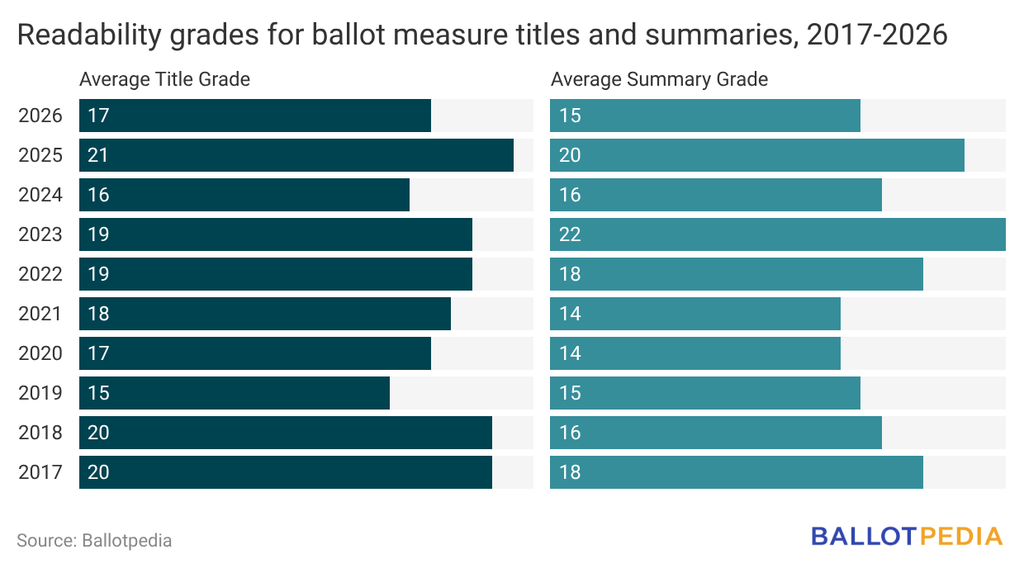
In 2026, the states with the lowest average grade level for a ballot title or question were Kentucky, Massachusetts, and Tennessee, with a score of 10 years of education each. Colorado had the highest average score at 33. There are 14 measures on the Colorado ballot.
An average of 81 words are in ballot titles, ranging from an average of nine words in Alaska to 598 in Kansas.
There was an average one-year difference in grade levels between citizen initiatives and measures legislatures put on the ballot. Initiatives had an average of 18 years of education and legislative referrals had an average of 17 years. The difference between constitutional and statutory measures was two years. Constitutional amendments averaged 18 years and statutes averaged 16 years.
Those who write the ballot titles include attorneys general, secretaries of state, lieutenant governors, state boards, state legislatures, or the initiative proponents themselves. Lieutenant governors and secretaries of state had the lowest average title grade, at 13, while state boards had the highest average title grade, with a score of 29.
The following individual ballot measures had the highest or lowest grade level scores or word counts:
- The ballot measure with the highest ballot title grade level, at 48, was Colorado Amendment 83, a constitutional amendment to establish a right to hunt and fish. While no formal education level, including post-graduate, corresponds to a 48th-grade level, this indicates that the language structure is advanced or difficult, at least based on the FKGL.
- The ballot measure with the lowest ballot title grade level, with a fifth-grade reading level, was Idaho's Official State Gun Question, an advisory question to provide voter preferences on the official state gun.
- The longest ballot title, with 927 words, was the Kansas Elections for Supreme Court Justices Amendment. Voters decided on the measure in August, and defeated 61.4% to 38.7%. It would have authorized the election of state supreme court justices and abolished the existing state supreme court nominating commission. Kansas requires the full text of a constitutional amendment to be printed as the ballot title.
- The shortest ballot title, with five words, was Alaska Ballot Measure 3, which would amend state law to provide that "Only a person who is a citizen of the United States" may vote in any election.
Click here to learn more about ballot measure readability scores in 2026.
Ballotpedia has identified two battleground U.S. House Districts in New Jersey

Welcome to our next installment of our 50 States in 50 Days series, covering New Jersey. To view our archive of past editions, click here.
On Nov. 3, there are two elections for U.S. House in New Jersey that Ballotpedia has identified as battlegrounds: New Jersey's 7th Congressional District and New Jersey's 9th Congressional District.
In the 7th District, incumbent Thomas Kean Jr. (R) and Rebecca Bennett (D) are running. Kean has represented the 7th District since 2023. Before being elected to Congress, he served in the New Jersey Senate from 2003 to 2022 and the New Jersey General Assembly from 2001 to 2003. Kean is also the son of former Gov. Thomas H. Kean (R). Bennett is vice president of strategic partnerships and network operations at Oshi Health and a former U.S. Navy helicopter pilot. She was previously a Republican but registered as a Democrat in July 2016. Major election forecasters have rated the election Lean/Tilt or Likely Democratic. Kean defeated incumbent Tom Malinowski (D) 51.4% to 48.6% in 2022 and Sue Altman (D) 51.8% to 46.4% in 2024. President Donald Trump (R) won the presidential election in the district 49.6% to 48.5% 2024, and Governor Mikie Sherrill (D) won the gubernatorial election in the district 50.7 to 48.3% in 2025.
In the 9th District, incumbent Nellie Pou (D), Rosemary Pino (R), and Terrisa Bukovinac (Save Our Babies Party) are running. Before her election to the U.S. House, Pou served 13 years in the state Senate and 14 years in the state Assembly. She earlier worked as a staffer for the city of Paterson, including as the city's director of human services. Pino has served on the Clifton City Council since 2019. She was a member of the Clifton Board of Education from 2014 to 2019. The 9th District is one of 23 U.S. House districts nationwide that Democrats are defending this year that Trump won in 2024. Pou was first elected 50.8% to 45.9% in 2024, and Trump won the presidential election in the district that year 49.2% to 48%. In 2025, Sherrill won the gubernatorial election in the district 59.4% to 39.9%. Major election forecasters rated the general election Likely Democratic or Safe Democratic.
Want to see what’s on your ballot this November? Click here to use our Sample Ballot Lookup Tool. Now let’s take a closer look at what’s happening in New Jersey.
Early voting opens Oct. 24 and ends Nov. 1.
Polls open on Election Day at 6:00 a.m. and close at 8:00 p.m.
Voter ID is not required to vote in New Jersey in most cases. The federal Help America Vote Act requires that individuals in all 50 states who register to vote by mail and who have not voted previously in a federal election in their state must provide either their driver's license or a paycheck, bank statement, current utility bill, or government document showing their name and address.
Absentee/mail-in ballots must be requested by Oct. 27 and postmarked by Nov. 3. Under a 2026 law, voters who are notified of a deficiency with their mail-in ballot via a cure form may vote on Election Day using a provisional ballot instead of curing the mail-in ballot.
Current party control
Democrats represent nine congressional districts, and Republicans represent three. Both of New Jersey’s U.S. Senators are also Democrats.
Democrats have a 25-15 majority in the New Jersey Senate and a 57-23 majority in the New Jersey General Assembly. Because the governor is a Democrat, New Jersey is one of 16 states with a Democratic trifecta. New Jersey’s attorney general and secretary of state are also Democrats. As a result, New Jersey is one of 21 states with a Democratic triplex. Democratic governors appointed six members of the New Jersey Supreme Court. A Republican governor appointed one member of the court.
Offices on the ballot
Elections are taking place for the U.S. Senate and the U.S. House of Representatives.
No state executive offices or state legislative seats are up for election.
Notable elections
In addition to the battleground elections we mentioned above, New Jersey is also holding an election for one of its two U.S. Senate seats. In that contest, incumbent U.S. Sen. Cory Booker (D), Justin Murphy (R), and three others are running. Major election forecasters have rated the race Solid or Safe Democratic.
Statewide ballot measures
This year, there are no statewide measures on the New Jersey ballot. Between 2000 and 2025, voters decided on 36 statewide measures in New Jersey, an average of 2.8 measures per even-numbered year. Thirty-one measures were approved and five were defeated.
Local ballot measures
Voters in Downe Township will vote on an advisory question on whether to support data centers in the township. Voters are deciding on at least 49 data center-related ballot measures this year, including 41 on Nov. 3.
Voters in Camden County will decide on a measure that would increase the county's annual property tax levy from $20 to $30 per $100,000 in assessed value to fund the Camden County Open Space, Recreation, and Farmland and Historic Preservation Trust Fund.
Join us next edition when we'll preview elections in Florida, the Sunshine State.
Click here to see every edition of 50 States in 50 Days as we publish them, and here to use our Sample Ballot Lookup Tool.
Ballotpedia by the numbers
Forty-nine state financial offices are up for election in 2026
Forty-nine state financial offices are up for election in 30 states this November. This includes elections for three types of office: Auditor, Comptroller, and Treasurer.
Heading into the election, there are:
- 19 Democratic, 27 Republican, and two unaffiliated treasurers
- 14 Democratic, 23 Republican, and one unaffiliated auditors
- Nine Democratic, eight Republican, and three unaffiliated comptrollers
These officials are generally responsible for tasks such as auditing other government offices, managing payroll, and overseeing state pensions. In some states, certain state financial offices are also responsible for investing state retirement and trust funds.
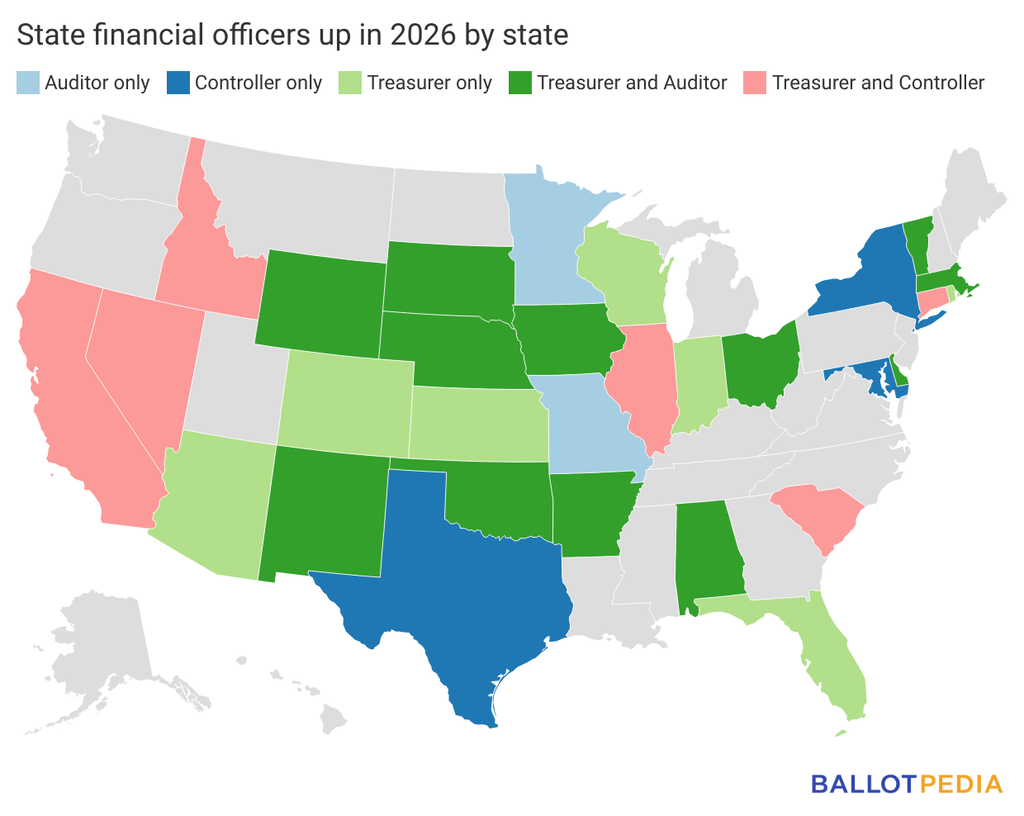
Noteworthy elections
Ballotpedia has identified a few contests as notable:
- Wisconsin Treasurer: Incumbent John Leiber (R) and Yee Leng Xiong (D) are running. This is the only statewide elected office in Wisconsin held by a Republican. Both candidates are running on whether to keep the office's functions as is or to expand them. According to Wisconsin Watch, Leiber says the office doesn't need further responsibilities and that during his tenure, he accomplished goals within the office's scope, including supporting the Board of Commissioners of Public Lands municipal loan program and a $1.6 billion common school fund. Xiong supports giving the position more responsibilities, saying he wants the treasurer to conduct state audits, create transparency portals on government spending, and create groups to educate Wisconsin residents on financial literacy and retirement savings.
- Minnesota Auditor: Zack Filipovich (D), Scott Jensen (R), Jay Reeves (Forward Independence Party) are running. Incumbent Julie Blaha (D) is retiring from public office. She won re-election in 2022 by 8,435 votes.
- Texas Comptroller: Incumbent Don Huffines (R), Sarah Eckhardt (D), Shehla Faizi (G), and V. Alonzo Echevarria-Garza (L) are running. Governor Greg Abbott (R) appointed Huffines to the office after incumbent Kelly Hancock (R) resigned. On Oct. 13, the University of Texas/Texas Politics Project released a poll that was about even with Huffines receiving 47% to Eckhardt’s 46%. The margin of error was ± 3.34 percentage points.
Key trends
Some of the notable trends to watch for include:
- Partisan control: Republicans control 58 state financial offices, Democrats control 42. Six officers are unaffiliated. Republicans have more treasurers and auditors, while Democrats have more comptrollers.
- Non-elected officials: In addition to elected officials, gubernatorial or state legislative elections will determine control of 21 auditor, 10 treasurer, and 10 comptroller offices. This includes battleground races in Alaska, Georgia, and Michigan.
Recent election history
In 2025, four total offices in two states were at stake in New Jersey and Virginia. All positions were appointed. Democrats won the gubernatorial elections in both states, which meant they gained two offices in Virginia and a majority of the comptroller offices nationwide. In 2024, two auditor elections resulted in a change of parties, one for Democrats, one for Republicans, keeping the overall partisan balance the same.
For more information on the 2026 state financial officer elections, click here.