


Welcome to the Thursday, Oct. 22, 2026, Brew.
By: Briana Ryan
Here’s what’s in store for you as you start your day:
- 49 states allow election recounts — here’s how laws vary in each state
- Florida to use a new congressional map in this year’s elections
- Four states are holding direct elections for state insurance commissioner this year
49 states allow election recounts — here’s how laws vary in each state
Forty-nine states could have an election this November head to a recount, though the exact requirements for when a recount occurs vary by state.
All states but Mississippi have a state law allowing for recounts in at least some circumstances. Recounts are either automatically triggered when certain circumstances are met or requested by an interested party.
Twenty-four states have both automatic and requested recounts. Five states only have automatic recounts, while 18 states have only requested recounts. Two states, Illinois and Tennessee, allow a recount only as part of an election contest or a post-election court action challenging the election results.
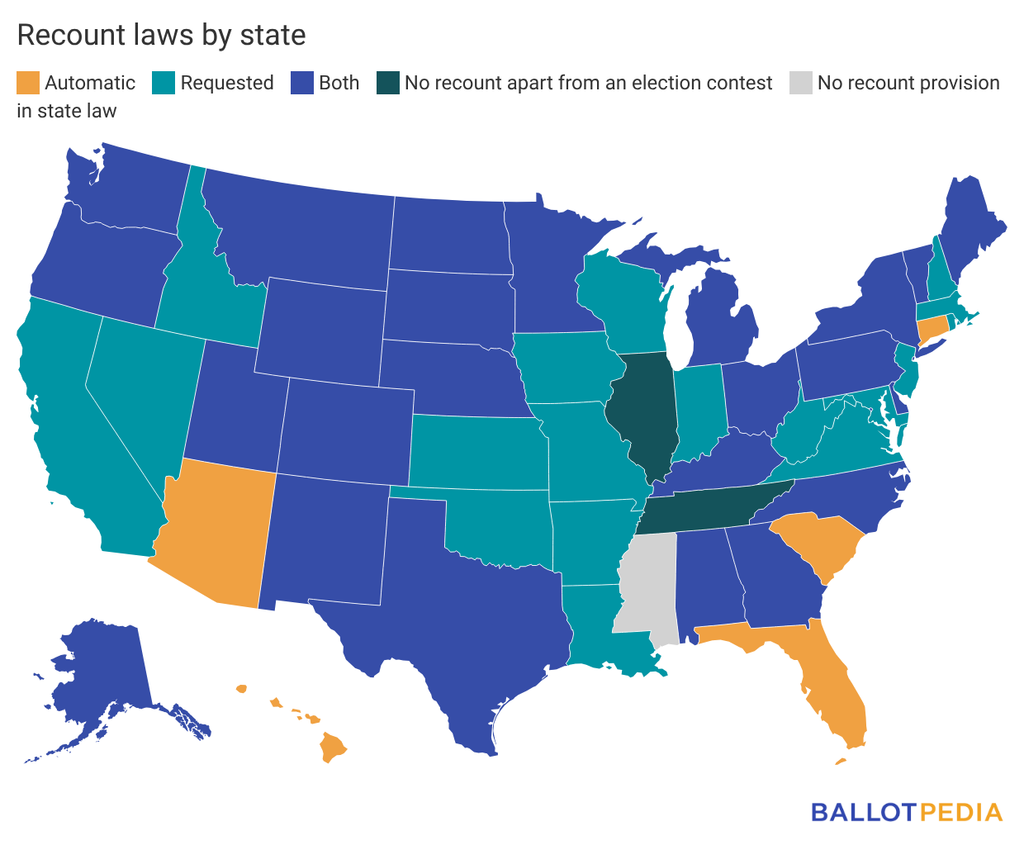
Who can request a recount varies by state and circumstances. In most states with requested recount procedures, an interested party is either a candidate or a voter. Some states allow political party chairs to request a recount.
Forty-two states allow candidates to request a recount in at least some elections. In four states, voters may request a recount for any election. In 32 states, voters can request recounts only in some elections or only for ballot measures.
While state and county governments generally pay for automatic recounts, states have different laws about who pays for a requested recount.
In 22 states, the person seeking a recount pays the costs, while in six states the state pays. In 12 states, who pays depends on the circumstances of the election or the recount. In those states, the government may pay for a recount in close races or in races for certain offices, and the requester pays in all other circumstances. In three states, state law does not address which party pays for the recount.
In 27 states, a refund is available for a requested recount if it changes the election results or meets other criteria. In four states, a refund depends on the circumstances of the recount, and in six states, no refund is available. Six states have state-funded recounts and seven states do not have requested recounts.
In 27 states, a partial recount may be requested.
A close race for governor in Georgia could trigger the state’s new automatic recount law, which will be in effect for the first time during the 2026 elections. Cook Political Report, Inside Elections, and Sabato’s Crystal Ball have all classified the 2026 gubernatorial race as a toss-up.
Under SB 3EX, which was enacted in June, the secretary of state must automatically order a manual recount in the first or second state executive races listed on the ballot if the margin separating the top two candidates is less than or equal to 0.5%. The first and second state executive races in 2026 are for governor and lieutenant governor.
A recount must be ordered within two days of the results being certified. There is no deadline in state law for completing the recount, but counties must finish a recount within 17 days of when it was ordered to be eligible for reimbursement of their costs.
Seven states, including Georgia, enacted nine laws in 2026 related to recounts. Notable other laws include:
- Connecticut HB 5001, which requires recounts depending on the results of a post-election audit.
- Iowa HF 2501, which amends recount procedures for ballot measures.
- Nebraska LB 1075, which requires a recount request to be filed within three days of the canvass, rather than five days.
- Rhode Island H 7782 and S 3113, which require a recount to be requested within nine days of the results being declared, rather than seven days.
Click here to check out more information on recount laws.
Florida to use a new congressional map in this year’s elections

Welcome to our next installment of our 50 States in 50 Days series, covering Florida. To view our archive of past editions, click here.
Florida will use a different congressional map in this year's elections than it did in 2024. On April 29, the Florida House of Representatives and the Florida Senate passed a new map. Florida Gov. Ron DeSantis (R) signed the new congressional map into law on May 4. Nationally, nine states will use different congressional maps in this year’s elections than the ones they used in 2024.
Based on the 2024 presidential election results, the new map made four districts — the 9th, 14th, 22nd, and 25th — more Republican. Redistricting across the country this year resulted in a net of nine districts becoming more Republican based on the 2024 presidential election results.
Early voting opens Oct. 24 and ends Oct. 31.
Polling places open on Election Day at 7:00 a.m. and close at 7:00 p.m.
Voter ID is required. Acceptable forms of ID include a Florida driver's license or ID card, a U.S. passport, military ID, student ID, or concealed carry license. Click here for more information on voter ID in Florida.
Absentee/mail-in ballots must be requested by Oct. 22 and received by Nov. 3.
Current party control
Republicans represent 20 congressional districts, and Democrats represent seven. One district is vacant after the Democratic incumbent resigned. Both of Florida's U.S. Senators are Republicans.
Republicans have a 26-12 majority in the state Senate, with one independent and one vacancy, and an 83-34 majority in the state House, with three vacancies. Because the governor is a Republican, Florida is one of 23 states with a Republican trifecta. Florida's attorney general and secretary of state are also Republicans. As a result, Florida is one of 24 states with a Republican triplex. Republican governors appointed all seven members of the Florida Supreme Court.
Offices on the ballot
Elections are taking place for the U.S. House of Representatives, and a special election is taking place for the U.S. Senate.
There will be elections for governor, lieutenant governor, attorney general, agriculture commissioner, and treasurer. Twenty seats in the state Senate and all 120 in the state House are up for election. There will also be a special election for Senate District 21.
One state supreme court justice and 22 intermediate appellate court judges are up for retention elections.
Florida is one of 32 states this year where we are providing comprehensive election coverage down to the local level. This year's ballot includes elections for municipal, county, and judicial offices as well as for school boards.
Notable elections
Governor: David Jolly (D), Byron Donalds (R), and eight other candidates are running in the open race. Three independent race forecasters rate the general election as Lean Republican.
U.S. Senate: Incumbent Sen. Ashley B. Moody (R), Angela Nixon (D), and Neil Gillespie (No Party Affiliation) are running. The winner will serve the remainder of the term Marco Rubio (R) was elected to in 2022, which expires in January 2029. Four independent race forecasters rate the general election as Solid, Safe, or Likely Republican.
Based on the new congressional district boundaries, President Donald Trump (R) would have won each of the following Democratic-held districts in the 2024 presidential election.
14th Congressional District: Incumbent Rep. Kathy Castor (D), Mike Beltran (R), Brian Lambert (L), Salomon Hernandez (No Party Affiliation), and Keith Varian (No Party Affiliation). Based on the new boundaries, Trump would have defeated Kamala Harris (D) in the district 55% to 44%.
22nd Congressional District: Pia Dandiya (D) and Casey Askar (R) are running in the open race. Based on the new boundaries, Trump would have defeated Harris in the district 55% to 44%.
25th Congressional District: Incumbent Rep. Jared Evan Moskowitz (D), Scott Singer (R), Peter Jassenoff (L), and Michaelangelo Hamilton (No Party Affiliation) are running. Based on the new boundaries, Trump would have defeated Harris in the district 54% to 45%.
Statewide ballot measures
There are three statewide measures on the ballot this year. From 1900 to 2025, Florida voters decided on 408 ballot measures, averaging six per even-numbered year. During that period, voters approved 289 and defeated 119. For more information about the history of Florida's statewide measures, visit its Historical Ballot Measures Factbook.
Florida has a supermajority requirement for constitutional amendments, meaning each measure needs at least 60% of the vote to pass. The three measures on the ballot are:
Amendment 1 would raise the maximum amount the state can hold in its budget stabilization fund (BSF) from 10% to 25% of general revenue collections. It also requires the Legislature to transfer $750 million or 25% of the general revenue collections, whichever is lesser, into the fund each year. The Legislature can suspend the transfer in years when the fund is used to cover a revenue shortfall or emergency spending, or when it determines, by a two-thirds vote, that a critical state need takes priority.
Amendment 2 and Amendment 3 are among the 12 statewide measures on property taxes that voters will decide on Nov. 3. Amendment 2 would exempt certain agricultural property from property taxes. Amendment 3 would expand the non-school property tax exemption from $25,000 to $150,000 in 2027 and $250,000 in 2028, with the amount indexed to inflation starting in 2029.
Local ballot measures
Voters in Miami, St. Petersburg, Hillsborough County, Leon County, Orange County, and the Duval County School District will decide on local measures.
Join us in our next edition when we'll preview elections in New York, the Empire State.
Click here to see every edition of 50 States in 50 Days as we publish them, and here to use our Sample Ballot Lookup Tool.
Four states are holding direct elections for state insurance commissioner this year
Welcome to the next installment of our series previewing the Nov. 3 elections by office. Today: state insurance commissioners.
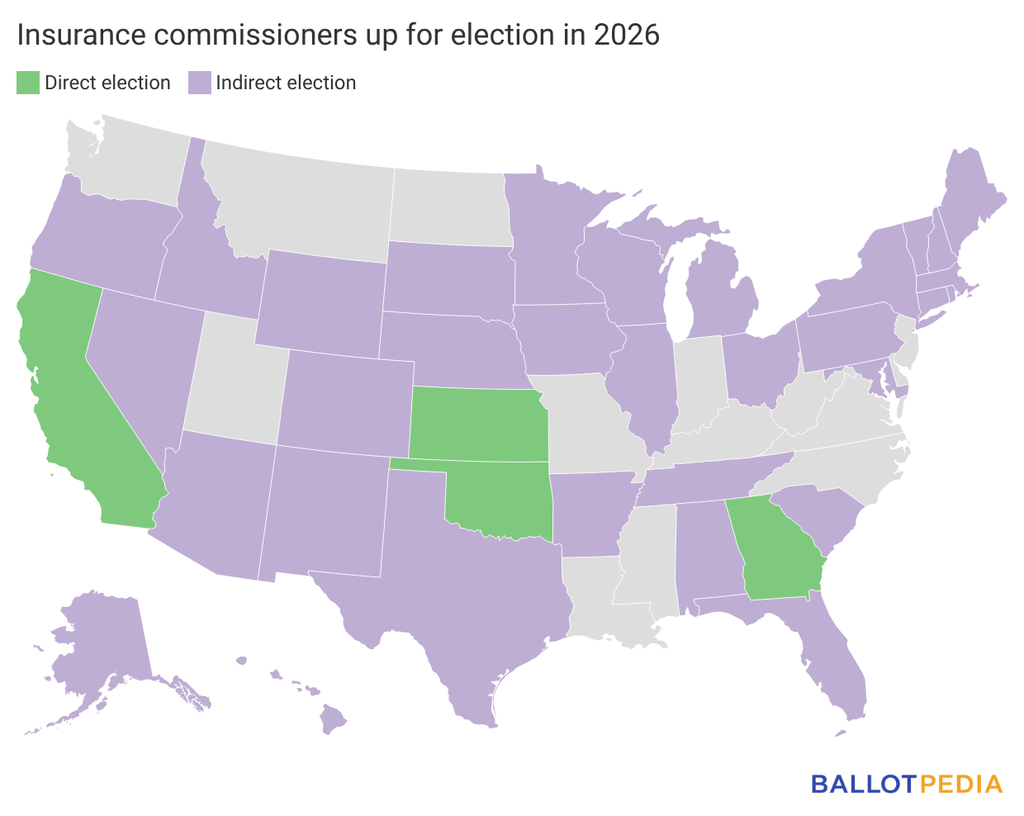
California, Georgia, Kansas, and Oklahoma are holding direct elections for state insurance commissioner this year. Republicans hold three of these offices, and Democrats hold one. In 32 states, the control of the insurance commission office will be decided indirectly, based on the results of the gubernatorial and state legislative elections. In those states, the governor or state legislature chooses the insurance commissioner.
All 50 states have an insurance commissioner, though the position is directly elected in only 11 states. Of all directly elected commissioners, Republicans hold eight, Democrats hold three, with the remaining 39 commissioners identified as nonpartisan.
The commissioner serves as the chief regulator of insurance markets in the state. The duties of the position vary from state to state, but their general role is as a consumer protection advocate and insurance regulator.
Battlegrounds
Ballotpedia identified one race as a battleground election.
California: Ben Allen (D) and Jane Kim (D) are running in the first Democratic vs. Democratic insurance commissioner election in state history. Wildfires and home insurance rates are among the issues in the race.
Key trends to watch
Ideological differences: In addition to Democratic vs. Republican elections, different factions of Democrats have endorsed in California, with the Democratic Party of California endorsing Allen, and Sen. Bernie Sanders (I-Vt.) endorsing Kim.
The role of housing prices: Insurance Business Magazine's Matthew Seller wrote that rising home insurance premiums across the country have become an issue in the elections, writing that the four states "happened to record meaningful 2025 rate increases: 24% in Oklahoma, 15% in Kansas, 9% in Georgia and 5% in California, according to Insurify. That combination is why analysts increasingly rank these particular down-ballot races among the ones most likely to actually move future premiums."
Recent election history
The last time insurance commissioner offices switched partisan control was in 2016 in Montana and North Carolina. In Montana, Matt Rosendale (R) defeated Jesse Laslovich (D) in an open race. In North Carolina, Mike Causey (R) defeated incumbent Wayne Goodwin (D). The last time any of the four insurance commissioner offices up for election this year switched partisan control was in 2010, in California and Oklahoma. In California, Dave Jones (D) defeated Mike Villines (R) in an open race. In Oklahoma, John Doak (R) defeated incumbent Kim Holland (D).
Click here for more information on this year's insurance commissioner elections.