


A total of 53 citizen-initiated ballot measures were certified for the 2026 ballot in 15 states. Proponents of citizen-initiated ballot measures—including veto referendums, initiated state statutes, and initiated constitutional amendments—collect petition signatures from a certain minimum number of registered voters in a state. For 2026, the average signature validity rate (the number of signatures deemed valid out of the raw total number of submitted signatures) was 77.96%.
In total, campaigns for the 53 initiatives needed to gather 11,578,713 valid signatures to qualify the measures for the ballot. The average number of required signatures to qualify a measure for the ballot was 218,466.
The initiative that required the smallest number of signatures was Alaska Ballot Measure 1; the campaign needed to submit 26,705 valid signatures to place the measure on the ballot. The initiatives that required the greatest number of signatures were the five initiated constitutional amendments in California. For 2026, 874,641 signatures were required to place an initiated constitutional amendment on the California ballot.
The campaign that gathered the greatest number of signatures was Protect Retirement & Life Savings, the campaign sponsoring California Proposition 42. The campaign submitted 1,638,055 signatures, 1,044,143 of which were found to be valid.
The campaign that gathered the greatest percent of the number of signatures required was No Tax Oregon, the campaign that supported a ‘no’ vote on Oregon Referendum 120. The campaign submitted 250,949 raw signatures, 321.25% of the 78,116 signatures that were required to place the veto referendum on the ballot.
On average, campaigns for initiatives certified for the 2026 ballot submitted 363,616 signatures, with an average signature validity rate of 77.96%. That results in the fourth highest average signature validity rate since Ballotpedia began gathering comprehensive data in 2017.
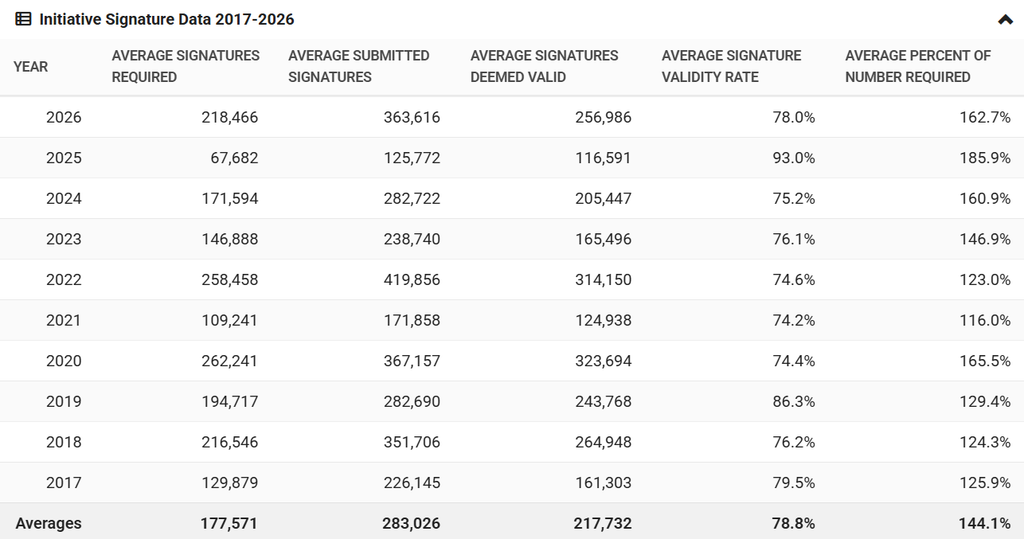
This year, the campaigns for initiatives submitted an average of 162.66% of the required number of signatures to place the initiative on the ballot. This is higher than the national average for 2017 to 2026, which is 144.1%.
From 2017 to 2026, Ballotpedia analyzed signature data for 240 initiatives. The average signature validity rate for initiatives certified to appear on the ballot in that time period was 78.8%.