


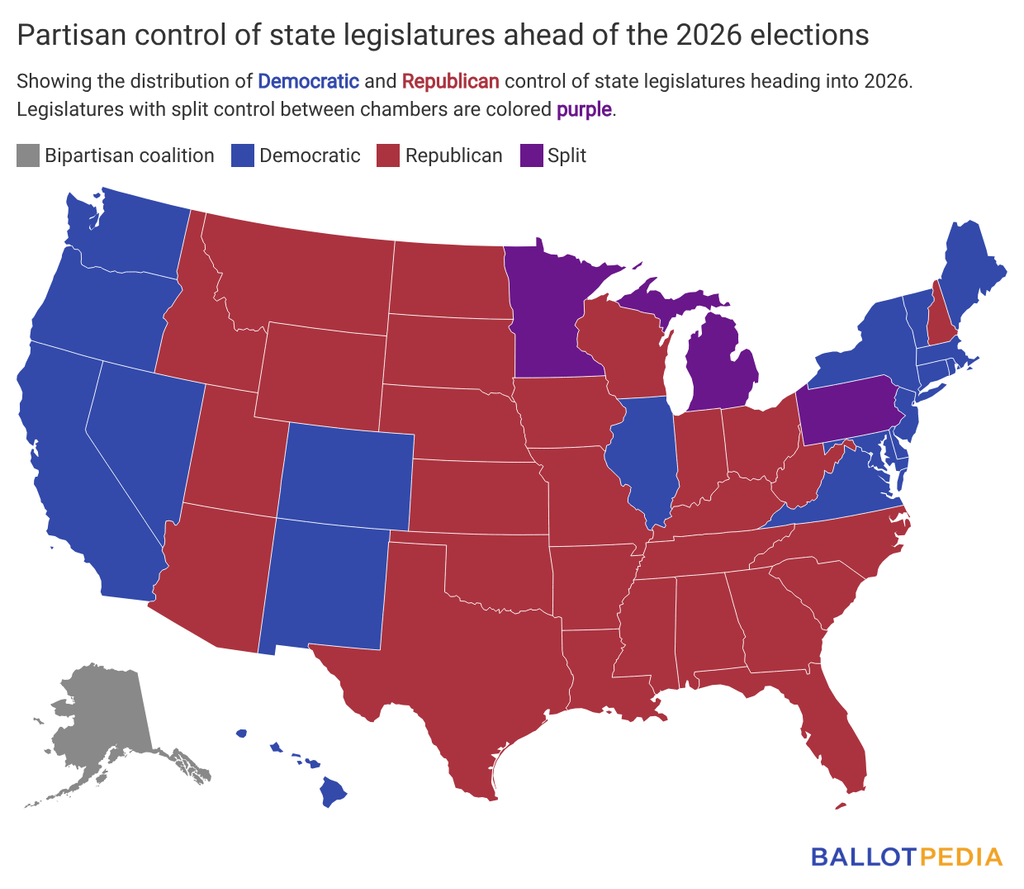
On Nov. 3, elections are happening in 46 states for 88 of the 99 state legislative chambers. In total, 6,139 of the country's 7,386 state legislative seats are up for election in 2026.
Republicans have majorities in 51 of the state legislative chambers whose members are up for election this year, and Democrats control 34. Power-sharing coalitions control the Alaska Senate and the Alaska House of Representatives, and the Minnesota House of Representatives is split evenly between the two parties.
Overall, Republicans control 57 state legislative chambers, while Democrats control 39. Three state legislative chambers either have power-sharing coalitions or are split evenly between the two parties.
Republicans control 3,325 of the state legislative seats up for election this year, and Democrats control 2,741. Third-party and independent legislators control 24 seats, and 49 are vacant.
Overall, Republicans control 4,061 state legislative seats, and Democrats control 3,238. Third-party and independent legislators control 28 seats, and 59 are vacant.
Battlegrounds
We have identified elections for 18 state legislative chambers as battlegrounds this year. Republicans control 10 of those state legislative chambers, and Democrats control five. Three state legislative chambers either have power-sharing coalitions or are split evenly between the two parties.
Key trends to watch
- State government trifectas: State government trifectas occur when one party controls the governorship and both state legislative chambers. In 1992, there were 16 Democratic trifectas, three Republican trifectas, and 31 divided governments. Since then, the number of states with single-party control has increased, while those with divided governments have decreased. Currently, there are 23 Republican trifectas, 16 Democratic trifectas, and 11 divided governments. Ballotpedia identified five states with Republican trifectas — Georgia, Iowa, Montana, New Hampshire, and Texas — and four states with Democratic trifectas — Maine, New Mexico, Oregon, and Washington — that could break this year. Democrats could gain trifectas in Kentucky and North Carolina, and Republicans could gain trifectas in Alaska and Kansas. There are seven states — Arizona, Michigan, Minnesota, Nevada, Pennsylvania, Vermont, and Wisconsin — in which either party could gain a trifecta. This year's elections could show whether or not the trend of increased single-party control continues.
- Supermajorities: Supermajorities occur when one party holds a majority in a state legislature large enough to override a gubernatorial veto without any votes from the minority party. Before the 2022 elections, 16 states had Republican supermajorities and six states had Democratic supermajorities. The number of supermajorities has increased since then. Currently, there are 19 states with Republican supermajorities and eight states with Democratic supermajorities. Ballotpedia identified eight states with Republican supermajorities — Florida, Kansas, Missouri, Nebraska, Ohio, Oklahoma, South Carolina, and Utah — and five states with Democratic supermajorities — California, Connecticut, Delaware, Illinois, and Maryland — as being exposed to breaking this year. Republicans could gain supermajorities in Alaska, Arizona, Georgia, Iowa, Montana, New Hampshire, North Carolina, Texas, and Wisconsin. Democrats could gain supermajorities in Colorado, Maine, Nevada, New York, Oregon, Vermont, and Washington. Ahead of the 2022 elections, there were four states in which the governor belonged to a different political party from the supermajority. That number has decreased over time to two such states — Kentucky and Kansas. Elections are happening this year for at least one chamber in each state legislature, meaning their supermajority status could change as a result. Ballotpedia identified five states — Arizona, Nevada, North Carolina, Vermont, and Wisconsin — that could switch to having a governor of one party and a supermajority of the opposing party as a result of this year's elections.
- Wave elections: In 2018, we published a study of wave elections examining the results of the 50 election cycles between 1918 and 2016. In that study, we defined wave elections as the 20% of elections resulting in the greatest swing against the president's party. This year, the president's party would need to lose at least 494 state legislative seats to qualify as a wave election historically. Including both presidential and midterm years, the president's party has lost 494 or more districts in 10 of the 50 election cycles between 1918 and 2024.
- Rematch elections: This year, 383 general elections for state legislative seats are rematches between the same candidates who ran in either 2024 or 2022. Ninety-three of those 383 races were decided by 10 percentage points or fewer the last time the candidates ran against each other.
Recent election history
There were elections for 85 state legislative chambers in 2024, accounting for 5,807 of the 7,386 seats nationwide. Republicans gained control of the Michigan House of Representatives from Democrats, and the Minnesota House ended in a tie.
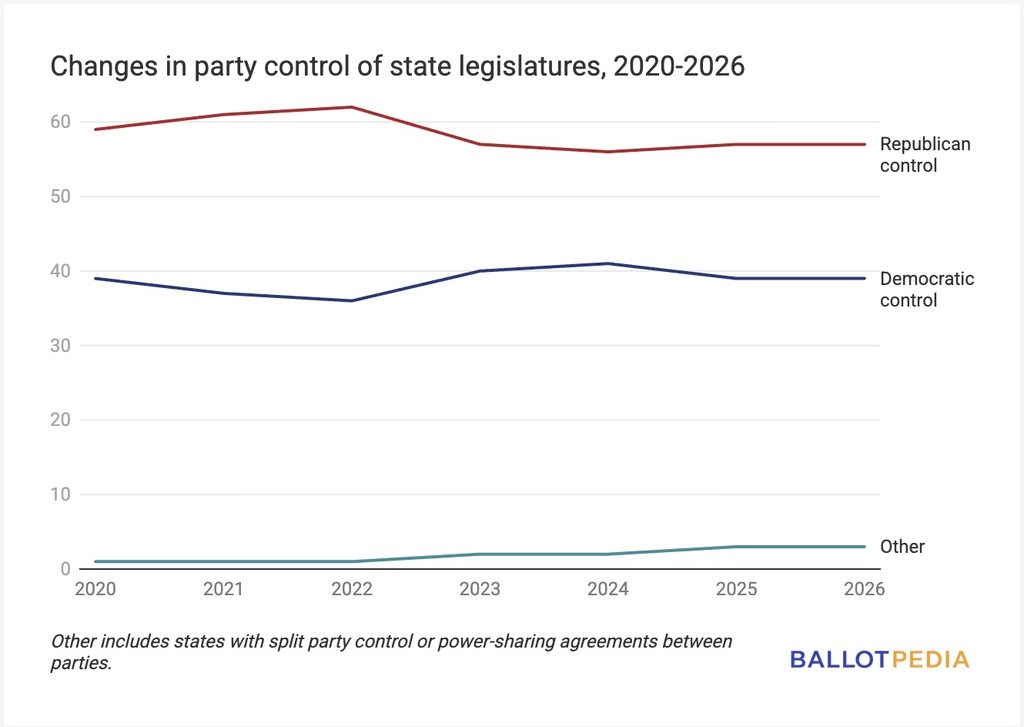
In 2022, the most recent midterm, Democrats gained control of four state legislative chambers: the Michigan Senate, the Michigan House, the Minnesota Senate, and the Pennsylvania House of Representatives.
For more information on this year's state legislative elections, click here.