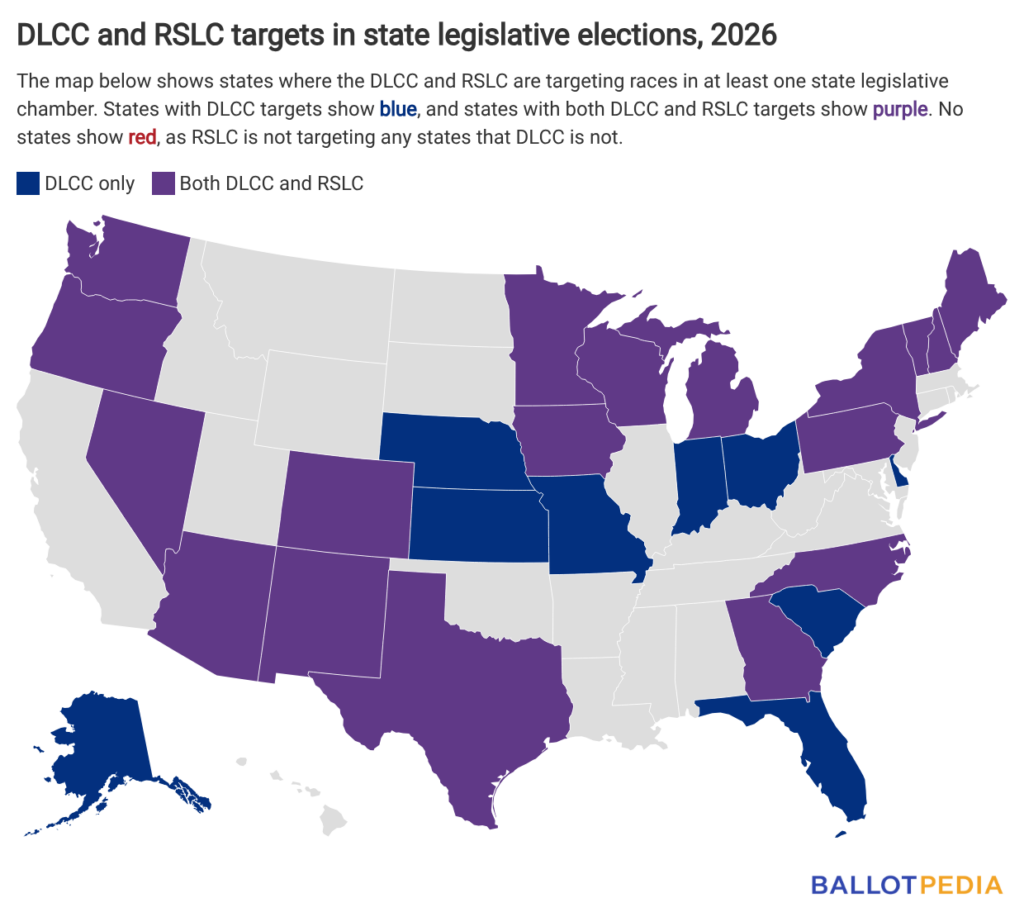
This year, the Democratic Legislative Campaign Committee (DLCC) and the Republican State Leadership Committee (RSLC) — the parties’ national campaign arms for state legislatures — are focusing on the same 30 chambers. In total, the DLCC will target 43 chambers, and the RSLC will target 35 chambers.
Ahead of this year’s state legislative elections, Republicans control a total of 57 chambers, and Democrats control a total of 39 chambers. The Alaska Senate and Alaska House are organized under multipartisan, power-sharing coalitions. The Minnesota House is evenly split between both parties.
Of the 88 chambers that are up for election this year, Democrats control 34 chambers and Republicans control 51. Of the 42 states where both chambers are up for election this year, Republicans control both chambers in 23 states, and Democrats control both chambers in 15 states.
The DLCC’s official website called this year’s elections “a historic opportunity to fundamentally shift the state legislative balance of power.” RSLC President Edith Jorge-Tuñón wrote, “Success this cycle will not be defined by sweeping gains, but by whether state Republicans can withstand sustained pressure in the most competitive districts.”
Democratic Legislative Campaign Committee (DLCC)
This year, the DLCC is seeking to gain control of both legislative chambers in Arizona, New Hampshire, and Wisconsin. They are also looking to gain control of the Michigan House and Minnesota House.
On the other hand, the DLCC is defending the Michigan Senate, the Minnesota Senate, and the Pennsylvania House.
The DLCC is also seeking to strengthen their coalitions in both chambers in Alaska. Currently, there are 11 Republicans and nine Democrats in the state Senate and 21 Republicans and 14 Democrats in the state House.
In terms of supermajorities, the DLCC sees the following chambers as possible gains: the Delaware House, Nevada House, New Mexico House, New York Senate, Oregon Senate, and Washington House. Both legislative chambers in Colorado and Vermont are also seen as opportunities to create Democratic supermajorities.
On the other hand, the DLCC is seeking to break Republican supermajorities in the Kansas House, North Carolina Senate, Ohio House, and South Carolina House. They are also seeking to break Republican supermajorities in both legislative chambers in Florida, Indiana, Iowa, and Missouri. The DLCC is also seeking to prevent the North Carolina House from becoming a Republican supermajority.
Finally, the DLCC is seeking to gain seats in the Nebraska Senate, Pennsylvania Senate, and Texas House. They are also aiming to pick up seats in both legislative chambers in Georgia and Maine.
Republican State Leadership Committee (RSLC)
This year, the RSLC is defending Republican majorities in both legislative chambers in Arizona, Georgia, Iowa, New Hampshire, North Carolina, Texas, and Wisconsin.
The RSLC is also seeking to compete for control of split legislatures in three states: Michigan, Minnesota, and Pennsylvania. Currently, Republicans have majorities in the Michigan House and Pennsylvania Senate. Democrats have majorities in the Michigan Senate, Minnesota Senate, and Pennsylvania House. As we mentioned above, the Minnesota House is evenly split between both parties.
Finally, the RSLC sees opportunities to pick up seats in both legislative chambers in Colorado, Maine, Nevada, New York, Oregon, Vermont, and Washington. They are also seeking to pick up seats in the New Mexico House. Currently, Democrats have majorities in all of those legislative chambers.
Historical context
The same 88 state legislative chambers up for election this year were up for election in 2022. In those midterm elections, which occurred following the 2020 presidential election, Democrats gained control of four chambers from Republicans — the Michigan House and Senate, Minnesota Senate, and Pennsylvania House.
Republicans had a net gain of 27 seats nationwide as a result of the 2022 state legislative elections. That included three seats created in Wyoming during the 2020 redistricting process. Democrats had a net loss of four seats in 2022, and independents and minor party officeholders lost 20 seats.
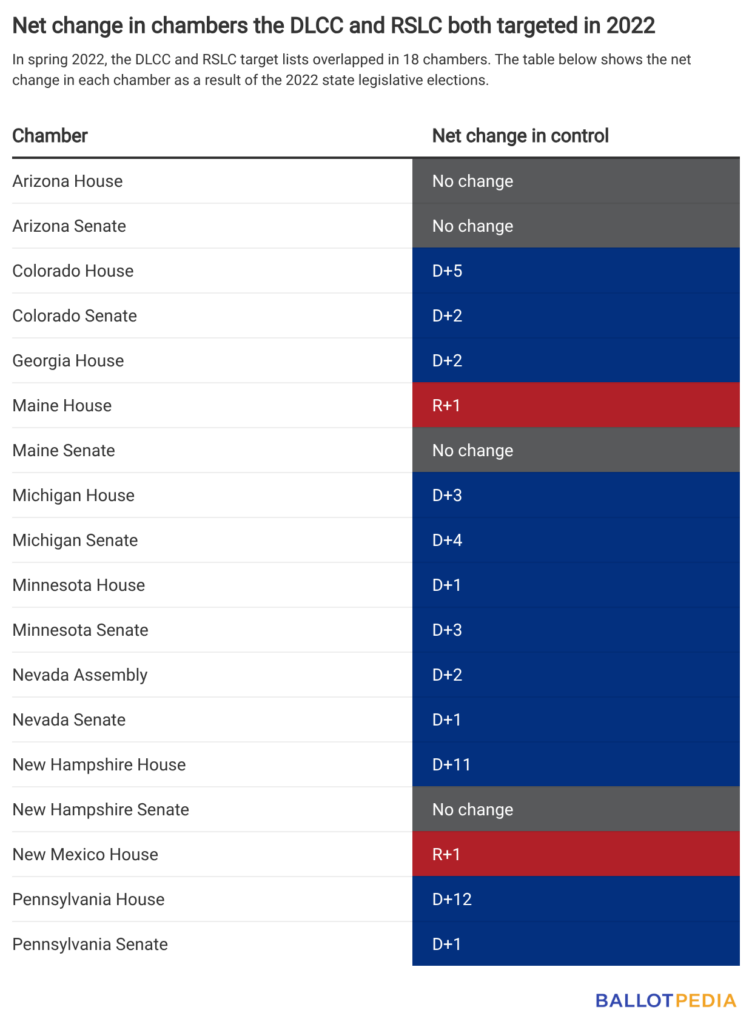
However, among the 18 state legislative chambers that both the DLCC and RSLC targeted in 2022, Democrats net 45 seats. Both groups are targeting state legislative races in the states listed below again in 2026.