


Welcome to the Monday, Oct. 26, 2026, Brew.
By: Briana Ryan
Here’s what’s in store for you as you start your day:
- The Democratic Socialists of America endorses 131 candidates and takes sides on 33 ballot measures in the Nov. 3 elections
- Supermajority status is at stake in Oklahoma’s state legislative elections on Nov. 3
- Nine states are holding public service commission elections in 2026, with two expected to be battlegrounds
The Democratic Socialists of America endorses 131 candidates and takes sides on 22 ballot measures in the Nov. 3 elections
The national chapter of the Democratic Socialists of America (DSA) and its local chapters have endorsed 131 candidates on the Nov. 3 ballot in 30 states and the District of Columbia. The groups have also taken positions on 33 state and local ballot measures on the same ballot.
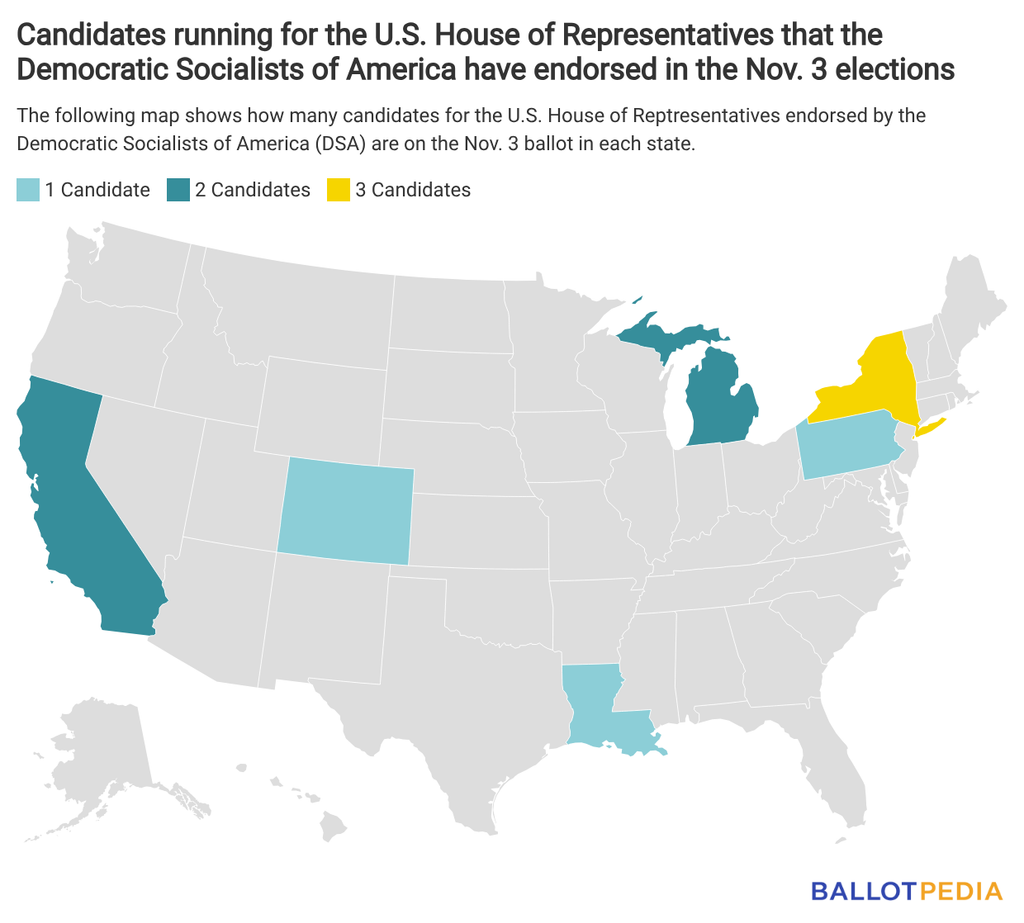
Ten candidates are running for the U.S. House of Representatives, 52 are running for state legislatures, and 69 are running for local offices.
The DSA website describes itself as "the largest socialist organization in the United States because we're a member-driven mass organization. We believe that working people should run both the economy and civil society, and we show our commitment to this principle by being an organization of, by, and for the working class."
They're one of what we at Ballotpedia refer to as a Recognized Endorsement Contributor (REC) — a person or organization that publicly expresses their support for candidates or campaigns. These endorsements provide voters with valuable information and, ultimately, contribute to an information environment that fosters a more civically engaged and informed electorate.
The following includes endorsements and positions on ballot measures from the national chapter and local chapters.
Congressional elections
Three DSA-endorsed candidates defeated Democratic incumbents in primaries this year. All three are among nine DSA-endorsed candidates running in districts that four independent race forecasters have rated Safe/Solid Democratic. The other six are two incumbents, two candidates running for open seats, and two candidates in California, where the top-two primary finishers advance regardless of party. In both California races, voters will decide between a DSA-endorsed candidate and a Democratic incumbent.
In the other seven Safe/Solid Democratic elections, voters will not decide between a DSA-endorsed candidate and another Democrat. As a result, the number of DSA-endorsed members of the U.S. Congress could increase from two to at least seven, and to nine if both DSA-endorsed candidates win in California.
One DSA-endorsed candidate is running in a district rated Safe/Solid Republican: Louisiana’s 1st Congressional District, where the candidate is one of four on the ballot and the only Democrat. Louisiana uses a majority-vote system in which all candidates appear on the same ballot regardless of party affiliation.
State legislative elections
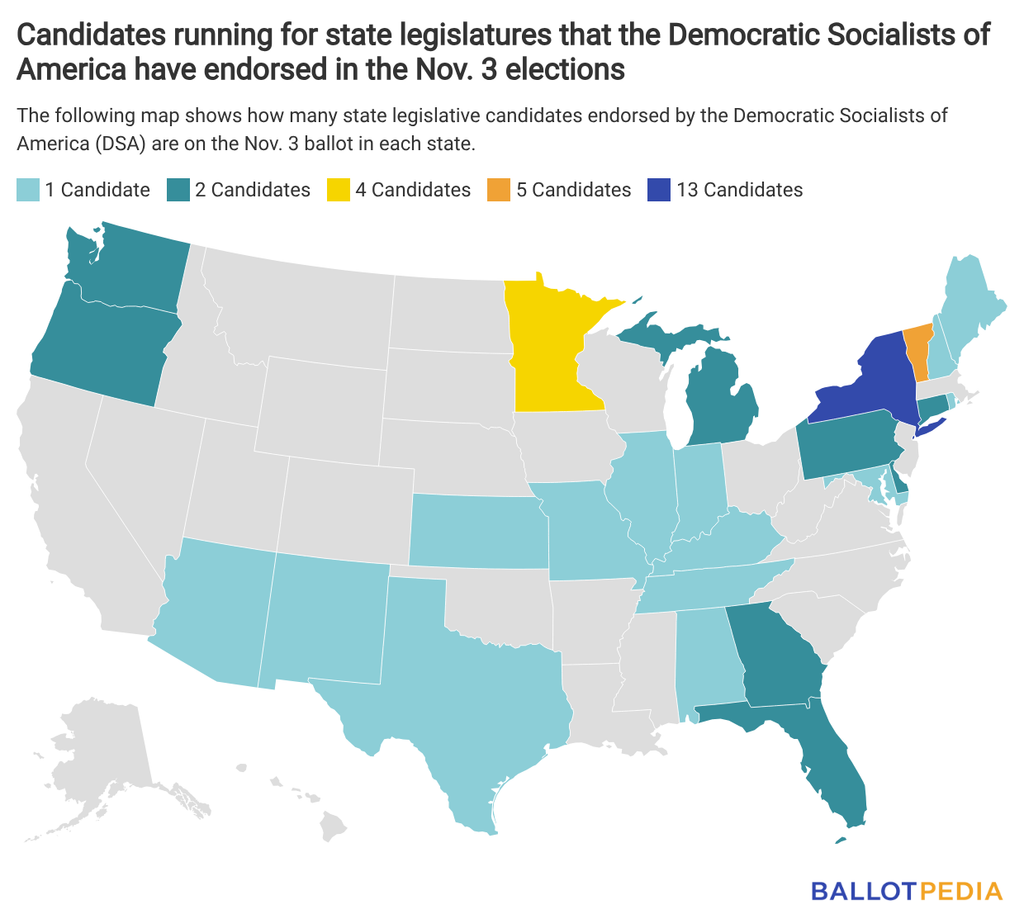
Fifty-two DSA-endorsed candidates are running for state legislative seats across 25 states and 31 chambers. Sixteen are incumbents, five of whom are in New York.
Of the 36 DSA-endorsed candidates who are not incumbents, nine defeated incumbents in Democratic primaries, so there will not be an incumbent on the Nov. 3 ballot. One other DSA-endorsed candidate is running in a multi-member district in Arizona. The candidate defeated one of the district’s two Democratic incumbents in the primary and will appear on the general election ballot alongside the other.
Another 13 DSA-endorsed candidates will appear on the Nov. 3 ballot alongside incumbents, 10 of whom are Republicans and two of whom are Democrats. In New Hampshire, the candidate advanced from the primary along with the district’s Democratic incumbent, and both will be on the Nov. 3 ballot with the district’s Republican incumbent.
The remaining 13 are running for open seats where no incumbent is running for re-election.
New York has the most DSA-endorsed candidates, with 11 running for the State Assembly. The Vermont House of Representatives has the second-most, with three. The other 38 candidates are spread across 29 chambers.
Local elections
DSA-endorsed candidates will be on the Nov. 3 ballot for mayor in two of the 100 most populous U.S. cities: Los Angeles, California, and Louisville, Kentucky. The Democratic incumbent mayors of both cities will also be on the ballot. A third DSA-endorsed candidate is running for mayor of Washington, D.C., where the office is open. In all, 10 DSA-endorsed candidates are running for mayor.
They are among a total of 69 DSA-endorsed candidates running for local offices, 37 of whom are running in California. Minnesota has the second-most, with six, and the remaining 26 are running across 17 other states and Washington, D.C.
Ballot measures
The DSA has taken positions on 23 statewide measures and 10 local measures on the Nov. 3 ballot. The DSA is supporting 13 of the statewide measures and opposing 10. The DSA is supporting all 10 local measures.
Massachusetts has the most statewide measures on the Nov. 3 ballot that DSA has taken a position on, with the organization supporting four measures and opposing three. California has the second-most, with the organization supporting two measures and opposing three. The other 11 statewide measures are spread across seven states.
The statewide measures that the DSA is supporting concern housing, taxes, and public services. They include California Proposition 40, a one-time 5% tax on wealth above $1 billion, and Proposition 3, which would make the state's top income tax rates permanent. DSA is also supporting Virginia constitutional amendments on abortion, same-sex marriage, and voting rights for people with felony convictions.
The DSA opposes five statewide tax measures, including California Propositions 41 and 42, which compete with Proposition 40. It also opposes two Washington initiatives on parental rights in schools and on sports eligibility sex requirements.
Click here to read more about the Democratic Socialists of America.
Supermajority status is at stake in Oklahoma’s state legislative elections on Nov. 3
Welcome to our next installment of our 50 States in 50 Days series, covering Oklahoma. To view our archive of past editions, click here.
Oklahoma's state legislative elections on Nov. 3 will determine whether Republicans maintain their two-thirds supermajority or whether Democrats will break it.
Republicans currently have a 39-8 supermajority in the Oklahoma Senate, with one vacancy, and an 81-18 supermajority in the Oklahoma House of Representatives, with two vacancies. Twenty-five seats in the state Senate, and all 101 seats in the state House are up for election this year. There will also be a special election for Oklahoma Senate District 17.
Democrats need to gain at least eight seats to break the supermajority in the state Senate, and Republicans need to lose no more than seven seats to maintain their supermajority. Democrats need to gain at least 14 seats to break the supermajority in the state House, and Republicans need to lose no more than 13 seats to maintain their supermajority.
Early voting opens Oct. 28 and ends Oct. 31.
Polls open on Election Day at 7:00 a.m. and close at 7:00 p.m.
Voter ID is required. Valid forms of ID include government-issued photo IDs and county election board voter identification cards (which do not include photographs). If a voter does not have an acceptable ID, they may fill out an affidavit and vote a provisional ballot. The ballot is counted if the person provides their name, address, date of birth, and ID number, and that information matches what is listed in the voter registration database. For more information on voter ID in Oklahoma, click here.
Absentee/mail-in ballots must be requested by Oct. 19 and received by Nov. 3. Under a 2025 law, a registered voter who is either a deployed first responder or a uniformed-service voter may make a written request for an emergency absentee ballot after the deadline to request an absentee ballot.
Current party control
Republicans represent all five congressional districts. Both of Oklahoma's U.S. Senators are Republicans.
Republicans control the governorship and both state legislative chambers, making Oklahoma one of 23 states with a Republican trifecta. Oklahoma's attorney general and secretary of state are also Republicans. As a result, Oklahoma is one of 24 states with a Republican triplex.
Oklahoma is one of two states with two courts of last resort, one for civil appeals and one for criminal appeals. Republican governors appointed six justices on the Oklahoma Supreme Court, and a Democratic governor appointed three. Republican governors appointed four justices on the Oklahoma Court of Criminal Appeals, and a Democratic governor appointed one.
Offices on the ballot
Elections are taking place for the U.S. Senate and the U.S. House of Representatives.
In addition to the state legislative elections mentioned above, there will also be elections for governor, lieutenant governor, attorney general, auditor, insurance commissioner, labor commissioner, superintendent of public instruction, treasurer, and one seat on the Oklahoma Corporation Commission.
Four state supreme court justices and one court of criminal appeals justice are up for retention elections. Four intermediate appellate court judges are also up for retention elections.
Oklahoma is one of 32 states this year where we are providing comprehensive election coverage down to the local level. This year's ballot includes elections for municipal, county, and judicial offices.
Notable elections
U.S. Senate: N'Kiyla Thomas (D), Kevin Hern (R), and three other candidates are running in the open race. The candidate who wins this race will be the fourth person to represent this seat since 2020. Jim Inhofe (R) won re-election in 2020 and resigned in 2023. Markwayne Mullin (R) won a 2022 special election to succeed Inhofe, but resigned in 2026 to serve as the U.S. Secretary of Homeland Security. Oklahoma Gov. Kevin Stitt (R) then appointed Sen. Alan Armstrong (R) to succeed Mullin. Armstrong did not run for a full term because Oklahoma law requires appointees to a Senate seat to sign an affidavit stating they will not run for a full term.
1st Congressional District: John Croisant (D) and Mark Tedford (R) are running in the open race. Croisant is a member of the Tulsa Public Schools Board of Education, and Tedford is a member of the state House. In his Candidate Connection survey response, Croisant wrote, "I will fight to bring back essential programs around infrastructure, economic development, and help working Oklahomans whether they be in our cities, suburbs, or in our farming communities." In his Candidate Connection survey response, Tedford wrote, "I am passionate about economic policy, workforce development, government efficiency, housing, and insurance reform."
Statewide ballot measures
There are two statewide measures on the ballot. Between 1907 and 2025, voters have decided on 455 measures, or an average of eight per even-numbered year. During that period, voters approved 234 and defeated 221. For more information about the history of Oklahoma's ballot measures, visit its Historical Measures Factbook.
Here's a closer look at the two measures.
State Question 845 would amend the Oklahoma Constitution to change the Oklahoma Judicial Nominating Commission in four ways. It would require officials to base appointments on the congressional districts in effect at the time of each appointment, and would allow commissioners to serve two consecutive six-year terms. It would also remove the provision limiting the commission to no more than three members from one political party and the provisions prohibiting certain commission members or their family members from being licensed attorneys.
State Question 847 would amend the state constitution to change how the state calculates the fair cash value of property beginning in tax year 2027. It would lower the annual growth limit on fair cash value from 5% to 4%, and from 3% to 1.75% for property that qualifies for a homestead exemption. It would also repeal the prohibition on any increase in the fair cash value of homestead property for people aged sixty-five or older whose income exceeds the median amount that the U.S. Department of Housing and Urban Development (HUD) determines. State Question 847 is among the 12 statewide property tax measures that voters will decide nationwide on Nov. 3.
Local ballot measures
Oklahoma County voters will decide on a measure that would levy an additional 0.4% sales tax in the county and use the revenue to fund the construction and operation of detention and mental health facilities.
Tulsa voters will decide on a measure that would increase the city's transient occupancy, or hotel, tax from 5% to 9.9%.
Join us again in our next edition when we'll preview elections in Kentucky, the Bluegrass State.
Click here to see every edition of 50 States in 50 Days as we publish them, and here to use our Sample Ballot Lookup Tool.
Nine states are holding public service commission elections in 2026, with two expected to be battlegrounds
Welcome to the next installment of our series previewing the Nov. 3 elections by office. Next: public utilities commissions.
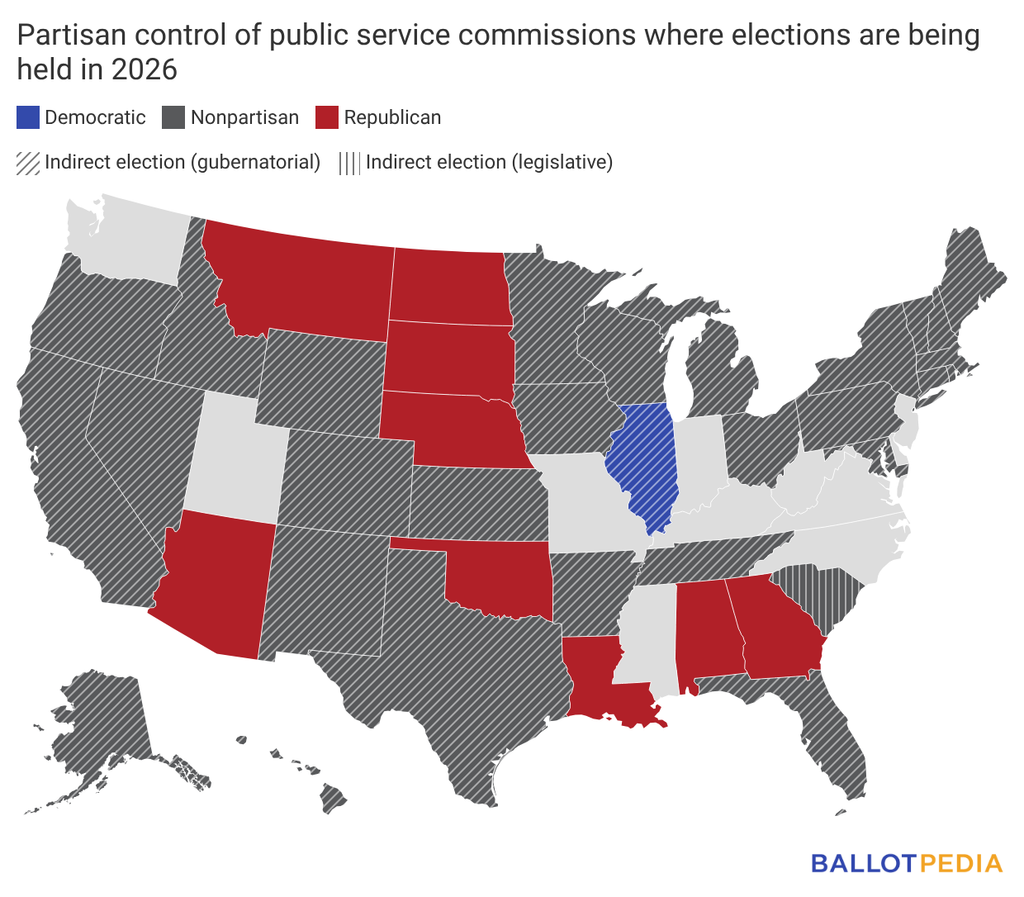
On Nov. 3, elections are happening in nine states for public service commissions. Gubernatorial elections are happening in 30 other states where the governor appoints members to their state’s commission, and state legislative elections are happening in one state — South Carolina — where the Legislature appoints members.
All 50 states have public service commissions that serve as the chief regulators of utilities, including energy, telecommunications, and water. Voters elect commissioners in 10 states, and governors or legislators appoint commissioners in 40 states.
Republicans have majorities on all nine commissions whose members are up for election this year. Overall, Republicans control 10 commissions, Democrats control one, and 39 are nonpartisan.
Battlegrounds
We identified elections for two commissions as battlegrounds this year.
Arizona: Five candidates are running for two seats on the Arizona Corporation Commission. The top two vote getters will win the seats, regardless of party. Two incumbents are running, Nick Myers (R) and Kevin Thompson (R). Myers did not advance from the primary, with Ralph Heap (R) getting the second-place spot. Jonathan Hill (D) and Clara Pratte (D) are running on the Democratic side. The commission is currently 5-0 Republican. If Democrats win both elections, it would narrow the majority to 3-2, with the possibility of control changing in 2028. A Democrat last won a seat in 2020.
Georgia: Two seats are up for election. Incumbent Peter Hubbard (D) and Fitz Johnson (R) are running in District 3, a rematch of 2025. Shelia Edwards (D) and Josh Tolbert (R) are running in District 5. In 2025, Democrats defeated two Republican incumbents, giving the commission a 3-2 Republican majority.
Key trends to watch
- Partisan control: In Georgia, if the commission switched from Republican-controlled to Democratic-controlled, it would join Illinois as the nation's only Democratic-aligned commission. Arizona could also see its composition set up a battle for the majority in 2028.
- Incumbent turnover: Incumbent commissioners lost primaries in Arizona and Alabama, and one incumbent in Montana won a primary by less than 1,000 votes. At least one incumbent is up in five states.
Recent election history
In 2025, Democrats won two seats in Georgia. In other states, there has been little change in terms of partisan control. The last time a commission changed partisan control was in Mississippi in 2019.
To read more about this year’s public service commission elections, click here.