


Welcome to the Tuesday, Oct. 27, 2026, Brew.
By: Lara Bonatesta
Here’s what’s in store for you as you start your day:
- Twenty-three states are holding state supreme court elections in November. Six are battlegrounds.
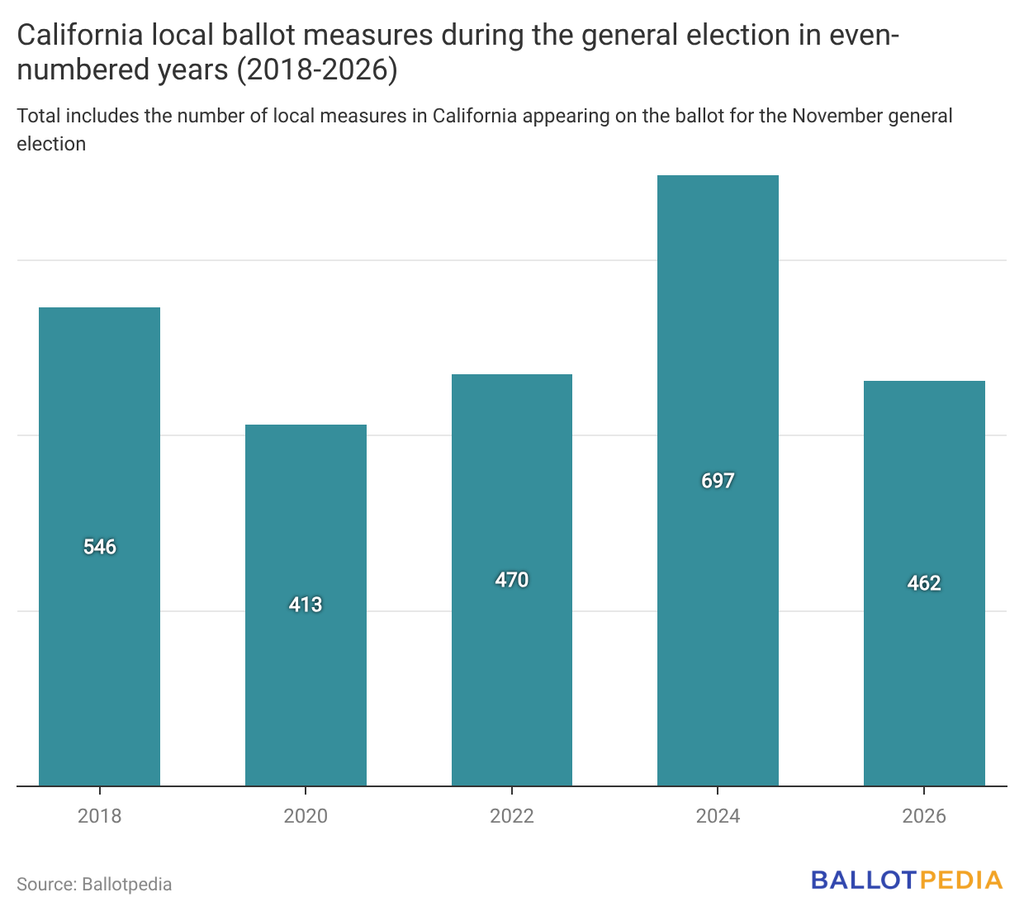
- California voters will decide on 462 local ballot measures in November, the second-lowest number since 2018
- Kentucky to hold first elections since changing its voter ID requirements
Twenty-three states are holding state supreme court elections in November. Six are battlegrounds.
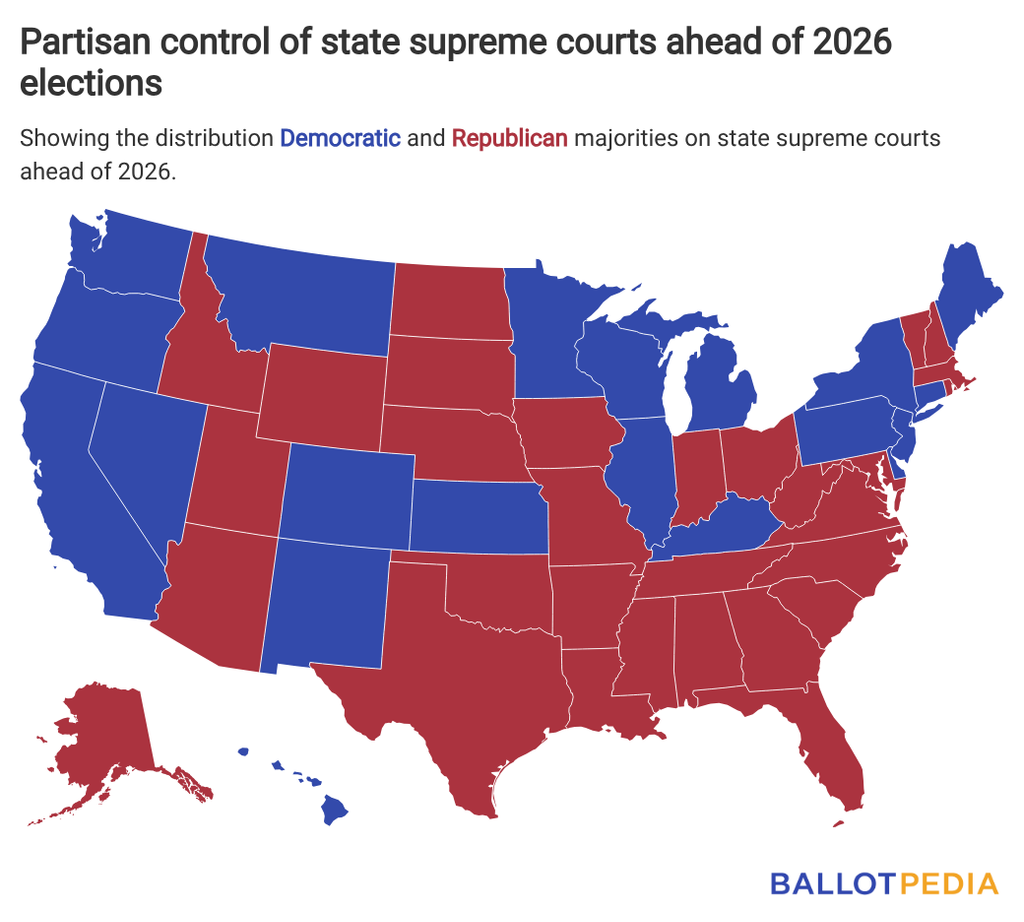
Twenty-three states are holding elections for state supreme courts in November. Of the courts up for election, 13 have a majority of Republican-appointed/elected justices, and 10 have a majority of Democratic-appointed/elected justices.
Each state and the District of Columbia has at least one supreme court, or court of last resort. Oklahoma and Texas both have two courts of last resort, one for civil appeals and one for criminal appeals.
These supreme courts hear appeals of the decisions made in lower trial or appellate courts. The number of justices on each court varies between five and nine. The length of a justice's term can be as short as six years or be a lifetime appointment.
Battlegrounds:
Ballotpedia identified six courts as battlegrounds. One state has the majority directly at stake, while the outcomes of others have implications for whether a party can gain a majority of seats in a future election:
- Michigan: Two seats are up for election. The elections are nonpartisan, but parties nominate justices at conventions. Incumbent Justices Megan Cavanagh (D) and Noah Hood (D) face Casandra Morse-Bills (R) and Michael D. Warren Jr. (R). All candidates run on the same ballot. Democrats control the court 6-1. If Republicans win both seats, the court will become 4-3 Democratic, and Republicans could win the court in 2028.
- Montana: Amy Eddy and Dan Wilson are running in a nonpartisan election. This is the only election in 2026 where the majority is directly at stake. According to Bolts Magazine, the court is 4-3 in favor of liberals, with Eddy being a liberal and Wilson a conservative.
- North Carolina: Incumbent Justice Anita Earls (D) and Sarah Stevens (R) are running. The court currently has a 5-2 Republican majority. Republicans won a majority on the court in 2022. If Earls wins re-election, Democrats could win a majority in 2028 when three Republican justices will be up for election.
- Ohio: Four candidates are running in the partisan general election for two seats. Incumbent Justice Jennifer L. Brunner (D) and Colleen O'Donnell (R) are running for one seat, and incumbent Justice Dan Hawkins (R) and Marilyn Zayas (D) are running for the other. Republicans have a 6-1 majority on the court and have held it since 1986.
- Utah: Justice Jill Pohlman is standing for retention. Bolts Magazine wrote that Republicans had disagreed with the court over redistricting and citizen initiative laws. At the state Republican Party convention in April, chair Robert Axon supported Pohlman’s retention. The Utah State Bar opposes it. Republicans have appointed every justice on the court.
- Washington: Five seats are up for election, three incumbents are running, and two are open. Washington State Standard's Jake Goldstein-Street wrote that a state 9.9% tax on families earning over $1 million, set to go into effect in 2028, has faced legal challenges and become an issue in the race, as the court may hear challenges to the law. Democrats appointed six of the court’s nine justices, and the election could determine how large the court’s Democratic majority is.
Key Trends:
Control for 2028: While Montana has the only election with direct majority control on the line, many contests will determine whether the partisan majority of the courts in 2028.
Ideological balance: Some states will not see their court’s majority change its partisan control, but the outcomes could potentially make for a narrower majority, which may affect the court’s future rulings.
Recent election history:
In 2025, no courts changed ideological control. In 2024, Kentucky went from a Republican-majority court to a divided court. In 2023, liberals gained control of the Wisconsin Supreme Court. In 2022, Republicans gained a majority on the North Carolina Supreme Court.
To read more about state supreme court elections, click here.
California voters will decide on 462 local ballot measures in November, the second-lowest number since 2018
Voters across California will decide on 462 local ballot measures during the general election on Nov. 3 — the second-lowest number since 2018. The 413 local measures that were on the ballot in 2020 were the fewest in an even-numbered year.
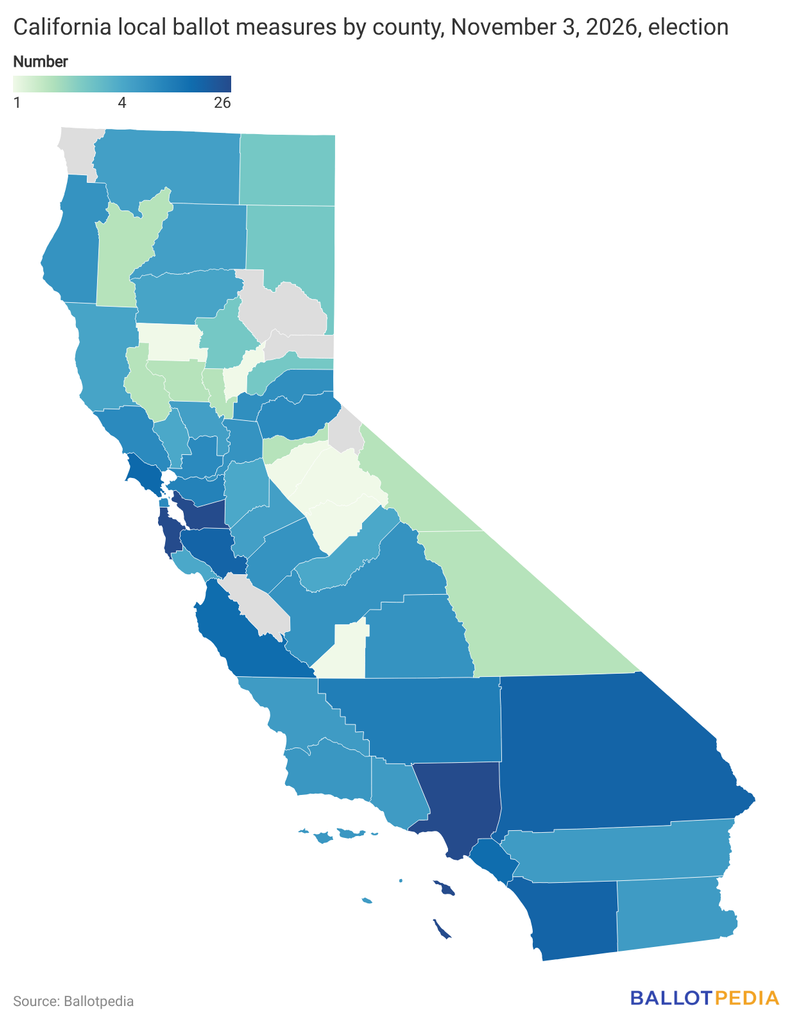
Los Angeles County has the most measures on the ballot, with 68 appearing across all of its jurisdictions, followed by San Mateo County with 29. The remaining 51 counties have between one and 28 measures. There are no measures on the ballot in Alpine, Del Norte, Plumas, San Benito, and Sierra Counties.
Here is a closer look at selected local measures in the state's 10 largest cities, along with other notable measures:
Los Angeles
Eight measures are on the ballot in the city of Los Angeles. Two are on campaign finance rules in local elections and one is on relief for the Palisades Fire in 2025:
- Measure EE would increase the authority of the Police Department Inspector General and the Fire Department Independent Assessor, prohibit ethics commissioners from running for elected office for five years, increase penalties for campaign finance violations, require the city council to meet once per week instead of three days per week, increase the number of signatures required for referendum petitions, "and make other changes regarding ethics, elections and governance."
- Measure SC would clarify campaign finance rules for Board of Education elections and authorize changes to be made by ordinance.
- Measure TE would authorize a one-time exemption from the special documentary transfer tax for residences that were damaged or destroyed by the Palisades Fire and sold within five years.
San Francisco
Ten local measures are on the ballot in San Francisco. One is on the local initiative process for ballot measures, and another is related to local appointees – both of which are supported by Mayor Daniel Lurie (D):
- Proposition D would add requirements to place a measure on the ballot, including increasing the number of required signatures and mandating that the entire Board of Supervisors vote to approve every measure.
- Proposition F would allow nomination boards to recommend one or more names to the mayor for a position and permit appointing officials to remove their appointees in most departments without cause. It would also permit the mayor to reorganize executive branch departments, hire deputy mayors, and hire and remove department heads.
San Jose
One measure is on the ballot in San Jose. Measure A would increase the city hotel tax from 4% to 6% for general fund services, including police, fire, homelessness response, and park maintenance.
Fresno
One measure is on the ballot in Fresno. Measure D would establish a 0.5% city sales tax to generate an estimated $65 million annually for general city services, lasting for 10 years or until the county adopts a transportation sales tax of an equal or higher rate that benefits the city, whichever occurs first.
Oakland
Two measures are on the ballot in Oakland, one on property tax transfers and the other on the powers of the mayor and city council.
Measure EE would change the city's form of government to a mayor-council system and make the mayor the city's chief executive officer. This is sometimes called a strong mayor system. The mayor would have the authority to veto ordinances and resolutions the city council passes, with the council authorized to override vetoes with at least six votes. The mayor would also oversee city departments, agencies, and appointed offices, while the city council could confirm department heads, hold legislative hearings, and issue subpoenas.
Currently, Oakland is one of seven cities, among the 100 most populous, with a hybrid government. Forty-seven of the 100 largest cities have strong-mayor governments. Forty-six have council-manager governments. Click here to learn more about each system.
Other ballot measures
In Alhambra, Measure DB would prohibit data centers citywide. Earlier this year, voters in neighboring Monterey Park approved Measure NDC 88.3 to 11.7%. It prohibits data centers within its jurisdiction. These are the only data center-related ballot measures in California this year. Voters have or will decide on at least 49 local ballot measures related to data centers in 13 states this year. Click here to learn more.
In Berkeley, voters are deciding on Measure AA and Measure Z. Measure AA would increase the existing tax on sugar-sweetened beverages from $0.01 to $0.02 and dedicate the revenue to fund public health, nutrition, and drinking water accessibility programs. Measure Z would establish a six-year parcel tax of $0.06 per square foot of residential improvements and $0.09 per square foot of nonresidential improvements to capitalize and support a public bank financing affordable housing, green energy and infrastructure, and small businesses.
In Culver City, Measure YV would lower the voting age to 16 for city and school district elections and ballot measures. Currently, the voting age is 18, but 17-year-olds can pre-register to vote.
If approved, Culver City would become the fourth municipality in California and the 16th nationally to allow individuals younger than 18 to vote in at least some local elections. Currently, 16-year-olds in Albany, Berkeley, and Oakland are permitted to vote in school board elections. Sixteen-year-olds in Newark, New Jersey, are also eligible to vote in school board races, while 16-year-olds in 10 Maryland municipalities, and Brattleboro, Vermont, are permitted to vote in local municipal elections.
Click here to learn more about local ballot measures in California.
Kentucky to hold first elections since changing its voter ID requirements
Welcome to our next installment of our 50 States in 50 Days series, covering Kentucky. To view our archive of past editions, click here.
On Nov. 3, Kentucky is holding its first general elections since the General Assembly overrode Gov. Andy Beshear’s (D) veto of a law that removed several types of identification that were previously accepted for voting.
The law, HB 139, removed the ability to use a Social Security card, food stamp identification card, electronic benefit transfer card, or supplemental nutrition assistance card as an ID if a person cannot obtain a photo ID. The law also removed the option for election officials to affirm the identity of an individual they knew personally.
Kentucky is one of 36 states that require voters to present ID at the polls on election day and one of 24 states that require voters to present photo ID.
Acceptable forms of ID are a photo ID issued by Kentucky, the United States, a military branch, a public or private institution of higher education, or a local government. Voters who cannot obtain a photo ID or have a religious objection to being photographed can sign a voter affirmation form and present a county-issued ID approved by the State Board of Elections or an identification card with a person's name and photograph. For more information on voter ID in Kentucky, click here.
Want to see what’s on your ballot this November? Click here to use our Sample Ballot Lookup Tool. Now let’s take a closer look at what’s happening in Kentucky.
Early voting opens Oct. 29 and ends Oct. 31.
Polls open on Election Day at 6:00 a.m. and close at 6:00 p.m.
Absentee/mail-in ballots must be received by Nov. 3. The last day to request an absentee/mail-in ballot was Oct. 20. Certain voters, such as those who are temporarily residing outside the state or who are incarcerated, are allowed to request an absentee/mail-in ballot within 14 days of Election Day.
Current party control
Republicans represent five congressional districts, and Democrats represent one. Both of Kentucky’s U.S. Senators are Republicans.
Kentucky is one of two states with a governor of one party and a veto-proof state legislative majority of the opposing party. The other is Kansas. Republicans have a 32-6 majority in the Kentucky Senate and an 80-20 majority in the Kentucky House of Representatives. Because the governor is a Democrat, Kentucky is one of 11 states with a divided government. Kentucky’s attorney general and secretary of state are Republicans. As a result, Kentucky is one of five states where neither party has a triplex. Six of the seven members of the Kentucky Supreme Court initially joined the court through a nonpartisan election. A Democratic governor initially appointed one member.
Offices on the ballot
Elections are taking place for the U.S. Senate, the U.S. House, 19 seats in the state Senate, and all 100 seats in the state House.
Kentucky is one of 32 states this year in which we are covering all local elections for school boards and municipal offices.
Noteworthy elections
U.S. Senate: Charles Booker (D), Andy Barr (R), and Christopher Campbell (Kentucky Party) are running. Incumbent Mitch McConnell (R), who first took office in 1985, is not running for re-election. Major race forecasters have rated this election Solid/Safe Republican.
Mayor of Louisville: Incumbent Craig Greenberg and Shameka Parrish-Wright are running. This is the first time Louisville is holding nonpartisan elections for mayor and metro council. The city is required to switch to nonpartisan elections under HB288, which the Kentucky General Assembly passed in 2024. Greenberg was elected as a Democrat in 2022 and has endorsements from Gov. Andy Beshear (D) and the Louisville Democratic Party. Parrish-Wright is a member of the Louisville City Council and one of two mayoral candidates in the 100 most populous cities who the Democratic Socialists of America (DSA) endorsed.
Statewide ballot measures
Kentucky voters will decide on one ballot measure on Nov. 3. From 1985 to 2024, Kentucky voters decided on 28 ballot measures, or between one and two per even-numbered year. During that period, voters approved 18 measures and defeated 10.
Kentucky voters will decide on a legislatively-referred constitutional amendment that would prohibit the governor from issuing a pardon or commuting a sentence 60 days before the gubernatorial election and up to the fifth Tuesday succeeding the election. Currently, the only limitation on the governor’s pardon power is that the governor cannot grant reprieves or pardons for impeachments. No state currently restricts the timing of gubernatorial pardons around an election.
Local ballot measures
We’re covering three local measures in Fayette County.
Join us next edition when we'll preview elections in Mississippi, the Magnolia State.
Click here to see every edition of 50 States in 50 Days as we publish them, and here to use our Sample Ballot Lookup Tool.