

Welcome to the Wednesday, Oct. 28, 2026, Brew.
By: Briana Ryan
Here’s what’s in store for you as you start your day:
- Fifteen of the 100 most populous U.S. cities are holding elections for mayor on Nov. 3
- The state elections that will affect K-12 policy
- Mississippi to hold its first general election under expanded proof-of-citizenship requirements
Fifteen of the 100 most populous U.S. cities are holding mayoral elections on Nov. 3
Welcome to the next installment of our series previewing the Nov. 3 elections by office. Next: mayors.
Fifteen of the 100 most populous cities in the U.S. are holding mayoral elections on Nov 3. Among those, nine cities have Democratic mayors, three have Republican mayors, and two have nonpartisan mayors. One mayor’s partisan affiliation is unknown.
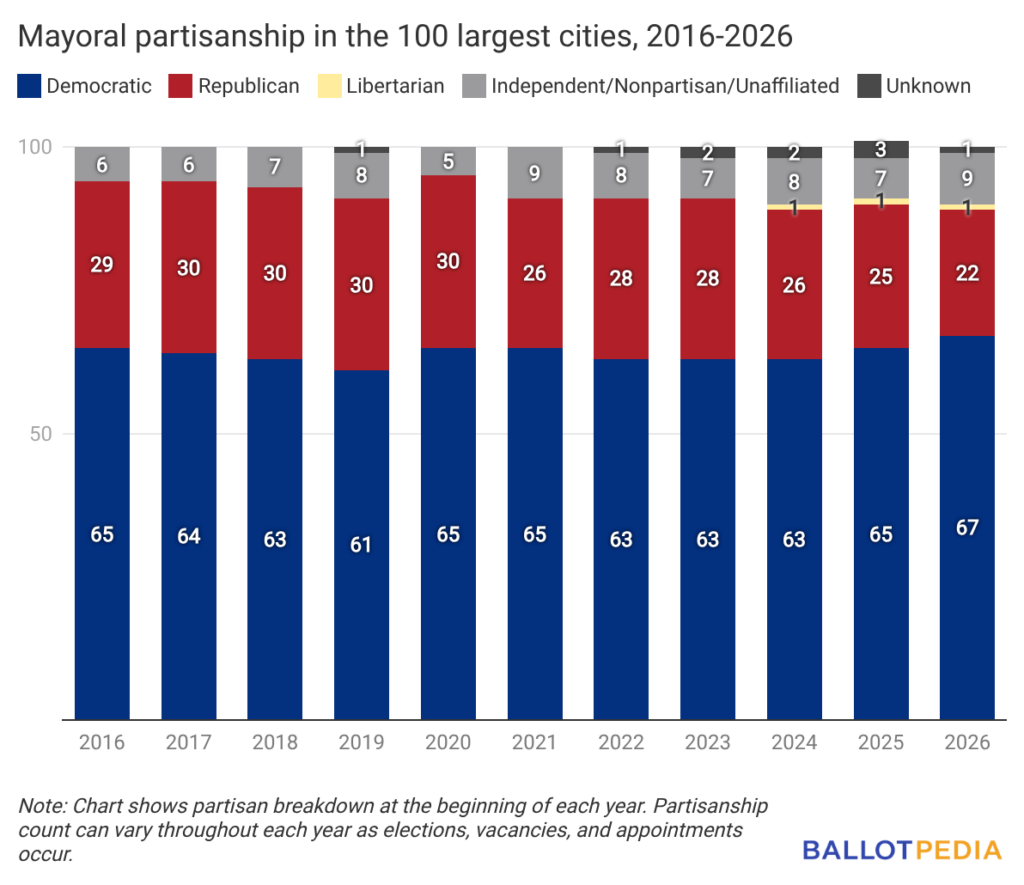
While most mayoral elections in the 100 most populous cities are nonpartisan, Ballotpedia has maintained a list of mayors’ partisan affiliations since 2016. Currently, there are 67 Democratic, 21 Republican, one Libertarian, three independent, six nonpartisan, and one unaffiliated mayor. One mayor's partisan affiliation is unknown.
Currently, there are the most Democratic mayors and the fewest Republican mayors in the top-100 cities since 2016. Since 2016, the number of Democratic-led top-100 cities has ranged from 61 to 67, and the number of Republican-led cities has ranged from 22 to 30. Based on 2020 population estimates, 81% of the population of the top 100 cities lives in cities with Democratic mayors, and 14% lives in cities with Republican mayors.
Battlegrounds
Los Angeles, California: Incumbent Karen Bass and Nithya Raman are running. Although the city's mayoral election is officially nonpartisan, both candidates are Democrats. Bass, who was elected in 2022, is the first mayoral incumbent in Los Angeles to face a runoff since 2005. Raman represents Los Angeles City Council District 4 and is an urban planner. Former Vice President Kamala Harris (D), Gov. Gavin Newsom (D), and U.S. Rep. Nancy Pelosi (D) endorsed Bass. The Democratic Socialists of America (DSA), the California Working Families Party, and Our Revolution endorsed Raman. Bass and Raman have both completed our Candidate Connection survey, click here and here to read their responses.
Louisville, Kentucky: Incumbent Craig Greenberg and Shameka Parrish-Wright are running. This is the first time Louisville is holding nonpartisan elections for mayor and metro council. A 2024 law, HB288, required the city to switch to nonpartisan elections. Greenberg was elected as a Democrat in 2022 and has endorsements from Gov. Andy Beshear (D) and the Louisville Democratic Party. Parrish-Wright is a member of the Louisville City Council and has an endorsement from the Democratic Socialists of America. Greenberg and Parrish-Wright have also both completed our Candidate Connection survey, click here and here to read their responses.
In addition to the battleground elections we mentioned above, each of the candidates running for mayor in Chula Vista, California, Henderson, Nevada, and Reno, Nevada also completed Ballotpedia’s Candidate Connection survey.
Key Trends to watch:
- DSA endorsements: As we mentioned above, DSA-endorsed candidates are on the Nov. 3 ballot for mayor in two of the 100 most populous U.S. cities: Los Angeles, California, and Louisville, Kentucky. The Democratic incumbent mayors of both cities are also on the ballot. A third DSA-endorsed candidate is running for mayor of Washington, D.C., where the office is open. In all, 10 DSA-endorsed candidates are running for mayor.
- Open seats: No mayors voluntarily retired this year. An average of 63.4% of mayors ran for re-election between 2020 and 2025, and an average of 16.3% of mayors retired (not including term-limited mayors). An average of 17.5% of mayors were term-limited. (Note: These figures do not include Washington, D.C.)
Recent election history
Seven top-100 cities have already held mayoral elections this year, including five that held general elections and two in which a candidate won the primary outright. Two of these elections resulted in a change in mayoral partisan control:
- In Irving, Texas, Albert Zapanta, who is unaffiliated, defeated two other candidates to succeed Republican incumbent Rick Stopfer.
- In Chandler, Arizona, Matt Orlando won outright after he received more than 50% of the vote in the primary. Orlando, an independent, will succeed Republican incumbent Kevin Hartke (R).
Click here to learn more about mayoral elections in 2026.
The state elections that will affect K-12 policy
On Nov. 3, voters in 46 states will indirectly shape the direction of their states' education policies through elections for governor, state legislature, and state education offices. Here's a closer look at this year's elections for each of these offices.
Gubernatorial elections
Gubernatorial elections are happening in 36 states this year. Democrats and Republicans each control 18 of the governorships up for election. Fifteen of those governors — six Democrats and nine Republicans — are term-limited.
Governors implement state laws, propose budgets, and use their veto power to influence spending. They can also direct resources toward addressing education issues through executive orders. For example, Alabama Gov. Kay Ivey (R) established a commission on classroom screen use this year, and Connecticut Gov. Ned Lamont (D) established one on school funding.
Governors, or another official or agency authorized to make federal tax decisions for the state, now also decide whether their states will participate in the Federal Scholarship Tax Credit program. The program was created in 2025 through the enactment of the One Big Beautiful Bill Act and takes effect Jan. 1, 2027. The program gives taxpayers federal tax credits for donations of up to $1,700 to scholarship-granting organizations (SGOs). SGOs use the funds to cover eligible students' educational expenses, including private school tuition. Taxpayers in any state can donate, but only students in participating states can receive scholarships.
Gubernatorial elections are happening in 20 of the 31 states that have opted into the program. Twenty-three of the 31 states have Republican trifectas, three have Democratic trifectas, and five have divided governments.
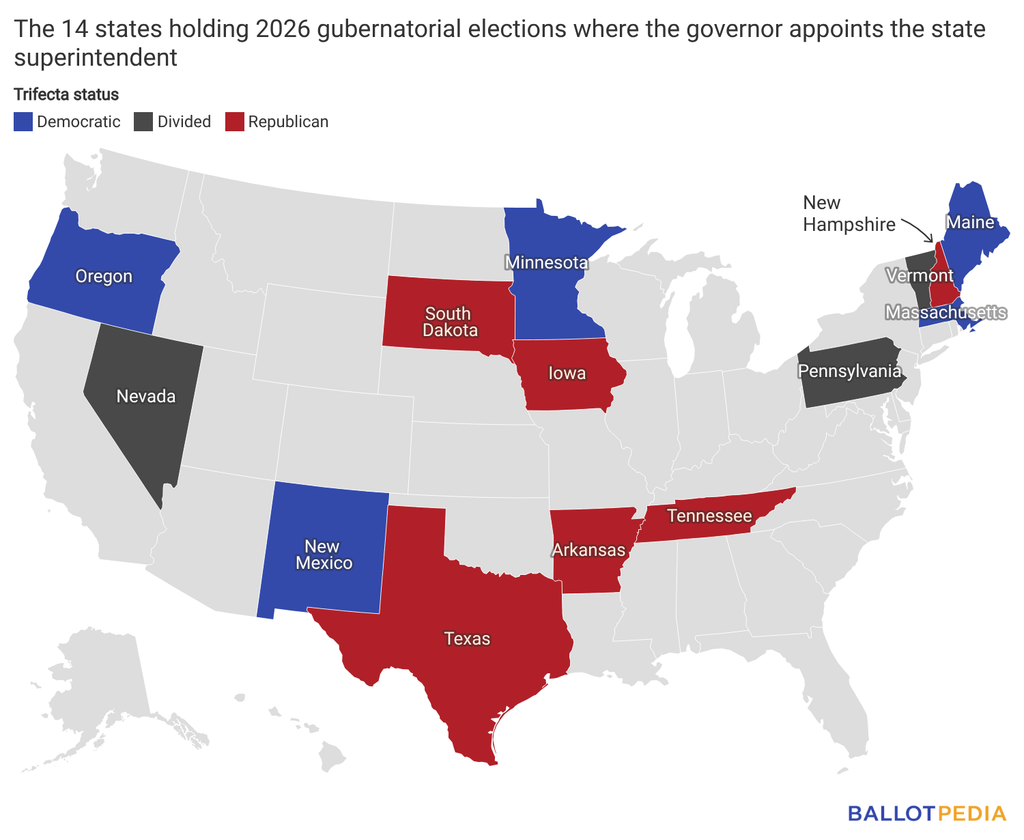
Most governors also help select the officials who oversee K-12 public education. Gubernatorial elections are happening in 14 of the 18 states where governors appoint the chief state school officer or superintendent. They're also happening in 26 of the 38 states where governors appoint some or all of the members of the state board of education.
State boards of education elections
Gubernatorial elections are happening in 26 of the 38 states where governors appoint some or all of the members of the state board of education. Voters in seven states and Washington, D.C., will decide elections for 39 state board of education seats nationwide.
- Alabama voters will elect four of the board's nine members. Republicans have a 7-2 majority on the board.
- Colorado voters will elect three of the board's nine members. Democrats have a 5-4 majority on the board.
- Kansas voters will elect five of the board's 10 members. Republicans have a 7-3 majority on the board.
- Louisiana voters will elect one board member as part of a special election.
- Michigan voters will elect two of the board's eight members. Democrats have a 6-2 majority on the board.
- Nebraska voters will elect four of the board's eight members, which is officially nonpartisan.
- Texas voters will elect eight of the board's 15 members. Republicans have a 11-4 majority on the board.
- Utah voters will elect eight of the board's 15 members. Republicans have a 12-2 majority (with one vacancy) on the board.
With the exception of Louisiana, Governors there play no role in appointing members.
In two other states, Louisiana and Nevada, the boards comprise a mixture of elected and appointed members. Louisiana and Nevada are holding elections for state board of education members in 2027 and 2028, respectively. In Louisiana, the three at-large seats are nonpartisan. When it comes to the elected seats, Republicans hold a 6-2 majority. The Nevada State Board of Education is officially nonpartisan.
According to the NASBE, state boards across the country share the following responsibilities: "(1) authority for adopting and revising policies that promote educational excellence and equity, (2) convening experts and stakeholders to serve as a bridge between policymakers and citizens, and (3) the power to raise questions as the citizens' voice in education."
Chief state school officer elections
Gubernatorial elections are happening in 14 of the 18 states where governors appoint the chief state school officer. Voters elect the chief state school officer in 12 states, with elections for the office happening in eight of those states this year.
The chief state school officer is known as the superintendent of public instruction or the superintendent of education (or schools), depending on the state. But in each case, the chief state school officer generally oversees the public school system and directs the state department of education.
Republicans control the partisan offices in Arizona, Georgia, Idaho, Oklahoma, and South Carolina. The offices in California, North Dakota, and Wyoming are officially nonpartisan.
Richard Barrera and Sonja Shaw are running for California Superintendent of Public Instruction. Barrera is a Democrat and the president of the San Diego Unified School District school board. Shaw is a Republican and the president of the Chino Valley Unified School District school board.
California's race pits Democrat Richard Barrera, president of the San Diego Unified School District board, against Republican Sonja Shaw, president of the Chino Valley Unified board. Both candidates opposed AB 181, which California Gov. Gavin Newsom (D) signed in July. The law shifts the superintendent to a more evaluative role in 2027 and puts a governor-appointed commissioner in charge of the Department of Education.
Private school choice is a common theme for superintendent candidates. In Arizona, Teresa Leyba Ruiz (D) supports adding more regulations and an income cap to the state's Education Savings Account (ESA) program. Kimberly Yee (R) said she supports some additional guardrails but opposes a cap.
Superintendent candidates in Idaho, Oklahoma, South Carolina, and Wyoming are also discussing private school choice.
State legislative elections
State lawmakers write the laws that shape and define the education system. They also control K-12 education spending, one of the largest line items in most state budgets.
Voters in 46 states will decide elections across 88 state legislative chambers. Republicans control 51 of the state legislative chambers whose members are up for election this year, and Democrats control 34. Power-sharing coalitions control two chambers, and one is split evenly between the two parties.
Republicans control 3,325 of the state legislative seats up for election this year, and Democrats control 2,741. Third-party and independent legislators control 24 seats, and 49 are vacant.
Click here for more information about the state legislative elections happening this year.
A version of this story appeared in our Hall Pass newsletter on Oct. 21. Hall Pass covers the conversations driving school board politics and education policy. Click here to sign up.
Ballotpedia by the numbers
Mississippi to hold its first general election under expanded proof-of-citizenship requirements
Welcome to our next installment of our 50 States in 50 Days series, covering Mississippi. To view our archive of past editions, click here.
Mississippi is holding its first general election since the state adopted a law expanding its proof-of-citizenship requirements for voter registration. The law directs election officials to verify each applicant’s citizenship using state driver’s license records and a federal immigration database. If officials cannot verify an applicant’s citizenship through those sources, the applicant must provide documentary proof of citizenship, such as a birth certificate, passport, or naturalization documents, before the registrar can add them to the voter rolls. If a registrant does not provide a driver’s license number when registering to vote and officials cannot locate their driver’s license number in the state system, they must also provide proof of citizenship. Registered voters whom officials identify as possible noncitizens must also provide proof of citizenship to vote.
Mississippi is one of four states, along with Florida, South Dakota, and Utah, that enacted new or expanded proof-of-citizenship requirements in 2026. Nationally, 12 states have laws requiring proof of citizenship to register to vote in at least some cases, though some states have not implemented these laws, and courts have blocked others.
Mississippi does not offer no-excuse early voting. Mississippi offers excuse-required early voting for individuals in eight categories.
Polls open on Election Day at 7:00 a.m. and close at 7:00 p.m.
Voter ID is required. Acceptable forms of ID include a valid Mississippi driver's license or identification card, a passport, a concealed carry license, a tribal ID, or a valid student ID from an institution of higher education in Mississippi. For more information on voter ID in Mississippi, click here.
Absentee/mail-in ballots must be postmarked by Nov. 3. There is no deadline for requesting an absentee/mail-in ballot.
Current party control
Republicans represent three congressional districts, and a Democrat represents one. Both of Mississippi's U.S. Senators are Republicans.
Republicans have a 34-17 majority in the Mississippi Senate, with one vacancy, and a 77-41 majority in the Mississippi House of Representatives, with two independents and two vacancies. Because the governor is a Republican, Mississippi is one of 23 states with a Republican trifecta. Mississippi's attorney general and secretary of state are also Republicans. As a result, Mississippi is one of 24 states with a Republican triplex. Republican governors initially appointed six justices on the Mississippi Supreme Court, and voters initially elected three justices in nonpartisan elections.
Offices on the ballot
Elections are taking place for the U.S. Senate and the U.S. House of Representatives.
There will also be special elections to fill vacancies in Mississippi House Districts 70 and 77.
Five intermediate appellate court judges are up for nonpartisan elections.
There will be a special election in Jackson, Mississippi, for the 7th Circuit Court District Attorney. An election is also taking place for one seat on the DeSoto County School District Board of Education.
Notable elections
U.S. Senate: Incumbent Sen. Cindy Hyde-Smith (R), Scott Colom (D), and Ty Pinkins (I) are running. NBC News' Bridget Bowman wrote that the general election isn't "the first time Hyde-Smith and Colom have clashed: the GOP senator blocked Colom's nomination for a federal judgeship during the Biden administration." Four independent race forecasters have rated the general election as Likely/Solid Republican.
7th Circuit Court District Attorney: Gwen Agho (I), Greta Mack Harris (I), Darla Palmer (I), Marvin Sanders (I), and Wendy Wilson White (I) are running in a special election for the remaining 14 months of the term Jody Owens won in 2023, which ends in January 2028. Owens resigned after pleading guilty to a federal bribery conspiracy charge on June 29. On July 10, Mississippi Gov. Tate Reeves (R) appointed Brad McCullouch as district attorney and called a special election. McCullouch is not eligible to run for the remainder of the term because he lives outside of the district.
Statewide ballot measures
There are no statewide measures on the ballot this year. Mississippi voters have not decided on a statewide ballot measure since 2020, when they decided on three. Between 2000 and 2025, Mississippi voters decided on 12 measures, or an average of one per even-numbered year. During that period, voters approved eight measures and defeated four.
Local ballot measures
Voters in Jackson, Mississippi, will decide on a local ballot measure that would increase the restaurant and prepared food tax by 0.5% and increase the hotel and transient occupancy tax by 1%. The city would use the additional revenue to fund the Jackson Convention & Visitors Bureau.
Join us again in our next edition when we'll preview elections in Alabama, the Yellowhammer State.
Click here to see every edition of 50 States in 50 Days as we publish them, and here to use our Sample Ballot Lookup Tool.