


Welcome to the Friday, Oct. 30, 2026, Brew.
By: Andrew Bahl
Here’s what’s in store for you as you start your day:
- Ballotpedia’s top 50 elections to watch on Election Day
- Ballotpedia is covering school board elections in 30 states this November
- New Hampshire's Republican governor and Democratic U.S. Senate seat are both on the ballot Nov. 3
Ballotpedia’s top 50 elections to watch on Election Day
On Nov. 3, voters across the country will decide congressional, state, and local elections.
Today, we're covering our top 50 elections to watch on Election Day. We selected these elections based on past election results, unique election-specific circumstances, and election race ratings. The final selections include a mix of federal, state, and local races happening across 23 states. For information on the top 50 ballot measures to watch in 2026, click here.
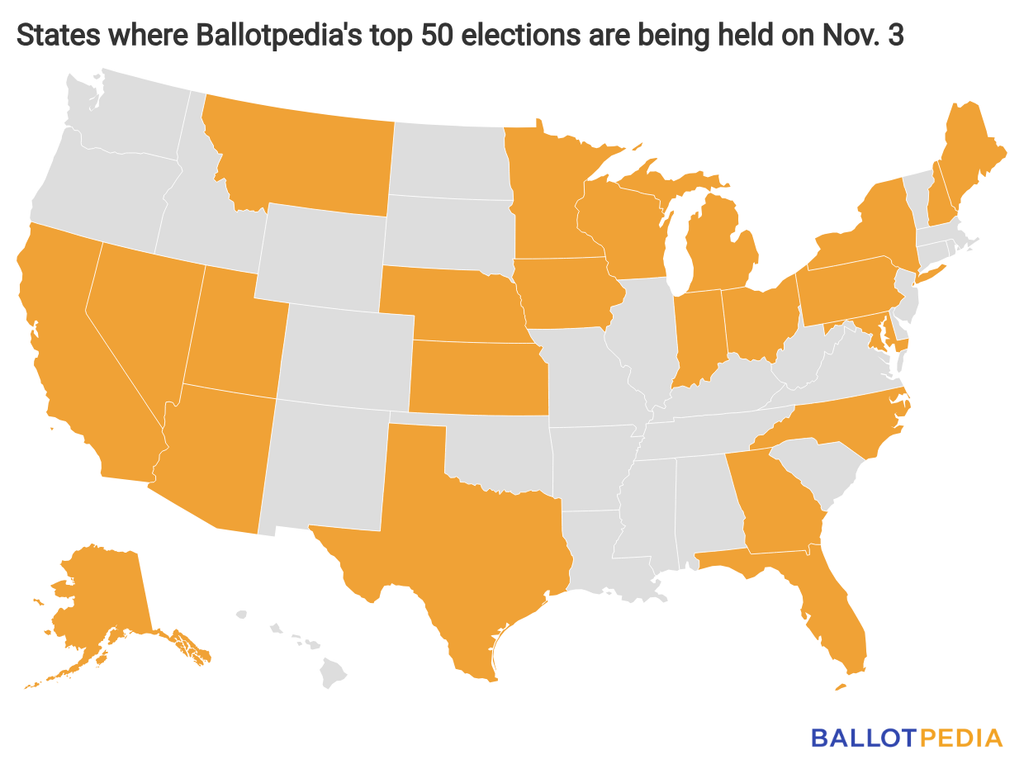
Here's a look at those elections by office type. In these battleground races, we'll name the major-party candidates and any minor-party or independent candidate who could affect the outcome. Every candidate in each race is listed on its linked article.
U.S. Senate
Ten of our top 50 elections are for the U.S. Senate. Republicans have a 53-45 majority in the chamber, with two independents who caucus with Democrats.
Four elections are for open seats:
- Abdul El-Sayed (D) and Mike Rogers (R) are running to succeed Sen. Gary Peters (D) in Michigan.
- Josh Turek (D) and Ashley Hinson (R) are running to succeed Sen. Joni Ernst (R) in Iowa.
- Chris Pappas (D) and John Sununu (R) are running to succeed Sen. Jeanne Shaheen (D) in New Hampshire.
- James Talarico (D) and Ken Paxton (R) are running for the seat in Texas, which effectively became open after Sen. John Cornyn (R) lost the Republican nomination.
In two of the top 50 elections, the incumbent’s party lost the state in the 2024 presidential election:
- Sen. Susan Collins (R) and Troy Jackson (D) are running in Maine, which Kamala Harris (D) won in 2024.
- Sen. Jon Ossoff (D) and Mike Collins (R) are running in Georgia, which President Donald Trump (R) won in 2024.
In Ohio, Sen. Jon Husted (R) and Sherrod Brown (D) are running in the special election to complete the final two years of Vice President J.D. Vance’s (R) six-year term that began in 2023.
Sen. Daniel S. Sullivan (R), Mary Peltola (D), Gerald Heikes (R), and Dan J. Sullivan (No Party Affiliation) are running in the second U.S. Senate general election in Alaska to be held using ranked-choice voting (RCV).
Sen. Pete Ricketts (R) and Dan Osborn (I) are running for the seat in Nebraska, where no Democrat is on the ballot. Cindy Burbank (D), the Democratic nominee, withdrew in July. The Nebraska Democratic Party endorsed Osborn in August 2025.
Sen. Roger Marshall (R) and Adam Hamilton (D) are running for the seat in Kansas. Kansas currently has a Democratic governor and two Republican U.S. Senators and has not elected a Democratic U.S. Senator since 1932.
U.S. House
Ten of our top 50 elections are for the U.S. House of Representatives, where Republicans have a 218-214 majority with one independent who caucuses with Republicans. There are also two vacancies in the chamber.
Two elections are for open districts:
- Christina Hines (D) and Michael Bouchard (R) are running to succeed Rep. John James (R) in Michigan's 10th.
- Jamie Ager (D) and Jennifer Balkcom (R) are running to succeed Rep. Chuck Edwards (R), who withdrew from the race after the Republican primary, in North Carolina's 11th. Edwards ended his campaign in August after the U.S. House Committee on Ethics recommended he be censured following an investigation related to allegations of sexual misconduct.
Three elections are for districts that were redrawn ahead of this year's elections:
- Rep. Kathy Castor (D) and Mike Beltran (R) are running in Florida's 14th. Donald Trump won the redrawn version of the 14th in 2024 with 54% of the vote, while Kamala Harris won the previous version of the district with 53% of the vote.
- Rep. Monica De La Cruz (R) and Bobby Pulido (D) are running for Texas' 15th, which was redrawn to be more Republican-leaning. Donald Trump won the redrawn version of the 15th in 2024 with 58% of the vote, while he would have won with 59% in the old district.
- Rep. Max Miller (R) and Brian Poindexter (D) are running in Ohio's 7th. Donald Trump won by 11 percentage points in both the redrawn and previous versions of the district.
Three elections include first-term incumbents seeking re-election in districts they won by five percentage points or less in 2024:
- Rep. Tom Barrett (R) and Will Lawrence (D) are running in Michigan's 7th. Barrett won 50.3%-46.6% in 2024.
- Rep. Ryan Mackenzie (R) and Bob Brooks (D) are running in Pennsylvania's 7th. Mackenzie won 50.4%-49.4% in 2024.
- Rep. Rob Bresnahan (R) and Paige Cognetti (D) are running in Pennsylvania's 8th. Bresnahan won 50.7%-49.1% in 2024.
Rep. Derrick Van Orden (R) and Rebecca Cooke (D) are running in a rematch for Wisconsin's 3rd. In 2024, Van Orden defeated Cooke 51.3% to 48.6%. It is one of 44 rematches in U.S. House races this year, which accounts for 10.1% of all races.
Rep. Mike Lawler (R) and Cait Conley (D) are running in New York's 17th, a Republican-held district that Harris won in the 2024 presidential election.
Governors
Five of our top 50 elections are for governor. Nationally, 26 governors are Republicans, and 24 are Democrats.
Four elections are for open seats:
- Keisha Lance Bottoms (D) and Rick Jackson (R) are running to succeed Gov. Brian Kemp (R) in Georgia.
- Amy Acton (D) and Vivek Ramaswamy (R) are running to succeed Gov. Mike DeWine (R) in Ohio.
- David Crowley (D) and Tom Tiffany (R) are running to succeed Gov. Tony Evers (D) in Wisconsin.
- In Alaska, Jonathan Kreiss-Tomkins (D), David Bronson (R), Treg Taylor (R), and Bernadette Wilson (R) are running to succeed Gov. Mike Dunleavy (R). The election is the second gubernatorial general election in Alaska to be held using RCV.
Gov. Joe Lombardo (R) and Aaron Ford (D) are running for the seat in Nevada. In 2022, Lombardo defeated incumbent Steve Sisolak (D) 48.8% to 47.3%.
Attorneys general
Three of our top 50 elections are for attorney general. Nationally, 27 attorneys general are Republicans, 22 are Democrats, and one is officially nonpartisan.
Nicole Cannizzaro (D) and Adriana Guzmán Fralick (R) are running in the open race to succeed Aaron Ford (D) in Nevada.
Incumbent Josh Kaul (D) and Eric Toney (R) are running in a rematch in Wisconsin. In 2022, Kaul defeated Toney 50.6% to 49.3%. It is one of 12 rematches for state executive offices in 2026.
Incumbent Kris Mayes (D) and Warren Petersen (R) are running in Arizona. In 2022, Mayes defeated Abraham Hamadeh (R) by 280 votes.
Secretaries of state
Two of our top 50 elections are for secretary of state. Nationally, 25 secretaries of state are Republicans, and 22 are Democrats. Alaska, Hawaii, and Utah do not have a secretary of state.
Both elections are for open seats. Garlin Gilchrist II (D) and Anthony Forlini (R) are running to succeed Jocelyn Benson (D) in Michigan.
Beau Bayh (D), Max Engling (R), and Greg Ballard (I) are running for the office in Indiana, which effectively became open after incumbent Diego Morales (R) lost the Republican nomination.
Other state executives
Two of our top 50 elections are for other state executive offices.
One election is for an open seat. Ben Allen (D) and Jane Kim (D) are running to succeed incumbent Ricardo Lara (D) as California Insurance Commissioner. This race is the first time two Democrats have advanced from the top-two primary for the office.
Four candidates are running for two seats on the Georgia Public Service Commission, which has a 3-2 Republican majority. If both Democrats win, the party will gain a 3-2 majority on the commission. If both Republicans win, the party will have a 4-1 majority on the commission. The 2025 elections replaced the commission's 5-0 Republican majority with the 3-2 Republican majority.
State supreme courts
Three of our top 50 elections are for state supreme courts.
Amy Eddy and Dan Wilson are running to succeed Justice Beth Baker on the Montana Supreme Court. Although the Court is officially nonpartisan, Bolts described it as having a 4-3 liberal majority. If Eddy wins, the liberal bloc will retain its majority. If Wilson wins, the conservative bloc will gain a majority.
Justice Anita Earls (D) and Sarah Stevens (R) are running for the North Carolina Supreme Court, which has a 5-2 Republican majority. This election cannot change the court’s majority this year, but three more seats are up in 2028. Control of the court flipped from a 4-3 Democratic majority to a 5-2 Republican majority following the 2022 elections.
Justice Jill Pohlman, who Gov. Spencer Cox (R) appointed in 2022, is standing for retention on the Utah Supreme Court for the first time. Utah Republican Party Chair Robert Axon opposes Pohlman's retention. The Utah State Bar supports it. No incumbent has lost a retention election in Utah since at least 1990.
State legislatures
Twelve of our top 50 elections are for state legislative chambers. They cover both chambers in six states:
- Alaska: Bipartisan coalitions run both chambers.
- Arizona and Wisconsin: Republicans control both chambers, and the governor is a Democrat.
- Michigan: Democrats control the Senate, and Republicans control the House.
- Minnesota: The House is tied, and Democrats control the Senate.
- Pennsylvania: Democrats control the House, and Republicans control the Senate.
Local elections
Three of our top 50 elections are for local offices.
Incumbent Karen Bass and Nithya Raman are running for mayor of Los Angeles, California. Although the race is officially nonpartisan, both Bass and Raman are Democrats. The Los Angeles branch of the Democratic Socialists of America (DSA) has endorsed Raman, who is running to Bass' left. The Los Angeles County Democratic Party and Gov. Gavin Newsom (D) have endorsed Bass.
Four candidates, including two incumbents, are running for two at-large seats on the City Board of School Commissioners in Baltimore, Maryland. This general election is the second ever for seats on the board. Read more on this race below.
Six candidates are running for three seats on the Public Power District Board in Omaha, Nebraska. According to The Downballot’s David Nir and Jeff Singer, if three candidates who support clean energy win, they would join incumbents Craig Moody and Eric Williams to form a majority on the board.
To read more about Ballotpedia’s 50 elections to watch, click here.
Ballotpedia is covering school board elections in 30 states this November
This November, school board elections are happening across the country. In 2026, Ballotpedia is covering elections for roughly 8,000 seats across more than 2,700 districts in 30 states and Washington, D.C. This includes all school districts in the nation’s 100 most populous cities and the 200 largest school districts by student enrollment. Ballotpedia also covers all school board recalls in the United States.
Key trends
Incumbent success rates: Since 2018, incumbent school board candidates have won re-election 82.5% of the time, on average. The highest success rate was in 2019, at 89%. The lowest was in 2022, at 78%.
Incumbent win rates: Since 2018, incumbents have won an average of 56% of the seats up for election. In 2021, incumbents won 51% of all seats, the lowest total since Ballotpedia began collecting this data. The highest share of seats won by incumbents was 61% in 2018.
Battleground elections
Baltimore Public Schools: Incumbent Commissioner Ashley Esposito, incumbent Commissioner Kwame Kenyatta-Bey, Jamar Day, and Domonique Flowers are running in the general election for two at-large seats on the Baltimore City Board of School Commissioners. The candidates who place first and second will win the seats. This is the second election since the Maryland General Assembly passed a bill in 2016 allowing voters to elect two of the 12 commissioners on the board. The mayor picks the nine other members, including one high school student commissioner.
Although the board is officially nonpartisan, all four candidates are Democrats. According to The Baltimore Banner's Maya Lora, each candidate represents a different faction within the party. Esposito identifies as a Democratic Socialist. Kenyatta-Bey said his "political philosophy centers [on] what his community wants and needs." Day identifies as a progressive Democrat. Flowers identifies with moderate liberalism. Click here to learn about the candidates' stances.
Cobb County School District, Georgia
Incumbent David Chastain (R) and Michael Garza (D) are running to represent District 4 on the Cobb County School District school board.
According to the Marietta Daily Journal, the race for District 4 “has been closely watched by Democrats and Republicans as it will decide if Republicans maintain their 4-3 majority on the Cobb Board of Education.” Three of the seven seats on the board are up for election this year, but only the race for District 4 is contested. Incumbents Becky Sayler (D) and Nichelle A. Davis (D) are running unopposed for Districts 2 and 6, respectively.
The district's book removal policies have been a source of disagreement in the race. In September, the district announced that it had removed Toni Morrison's The Bluest Eye from school libraries. Chastain said, "In the Cobb County School District, you are not going to find sexually explicit materials in any of our media centers." Garza said, "There is a ripple effect when they make these decisions, teachers may stop recommending books for their students for fear of recommending a book that somebody may find problematic."
Chicago Public Schools, Illinois
Chicago Public Schools (CPS) is the fourth-largest district in the country by student enrollment and will elect all 21 board members on Nov. 3. Forty-six candidates are running. This is the first time Chicagoans will elect all members of the board, including an at-large president who represents the board before the public and runs its meetings. Before 2024, the mayor appointed the board’s members.
The board oversees a budget of more than $10 billion, hires the superintendent, approves union contracts, and decides whether to close schools.
According to the Chicago Tribune, “Two main blocs are competing for influence on the board: Those aligned with the progressive CTU [Chicago Teachers Union] and [Mayor Brandon] Johnson, and those who are not. Most opposing candidates have support from several pro-school-choice groups that have opposed CTU, including the Illinois Network of Charter Schools, Common Ground Collective, and the Urban Center.”
To look up which school boards are on your ballot, click here to use Ballotpedia’s sample ballot tool.
To read more about school board elections happening across the country this year, click here.
New Hampshire's Republican governor and Democratic U.S. Senate seat are both on the ballot Nov. 3

Welcome to our last installment of our 50 States in 50 Days series, covering New Hampshire. To view our archive of past editions, click here.
New Hampshire is one of four states this year where the governor and the U.S. Senator whose seat is on the ballot belong to different parties.
Incumbent Gov. Kelly Ayotte (R), Cinde Warmington (D), and Stephen Villee (Libertarian Party) are running in the gubernatorial race. Ayotte has served as governor since 2025, and Warmington served on the New Hampshire Executive Council from 2021 to 2025. Three independent race forecasters have rated the general election as Solid/Likely Republican.
Chris Pappas (D), John E. Sununu (R), and Edmond Laplante (Constitution Party) are running in the open U.S. Senate race. Incumbent Sen. Jeanne Shaheen (D) did not seek re-election. Pappas has served in the U.S. House since 2019, and Sununu served in the U.S. Senate from 2003 to 2009. Four independent race forecasters have rated the general election as Likely/Lean/Tilt Democratic. New Hampshire’s other U.S. Senator, Maggie Hassan, is a Democrat.
New Hampshire is not the only state where this type of split partisanship could change in 2026. Georgia has a Democratic U.S. Senator and a governorship currently held by Republicans on the ballot in 2026. Kansas and Maine have governorships currently held by Democrats and Republican U.S. Senators on the ballot in 2026. Unlike the other three states, Maine's U.S. Senate delegation is itself split, with one Republican and an independent who caucuses with Democrats.
Nationwide, seven states have a governor from one party and two U.S. senators who caucus with the other party.
New Hampshire does not offer no-excuse early voting. Excuse-required early voting is offered on at least some days during the absentee voting period.
Polling place hours on Election Day vary by municipality. Under state law, polling places must be open from at least 11:00 a.m. to 7:00 p.m. To find the hours for your polling place, click here.
Voter ID is required. Acceptable forms of identification include a driver’s license, non-driver ID card, armed services identification card, or U.S. passport. Under a 2026 law, student IDs are not acceptable forms of identification. Local election officials may also verify a voter’s identity if they personally know the voter. For more information on voter ID in New Hampshire, click here.
Absentee/mail-in ballots must be requested by Nov. 2 and returned by Nov. 3. Under a 2025 law, voters must provide a copy of their photo identification with their absentee ballot application, present photo identification in person, or submit a notarized signature on their application in order to receive a ballot.
Current party control
Democrats represent both congressional districts. Both of New Hampshire's U.S. Senators are Democrats.
Republicans have a 16-8 majority in the New Hampshire Senate and a 212-169 majority in the New Hampshire House of Representatives, with one independent and 18 vacancies. Because the governor is a Republican, New Hampshire is one of 23 states with a Republican trifecta. New Hampshire's attorney general and secretary of state are also Republicans. As a result, New Hampshire is one of 24 states with a Republican triplex. Republican governors appointed four justices on the New Hampshire Supreme Court. Additionally, there is currently one vacancy on the court.
Offices on the ballot
Elections are taking place for the U.S. Senate and the U.S. House of Representatives.
There will also be elections for governor, all five seats on the New Hampshire Executive Council, all 24 seats in the state Senate, and all 400 seats in the state House.
Voters in Merrimack County will also elect a county attorney.
Notable elections
1st Congressional District: Stefany Shaheen (D) and Anthony DiLorenzo (R) are running in the open race. The district changed party hands five times in elections between 2006 and 2016, alternating between Carol Shea-Porter (D) and Frank Guinta (R). Democrats have represented the district since 2017. The seat is currently held by Pappas. Shaheen, who is the daughter of U.S. Sen. Jeanne Shaheen (D), is the co-founder and president of the nutrition counseling service Good Measures. DiLorenzo is a real estate developer and the owner of the Key Auto Group.
According to the New Hampshire Bulletin's William Skipworth, "Political observers are now wondering whether the district soured on Republicans or if Pappas was a uniquely strong candidate. This election could provide insight into that question, but it will also have ramifications nationwide as the two parties battle for control of the House of Representatives."
Statewide ballot measures
There is one statewide measure on the ballot this year. It would eliminate the register of probate offices and any references to the offices in the New Hampshire Constitution. New Hampshire has a supermajority requirement for constitutional amendments, meaning the measure needs at least two-thirds (66.67%) of the vote to pass. In 2022, an identical measure received 62.9% support but fell short of the two-thirds threshold and was defeated.
Between 2000 and 2025, voters decided on 14 measures, or an average of one per even-numbered year. During that period, voters approved five measures and defeated nine.
Local ballot measures
Voters in Concord, New Hampshire, will decide on a local ballot measure that would limit property tax growth for the Concord School District and Merrimack Valley School District to no more than the previous year's amount or 6% of total school district appropriations, whichever is lower, for two years. The measure would exclude bonded capital costs from these limits.
Click here to see every edition of 50 States in 50 Days, and here to use our Sample Ballot Lookup Tool.