

Welcome to Ballotpedia’s Weekly Brew. Each week, we’ll bring you a collection of the most-viewed stories from the Daily Brew, condensed, along with other content from across Ballotpedia that we think you’ll like.
Today’s Weekly Brew brings together content from the week of October 26 - October 30.
This week’s top stories
Here are the Daily Brew stories our subscribers clicked on most this week.
Ballot measure campaigns raised more than $1.2 billion so far in 2026 and spent a record-high $193 million on signature drives
Campaigns supporting and opposing the 164 statewide ballot measures in 2026 raised more than $1.2 billion. Initiative campaigns spent a record $193 million on signature gathering.
Here's a look at the five states where campaigns supporting and opposing measures raised the most as of Oct. 26:
- The 14 measures in California raised $798.9 million, or more than 66% of the 2026 total and the most in state history.
- The four measures in Virginia raised $107.6 million, or 8.9%
- The nine measures in Missouri raised $67.9 million, or 5.6%
- The 14 measures in Colorado raised $43.1 million, or 3.6%
- The two measures in Kansas raised $29.4 million, or 2.4%
Ballotpedia’s top 50 elections to watch on Election Day
On Nov. 3, voters across the country will decide congressional, state, and local elections.
This week, we're covering our top 50 elections to watch on Election Day. We selected these elections based on past election results, unique election-specific circumstances, and election race ratings. The final selections include a mix of federal, state, and local races happening across 23 states. Click “Read more” for information on Ballotpedia’s top 50 elections to watch.
Twenty-five states are holding state supreme court elections in November. Six are battlegrounds.
Twenty-five states are holding elections for state supreme courts in November. Of the courts up for election, 13 have a majority of Republican-appointed/elected justices, 11 have a majority of Democratic-appointed/elected justices, and one court is split.
Ballotpedia identified six courts as battlegrounds. One state has the majority directly at stake, while the outcomes of others have implications for whether a party can gain a majority of seats in a future election.
The Democratic Socialists of America endorses 131 candidates and takes sides on 33 ballot measures in the Nov. 3 elections
The national chapter of the Democratic Socialists of America (DSA) and its local chapters have endorsed 131 candidates on the Nov. 3 ballot in 30 states and the District of Columbia. The groups have also taken positions on 33 state and local ballot measures on the same ballot.
Ten candidates are running for the U.S. House of Representatives, 52 are running for state legislatures, and 69 are running for local offices.
The DSA website describes itself as "the largest socialist organization in the United States because we're a member-driven mass organization. We believe that working people should run both the economy and civil society, and we show our commitment to this principle by being an organization of, by, and for the working class."
Steeped in History
Welcome to Steeped in History, a column where every week we'll share a story from America's political past. Today’s column is adapted from Ballotpedia founder and CEO Leslie Graves’ weekly Substack column, Civic Blueprints.
From glass globes to the 26th Amendment: How voting has changed
Most voters will use some form of printed ballot in the Nov. 3 elections. But ballots have changed a great deal since the 19th century.
Sometimes those ballots were just scraps of paper with a candidate’s name written on them. If they were printed, they were products of political parties, easily identifiable by color, allowing everyone to see which party’s candidate a voter had selected. In many places, those ballots were placed in clear glass globes — making the votes as public as they were in early U.S. history, when voting was done out loud and in public.
A truly secret ballot didn’t begin to take hold in the United States until late in the 19th century, with the adoption of the Australian ballot. Reformers hoped it would free voters from outside influence and intimidation. It first appeared in the 1888 presidential election, in only about 7% of congressional races. By 1892, more than 75% of those races used it.
The secret ballot was a major reform that gave us the system we use today. It was one in a long series of changes that included not just the mechanics of casting a ballot but also the expansion of the franchise to groups who were previously denied the right to vote.
Some of the hardest-fought of those battles, over the 15th Amendment’s promise that the right to vote can’t be denied because of race, and the poll taxes, literacy tests, and other barriers that followed until the Voting Rights Act of 1965, are stories of their own, one we’ve written about here.
The deep roots of women’s suffrage
The American Revolution prompted some people to consider who should have a voice in the new nation. In March 1776, Abigail Adams urged her husband, John, to “remember the Ladies” as Congress drafted new laws. Two months later, in a May 26, 1776, letter to James Sullivan, the future president warned that changing the qualifications for voting would be dangerous:
There will be no End of it. New Claims will arise. Women will demand a Vote. Lads from 12 to 21 will think their Rights not enough attended to, and every Man, who has not a Farthing, will demand an equal Voice with any other in all Acts of State. It tends to confound and destroy all Distinctions, and prostrate all Ranks, to one common Levell.
Women across the country would not get the vote for another 144 years, when the 19th Amendment was ratified in 1920.
But there were early exceptions. In New Jersey, a state law explicitly recognized women’s right to vote as early as 1790, until the legislature took it away in 1807. In 1869, the Wyoming Territory became the first to give women the right to vote. There was an almost immediate effort to repeal women’s suffrage in the Territory, but it failed when the legislature fell one vote short of overriding the governor’s veto.
Lowering the voting age
For most of the nation’s history, 21 was the standard voting age. The 14th Amendment, ratified in 1868, penalized states that denied the vote to male citizens 21 and older.
It wasn’t until the ratification of the 26th Amendment in 1971 that the voting age was lowered to 18. The reasons were rooted in a change in the draft age during World War II:
With the lowering of the draft age from 21 to 18 for World War II, there began numerous Congressional proposals to match the voting age to the draft age. The idea was also endorsed by First Lady Eleanor Roosevelt. Dwight D. Eisenhower was the first president to endorse the change, publicly supporting the lower voting age in his 1954 State of the Union address.
The issue came back during the Vietnam War. Men ages 18 to 20 could be drafted to fight, but in most states they couldn’t vote on the war or the leaders who were waging it. Supporters of a lower voting age summed up their argument in a popular slogan: “Old enough to fight, old enough to vote.”
The 26th Amendment has the distinction of being ratified the fastest of any amendment in history. It was proposed and passed by both chambers of Congress in March 1971 and was ratified on July 1, 1971.
In other news
Go beyond the Daily Brew with Ballotpedia News. Explore this week's headlines below:
- State Democratic and Republican parties took opposing positions on 70 ballot measures and agreed on six in 2026
- School board incumbents have won re-election 82.5% of the time since 2018 as voters in 30 states and D.C. head to the polls on Nov. 3
- Open seats, redrawn districts, and rematches among Ballotpedia's top 50 elections on Nov. 3
- There are 163 city council elections happening in the 100 most populous cities on Nov. 3
This week’s read
This week's read comes from Ballot Bulletin, a weekly newsletter that delivers the latest updates on election policy around the country, including nationwide and recent legislative activity.
Policy spotlight: Voters will determine 15 election policy ballot measures on Nov. 3
Voters in 13 states will decide on 15 ballot measures related to election policy in the Nov. 3 election.
Voter ID laws
Six states will vote on ballot measures related to voter ID. The seven measures represent the largest number of statewide ballot measures related to voter identification in a single year.
Citizenship requirements for voting
Six states will decide ballot measures related to citizenship requirements for voting. Each measure would establish that only U.S. citizens may vote in state and local elections.
Nationally, 18 state constitutions explicitly prohibit noncitizen voting. Three states — California, Maryland, and Vermont — have localities that allow noncitizens to vote in municipal or school board elections.
Voter registration
Massachusetts voters will decide on a measure that would institute same-day voter registration in the state. Currently, voters must register to vote 10 days before the election. The registration period overlaps with the early voting period for eight days.
Voting rights for people with felony convictions
In Virginia, voters will decide on a constitutional amendment to automatically restore political rights, including the right to vote, of individuals convicted of a felony upon release from incarceration.
Electoral systems
Voters in Alaska and Massachusetts will decide whether to change their state’s electoral system.
In Alaska, Ballot Measure 2 would repeal the state’s top-four primary system and the use of ranked-choice voting (RCV) in general elections.
In Massachusetts, voters will decide whether to implement top-two primaries. Currently, the state uses a semi-closed primary system. This means that voters who are affiliated with a political party and unaffiliated voters may vote in that party's primary.
Read more on election policy ballot measures
This week’s watch
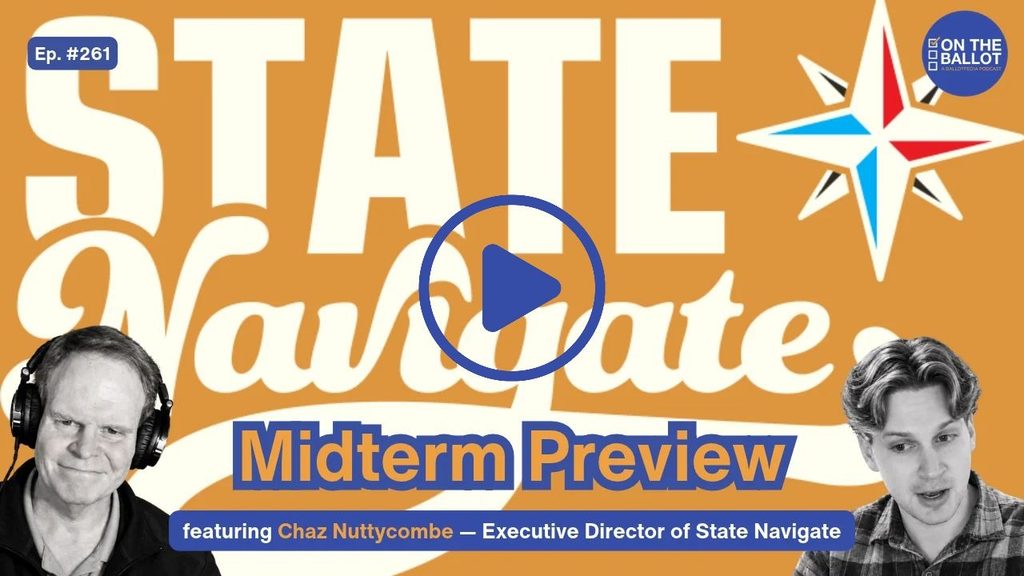
Forecaster Chaz Nuttycombe on 6,000+ State Legislative Races and Trust in Polling
On this episode of On the Ballot: A look at the state of the states. State Navigate's Chaz Nuttycombe and host Norm Leahy discuss the national mood shaping thousands of state legislative races, which chambers and trifectas could change hands, what State Navigate’s polling in states like Georgia and Vermont is showing, why shifts in who turns out can make comparisons to past elections tricky, the rise of fake polls and what it means for trust in polling, and an early look at Virginia’s 2027 General Assembly elections.